While Twitter has always struggled with combating misinformation about major news events, it was still the go-to place to find out what’s happening in the world. But the Israel-Hamas war has underscored how the platform now transformed into X has become not only unreliable but is actively promoting falsehoods.
Experts say that under Elon Musk the platform has deteriorated to the point that it’s not just failing to clamp down on misinformation but is favoring posts by accounts that pay for its blue-check subscription service, regardless of who runs them.
If such posts go viral, their blue-checked creators can be eligible for payments from X, creating a financial incentive to post whatever gets the most reaction — including misinformation.
Ian Bremmer, a prominent foreign policy expert, posted on X that the level of disinformation on the Israel-Hamas war “being algorithmically promoted” on the platform “is unlike anything I’ve ever been exposed to in my career as a political scientist.”
And the European Union’s digital enforcer wrote to Musk about misinformation and “potentially illegal content” on X, in what’s shaping up to be one of the first major tests for the 27-nation bloc’s new digital rules aimed at cleaning up social media platforms. He later sent a similar, though toned-down, version of the letter to CEO Mark Zuckerberg of Meta, which owns Facebook and Instagram.
While Musk’s social media site is awash in chaos, rivals such as TikTok, YouTube and Facebook are also coping with a flood of unsubstantiated rumors and falsehoods about the conflict, playing the usual whack-a-mole that emerges every time a news event captivates the world’s attention.
“People are desperate for information and social media context may actively interfere with people’s ability to distinguish fact from fiction,” said Gordon Pennycook, an associate professor of psychology at Cornell University who studies misinformation.
For instance, instead of asking whether something is true, people might focus on whether something is surprising, interesting or even likely to make people angry — the sorts of posts more likely to elicit strong reactions and go viral.
The liberal advocacy group Media Matters found that since Saturday, subscribers to X’s premium service shared at least six misleading videos about the war. This included out-of-context videos and old ones purporting to be recent — that earned millions of views.
TikTok, meanwhile, is “almost as bad” as X, said Kolina Koltai, a researcher at the investigative collective Bellingcat. She previously worked at Twitter on Community Notes, its crowd-sourced fact-checking service.
But unlike X, TikTok has never been known as the No. 1 source for real-time information about current events.
“I think everyone knows to take TikTok with a grain of salt,” Koltai said. But on X “you see people actively profiteering off of misinformation because of the incentives they have to spread the content that goes viral — and misinformation tends to go viral.”
Emerging platforms, meanwhile, are still finding their footing in the global information ecosystem, so while they might not yet be targets for large-scale disinformation campaigns, they also don’t have the sway of larger, more established rivals.
Meta’s Threads, for instance, is gaining traction among users fleeing X, but the company has so far tried to de-emphasize news and politics in favor of more “friendly” topics.
“One of the reasons why you’re not hearing a lot about Facebook is because they have something called demotions,” said Alexis Crews, a resident fellow at the Integrity Institute who worked at Meta until this spring. If something is labeled as misinformation, the system will demote it and send it to independent fact-checkers for assessment. Crews cautioned that if Meta — which has been cutting costs and laid off thousands of workers — deprioritizes its fact-checking program, misinformation could flood its platforms once again. The Associated Press is part of Meta’s fact-checking program.
Meta and X did not immediately respond to AP requests for comment. TikTok said in a statement that it has dedicated resources to help prevent violent, hateful or misleading content, “including increased moderation resources in Hebrew and Arabic.” The company said it also works with independent fact-checkers to help assess the accuracy of material posted to its platform.
A post late Monday from X’s safety team said: “In the past couple of days, we’ve seen an increase in daily active users on @X in the conflict area, plus there have been more than 50 million posts globally focusing on the weekend’s terrorist attack on Israel by Hamas. As the events continue to unfold rapidly, a cross-company leadership group has assessed this moment as a crisis requiring the highest level of response.”
While plenty of real imagery and accounts of the carnage have emerged, they have been intermingled with social media users pushing false claims and misrepresenting videos from other events.
Among the fabrications are false claims that a top Israeli commander was kidnapped, a doctored White House memo purporting to show U.S. President Joe Biden announcing billions in aid for Israel, and old unrelated videos of Russian President Vladimir Putin with inaccurate English captions. Even a clip from a video game was passed on as footage from the conflict.
“Every time there is some major event and information is at a premium, we see misinformation spread like wildfire,” Pennycook said. “There is now a very consistent pattern, but every time it happens there’s a sudden surge of concern about misinformation that tends to fade away once the moment passes.”
“We need tools that help build resistance toward misinformation prior to events such as this,” he said.
For now, those looking for a central hub to find reliable, real time information online might be out of luck. Imperfect as Twitter was, there’s no clear replacement for it. This means anyone looking for accurate information online needs to exercise vigilance.
In times of big breaking news such as the current conflict, Koltai recommended, “going to your traditional name brands and news media outlets like AP, Reuters, who are doing things like fact checking” and active reporting on the ground.
Meanwhile, in Europe, major social media platforms are facing stricter scrutiny over the war.
Britain’s Technology Secretary Michelle Donelan summoned the U.K. bosses of X, TikTok, Snapchat Google and Meta for a meeting Wednesday to discuss “the proliferation of antisemitism and extremely violent content” following the Hamas attack.
She demanded they outline the actions they’re taking to quickly remove content that breaches the U.K.’s online safety law or their terms and conditions.
European Commissioner Thierry Breton warned in his letter to Musk of penalties for not complying with the EU’s new Digital Services Act, which puts the biggest online platforms like X, under extra scrutiny and requires them to make it easier for users to flag illegal content and take steps to reduce disinformation — or face fines up to 6% of annual global revenue.
Musk responded by touting the platform’s approach using crowdsourced factchecking labels, an apparent reference to Community Notes.
“Our policy is that everything is open source and transparent, an approach that I know the EU supports,” Musk wrote on X. “Please list the violations you allude to on X, so that the public can see them.”
Breton replied that Musk is “well aware” of the reports on “fake content and glorification of violence.”
“Up to you to demonstrate that you walk the talk,” he said.
Social media has been awash with false claims, conspiracy theories and hateful content surrounding what’s happening in Israel and Gaza – and questions over whether inauthentic accounts are being used to manipulate the conversation.
As violence unfolds on the ground, I’ve been looking into who is behind this.
When I opened up my TikTok For You Page earlier this week, I was met with a video showing a young Israeli woman being taken hostage by Hamas fighters on 7 October. The footage was shocking.
When I scrolled through the comments, the reaction was not what I expected.
While some were distressed by the post, other users falsely suggested this footage was not what it seemed.
They said the woman in it is “not a civilian” but a soldier, or that the clips had been staged to frame Hamas.
Some claimed there’s no evidence the group have acted violently towards hostages.
The clip, which has been verified by the BBC, shows a young woman covered in blood being pushed into a car by armed men. It was filmed on the outskirts of Gaza City in Sheijia.
I scrolled through several more videos and posts about hostages on other social media sites and spotted similar comments.
Israeli people are subject to compulsory national service – but evidence suggests many of those taken hostage by Hamas are civilians, like the people featured in these videos. The hostages include festival-goers and children.
Disinformation is not limited to accounts seeking to undermine violence against hostages, either. Profiles supporting the actions of the Israeli government have also shared misleading and hateful content.
Israeli soldiers patrol the area of an attack that killed more than 260 people at a music festival
One account I came across this weekend shared a video falsely suggesting Palestinian people were faking their injuries in Gaza. The footage was actually from a 2017 report about a makeup artist working on Palestinian films and with charities.
All of these claims were not just shocking to me – they affect the wider understanding of what’s happening.
Successful attempts to distort and confuse the online conversation make it a lot harder to get to the truth of what’s unfolding on the ground if you’re relying on social media for updates.
That can have serious implications for the international community when it comes to investigating allegations of war crimes, providing aid and figuring out what’s happening where.
Sometimes, the source of these misleading posts is easier to identify.
Take, for example, celebrities, like popstar Justin Bieber, who inadvertently shared a post on Instagram asking people to “pray for Israel’ – but used images showing the destruction of Gaza by Israeli forces.
Several accounts on X (formerly known as Twitter) with a track record of pushing conspiracy theories about crises have amplified misleading posts in what seems to be a bid to either downplay or exaggerate what’s happening on the ground.
That includes sharing old videos from different wars and footage from video games, which the accounts claim is from the current situation in Israel and Gaza.
Some very active accounts on X sharing pro-Israel content and anti-Muslim posts appear to be based in India and express support for the country’s Prime Minister Narendra Modi.
I want to try to get to the bottom of the profiles whose identities and locations are less obvious.
Several of the accounts suggesting that hostages were soldiers rather than civilians seem to belong to real, younger people. They have otherwise shared funny memes or football clips to their profiles.
Some have posted pictures with slogans like “Free Palestine”. When I message them they tell me they are based in Pakistan and the United Arab Emirates.
For some profiles, whether they’re real people is less obvious.
A handful have posted about an eclectic mix of political topics; in support of Russian President Putin and the war in Ukraine, as well as about former US President Donald Trump. Several of these accounts are newly set up or have recently become active.
In the past, both the Israeli government and Hamas militants have faced accusations of trying to distort online narratives with “bot” networks – inauthentic accounts used to repeatedly push divisive or misleading ideas.
According to Cyabra, a company based in Israel that analyses social media, one in five accounts taking part in conversations about the attacks committed by Hamas since 7 October are fake.
“Fake” in this context can mean they are automatically operated – but others could also be run by real people posing under false identities.
The company says they’ve found approximately 40,000 fake accounts, including on X and TikTok.
It says some of these profiles have been spreading misleading claims in support of Hamas and suggesting – for example – that militants were compassionate to hostages in situations where evidence suggests otherwise. That does not rule out the existence of inauthentic pro-Israel accounts, too.
There are clues we can use to identify an account as inauthentic. For example, if a profile is newly set up and is suddenly sharing a large amount of divisive, misleading and at times conflicting content.
Ultimately, though, determining whether a profile is actually fake and who exactly is behind it is a very difficult task. It requires information from the social media companies that journalists don’t often have access to.
Ray Serrato, who tackled state-sanctioned campaigns at the social media company, told me how his former team was “decimated” after the takeover.
According to him, that means a number of key experts who “covered special regions” – including in the Middle East – and whose job it was to deal with specific co-ordinated disinformation operations, are no longer at the company.
X has not responded to the BBC’s request for comment. The social media site this week said it had removed hundreds of Hamas-affiliated accounts from the platform.
In TikTok’s Community Guidelines, the company says it has “increased dedicated resources to help prevent violent, hateful, or misleading content on TikTok” in relation to the current situation.
The way that disinformation spreads on X, TikTok and other platforms can shape the general public’s view of the situation in both Gaza and Israel.
That in turn could also put pressure on the politicians making big decisions about what’s unfolding.
Armenia needs to diversify relations in the security sector, and we’re trying to do that now, Prime Minister Nikol Pashinyan said in an interview with The Wall Street Journal.
“We are not doing the right thing when we mean only the army, only weapons when speaking about security, because, unfortunately, in many cases we see that there are countries that do not have a problem with weapons, but have a security problem. And there are countries that have a problem of weapons, but no security problem,” PM Pashinyan said.
“Now, our understanding of security is, first of all, based on that we should try to make our environment as manageable and predictable in terms of security as possible. And we have to be predictable for the environment. That is, the threats are generally reciprocal, and sometimes it is very difficult to find the starting point, because it is always a chicken and egg problem. And sometimes it doesn’t even make sense to find the starting point, because nothing changes from it. And when we say arranging of our security relations, we do not mean that we should go and bring weapons from other places and shoot at our neighboring states. In that same security domain, we also need to build relationships with our neighbors to be able to build the right security relationships,” the Prime Minister further elaborated.
Below is the full text of the interview:
The Wall Street Journal: Yaroslav Trofimov – Mr. Prime Minister, thank you for the interview with The Wall Street Journal. I will start with the most difficult questions. Recently, we witnessed dramatic events in Nagorno-Karabakh. Do you have concerns that a full-scale war could spread to the territory of sovereign Armenia, and in your opinion, what should Armenia’s allies and partners do to prevent this?
Prime Minister Nikol Pashinyan – I would, however, separate the issue of ethnic cleansing in Nagorno Karabakh and the issue of more than 100 thousand new refugees and military operations against Nagorno Karabakh from the question of Azerbaijan’s possible aggression against Armenia. Of course, I will not say that there are no correlations between these issues, but they are separate issues.
Of course, we hope that in the near future the agreements reached at the quadrilateral meeting in Prague on October 6, 2022, at the trilateral meeting in Brussels on May 14, 2023 and at the trilateral meeting in Brussels on July 15, 2023 will be formalized, will be reaffirmed and become the basis for the peace treaty. I want to remind those agreements expressed in the statement of the President of the European Council and the Prague statement.
The first principle is that Armenia and Azerbaijan mutually recognize each other’s territorial integrity. This provision was agreed on at the Prague meeting and already on May 14, 2023, another step was taken in Brussels and it was recorded that Azerbaijan recognizes the territorial integrity of 29,800 square km of Armenia, and Armenia recognizes the territorial integrity of 86,600 square km of Azerbaijan.
The second principle is that the delimitation process between Armenia and Azerbaijan should take place on the basis of the 1991 Alma-Ata Declaration. And what is special about it? Its peculiarity is that at the time of signing, the countries of the Soviet Union were already becoming or had become de facto independent countries, and with the Alma-Ata Declaration they recorded that they recognized the existing Soviet administrative borders between the republics as state borders, recognized the inviolability and territorial integrity of these borders. When we say that the delimitation of the borders should take place on the basis of the 1991 Alma-Ata Declaration, it is meant that the state maps existing at that time should be taken for the basis of the border delimitation.
And the third principle is that the opening of communications in the region, including the opening of roads and railways of Armenia and Azerbaijan for mutual and international trade, should take place on the basis of the principles of sovereignty, jurisdiction, equality and reciprocity of the countries. These principles are practically agreed upon, and it remains to conclude a peace treaty based on these agreed principles and move forward.
And, of course, there is a preliminary agreement that we will have a tripartite meeting in Brussels at the end of October. I hope that these agreements will be reaffirmed during that meeting, which will mean that about 70 percent of the necessary agreements for a peace treaty have been reached. And it remains to put those principles in the text of the peace treaty.
The Wall Street Journal: Yaroslav Trofimov – In your speech to the European Parliament, you mentioned that you are disappointed with the behavior of some of your allies. Could you be more specific, what do you think your formal allies in the CSTO allies, particularly Russia, should have done differently, and what are your expectations from your Western partners?
Prime Minister Nikol Pashinyan – We are not talking about this for the first time and we have talked about the fact that in May 2021 and September 2022, Azerbaijan carried out aggressive actions against Armenia and occupied territories. The Collective Security Treaty and the Charter of the Collective Security Treaty Organization clearly state the actions to be taken when aggression against a member state occurs. What was described did not happen and, of course, it is disappointing for both the Armenian government and the Armenian public.
Also, we have a bilateral agreement with Russia in the field of security, and the actions described in that agreement also did not take place, which also raised very serious questions among both the Government and the public.
As for the relations with other partners, I will be more honest if I say that these situations, in fact, led us to a decision that we need to diversify our relations in the security sector. And we’re trying to do that now.
The Wall Street Journal: Yaroslav Trofimov – But actually right now you still have that agreement with Russia, there are Russian military bases in Armenia. Do you think Russia’s military presence in Armenia is an asset or a liability?
Prime Minister Nikol Pashinyan – You know, at least at this moment I have already said that, unfortunately, we have not seen the advantages in the sidelines of the cases I have described.
The Wall Street Journal: Yaroslav Trofimov – Does this mean that you are planning to call that Russia withdraws its military bases from Armenia?
Prime Minister Nikol Pashinyan – We are not discussing such a question. We are now more focused on discussing other issues, we are trying to understand what is the cause of such a situation, and of course, I also think that this will be the agenda of working discussions between Armenia and Russia, Armenia and the Collective Security Treaty Organization.
The Wall Street Journal: Yaroslav Trofimov – Quite senior officials in Russia, including former President Medvedev, have used really insulting words against you and called for a coup against you or removing you from office. How did you respond to all this, and in your opinion, what are the reasons for this campaign against you in Russia?
Prime Minister Nikol Pashinyan – You know, if I’m not mistaken, I didn’t directly respond to that and I’m not going to respond publicly in addition to what I have already said. But it is also obvious that those facts you mentioned at least raise questions, and the answers to those questions must be found, because such an approach violates many rules, starting from not interfering in each other’s internal affairs and diplomatic correctness and, of course, it also creates problems at personal dimension, because such a wording, such a language and such a position are incomprehensible for people who have worked with each other for quite a long time.
The Wall Street Journal: Yaroslav Trofimov – When you spoke about diversifying your relationships, what do you mean by that, what can other countries do? Do you expect the military presence of other partners, an American or French military base or maybe India? In practical terms, how do you see it?
Prime Minister Nikol Pashinyan – I want to say that we are not doing the right thing when we mean only the army, only weapons when speaking about security, because, unfortunately, in many cases we see that there are countries that do not have a problem with weapons, but have a security problem. And there are countries that have a problem of weapons, but no security problem. Of course, it depends on many circumstances, environment, etc.
Now, our understanding of security is, first of all, based on that we should try to make our environment as manageable and predictable in terms of security as possible. And we have to be predictable for the environment. That is, the threats are generally reciprocal, and sometimes it is very difficult to find the starting point, because it is always a chicken and egg problem. And sometimes it doesn’t even make sense to find the starting point, because nothing changes from it. And when we say arranging of our security relations, we do not mean that we should go and bring weapons from other places and shoot at our neighboring states. In that same security domain, we also need to build relationships with our neighbors to be able to build the right security relationships.
Look, what I was just talking about, delimitation of borders, mutual recognition of territorial integrity, etc., rules for opening communications, these are all very important components of security policy. And, especially now, I think today’s world shows that the approach that you can have a lot of weapons, you can have a very strong army and produce weapons, import them and shoot them is at least outdated. It will never produce good results in the long term and it doesn’t always produce good results in the short term. And when we say diversification, we also mean balanced and balancing policies in the context of foreign policy. This also includes our neighborhood, our environment, our region.
You know, the approach that we have to find allies somewhere, bring weapons and shoot at our neighbors, that is not our approach. Of course, we have fears that our neighbors will shoot at us. Those fears also need to be managed. But on the other hand, I think that any modern country should and has the right to have a modern army, it has the right to develop its armed forces, it has the right to meet its security needs with this component as well. But the meaning of my answer is that our understanding is not that it is necessary to provide security only with the army, but also to go for peace in the region…. By the way, in my speech to the European Parliament, I said what we mean by saying peace.
When we say peace, we mean that the borders of all the countries of the region are open to each other on the same principles, we mean that these countries are connected by economic ties, they are connected by political dialogue and conversation, they are connected by cultural ties. Look, there’s no mention of weapons here. But this is an important security component. Why? Because this makes it possible for others to understand you better, and for you to understand others better. This is what makes it possible to establish interconnections, where the safety of the other somehow becomes important for you, and your safety also becomes important for the other, because otherwise there may be economic risks, political risks, etc. and so on.
The Wall Street Journal: Yaroslav Trofimov – You talked about interconnectivity, which presumably also includes transit from Azerbaijan to Nakhichevan. The existing agreements call for the role of Russian FSB in controlling, managing this traffic. Do you think FSB should really play a role here, or can Armenia and Azerbaijan deal with this on their own, without Russia’s involvement?
Prime Minister Nikol Pashinyan – First of all, I would like to emphasize that there is no separate agenda regarding the connection between Azerbaijan and Nakhichevan. Such an agenda exists in the context of the opening of regional communications, when all regional communications must be opened. This is the second. Thirdly, it is not written anywhere that any body of the Russian Federation should have control over any territory of the Republic of Armenia. Nowhere is it written that the Republic of Armenia agrees for any limitation of its sovereign right. It is not written anywhere that any function assigned to the state institutions of the Republic of Armenia should be delegated to someone else. It is not written anywhere and it is not intended, there is no such thing that someone else should provide security in the territory of the Republic of Armenia. No such thing was written.
In general, after the failure of the peacekeeping contingent of the Russian Federation in Nagorno-Karabakh, many questions arise, and these questions are legitimate, because by saying failure I mean that it is a fact that the peacekeeping troops of the Russian Federation were unable or unwilling to ensure the safety of the Armenians of Nagorno-Karabakh. Very serious questions arise here, but on the other hand, there has never been any talk of restricting any sovereign right of the Republic of Armenia and there can be no such talk.
But on the other hand, I want to say that as I already said at the European Parliament, and as we already agreed at the last Brussels meeting and which was expressed in the July 15 statement of the President of the European Council, Charles Michel, the opening of regional communications should take place on the basis of countries’ sovereignty and jurisdiction.
As a result, should the western regions of Azerbaijan have a transport connection with Nakhichevan, including through the territory of Armenia? Yes of course. Can the Republic of Armenia use those same routes, for example, to provide a railway connection between its different parts? Yes of course: In that case, can Azerbaijan use the transport routes of Armenia for international trade? Yes of course. Should Armenia have the opportunity to use the roads of Azerbaijan for international trade? Yes of course. Should international trade participants have the opportunity to trade with Turkey, Iran, and Georgia through the territory of Armenia as a global trade route? Yes of course. And we make this proposal, we are ready for this solution and we call this proposal “Crossroads of Peace” and we invite all our partners to make this project a reality together.
The Wall Street Journal: Yaroslav Trofimov – You keep saying that you and the people of Armenia have questions about the behavior of Russian troops, the behavior of Russia. What are those questions?
Prime Minister Nikol Pashinyan – I already said. First of all, referring to your question, I already mentioned the actions of the peacekeeping troops in Nagorno Karabakh, the actions or rather the inaction of the Collective Security Treaty Organization in May 2021, September 2022. The same applies to the bilateral security agreements of Russia and Armenia. But I also want to draw your attention to a nuance that we have started a conversation, a dialogue on these issues. I mean, it’s not like that this conversation isn’t taking place. That conversation is still taking place today, I had the opportunity to speak on that topic, our various partners are speaking, and that conversation will continue, because here it is really very important that we and Russia understand each other better and more correctly.
The Wall Street Journal: Yaroslav Trofimov – You mentioned the disfunction of CSTO. Why is Armenia still a member of that organization?
Prime Minister Nikol Pashinyan – It is for the same reason that we are in the process of discussing issues, because we do not want to have misunderstood the Collective Security Treaty Organization on any issue and we do not want the Collective Security Treaty Organization to have misunderstood us on any issue. For this, we need to carry out consistent work until the time is ripe to draw any conclusions.
The Wall Street Journal by Yaroslav Trofimov – The international environment has obviously changed in the last three years. In the war in Ukraine, Russia and the USA, together with its allies, are at opposite sides. In your opinion, how did Russia’s invasion of Ukraine impact Armenia’s security environment?
Prime Minister Nikol Pashinyan – My belief is that all the events taking place are interconnected by internal connections, including the 44-day war in Nagorno-Karabakh in 2020. Of course those impacts are very direct and now in the modern world they are felt, visible and significant even thousands of kilometers away, but the events you mention are happening in our region, near our transport routes, or on our transport routes.
But also our reaction to the events is that our region needs peace, and we consider it important to pursue this policy consistently, because you see, there is a very important nuance that I mentioned again in my speech in the European Parliament, which sometimes can remain unnoticed, unrecorded. When we say that we have a peace agenda, the Republic of Armenia can be peaceful if our region is peaceful, there cannot be such a situation that our region is not peaceful, but the Republic of Armenia is peaceful. And for that reason, we do not oppose or separate our ideas of peace from the regional interests of peace in any way. And this is a very important wording, a very important feature that I would like to emphasize.
The Wall Street Journal: Yaroslav Trofimov – We started this conversation referring to the tragic events that took place in Nagorno-Karabakh. What do you think is the future of these 100,000 people who had to leave the region?
Prime Minister Nikol Pashinyan – There is a short-term future, there is a medium-term future, there is a long-term future. In the short term, our task is to meet the most urgent needs of our compatriots who have become refugees. In the medium term we want them to have decent opportunities for living. Our approach is that if they do not have the opportunity or desire to return to Nagorno-Karabakh, we should do everything for them to stay, live, and create in the Republic of Armenia.
Of course, what that future will look like largely depends on what proposal Azerbaijan will make to them, or what position it will take, or what conditions Azerbaijan will create. And in this regard, will the international community encourage it and what will it support? But also, taking into account the fact of ethnic cleansing, starving people, in fact, forced displacement, very great efforts should be made so that the Armenians of Nagorno-Karabakh would have the desire to return there, if the possibility of this realistically exists. That is, there are questions that can even reach a dozen. The first is how realistically this possibility exists, and if it realistically exists, to what extent people will trust this possibility? These are very serious and deep questions.
The Wall Street Journal: Yaroslav Trofimov – If we look at the history of relations between the Armenian people and Russia over the centuries, this tension that we see now, I would not call it break necessarily, but maybe for many people the feeling of being betrayed, how historical is this tension?
Prime Minister Nikol Pashinyan – You know, if you emphasize the historical context, in that historical context I would not so much emphasize the relations between Armenia, the Armenian people and Russia, as I would emphasize the relations between Armenia and Turkey or between Armenia and the Turkish-speaking peoples of the region, or rather, Armenia’s relations with Turkey and Azerbaijan. Here are all the questions and here are the answers to all the questions. And I bring forward this logic that we should work, first of all, to improve our relations in our region, with whom we have good relations, to make those relations better. This refers to Georgia and the Islamic Republic of Iran, and create those relations and try to move forward step by step with those countries with which relations are strained or there are no relations.
It is a very important circumstance and, frankly speaking, I do not have the answer to that question and I am trying find the answer to the question what Armenia should do. It is very important to what extent we will be able to formulate regional interests, moreover, in this context, we can understand regional interests a little narrower and a little wider, in the context of the South Caucasus and in a wider context.
Much depends on to what extent we will be able to formulate regional interests, because when there are no formulated regional interests, tensions begin to arise between the interests of sovereign countries, which, if not managed, turn into escalations and wars. But the correct and competent way to manage these tensions is to have an understanding of regional interests, because you know, we cannot make all the countries and peoples of the region to be identical, with identical thinking, identical ideas, perceptions and so on, and there is no need to do that, because what becomes a cause of contradictions can sometimes become a cause of complementarity, not to mention that these cultures, histories, traditions can complement each other.
But it is necessary to find that formula of how to formulate and arrange them so that they do not collide, but complement one another, emphasize one another, maybe strengthen one another.
In other words, it’s not so that we have defined the task but we cannot solve it, we just have not defined the task, that is, we still do not have the title. Now I think we should have that title and try to create content under that title. I cannot say what that content will and should be like, because it can only be the result of collaboration and joint work. I cannot boast that we are doing this work sufficiently in the region, but I think that if we stay within the framework of the agreeements that are already known and that I have talked about, the chances of having something like this will increase.
The Wall Street Journal: Yaroslav Trofimov – Thank you Mr. Prime Minister for your time.
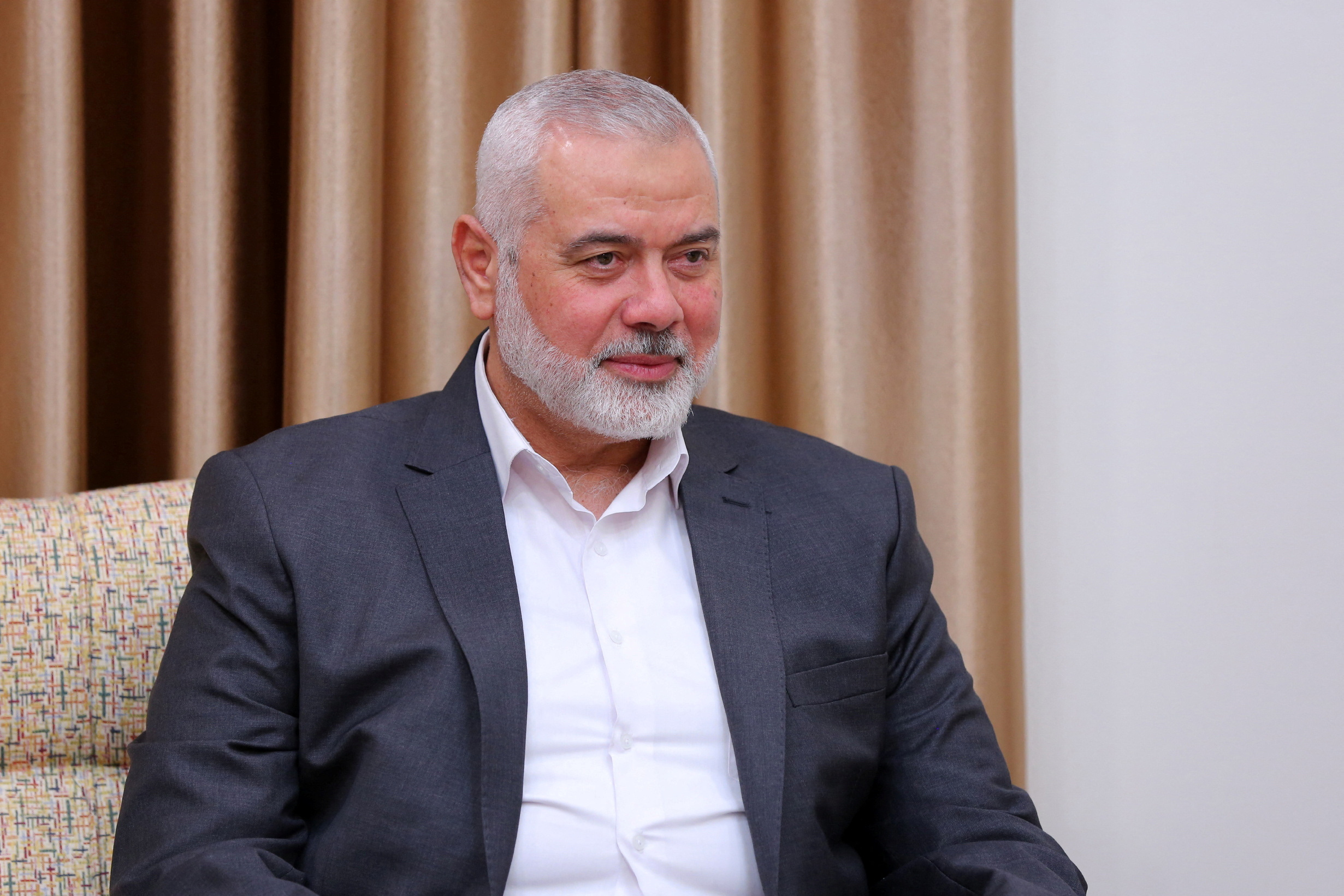
Palestinian group Hamas’ top leader, Ismail Haniyeh meets with Iran’s Supreme Leader Ayatollah Ali Khamenei (not pictured), in Tehran, Iran June 21, 2023. Office of the Iranian Supreme Leader/WANA (West Asia News Agency) via REUTERS/File photo Acquire Licensing Rights
Oct 7 (Reuters) – Ismail Haniyeh, the leader of the Palestinian Islamist group Hamas, told fellow Arab countries on Saturday that Israel cannot provide them with any protection despite recent diplomatic rapprochements.
Hamas launched the biggest attack on Israelin years on Saturday, killing dozens of people and taking hostages in a surprise assault that combined gunmen crossing into Israel with a barrage of rockets fired from the Gaza Strip.
Israel said the Iran-backed group had declared war as its army confirmed fighting with militants in several Israeli towns and military bases near Gaza, and Prime Minister Benjamin Netanyahu vowed to retaliate.
In a televised speech, Haniyeh addressed the Arab countries that have normalised ties with Israel in recent years.
“We say to all countries, including our Arab brothers, that this entity, which cannot protect itself in the face of resistors, cannot provide you with any protection,” he said.
“All the normalization agreements that you signed with that entity cannot resolve this (Palestinian) conflict.”
In 2020, Israel reached normalisation with the United Arab Emirates and Bahrain, and upgraded ties with Morocco and Sudan, despite talks with the Palestinians being frozen for years.
Regional powerhouse Saudi Arabia and Israel are also engaged in U.S.-mediated talks to normalise relations, a prospect that drew condemnation from some Palestinian factions.
Haniyeh also said armed Palestinian factions intend to expand the ongoing battle in Gaza to the West Bank and Jerusalem. “The battle moved into the heart of the ‘zionist entity'” he said.
Reporting by Hatem Maher and Nidal al-Mughrabi; Editing by Nick Macfie