Radio Free Europe / Radio Liberty
 The South Caucasus News - SouthCaucasusNews.com
On 7 October, hours after the surprise offensive by Hamas that left 1,400 Israelis dead, the Israeli prime minister, Benjamin Netanyahu, took to the airwaves to declare war on Hamas and issue a warning to Palestinians in Gaza: “leave now”. The question of where 2.3 million Palestinians, the vast majority of them refugees who have lived under a brutal siege and blockade for the past 16 years, should go to was left unsaid.
Israel proceeded to unleash an unprecedented aerial assault, dropping 6,000 bombs on the densely populated enclave in the first five days alone. Then came the order: a directive for the 1.1 million people in northern Gaza to evacuate to the south within 24 hours.
Maps showing evacuation corridors along which Palestinians were told to flee appeared as manifestations of colonial fantasy: two long arrows pointing southward, away from Palestine towards the Egyptian border.
Egypt, the only country other than Israel to share a border with Gaza, is being pressed by the US and other western states to open the gates and accept a flood of Palestinians fleeing the relentless assault and humanitarian crisis. In an interview on Sky News, Israel’s former ambassador to the US, Danny Ayalon, said: “The people of Gaza should evacuate and go to the vast expanses on the other side of Rafah at the Sinai border in Egypt … and Egypt will have to accept them.”
Instead of putting pressure on Israel to halt its bombing campaign, protect civilian life and allow in aid, various western governments have instead tried to broker a deal with Egypt by offering economic incentives for them to let in Palestinians, according to the Egyptian news site Mada Masr.
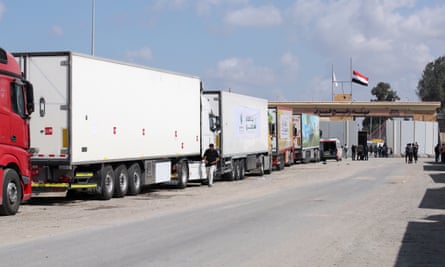
Egypt has said it will allow foreigners and Palestinian dual nationals through the Rafah crossing on the condition that Israel allows humanitarian aid in. Thousands of tonnes of food, fuel, water, medicine and other lifesaving aid packed into a long convoy of trucks have been idling on the Egyptian side of Rafah for days. On Wednesday, Israel said that it will allow Egypt to deliver limited humanitarian aid to Gaza, though the flow of relief is expected to fall short of what is needed, and the deal remains fragile.
However, Egypt has remained steadfast in its refusal to allow for the mass resettlement of Palestinians in North Sinai. “We reject the displacement of Palestinians from their land,” the Egyptian president, Abdel Fatah al-Sisi, said on Wednesday, stressing that “the Palestinian cause is the mother of all causes and has a significant impact on security and stability”. He also warned that Egypt could then become a new base of Palestinian attacks against Israel. Meanwhile, Egypt’s foreign minister, Sameh Shoukry, speaking on CNN, warned that the forcible resettling of Palestinians into Egypt might constitute a war crime.
While rejecting a policy that essentially amounts to a second Nakba (the mass displacement of Palestinians during the 1948 Arab-Israeli war) is laudable, Cairo’s rhetoric invoking the Palestinian cause rings hollow. Egypt’s decisions are ultimately driven by national security concerns and avoiding what it would consider a nightmare scenario of a mass Palestinian refugee population to contend with on its own territory.
For years, Egypt has been complicit in the siege on Gaza, helping to enforce the blockade, destroying tunnels that provided a lifeline to the strip, and coordinating with Israel on security, including allowing Israeli drones, helicopters and warplanes to carry out a covert air campaign in Sinai. Egypt’s treatment of Palestinians entering and exiting Gaza is notorious for its indignity – the latest iteration being Palestinians who tried to enter Gaza only to find the border closed on 7 October, stranding them in North Sinai; they are being hosted by families who are under strict security instructions not to allow them to leave the neighbourhoods where they reside.
Egypt has erected barricades at the border to contain more tightly any mass exodus – should it come. Meanwhile, Israel has bombed the Rafah crossing four times, most recently slamming a missile right by the concrete barrier on Egyptian territory.
As it stands, the situation in Gaza is at a catastrophic impasse. Food and water are running out. Medicines and other critical supplies have been exhausted, with doctors performing surgery on floors, often without anaesthetics. There is little to no fuel or electricity. Even colour has been obliterated, with entire neighbourhoods now reduced to rubble, encased in grey concrete dust.
As of Thursday, the death toll in Gaza stood at 3,478, including more than a thousand children, according to the health ministry in Gaza. Another 1,300 people are believed to be buried under the rubble, alive or dead. About a million have been displaced. And many more untold horrors we have yet to discover.
Mohammed Ghalayini, the son of an acquaintance, fled his home in Gaza City to Khan Yunis, in the south of Gaza. He told me on Wednesday: “I think Israel’s endgame is for Palestinians to be pushed out of Gaza into Egypt: 100% that’s their gameplan. I think this is ethnic cleansing and genocide all wrapped into one.”
The idea of resettling Palestinians in Gaza to Sinai is not new. In the mid-1950s, the UN devised a plan to transfer thousands of Palestinian refugees in Gaza to Sinai’s north-western region, a project that was met with popular outrage and crushed in a mass uprising. After the Naksa of 1967 (the six-day war, in which Israeli forces captured East Jerusalem and the Palestinian territories, including Gaza), the Allon plan, drafted by Israeli politician Yigal Allon, envisioned the Gaza Strip being annexed to Israel. In 1971, about 400 Palestinian families displaced by the Israeli army were relocated to Arish, while 12,000 relatives of suspected Palestinian guerrillas were deported to detention camps in the Sinai desert and were only able to return to Gaza two decades later after significant international pressure.
Israel is seizing the moment. As western governments cheer them on, they are driving Palestinians in Gaza to the very brink. They might be trying to drive them out of Gaza altogether, to extend the arrows on the maps further outward.
Sharif Abdel Kouddous is an independent journalist based in New York and Cairo. He has reported multiple times from Gaza and across Palestine since 2011
Do you have an opinion on the issues raised in this article? If you would like to submit a response of up to 300 words by email to be considered for publication in our letters section, please click here.
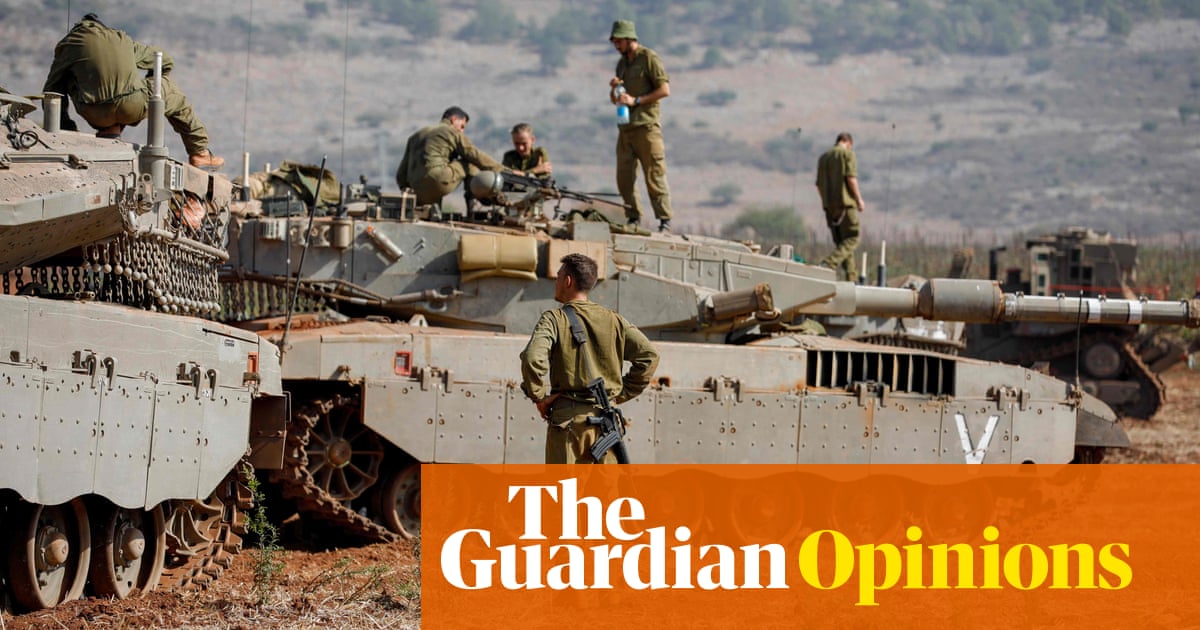
Since 7 October, questions have been posed over whether Hezbollah would intervene in the fight against Israel in aid of Hamas, and on the extent of Iran’s involvement in Hamas’s attack on Israel. Iran backs both Hamas and Hezbollah: they are military partners and have coordinated training and battles with support from the Islamic Revolutionary Guards Corps. Neither Hamas nor Hezbollah take decisions to declare war or peace without explicit prior agreement from Iran.
However, battles are not the same as full-on war. To date, Hamas and Hezbollah have never been involved in a war on two fronts against Israel. This is a scenario that neither the two groups nor Iran take lightly, because such a scenario amounts to regional war in the Middle East, which is in no one’s interest.
Hamas’s objectives in the 7 October attack on Israel were political: it wants to assert itself as the sole legitimate representative of Palestinian voices by engaging in an act which, in its eyes, would be seen by its supporters as heroic and would force the international community to engage with it as a de – facto military and political authority.
Hezbollah recognises this approach as it pursued a similar strategy in its own war with Israel in 2006. At that time, Hamas did not intervene to support Hezbollah, leaving the latter to claim singlehanded “victory” against Israel. With Hezbollah being the better equipped of the two militant groups, there is a clear imperative for Hezbollah to let Hamas be the leading actor in this war so as not to detract from Hamas’s pursuit of status. This is partly why Hezbollah’s leader, Hassan Nasrallah, has been noticeably absent from the public domain since 7 October.
Iran, on the other hand, has always made sure its superiority over the groups it supports is known. Iran does not need to instruct Hamas to start a war with Israel or even to be directly involved in Hamas’s war planning. What Iran does is more nuanced: on the one hand it expresses support for the actions of Hamas but then shakes the stick of Hezbollah against Israel. This was seen in the 12 October speech by the Iranian foreign minister, Hossein Amir-Abdollahian, during his visit to Beirut when he raised the prospect of Israel receiving a response from “the rest of the axis”. This way Iran does not undermine Hamas’s stature, but at the same time the invocation of Hezbollah places it as a stand-in for all Iran-backed militias in the Middle East – Hamas included – and therefore affirms Iran’s position as their patron.
Yet, while they have been careful not to detract from the leading role Hamas is taking in the war, Hezbollah’s status does carry the expectation of not standing still while its ally is engaged in the most important fight of its history against Israel. This is translating into escalated but calculated attacks by Hezbollah on areas in northern Israel. The attacks have mainly been on military targets and disputed territories that Hezbollah regards as Lebanese but occupied by Israel. Hezbollah’s rockets have not reached areas further inside Israel, as they did in 2006. Although Israel has responded by bombing southern Lebanon, killing two civilians and a Reuters journalist in separate attacks, the extent of this bombing remains within 3km of Lebanon’s southern border and most of the targets are connected to Hezbollah. It is clear from Hezbollah’s actions and Israel’s reactions that both still abide by their undeclared rules of engagement whereby neither side sparks a new war.
But there is a threat that still looms: if such a war were to happen again, Israel has said it would no longer distinguish between Hezbollah and the rest of Lebanon. It is, though, not in Israel’s interest to open a northern front while it is engaged in a significant southern front, especially considering political divisions within the country and question marks over its security and intelligence apparatuses, which failed to see the Hamas attack coming. While this may seem like an opportune moment for Hezbollah to take advantage, the group must also answer to the Lebanese public. Lebanon is suffering from the worst financial crisis in its modern history and cannot withstand the cost of another war. Unlike in 2006, when the country could expect aid and reconstruction money from Arab Gulf countries in the war’s aftermath, those countries have made it clear they will no longer engage in this kind of unconditional rescue.
As things stand, the likelihood of escalation from Hezbollah is low, and lowered further by the fact that, unlike in 2006, it does not need another “victory” to consolidate its position in the country, as it is comfortably the the most powerful political actor in Lebanon. Nor will Iran want to sacrifice Hezbollah’s political gains for the sake of Hamas, as the Lebanese militant group’s role in aiding Iranian allies across the Arab world is key to Iran’s regional influence.
Iran’s preferred method of balancing politics and military action is for its allies to be on the frontline against Israel, so it can celebrate them as winners and martyrs at once. This way both Iran and these militant groups reap the political benefits while keeping Iranian territory out of the line of fire. That is why a Lebanese front is unlikely: it wouldn’t be in Iran’s interests, as it would entail the intervention of the US, which has already sent aircraft carriers to the eastern Mediterranean as a deterrent. US intervention sparks the potential for the war to spread to Iran itself, which is the last thing Iran wants. Its role and Hezbollah’s position would seem to suggest that, unless something dramatically changes, they are adhering to their post-2006 stance of mutual deterrence.
Lina Khatib is director of the Soas Middle East Institute and associate fellow at the Middle East and North Africa programme at Chatham House
 “Nova Credit” non-bank credit organization has received a license from the Central Bank of Azerbaijan.This is reported on the website of the regulatory body.According to the information, the number of licensed NBCOs in the country has reached 53. “Nova Credit” was registered by the state in May 2023.The State Register of Commercial Structures of the State Tax Service under the Ministry of Economy reports that its legal address is …
 We are currently facing the threat of a potential military confrontation in the South Caucasus, specifically regarding the corridor that would provide Azerbaijan with direct land access to its territory in Nakhichevan.It is important to acknowledge that Russia has a vested interest in instigating this conflict. Such a war would not only damage Azerbaijan’s international reputation, but could also lead to a change in government in Armenia. However, there are alternative solutions …
 The cancelled “Muganbank” declared bankrupt, the Azerbaijan Deposit Insurance Fund (ADIF) has been appointed liquidator of the bank.This is reported by the ADIF.The court’s decision on this matter was adopted on October 24, the report says.Based on the ADIF’decision, it will provide information about the time and place of payment of population’s savings.On October 19, the Central Bank of Azerbaijan, guided by the fact …