
Published on Oct 25, 2023 08:41 PM IST
 The South Caucasus News - SouthCaucasusNews.com
Published on Oct 25, 2023 08:41 PM IST
YEREVAN—A planned meeting between Armenian Prime Minister Nikol Pashinyan, Azerbaijani President Ilham Aliyev and European Council President Charles Michel has been canceled, the latest sign of the failure of the peace process between Armenia and Azerbaijan.
The breakdown of negotiations became evident when Aliyev refused to participate in European-brokered talks in Granada, Spain at the beginning of this month. Yet he sent Azerbaijan’s foreign minister to Iran for the “3+3” format talks, which took place on Monday, October 23. While another meeting was scheduled between Aliyev, Michel and Pashinyan at the end of October, European Union Special Representative for the South Caucasus Toivo Klaar confirmed today that the meeting will not take place. The Speaker of the Armenian Parliament Alen Simonyan stated that the meeting between Pashinyan and Aliyev was canceled due to Azerbaijan’s opposition to holding the meeting in Brussels.
The idea of a “new platform for regional cooperation to ensure lasting peace and stability,” or the “3+3” format, entails a regional mechanism for peace, where the stakeholders include Southern Caucasus countries Armenia, Azerbaijan and Georgia, and their more internationally influential neighbors Iran, Russia and Turkey. While Turkish President Recep Tayyip Erdogan first suggested a regional format following the ceasefire agreement ending the 2020 Artsakh War, this format was formally introduced in October 2021 by Russian Foreign Minister Sergey Lavrov.
The first round of talks in this format was held in Moscow in December 2021. While most countries were open to this format, Georgia declined from the start, citing the unsettled disputes with Russia over the breakaway territories of South Ossetia and Abkhazia and wary of upsetting the political alliance with the West. Georgia also refused to participate in the latest “3+3” talks on Monday.
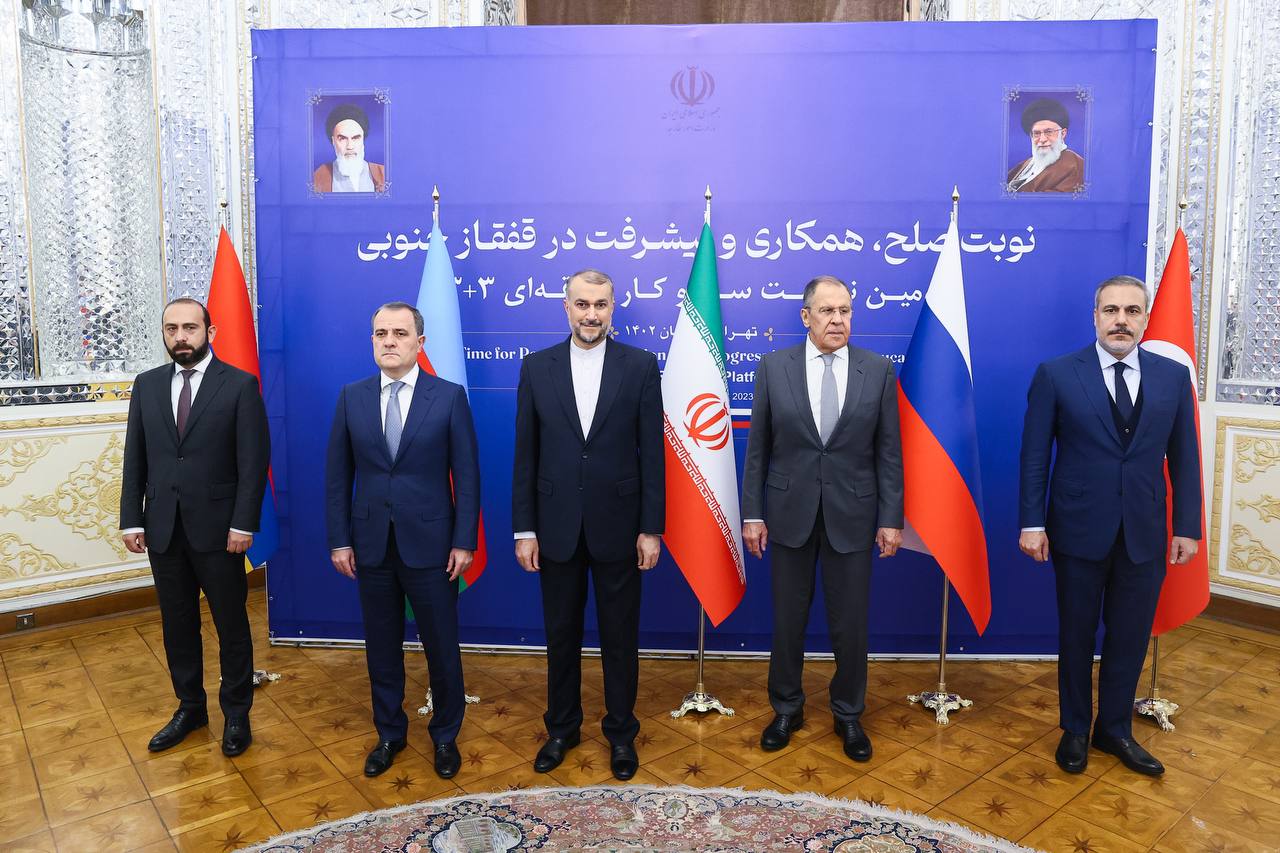 Foreign Ministers of Armenia, Azerbaijan, Iran, Russia and Turkey meet in Tehran on October 23 (Russian Foreign Ministry)
After the “3+3” format meeting held in Tehran, the participating parties issued a nine-point joint statement:
Taking into account the importance of the development of relations between countries based on mutual interests and neighborliness, they emphasized the peaceful settlement of disputes, respect for sovereignty, political independence, territorial integrity, the inviolability of internationally recognized borders, non-interference in internal affairs, the prohibition of the threat or use of force and human rights based on all the principles of the United Nations Charter.
They discussed the most pressing issues in the region and emphasized the importance of platforms such as “3+3” to provide opportunities for constructive dialogue and establish mutually beneficial cooperation between the countries of the region. They stressed the positive impact of economic cooperation on strengthening mutual trust, the well-being of nations and the stability of the region. They also noted the importance of cultural cooperation, people-to-people contacts and joint projects in the fields of education, science, tourism, culture and sports.
The countries’ foreign ministers also discussed strengthening bilateral and multilateral consultations and cooperation to promote lasting peace and economic development and welcomed the ongoing processes aimed at the regulation and development of relations between all the countries of the region. Positively evaluating the results of this meeting, they reaffirmed that this platform is open for the equal participation of Georgia.
The Ministers of Foreign Affairs of Armenia, Azerbaijan, Turkey and Russia thanked the Iranian Foreign Minister for the positive reception and successful meeting. Russian Foreign Minister Lavrov announced that the next meeting will be held in Turkey in 2024, noting that periodic meetings of the “3+3” regional platform can expand and strengthen the environment of trust and cooperation in the region.
High ranking officials who participated in Monday’s meeting have made several announcements post factum. Iranian Foreign Minister Hossein Amir Abdollahyan stated that the meeting can create a basis for peace with the participation of regional actors and neighbors in the South Caucasus. Turkey’s Foreign Minister Hakan Fidan said Ankara hoped the talks would “give impetus to normalization and peace processes.”
While some believe that these talks represent progress in the normalization of relationships between Armenia and Azerbaijan, the most important factor for regional stability is lacking. Political analyst Ruben Mehrabyan says that Armenia considers the “3+3” a consultative platform and is not foreseen to discuss conflict. “Armenia does not consider this platform functional to any extent until peace is established in the region, and peace will not be established on this platform at all,” he said.
According to Mehrabyan, the “3+3” platform implies more risks than benefits for Armenia. This platform is focused on solving the problems of the region through the leadership of Iran, Russia and Turkey, without the West. Mehrabyan believes that without the participation of Georgia, any agreement within the format is between Ankara, Moscow, Tehran and Baku. “Azerbaijan has done everything to turn this meeting in Tehran into a factor that would allow Baku to avoid traveling to Brussels,” Mehrabyan added, which was confirmed today.
In an interview with ABC Media, political analyst Tevan Poghosyan said that Aliyev will not sign a peace agreement after the signing of the ceasefire on November 9, 2020. Poghosyan added that Aliyev will not participate in any format that is not in favor of his interests. “He received all of the demands he had from Europe and now seeks a greater strategic advance through other formats,” Poghosyan said.

Hoory Minoyan was an active member of the Armenian community in Los Angeles until she moved to Armenia prior to the 44-day war. She graduated with a master’s in International Affairs from Boston University, where she was also the recipient of the William R. Keylor Travel Grant. The research and interviews she conducted while in Armenia later became the foundation of her Master’s thesis, “Shaping Identity Through Conflict: The Armenian Experience.” Hoory continues to follow her passion for research and writing by contributing to the Armenian Weekly.
The post Failed peace negotiations between Armenia and Azerbaijan appeared first on The Armenian Weekly.
Armenia
The first of its kind arms deal was signed on Monday, October 23 between Armenia and France, deepening France’s engagement in the region while Armenia continues to distance itself from Russia, Armenia’s traditional arms dealer. The agreement allows Armenia to obtain three Ground Master 200 radars manufactured by Thales and equipment including binoculars and sensors from Safran. A French military official will also travel to Armenia in the coming months as a defense consultant for the Armenian government. Armenian Defense Minister Suren Papikyan and his French counterpart, Sébastien Lecornu, also signed a “letter of intent” to greenlight the future sales of French Mistral short-range surface-to-air missiles to Armenia.
Artsakh
Dozens of protestors gathered outside the building of the Representation of Artsakh in Yerevan on Saturday, October 21, demanding a meeting with Artsakh’s President Samvel Shahramanyan. The protesters called on Shahramanyan to nullify the decree he signed to dissolve the Artsakh government on January 1, 2024. Shahramanyan met with a group of the protesters and discussed employment, social issues, housing and the political future of Artsakh. Shahramanyan apologized to the public for not being able to discuss the latter, stating that it could have dangerous repercussions. In the near future, Shahramanyan will give an interview regarding the issues of concern to Artsakh residents.
The protests began after it became public that President Shahramanyan had signed a decree that relieved all government and community officials from their duties starting October 1, 2023, excluding the office of the president of Artsakh, the head of his administration, the secretary of the Security Council, members of parliament, the chairman of the National Assembly (Davit Ishkhanyan, who continues to be illegally detained in Baku), judges, the ombudsman, chairman of the Central Elections Committee, the attorney general, the state minister and other ministers and the chief of police.
The illegal detention and trial of Artsakh civilian Vagif Khachatryan continues in Baku. On Tuesday, Khachatryan made a statement denying accusations of his participation in the events of Meshali. When he apologized, stating that he was not there during these events, the translator deliberately misinterpreted and conveyed the apology as directed to the Azerbaijani people for all the incidents committed by Armenians.
Turkey/Azerbaijan
The Turkish Armed Forces and Azerbaijani army held joint military exercises named after the founder of the Turkish Republic, Mustafa Kemal Ataturk, from October 23-25 in Baku, Nakhichevan and the seized Armenian territories of Artsakh. Azerbaijan’s defense ministry stated that about 3,000 military personnel from both countries, over 100 armored and artillery vehicles, more than 20 aviation and aircraft, engineering equipment and small boats were involved in the exercises. The special forces of both sides carried out exercises with the purpose of penetrating the enemy’s operational area and neutralizing the armed groups of the enemy located in nearby settlements.
Hoory Minoyan was an active member of the Armenian community in Los Angeles until she moved to Armenia prior to the 44-day war. She graduated with a master’s in International Affairs from Boston University, where she was also the recipient of the William R. Keylor Travel Grant. The research and interviews she conducted while in Armenia later became the foundation of her Master’s thesis, “Shaping Identity Through Conflict: The Armenian Experience.” Hoory continues to follow her passion for research and writing by contributing to the Armenian Weekly.
The post The Region in Brief appeared first on The Armenian Weekly.