Categories
South Caucasus News

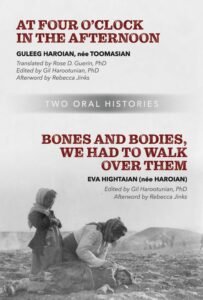
Two rare oral histories converge in Dr. Gil Harootunian’s newest publication


Book Review | At Four O’clock in the Afternoon and Bones and Bodies, We Had to Walk Over Them

Written by Guleeg Haroian and Eva Hightaian

Translated by Rose D. Guertin, Ph.D.

Edited by Gil Harootunian, Ph.D.

Two oral histories are combined in one collection. At Four O’clock in the Afternoon is the only existing firsthand oral account of an adult female who survived both the 1895 Hamidian massacres and the 1915 Armenian Genocide. Bones and Bodies, We Had To Walk Over Them is the firsthand oral account of her nine-year-old daughter who survived the Genocide.

Both accounts were translated by Rose D. Guertin, Ph.D. and written and edited by Gil Harootunian, Ph.D. This stunning collection is told in four voices. 

Dr. Harootunian’s voice provides the introduction to both oral histories with thoroughly researched facts and a relevant overview that shine a light on key points that may have been dimmed during the emotional narration or translation in language. She states there are many reasons why self-narrated histories were not written by women, including but not limited to the lack of literacy skills and the community taboo that precludes females discussing their sexual trauma.

Guleeg (Toomasian) Haroian narrates At Four O’clock In the Afternoon, starting her story at the age of 10, when she witnessed the killing of her father, the theft of their wealth and the burning of their house down to ashes by the Turks. By 1913, she was married to Hagop Haroian, blessed with two daughters and pregnant with a third, when he left for America with the dream of saving money to bring his family a life of freedom. With dreams shattered, she survived the 1915 Genocide through a forced marriage to a Muslim and later reunited with her daughter. 

Excerpt: “And soon the crier yelled for us to go. I jumped. I knew that place so well! I ran. They had begun separating the pretty ones, the brides, for rape, marriage and property. They were raping and beating them, then driving them out…I escaped. I had a stick in my hand. I was in my thirties; my eyes and face I had rubbed all black mud on, so the Turks wouldn’t recognize me, and they wouldn’t see how young I was…From roof to roof, I jumped.”

Eva (Haroian) Hightaian, Guleeg’s only surviving daughter from “the old country,” narrates Bones and Bodies, We Had to Walk Over Them. Eva’s oral history is significant, as she reveals the decision-making process of a nine-year-old child experiencing the collections, the Death March and forced transfer into a Muslim household. Eva also talks about her years with an Arab adoptive mother and her reluctance to re-join her mother and the Armenian community.

Excerpt: “After the Turkish government took all the ammunition and everything they saw, they decided you still have more…The soldiers took the women they found to the konagh. They tortured them. No woman would talk about it, but you can imagine what they did to the women. …The Turkish soldiers collected all the old men. They took them to a gorge, shot them, and those old men fell right there…After that, the massacre time came…And now the Turks claim they never did such a thing. But I saw it with my own eyes, in my young days, my childhood, they did all those things…” 

The afterword is written by Dr. Rebecca Jinks, Department of History, Royal Holloway, University of London, and a respected authority of women’s experiences during the Armenian and Yezidi genocides and humanitarian responses and representations in the aftermath. Her article “‘Marks Hard to Erase”: The Troubled Reclamation of ‘Absorbed’ Armenian Women, 1919-1927” was published in 2018 in the American Historical Review. Dr. Jinks provides a comparative analysis to a phenomenon called “genocidal absorption” that occurs when children are removed from the ethnic, religious and national communities that they are born into, as part of the process of group destruction. Dr. Jinks states that Guleeg and Eva’s experiences give us real insight into different experiences of genocidal absorption during the Armenian Genocide.  

The book is just over 200 pages and flows smoothly for a quick read. However, the words on those pages will stay with you long after as you reflect on the unspeakable horror and remarkable resilience. Please note trigger warnings of violence, sexual trauma and genocide. 

This level of firsthand accounts is a rarity, and their value cannot be understated.

It was not lost on me that this rare collection of Armenian history was written by a family matriarchy of four generations of women. The two oral histories consist of excerpts from recordings made beginning in 1976 with all four generations present. Had this not been a collaborative effort among trusted family members, these stories would join others that will never be told. This level of firsthand accounts is a rarity, and their value cannot be understated.

This treasure could not have been written by anyone other than Dr. Harootunian. We highly recommend this book for its rare and unique firsthand points of view, especially for readers and researchers interested in the lesser told stories from women that are written in English. 

We also commend and thank Guleeg and Eva for their selfless bravery, for opening deep wounds and for reliving their nightmares, and Rose and Gil for pushing through their generational trauma to share this invaluable treasure with the world.

Author information
Victoria Atamian Waterman

Victoria Atamian Waterman

Victoria Atamian Waterman is a writer born in Rhode Island. Growing up in an immigrant, bilingual, multi-generational home with survivors of the Armenian Genocide has shaped the storyteller she has become. She is a trustee of Soorp Asdvadzadzin Armenian Apostolic Church and chair of the Armenian Heritage Monument in Whitinsville, MA. She is the author of “Who She Left Behind.”

|

The post Two rare oral histories converge in Dr. Gil Harootunian’s newest publication appeared first on The Armenian Weekly.


Categories
South Caucasus News

Vocalist, composer Astghik Martirosyan reflects on hope and mutual care in the midst of sorrow on her debut album Distance


Armenian born, New York City-based vocalist, composer, and pianist Astghik Martirosyan brings her powerful album Distance to National Sawdust in New York on November 19. Distance is an artistic statement born of intense reflection on the relationship between present and past, self and nation, one’s inner emotional life and the call of homeland. Martirosyan wrote the music in 2020 while experiencing a stark duality: tremendous artistic growth and fulfillment at New England Conservatory (NEC) in Boston amid gut-wrenching news from an Armenia embroiled in a 44-day war with neighboring Azerbaijan over the status of the long-disputed Artsakh. This was during the pandemic as well, giving the title Distance another fraught layer of meaning. “All these emotions were happening,” Martirosyan recalls. “I was experiencing it at a distance, by myself, far from my family and my country, and all of this came out in the music. This was my way of trying to heal, hope and dream, but also to express real sorrow. I lost friends in that war. I have friends who lost their homes. Music was my outlet.”

Born and raised in Yerevan, Armenia, where she began her career at 15, Martirosyan went on to earn a master’s degree from NEC, studying with Dominique Eade and Frank Carlberg, among others. She now divides her time between New York and Los Angeles. She captures the uniqueness of her journey to brilliant effect on her debut album, Distance, which features some of the finest musicians of the Los Angeles scene. Pianist Vardan Ovsepian (who co-produced the date with Martirosyan), veteran bassist Darek Oleszkiewicz and top-ranked rising drummer Christian Euman make up the core band, with vital assists from tenor saxophonist Daniel Rotem and cellist Maksim Velichkin on two tracks apiece.

 The seven pieces included on Distance weave genres and idioms, blending lyrical influences of Armenian folk songs and Eastern European poetry with the modalities of classical, jazz and improvised music. “Silence,” the leadoff track and the only one on which Martirosyan plays piano, was loosely inspired by a line of Emily Dickinson’s: “I many times thought peace had come when peace was far away.” The title track “Distance” is inspired by Marina Tsvetaeva’s poem “To Boris Pasternak,” while “Song of the Final Meeting” is based on Anna Akhmatova’s poem of that name. The music for the poetry settings is all original.

 “Silence” and the haunting “Spring Is On Its Way” feature Martirosyan’s original music and lyrics. The latter she describes as “an intimate letter to my homeland, written during the eerie silence of a temporary ceasefire, in which Azerbaijan claimed ownership of the mountains in the disputed territory.” Martirosyan evokes these sentiments in a musical language that is flowing, harmonically rich, full of melodic and formal invention and a surefooted vocal delivery (with layers of backing vocals heightening the emotional sweep).

 “Summer Night” and “I’m Calling You” are Armenian folk songs, sung by Martirosyan in her native tongue. The former is heard in an epic, meter-shifting arrangement by the leader, while “I’m Calling You,” with tenor sax and cello enhancing the ensemble texture, is Ovsepian’s. “It was important to keep these melodies as pure as possible,” says Martirosyan, noting that Armenian music in general is monophonic, with the single melodic line predominant.

 “Heartsong” has been recorded several times by its composer, the great Fred Hersch, whose vocal version with singer and lyricist Norma Winstone (a major influence on Martirosyan) can be heard on Songs & Lullabies from 2003 (under the alternate title “Song of Life”). “Lyrically, the song expresses hope and celebrates life, and I felt it was important to include that perspective,” says Martirosyan. “It’s the bright star on the album.”

Astghik Martirosyan

“This is not a protest album,” Martirosyan says in sum, “but rather a statement about the human side of separation and conflict and the need to care for one another and our communities. I want to show how there can be hope and how we can move forward.” 

The album features Vardan Ovsepian (piano, coproducer), Darek Oleszkiewicz (bass), Christian Euman (drums), Daniel Rotem (tenor sax) and Maksim Velichkin (cello).

The concert at National Sawdust will feature Astghik Martirosyan (piano and voice), Vardan Ovsepian (piano), Joe Martin (bass), Ari Hoenig (drums) and Steve Wilson (alto sax).

Author information

Guest Contributor

Guest Contributor

Guest contributions to the Armenian Weekly are informative articles or press releases written and submitted by members of the community.

|

The post Vocalist, composer Astghik Martirosyan reflects on hope and mutual care in the midst of sorrow on her debut album Distance appeared first on The Armenian Weekly.


Categories
South Caucasus News

How the military escalation in Gaza could impact the South Caucasus – Armenian Weekly


How the military escalation in Gaza could impact the South Caucasus  Armenian Weekly

Categories
Selected Articles

Israel-Hamas War: Biden Affirms Evidence Backing Israel’s Denial of Causing Hospital Blast


18israel-hamas-promo-4pm-hlwq-facebookJu

President Biden also appeared to have secured Israel’s agreement to allow food, water and medicine for civilians to enter Gaza via Egypt.


Categories
Selected Articles

Biden Affirms Evidence Backing Israel’s Denial of Causing Hospital … – The New York Times


Biden Affirms Evidence Backing Israel’s Denial of Causing Hospital …  The New York Times

Categories
Selected Articles

President Biden’s Middle East visit reveals the challenges for US diplomacy – and the cost of American withdrawal from … – Chatham House


President Biden’s Middle East visit reveals the challenges for US diplomacy – and the cost of American withdrawal from …  Chatham House

Categories
Selected Articles

Biden’s Middle East trip has messages for both global and domestic … – El Paso Inc.


Biden’s Middle East trip has messages for both global and domestic …  El Paso Inc.

Categories
Selected Articles

Will Falcon be Egypt’s Wagner? – Middle East Monitor – Middle East Monitor


Will Falcon be Egypt’s Wagner? – Middle East Monitor  Middle East Monitor

Categories
South Caucasus News

US to allocate millions to aid Gaza – Trend News Agency


US to allocate millions to aid Gaza  Trend News Agency

Categories
South Caucasus News

Local Armenians have contributed to Oakland’s identity, and vice versa – Oaklandside


Local Armenians have contributed to Oakland’s identity, and vice versa  Oaklandside