Categories
South Caucasus News

Pfizer Slashes Revenue Forecast on Lower COVID Sales, Will Cut Costs


Pfizer slashed its full-year revenue forecast by 13% and said Friday it will cut $3.5 billion worth of jobs and expenses due to lower-than-expected sales of its COVID-19 vaccine and treatment.

Pfizer earned record revenue in 2021 and 2022, topping $100 billion last year, after developing its vaccine Comirnaty with German partner BioNTech SE and antiviral treatment Paxlovid on its own. Last year, revenue from those two products exceeded $56 billion.

But annual vaccination rates have dropped sharply since 2021 and demand for treatments has dipped as population-wide immunity has increased from vaccines and prior infections. Pfizer and rivals have begun selling an updated COVID vaccine for this fall.

“We remain proud that our scientific breakthroughs played a significant role in getting the global health crisis under control,” Pfizer CEO Albert Boura said in a statement. “As we gain additional clarity around vaccination and treatment rates for COVID, we will be better able to estimate the appropriate level of supply to meet demand.”

The drugmaker said it now expects 2023 revenue of between $58 billion and $61 billion, down from its prior forecast of $67 billion to $70 billion. It said the reduction was solely due to lowered expectations for its COVID-19 products.

Pfizer said it will take a noncash charge of $5.5 billion in the third quarter to write off $4.6 billion of Paxlovid and $900 million of inventory write-offs and other charges for the vaccine.

The cost-cutting program, which will target savings of at least $3.5 billion annually by the end of 2024, will include layoffs, the company said, without providing details on how many jobs will be cut or from what areas. One-time costs to achieve the savings are expected to be around $3 billion.

Shares of the New York-based company were down about 7% in extended trading.

Pfizer slashed its forecast for sales of its antiviral COVID treatment Paxlovid by about $7 billion, including a noncash $4.2 billion revenue reversal, as it agreed to allow the return of 7.9 million courses purchased by the U.S. government. It had previously expected Paxlovid revenue of about $8 billion for the year.

Pfizer said that under a deal with the U.S. government, a credit for the returned Paxlovid doses will underwrite a program to supply the drug free-of-charge to uninsured and underinsured Americans through 2028 and to patients insured under the government’s Medicare and Medicaid programs through the end of next year.

Pfizer will also provide the U.S. government 1 million courses of Paxlovid for the Strategic National Stockpile.

The company expects the drug will become commercially available to people with private insurance on January 1.

Pfizer also cut full-year revenue expectations for the COVID vaccine by about $2 billion due to lower-than-expected vaccination rates.

Pfizer said its non-COVID products remain on track to achieve 6% to 8% revenue growth year over year in 2023.


Categories
South Caucasus News

ANCA-WR to Honor Ambassador Edward P. Djerejian with ‘Lifetime … – Asbarez Armenian News


ANCA-WR to Honor Ambassador Edward P. Djerejian with ‘Lifetime …  Asbarez Armenian News

Categories
South Caucasus News

A judge has declined to block parts of Georgia’s election law while legal challenges play out – Hilton Head Island Packet


A judge has declined to block parts of Georgia’s election law while legal challenges play out  Hilton Head Island Packet

Categories
South Caucasus News

“It all started with Georgia” – Putin on the attitude of Georgia, Ukraine … – JAMnews


“It all started with Georgia” – Putin on the attitude of Georgia, Ukraine …  JAMnews

Categories
South Caucasus News

Putin Says He is ‘Ready’ to Visit Armenia – Asbarez.com – Asbarez Armenian News


Putin Says He is ‘Ready’ to Visit Armenia – Asbarez.com  Asbarez Armenian News

Categories
South Caucasus News

Kidnapped Artsakh Patient’s Sham Trial on Fabricated Charges Begins in Baku


Vagif Khachatryan, who in July was kidnapped by Azerbaijani border guards during his evacuation from Artsakh by the International Committee of the Red Cross, appeared in a Baku court for a preliminary hearing to face fabricated charged.

The 68-year-old Khachatryan was placed under arrest soon after his abduction and was remanded into custody facing bogus charges of terrorism.

The hearing will continue on October 17, Azerbaijani sources reported.

Armenia’s Foreign Ministry said the trial was a “show of complete disregard for any norms in Baku.”

Foreign ministry spokesperson Siranush Badakyan called the legal proceedings in Baku a “Sham Trial.”

Badalyan said in a post on X that the trial is a “show of complete disregard of any norms in Baku against Armenian civilian, 68-year-old resident of Nagorno Karabakh who under ICRC’s protection was being transported to Armenia for heart surgery and was abducted at the illegal checkpoint weeks before the ethnic cleansing in Nagorno Karabakh.”

“Illegal abduction, in flagrant violation of international humanitarian law, is now followed by publication of videos and photos showing the suffering of the 68-year-old civilian. As requested by numerous international human rights organizations and institutions, Armenian POWs and civilians that are still being kept hostage in Baku should be released,” Badalyan added.

Armenia’s Ambassador At-Large Edmon Marukyan said the Khachatryan’s trial was a “mockery of European conventions” and lambasted the Azerbaijani “kangaroo court.”

In a post on X, Marukyan alled on Azerbaijan to stop such actions that degrade people’s fundamental freedoms and human dignity and release all prisoners from Armenia and Nagorno Karabakh immediately.

Marukyan said that all existing proceedings in Azerbaijan are a farce, a mockery of the European Convention and a violation of all universally accepted international norms in the context of all obligations undertaken by Azerbaijan itself.

“The trial of Vagif Khachatryan, abducted from Nagorno Karabakh, has started in Azerbaijan today. He, of course, has nothing to do with the crime, he is merely punished for being born in Nagorno Karabagh and for living on his ancestral land. I want to make this very clear, in Azerbaijan, where the government has not changed for more than 20 years, during which 5 presidents were elected in Nagorno-Karabakh, which Freedom House rated as partially free with 37 score by all indicators, and Azerbaijan – Not Free, with 9 scores, there cannot be a fair trial, fair court and/or fair accusation. All existing proceedings are a farce, a mockery of the European Convention and a violation of all universally accepted international norms in the context of all obligations undertaken by Azerbaijan. Azerbaijan must end the treatments that degrade people’s fundamental freedoms and human dignity and release all prisoners from Armenia and Nagorno Karabakh immediately. P. S. In the video you can see a crying man in the fake court hearing,” Marukyan said on X.

At the time of Khachatryan’s kidnapping and subsequent arrest in July, Armenia’s foreign ministry called said that the act amounts to war crime.

Prominent attorney Siranush Sahakyan said at the time of Khachatryan’s arrest that the kidnapping constituted extraordinary rendition in terms of international law and a due process is therefore ruled out.

Khachatryan’s daughter appealed to the United Nations ensure the safe release of her father and said that all charges pressed by Azerbaijan’s prosecutors were fabricated.


Categories
South Caucasus News

Putin Says He is ‘Ready’ to Visit Armenia


Offers to Host Yerevan-Baku Talks

President Vladimir Putin of Russia on Friday said he will visit Armenia, despite the recent ratification by the Armenian Parliament, of the statute governing the International Criminal Court, which has issued an arrest warrant for the Russian leader.

Russia has warned on Armenia about ratifying the ICC treaty, known as the Rome Statute, with some officials in Moscow saying that such a move would cause serious damage to Yerevan-Moscow relations.

Prime Minister Nikol Pashinyan pushed ahead with the ratification, which the Parliament debated and voted on last week.

Putin said that he and Pashinyan have exchanged invitations to visit their respective capitals. He said he didn’t plans to travel to Yerevan yet because Pashinyan is now busy coping with “the tragedy of Nagorno-Karabakh’s Armenians.”

“He probably has no time for traveling right now,” Putin told reporters after the Commonwealth of Independent States summit in Bishkek, Kyrgyzstan’s capital. “When the situation [in Armenia] normalizes I will visit them and [Pashinian] will come [to Moscow.]”

Putin stressed that he and Pashinyan “remain in touch” and that their governments keep working together on their bilateral agenda. He went on to play down Pashinyan’s decision not to attend the CIS summit, attributing it to “quite understandable circumstances.”

“I’m not going to talk about them. You had better ask the Armenian prime minister. As far as I understand, Armenia is not leaving the CIS,” added the Russian leader.

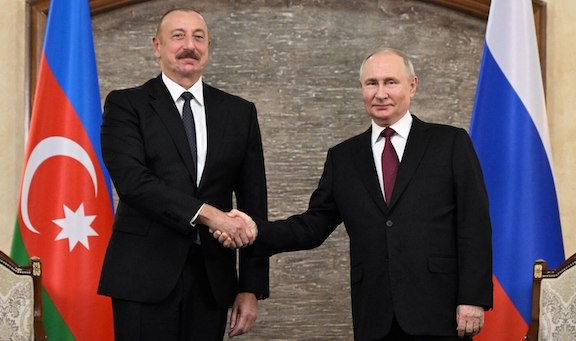
Presidents Vladimir Putin (right) and Ilham Aliyev meet in Bishkek, Kyrgyzstan on Oct. 12

During the CIS Summit, Putin said that he was willing to host talks between Pashinyan and President Ilham Aliyev of Azerbaijan, with whom the Russian leader met on the margins of the meeting.

“On the agenda is the preparation of a peace agreement to end this protracted conflict,” Putin said. “And the Russian side is, of course, ready to provide our partners with all possible assistance in this. In particular, we stand ready to organize negotiations in Moscow, if necessary, in any format. For starters, [talks between] foreign ministers, experts.”


Categories
South Caucasus News

ANCA-WR to Honor Ambassador Edward P. Djerejian with ‘Lifetime Achievement’


BY KATY SIMONIAN

The Armenian National Committee of America–Western Region will bestow the prestigious Lifetime Achievement Award to retired Ambassador Edward P. Djerejian for his years of service as a diplomat across the international stage.

His work and continued efforts to educate, inspire and promote peace will be in the spotlight at the 2023 Annual Awards event which will take place on Sunday, November 12 at The Omni Hotel.

Following nearly ten months of Azerbaijan’s illegal blockade of Artsakh and its military onslaught which resulted in the forced depopulation of Artsakh, the ANCA-WR Board seriously considered canceling this year’s Awards Gala. However, remembering the inspiring words of Artsakh Foreign Minister and last year’s Freedom Award honoree David Babayan, who is currently unlawfully imprisoned in Baku, the ANCA-WR Board decided that it must not cower in the face of Azeri aggression and that it must forge ahead in a show of unity and resilience against the injustices inflicted on our people, pledging to donate a portion of the proceeds toward humanitarian assistance for Artsakh genocide survivors. 

“Ambassador Edward P. Djerejian’s lifetime of diplomatic service is virtually unparalleled. He has served eight presidential administrations and remains a prominent voice of international relations,” says ANCA-WR Chair Nora Hovsepian, Esq.

“We salute his contributions to diplomatic relations and education which have enriched the landscape of political policies in the United States and across the international community. His devotion to contributing to the enrichment of the Armenian Nation and protection of our rights is a testament to the Armenian spirit and the bravery of his parents who were Armenian Genocide survivors. We should learn from the example he has set, as we seek to embrace his energy and dedication to improving policies for the good of people everywhere,” added Hovsepian.

“I believe in an America that is on the march. An America respected by all nations, friends and foes alike; an America that is moving, doing, working, trying; a strong America in a world of peace.” President Kennedy’s immortal words echo through a new century and express a vision that continues to inspire generations of Americans. It is poignant to think that the storied 32- year diplomatic career of Ambassador Edward P. Djerejian began during President Kennedy’s administration in 1962, when he served as a staff assistant to Under Secretary George W. Ball.

Following his graduation from Georgetown University in 1960, his time in the State Department inspired him to remain devoted to President Kennedy’s vision, as he began serving his country as a diplomat throughout Europe and the Middle East. Djerejian, who speaks five languages – English, Armenian, Arabic, French and Russian – went on to serve as a political officer in Beirut, Lebanon from 1966 to 1969 and Casablanca, Morocco from 1969 to 1972. Between 1975 and 1977, he was named Consul General in Bordeaux, France. He was later assigned to the U.S. Embassy in Moscow from 1979 to 1981, where he led the political section during the critical period in U.S.-Soviet relations marked by the invasion of Afghanistan.

Born in New York in 1939, Djerejian, who served honorably in the Korean War, was inspired to participate in public service at a young age, after hearing stories about the Armenian Genocide from his father Bedros, whose parents were slaughtered by the Ottoman Turks. After losing both of his parents, Bedros was forced into the horrific death march into Deir-ez-Zor through the Syrian deserts. Against all odds, Bedros survived and ran away in Aleppo, where he began a long, extraordinary journey that brought him to the East Coast of the United States where he settled and eventually married a young woman, Mary Yazudjian, who had also escaped the death march. Their harrowing stories summoned a sense of purpose and duty in their son’s heart to, in his words, “honor those who were not as lucky as I, and to give back to the United States, the great country that gave my parents political refuge.”

Djerejian, a leading expert on national security, foreign policy, public diplomacy, and the complex political, security, economic, religious, and ethnic issues of the broader Middle East, has played key roles in the Arab-Israeli peace process and regional conflict resolution. He remains a prominent voice, educating people on the nuances of public service in areas of conflict, authoring Danger and Opportunity: An American Ambassador’s Journey Through the Middle East.

His expertise in diplomatic relations in the Middle East made him uniquely suited for representing the United States for the next two decades in different parts of the region. Djerejian served as Deputy Chief of the U.S. Mission to the Kingdom of Jordan from 1981 to 1984.

One of the highlights of Djerejian’s tenure in the diplomatic service came when he was assigned to the White House in 1985 as Special Assistant to President Ronald Reagan and Deputy Press Secretary of Foreign Affairs. He was made Deputy Assistant Secretary of Near Eastern and South Asian Affairs from 1986 to 1988. Djerejian served both President Reagan and President Bush as U.S. Ambassador to the Syrian Arab Republic from 1988 to 1991, playing a vital role for both administrations in preserving America’s position and influence in the tense environment produced by conflicts within and between Middle Eastern countries. It was his post in Damascus that proved to be deeply meaningful, as it was in Aleppo, located in Northern Syria, that his father Bedros escaped death and found hope for a better future. During this period, Djerejian built a strong relationship with Syria’s then leader, Hafez al-Assad who was moved by his family’s endearing connection to the country and the harrowing story of his father Bedros as a genocide survivor.

“If anyone had told that young Armenian boy who had just lost his parents in the Genocide that one day, his son would come to Damascus as the American ambassador, he would have said ‘You’re out of your mind.’ But it happened,” says Djerejian, marveling at the convergence of his family’s past and his powerful influence as an Armenian American diplomat.
His post as Ambassador to Syria was followed by his service under President Bush and President Clinton as Assistant Secretary of State for Near Eastern Affairs from 1991 to 1993.  
His years of service culminated in 1993 when he was named United States Ambassador to Israel by President Clinton. As Ambassador, he presided over the Arab-Israeli peace process, the U.S.-led coalition against Saddam Hussein’s invasion of Kuwait, successful efforts to end the civil war in Lebanon, the release of U.S. hostages in Lebanon, and the establishment of collective and bilateral security agreements in the Persian Gulf.

One of the constants of his life and political career has been his unwavering commitment to creating strong foundations for democracy in Armenia to safeguard the country’s future. “The best legacy we can leave to those who perished during the Genocide is to work seriously for a prosperous, secure, peaceful Armenia,” says Djerejian. “We must do everything we can as the Diaspora to help Armenia become stable and to deal with the dangerous and isolated neighborhood in which it is located.” Djerejian continues to be a formidable voice for encouraging new generations of Armenians to contribute to the peace and safety of Armenia in a way that honors our rich cultural history, recognizes the crimes against humanity perpetrated against the Armenian Nation throughout the twentieth century, and embraces hope, which is a virtue innately embedded into the fabric of Armenian culture. For Djerejian, his family’s survival and our collective growth as a people, must inspire us to meet today’s challenges and rise to fulfill our greatest goals as a people and a nation.

After his highly lauded career as a diplomat and thirty-year tenure as Founding Director of Rice University’s Baker Institute for Foreign Policy, Djerejian joined Harvard Kennedy School’s Middle East Initiative where he now serves as a Senior Fellow.

Djerejian has been awarded the Presidential Distinguished Service Award, the Department of State’s Distinguished Honor Award, the Ellis Island Medal of Honor, and the Anti-Defamation League’s Moral Statesman Award. Throughout the past twenty years he has received numerous honors including the Award for Humanitarian Diplomacy from Netanya Academic College in Israel, the National Order of the Cedar, bestowed by President Émile Lahoud of Lebanon, the Order of Ouissam Alaouite, bestowed by King Mohammed VI of Morocco, and the Order of Honor, bestowed by President Serzh Sargsyan of Armenia. He is also a recipient of the Association of Rice Alumni’s Gold Medal for his service to Rice University and is a Lifetime Member of the Baker Institute Board of Advisors. 

Djerejian received his Honorary Doctorate from his Alma Mater, Georgetown University, in 1992 and Doctor of Law from Middlebury College. He is a fellow of the American Academy of Arts and Sciences, one of the nation’s oldest and most prestigious honorary societies and independent policy research centers. He is a member of the Board of Trustees of the Carnegie Corporation of New York. Djerejian has also served on numerous corporate boards including Global Industries, Inc., Occidental Petroleum Corporation where he was Chairman of the Board from 2013 to 2015, Baker Hughes Company, and is currently with The Mexico Fund and Magnolia Oil & Gas Operating LLC, where he applies his vast knowledge of international relations to building effective policies for growth and development.

It is said, that a life devoted to serving the good of others, is a life well-lived.

Ambassador Djerejian’s lifetime of service is an inspiration and has provided a blueprint of the highest standards for new generations to emulate in their entry into diplomatic service. His life’s work in the field of international diplomacy is an indelible part of American history and he has represented both the Armenian people and the American people with integrity and the utmost respect for duty, promoting a strong America in a world of peace. At a time when the Armenian community of Southern California stands in solidarity with all across the Armenian Diaspora in support of the people of Artsakh and defending the Armenian homeland, Ambassador Djerejian’s commitment to creating impactful change across international affairs in the name of democracy shines a light on the value and significance of public service.

For more information about Ambassador Djerejian’s storied career in the diplomatic service, and to purchase tickets for the 2023 ANCA-Western Region Awards event, please click here. A portion of the proceeds from this year’s gala will be donated to support Artsakh Genocide survivors.

The Armenian National Committee of America – Western Region is the largest and most influential nonpartisan Armenian American grassroots advocacy organization in the Western United States. Working in coordination with a network of offices, chapters, and supporters throughout the Western United States and affiliated organizations around the country, the ANCA-WR advances the concerns of the Armenian American community on a broad range of issues in pursuit of the Armenian Cause.

Katy Simonian is a member of the 2023 ANCA-WR Awards Banquet Committee.


Categories
South Caucasus News

“It all started with Georgia” – Putin on the attitude of Georgia, Ukraine and Moldova to the CIS


According to Russian President Vladimir Putin, Georgia and Ukraine no longer work in the CIS format, and Moldova has “practically lost its identity.”

“With Georgia, it all started after former Georgian President [Mikheil Saakashvili] failed attempts to solve some internal problems through force and attacks on South Ossetia <…> and the consequences that resulted from this adventure,” Putin said at an Oct. 13 meeting of the CIS Council of Heads of State.

Regarding Ukraine, Putin said it once signed the founding document on the CIS, but in fact never joined it in its full format.

“Moldova is practically losing its identity. The elites of this country generally believe that they are not Moldovans, they call themselves Romanians. But this is their choice,” the Russian president continued.

At the same time, Putin argues that CIS countries can preserve their own identity:

“It is the choice of each of us – do we want to preserve our identity or not? And working within the CIS framework gives us such an opportunity and, on the contrary, strengthens our positions without preventing us from cooperating with each other and respecting our national peculiarities.”


Armenian Prime Minister Nikol Pashinyan did not attend the meeting of CIS leaders, while Belarusian President Alexander Lukashenko emphasized the change of Armenia’s political course.

“Initially Georgia left our union, de facto Ukraine is not with us. There are big question marks regarding Moldova. Unfortunately, Armenia does not always behave in a partner-like manner,” Lukashenko said.

CIS – Commonwealth of Independent States, a regional intergovernmental organization formed in 1991 after the collapse of the Soviet Union. According to the general concept, the purpose of the organization is to regulate cooperative relations between countries: to promote cooperation in economic, political and military matters and certain powers related to the coordination of trade, finance, lawmaking and security.

The CIS consists of nine former Soviet republics: Azerbaijan, Belarus, Turkmenistan, Moldova, Armenia, Russia, Tajikistan, Uzbekistan, Kazakhstan and Kyrgyzstan. Turkmenistan withdrew from full membership on August 26, 2005 and is currently an associate member. Georgia withdrew from the CIS in August 2009.


Categories
South Caucasus News

NPR News: 10-13-2023 7PM EDT


NPR News: 10-13-2023 7PM EDT