Categories
South Caucasus News

A Precious Legacy


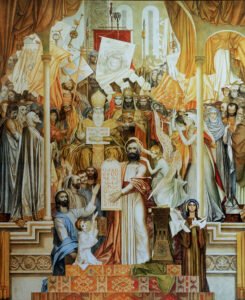
Krikor Khanjian’s mural The Creation of the Armenian Alphabet

In the month of October, Armenians all over the world celebrate the Feast of the Holy Translators. The Holy Translators were a group of Armenian scholars, headed by two towering Armenian churchmen, St. Sahag and St. Mesrob, who laid the foundations of Armenian literature in the fifth century A.D. That century was known as the Golden Age of Armenian Literature.

In order to understand and appreciate the magnitude of the work of the Holy Translators, one has to know the political and religious situation of Armenia at that time. 

In 387 A.D., the two superpowers of the era, Byzantium and Sasanid Dynasty of Persia, had partitioned Armenia into two sections, Western and Eastern Armenia. In Western Armenia, the official government language was Greek, while in Eastern Armenia, it was Persian. Besides these two languages, Syriac was also used because of its wide usage in religious literature. In fact, all Bible readings and liturgy were read from either Greek or Syriac texts and translated or interpreted by men who were known as “Translators.”

St. Sahag Bartev (348-438) and St. Mesrob Mashtots (361-439) saw the gravity of the political and religious state of the Armenian nation. They realized the importance of a literary Armenian language for the propagation of the Christian faith among Armenians. They knew that without the Bible in the hands of the lay people, the Armenian Church would not grow and could not stand very long in the midst of the pagan world.

St. Sahag and St. Mesrob also realized that a common literary language would unite the Armenian people in the Byzantine and Persian sections of Armenia. King Vramshabouh (Eastern Armenia) could see their logic, and thus, he lent his financial and moral support.

The only thing lacking was an Armenian alphabet. St. Mesrob was commissioned to do the task: inventing an Armenian alphabet as a tool for evangelism as well as a unifying force.

Mesrob traveled extensively and examined different alphabets. Finally, in 406 A.D., he invented the 36 letters of the Armenian alphabet.

The invention of the Armenian alphabet ushered in a new age of intellectual and spiritual enlightenment. The Armenian literary language and literature freed the Armenian people from the domination of the Persian, Syriac and Byzantine cultures. With the establishment of schools and the proliferation of writing, wider horizons opened up to the people, and their national consciousness was solidified. A host of disciples were trained under the guidance of St. Sahag and St. Mesrob, ushering in a new period of translating the Bible and other major Christian and philosophical texts into Armenian.

The group of scholars who launched the venture of translation of the Bible and other works came to be known as “The Holy Translators” or “Soorp Tarkmanitchk.” 

The first translation of the Bible into Armenian, starting with the Book of Proverbs, was made from one version of the Syriac text, probably the Pershitta.

There was a second translation of the Bible into Armenian from the Greek Septuagint Bible under the supervision of Catholicos St. Sahag. The final revision was rendered between the years 432-438, and in 438, Catholicos Sahag approved it and authorized its use in the Armenian Church.

We owe an eternal debt to St. Sahag and St. Mesrob, the chief architects of the Golden Age of Armenian Literature, and their venerable disciples, the Holy Translators, who became a source of inspiration, generation after generation, to numerous Armenians throughout our history.

Author information
Rev. Dr. Vahan Tootikian

Rev. Dr. Vahan Tootikian

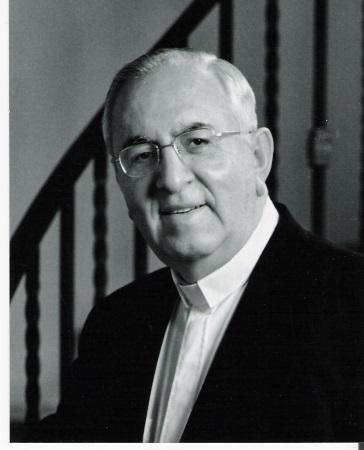
Rev. Dr. Vahan H. Tootikian is the Executive Director of the Armenian Evangelical World Council.

|

The post A Precious Legacy appeared first on The Armenian Weekly.

Categories
South Caucasus News

Preparing for the inevitable next Azeri incursion


The Armenian nation is not allowed the proper time to absorb the tragedy of Artsakh, partly because the threat to the sovereignty of Armenia is imminent. It reminds us that barbaric aggressors have no human compassion and are driven by an insatiable appetite for theft and atrocities. It is worth remembering that about a century ago, in the short span of five years, the Armenians experienced the beginning of the Genocide of 1915, the rebirth from the ashes at Sardarabad and the cruel division of our hope by the Turks and Soviet Russians. In 1988, the horrific earthquake occurred, followed by the brutal deportations of Armenians from Baku, only to be followed by the Artsakh liberation movement and the independence of Armenia—all within three years. Sometimes we are forced to postpone the full cycle of mourning in order to take advantage of an opportunity or prevent further losses. It is surreal to internalize that we have just witnessed what was considered unthinkable in our conscious reality. Our position can and has changed quickly—from humiliation to optimism and the inverse. It is never as hopeless as we may feel during difficult times and never as positive as we may believe during hopeful times. We must be ever cautious and self serving. Our experiences in Artsakh over the last 30 years teach us that painful lesson. Given the calamitous tragedies that have been our history, it is important to avoid wild swings in our emotions. This is where leadership earns its credibility, whether it is religious, political or social in nature. Leadership helps us avoid the peaks and valleys that can leave us damaged.

The prevailing view in our communities is that the loss of Artsakh will not satisfy the genocidal motivations of criminal Azerbaijan. Armenians are living in fear today, as they have lost hope in their leaders and other nations. Is our sovereignty as a nation state the next chapter? Are we simply waiting for the enemy? The Azeris are coy but uncomplicated. They usually telegraph their next exploits. While the Europeans and United States issued statements of concern and diplomatic consequences, the Azeris ignored civility by amassing troops on the border before their assault on Artsakh last month. War “games” were organized with their complicit genocidal cousins prior to the 2020 war. With the blood still fresh from occupied Artsakh and the deported residents seeking a new life, Aliyev, emboldened by a lack of military and diplomatic resistance, now speaks of demanding eight enclaves, while he audaciously occupies 145 km of sovereign Armenian territory, holds POWs from 2020 and arrests the leaders of Artsakh. When there is little substantive opposition from foreign powers, he is free to demand almost anything. 

Armenians are living in fear today, as they have lost hope in their leaders and other nations. Is our sovereignty as a nation state the next chapter? Are we simply waiting for the enemy?

Even though Azerbaijan has committed genocide and numerous other criminal acts, the Europeans have not sanctioned Azerbaijan, because Azeri energy is more important than their often-stated principles of human rights, freedom and the rule of law. The United States has not even been able to end the waiver of section 907 of the Freedom Support Act. Regardless of the quantity of weapons shipped, it is a clear statement of values when they pander to a terrorist state. The relationship with Israel is also a major variable. The current war with the Palestinians has heightened the wall between Iran and the West, particularly the United States. Despite the despicable Azeri-Israeli arrangement of energy and spy presence in return for billions in military hardware used to kill Armenians, the U.S. is not expected to sanction Azerbaijan. The U.S. may be motivated to outflank the Russians in the Caucasus, but apparently not at the expense of rogue Azerbaijan. 

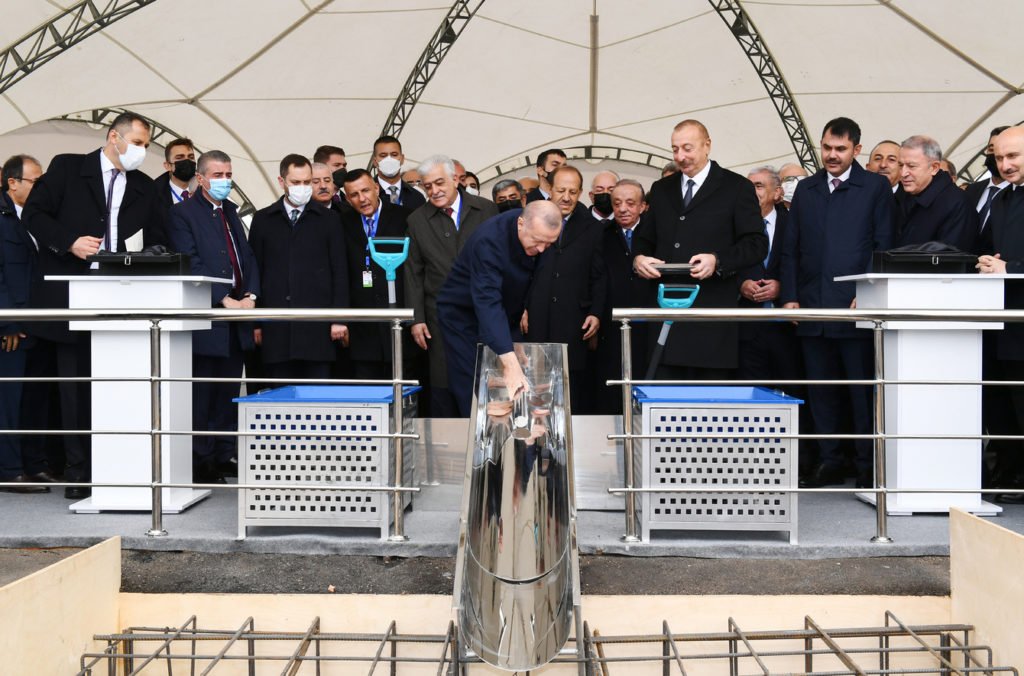
Presidents Erdogan and Aliyev lay the foundation stone for the so-called Zangezur Corridor, October 26, 2021 (Photo: Official website of the President of the Republic of Azerbaijan)

In addition, Aliyev continues to rant about the “Zangezur Corridor.” Imagine the arrogance of two nations, Azerbaijan and Turkey, demanding a sovereign corridor to connect their stolen land that would unite the Turkish criminals and would severely wound Armenia. Despite the outrageous nature of their demand, it is considered one of the prime motivators for conflict in the Syunik region. Recently, there have been sources, one Iranian and the other Azeri, suggesting that Azerbaijan is considering a “Plan B” to “Zangezur” due to Armenian opposition. The Pashinyan government has consistently stated that there was never such an agreement in the trilateral statement of November 2020 and that Armenia would never accept such a concept. For its part, Russia has also stated that such an agreement does not exist. Given Russia’s duplicitous politics towards Armenia, this should not be considered a reliable commitment for Armenia. The “Plan B” is a rail and land link on the Iranian side of the Armenian border. This plan is not a sovereign Azeri corridor and would be subject to the normal border and customs controls of the host nation. Iran seems to be offering this as an alternative to protect their interests in any territorial changes. Some sources believe Azerbaijan may find favor with this. Don’t believe a word of this. Azerbaijan wants the “Zangezur” corridor for two reasons: to establish a land route to connect Turkey, Nakhichevan and Azerbaijan and to destroy Armenian sovereignty. “Plan B” does not address the latter. They also want at least the eastern shore of Lake Sevan. In this sea of chaos, two conclusions can be drawn: Azerbaijan will attack, and Armenia should not expect much military support from the western defenders of democracy.

In light of the ominous clouds coming from the east, what should Armenia do to thwart such a challenge? As a baseline position, Armenia should continue bilateral talks with both Turkey on “normalization” and with Azerbaijan on a “peace” agenda. Let’s not fool ourselves. The Turks and Azeris are looking for capitulation and destruction of our sovereign state, but “negotiating” can serve as a small deterrent with Russian, U.S. and European sponsorship. The best case scenario is that Azerbaijan will continue to be uncooperative, which could strengthen the Armenian position. The European organizers must have been annoyed with the Aliyev boycott of the recent Granada sideline discussion. Armenia’s presence prevented a total embarrassment, but certainly not enough to overcome Europe’s energy obsession. Talk of sanctions by members of the European Parliament should not raise optimism on the Armenian side. The Americans have had similar rumbling, but Congress is not in a position to pass binding legislation, and the State Department will only serve as a mediator. After publicly criticizing Armenia, the Russians have signaled that they may be willing to sponsor another round of trilateral talks. Of course, this type of gamesmanship should be expected, as the Russians will alternate short-term tactical positions to serve the longer term interest of controlling their backyard. The high volume of diplomatic engagement by the Armenian government may yet yield a defensive option.

Whether motivated by self interest or a latent guilt complex, the West has offered several options to Armenia with onsite presence. The Artsakh disaster has Armenia flooded with European observers (increased and renewed), USAID personnel, a variety of diplomatic missions and other Western interests. Argentina has also offered onsite “white helmet” support to promote humanitarian needs and support. The military defense mechanisms to defend the homeland have been slow in developing. France has strongly hinted at providing military aid after a visit by a top official, but the content and timing is unclear. Deals have been announced with India, but again with uncertain timing. In an absurd irony, Russia maintains a military presence in Armenia, yet it has denied CSTO support several times in violation of the defense pact and has criticized Armenia’s Western engagement. Russia clearly cannot be trusted to support Armenia, but it is still dangerous as the only regional power that can greenlight the Azeris. The U.N. Mission to Artsakh was a farce and insulting, as it was limited to an Azeri-controlled “tour” and foolishly declared no evidence of civilian targeting. This is comparable to allowing the criminal to guide investigators through the crime scene. It is another example of how the U.N., in the interest of remaining a global facade, has rendered itself ineffective.

Perhaps the best option for Armenia is to invite as many foreign missions on the ground, particularly on the eastern front, as possible. The European and American presence could serve as a deterrent to Azeri military action. I don’t think the Europeans and Americans will be as forgiving to the Azeris as the Russians were when their peacekeepers were murdered by the Azeris. Fortifying the defenses militarily goes without saying, but a physical presence of humanitarian, military attachés and consulate presence in Syunik might slow the Azeris down long enough to build a stronger defense. This is not a time to say no to any legitimate foreign presence that can further the short-term humanitarian and intermediate-term security issues in the homeland. On the contrary, we should be recruiting physical presence. 

All of this is dependent on displaying a willingness to defend what is ours. Whatever the foreign presence can do will be limited if Armenia is totally dependent on a negotiated solution with the Turks. Azerbaijan has never honored any agreement with the Armenians and is not about to start now. This may be our generation’s Sardarabad. Let’s hope it does not come to life or die in battle, but we need to prepare on the assumption that the Turks’ definition of peace is synonymous with unconditional surrender. This is a time for all interior walls to be torn down in defense of the homeland. The church must become visible as raising the hope of the people. This is not politics. This is survival. Political instability is not going to help Armenia defend the homeland. We must ask ourselves: Are our disagreements more important than the survival of the homeland? It is time to put aside our differences on how to run the country, or there may not be a country to debate.

Author information

Stepan Piligian

Stepan Piligian

Columnist

Stepan was raised in the Armenian community of Indian Orchard, MA at the St. Gregory Parish. A former member of the AYF Central Executive and the Eastern Prelacy Executive Council, he also served many years as a delegate to the Eastern Diocesan Assembly. Currently , he serves as a member of the board and executive committee of the National Association for Armenian Studies and Research (NAASR). He also serves on the board of the Armenian Heritage Foundation. Stepan is a retired executive in the computer storage industry and resides in the Boston area with his wife Susan. He has spent many years as a volunteer teacher of Armenian history and contemporary issues to the young generation and adults at schools, camps and churches. His interests include the Armenian diaspora, Armenia, sports and reading.

|

The post Preparing for the inevitable next Azeri incursion appeared first on The Armenian Weekly.


Categories
South Caucasus News

After the loss of Artsakh, Pashinyan should declare the 2020 agreement null and void


On Nov. 10, 2020, Prime Minister of Armenia Nikol Pashinyan, President of Azerbaijan Ilham Aliyev and President of Russia Vladimir Putin signed a ceasefire agreement ending the 2020 Artsakh War. 

Ceasefires usually signify that the warring sides stop the fighting at their positions at that point. In the case of the 2020 ceasefire agreement, Armenia surrendered to Azerbaijan large swaths of land where no Azeri soldier had set foot, such as the Aghdam, Kalbajar and Berdzor (Lachin) districts, but not the corridor.

The 2020 agreement was more of a capitulation than a ceasefire for Armenia, with the following resulting problems: 

1) Prime Minister Pashinyan had no reason to sign a ceasefire agreement with Azerbaijan, since the war was between Azerbaijan and Artsakh, not Armenia. Neither Armenia nor Azerbaijan had declared war against each other.

2) Pashinyan had no authorization to turn over to Azerbaijan territories that belonged to Artsakh, not Armenia. 

3) The 2020 agreement set deadlines for Armenia, but not for Azerbaijan, to carry out various obligations, such as the evacuation of territories and exchange of prisoners of war. Unwisely, the Armenian government handed over all the Azeri prisoners right away, while Azerbaijan released only a small number of Armenian prisoners. Three years later, dozens of Armenian prisoners are still languishing in Baku jails. Pashinyan is not only making no efforts to return these prisoners but does not even talk about them. 

4) The Berdzor (Lachin) Corridor—the only road that connected Artsakh to Armenia—was forcefully and illegally taken over by Azerbaijan on Dec. 12, 2022, even though Russian peacekeepers were supposed to control it under the 2020 agreement.  

5) The 2020 agreement mandated that “all economic and transport connections in the region shall be unblocked.” This means that both Armenia and Azerbaijan would be able to cross each other’s territories. Pashinyan expressed his readiness to allow Azeris to travel through Armenia from the eastern part of Azerbaijan to its exclave of Nakhichevan but never mentioned that such access was to be reciprocal. Contrary to the 2020 agreement, Azerbaijan demanded not just a passage, but a “corridor,” which means that the road through Armenia would belong to Azerbaijan. President Aliyev never once mentioned that he would, in turn, allow Armenians to cross Azerbaijan’s border. To make matters worse, Turkey has been demanding that Armenia accept the “Zangezur Corridor” before it would agree to open the Armenia-Turkey border.

6) Pashinyan has repeatedly talked about his plan to sign a peace treaty with Azerbaijan. There is no need to sign such a peace treaty, since Armenia was not at war with Azerbaijan. Peace treaties are signed between warring parties. Azerbaijan was at war with Artsakh, not Armenia. 

7) Contrary to the 2020 agreement, which mandated that Russian peacekeepers would remain in Artsakh until 2025, Azerbaijan violated that provision by invading and occupying the remainder of Artsakh last month, forcing its 120,000 inhabitants to flee to Armenia. 

8) Azerbaijan’s occupation of Artsakh in September 2023 made the role of the Russian peacekeepers unnecessary, which means that the Russian soldiers would have to leave what is now Azeri territory. 

9) While there are good reasons to blame Russia for its inaction in protecting Artsakh Armenians, there is equally good reason to blame Pashinyan for conceding that Artsakh is part of Azerbaijan. It is clear that despite Russia’s alliance with Armenia, given its involvement in the war in Ukraine, President Putin has decided that Turkey (the only NATO member that has not sanctioned Russia) and its junior brother Azerbaijan are much more important to Russia’s national interests than Armenia or Artsakh. Meanwhile, the West has not been of much help to Armenia either, issuing supportive statements without taking action. 

10) After the 2020 War, when Azerbaijan’s army entered and occupied the eastern territory of Armenia, Pashinyan made no effort to dislodge the enemy from Armenia’s sovereign territory and does not even talk about Azerbaijan’s illegal presence there. 

11) Pashinyan’s long list of mistakes includes acknowledging that the Soviet-era Azeri inhabited enclaves inside Armenia are part of Azerbaijan. There was no reason for Pashinyan to offer these enclaves to Azerbaijan, especially since Aliyev had made no such demands.

12) Pashinyan unilaterally recognized Azerbaijan’s territorial integrity without any reciprocal recognition by Aliyev.

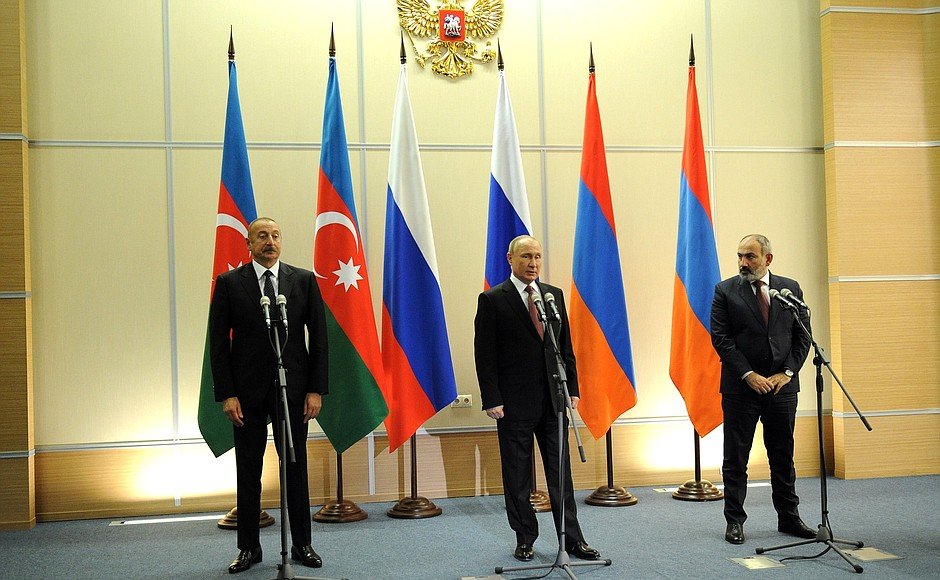
Azerbaijani President Ilham Aliyev, Russian President Vladimir Putin and Armenian PM Nikol Pashinyan brief the press after their trilateral meeting in Sochi (Photo: Kremlin, November 26, 2021)

Given Pashinyan’s mishandling of the above 12 critical issues and his refusal to resign and turn over his seat to a competent leader, the only option left for him is to declare that the 2020 agreement is null and void, since Azerbaijan has violated most of its provisions. 

Pashinyan should refuse to sit at the negotiating table with Aliyev until he releases all Armenian prisoners of war and withdraws his troops from Armenia’s territory. Aliyev should honor his previous commitments before Armenians can trust him to abide by future agreements.

Fortunately, the 2020 agreement can easily be discarded, because it was not ratified by the parliaments of Armenia, Azerbaijan and Russia as an international treaty. It was simply signed by Pashinyan without consulting anyone. The next leader of Armenia, on his first day in office, should nullify the 2020 agreement.

Author information

Harut Sassounian

Harut Sassounian

California Courier Editor

Harut Sassounian is the publisher of The California Courier, a weekly newspaper based in Glendale, Calif. He is the president of the Armenia Artsakh Fund, a non-profit organization that has donated to Armenia and Artsakh $917 million of humanitarian aid, mostly medicines, since 1989 (including its predecessor, the United Armenian Fund). He has been decorated by the presidents of Armenia and Artsakh and the heads of the Armenian Apostolic and Catholic churches. He is also the recipient of the Ellis Island Medal of Honor.

|

The post After the loss of Artsakh, Pashinyan should declare the 2020 agreement null and void appeared first on The Armenian Weekly.


Categories
South Caucasus News

Letter to the Editor: Feel neither guilt nor regret


Feel neither guilt nor regret.

We realize the dire straits in Artsakh. How can we not with the constant barrage of bad news? Our hearts weep every day for those in need. We could spend every hour of every day reading on social media and in the Weekly about this injustice. We must all rise above this.

I agree with my friend Steve Piligian on most issues related to Armenia. Recently, he posted on Facebook a statement that I respectfully disagree with:

“I know that life must carry on, but I feel empty with celebratory and social functions in our community given our Artsakh tragedy. Too soon…Too serious.”

I know it is hard to decouple our sadness and outrage from the importance of moving forward. But we must.

The weekend following the events in Artsakh, the Providence community held their annual Armenian Food Fest. It is the largest fundraiser for Sts. Vartanantz Church, which will allow the church to continue to serve the Armenian community in a multitude of ways. It allowed us to celebrate our culture, our heritage which identifies who we are. 

More importantly, in these trying times it allowed us to bring to light the plight of our brothers and sisters in Artsakh. We took the occasion to have a booth dedicated to bringing awareness to both Armenians and non-Armenians of the Artsakh situation complete with a video presentation. We collected funds at every booth to donate to those in need in Artsakh. We invited politicians, so they would hear from us firsthand what we expect of them in regards to Artsakh. We heard from community leaders, such as Hagop Khatchadourian, who through emotional speeches encouraged the community to get involved and to help our homeland in any way they can. Having this event did more to help the cause than if it was canceled due to our sadness.

I am not sure how many share my feelings. However, I am sure that everyone would agree that at this time, it is most important that we stand together, in the light, proud of being Armenian and collectively defiant against those who aim to do us harm.

Author information

John Mangassarian

John Mangassarian

John Mangassarian is a former camper, counselor, board member and lifelong supporter of Camp Haiastan.

|

The post Letter to the Editor: Feel neither guilt nor regret appeared first on The Armenian Weekly.


Categories
South Caucasus News

US carrier Ronald Reagan to visit South Korea in show of force – Arab News


US carrier Ronald Reagan to visit South Korea in show of force  Arab News

Categories
South Caucasus News

Israel War Crimes: Israel Kills 13 UN Staff And 30 Children In Gaza School


A UN school in Gaza was hit by an Israeli airstrike on Thursday, killing 13 staff members and 30 children who were taking shelter there, according to the UN spokesperson. The school, run by the UN Relief and Works Agency for Palestine Refugees (UNRWA), was one of the 64 schools that were hosting thousands of displaced Palestinians who fled their homes near the Israeli border amid the ongoing conflict.

The UNRWA condemned the attack as a “grave violation of international humanitarian law” and called for an immediate cessation of hostilities. “This is a tragedy that should never have happened. These children and staff were seeking refuge and protection in a UN facility. They had a right to feel safe and secure. They had a right to live and learn,” said the UNRWA Commissioner-General Philippe Lazzarini.

The Israeli military said it was targeting Hamas who were firing rockets from the vicinity of the school, and that it had warned the UN in advance to evacuate the civilians. However, the UNRWA said it had received no such warning, and that it had shared the coordinates of all its schools with the Israeli authorities to avoid such incidents.

The attack came as the death toll from the Israeli offensive on Gaza rose to over 500, including 91 children.

The UN said it urgently needed $95 million to provide humanitarian assistance to the 1.8 million people in Gaza, who are facing a dire situation due to the blockade, power cuts, water shortages and lack of medical supplies1. The UN also appealed for a political solution to end the cycle of violence and address the root causes of the conflict.


Categories
South Caucasus News

Israel war economic complications – MacroBusiness


Israel war economic complications  MacroBusiness

Categories
South Caucasus News

Israel’s War on Hamas: What to Know – Council on Foreign Relations


Israel’s War on Hamas: What to Know  Council on Foreign Relations

Categories
South Caucasus News

Russia MFA on signing Armenia-Azerbaijan peace treaty by year’s … – Armenia News


Russia MFA on signing Armenia-Azerbaijan peace treaty by year’s …  Armenia News

Categories
South Caucasus News

Young women leaders from Armenia examine local government in … – Armenian Weekly


Young women leaders from Armenia examine local government in …  Armenian Weekly