
Day: October 11, 2023
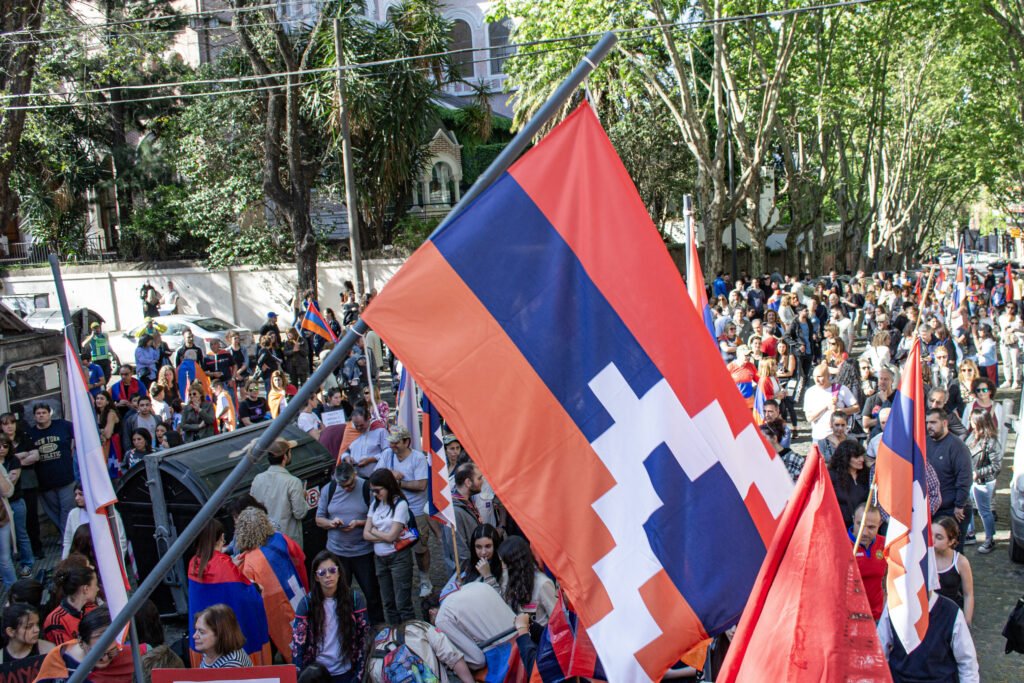 A large crowd gathered in Buenos Aires in front of the Azerbaijani Embassy.
BUENOS AIRES, Argentina—The Armenian community of Argentina marched to the Embassy of Azerbaijan on October 7 to denounce the genocide suffered by the Armenian population of the Republic of Artsakh (Nagorno-Karabakh).
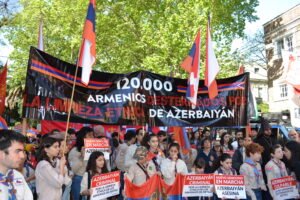 “120,000 Armenians exiled by the ethnic cleansing of Azerbaijan.”
Under the banner “120,000 Armenians exiled by the ethnic cleansing of Azerbaijan,” the crowd marched towards the diplomatic representation of the government of Azerbaijan, chanting slogans such as “new genocide underway,” “Azerbaijan murderer state,” “Azerbaijan guilty of ethnic cleansing of the Armenians of Artsakh” and “genocide denied, genocide repeated.” One of the posters summed up the collective feeling of the Armenian community after so many demonstrations against injustice: “Are you tired of hearing it? We are tired of living it.”
On September 19, Azerbaijan launched an attack against Artsakh after almost 10 months of a complete blockade of its Armenian population, a crime that was considered a genocide by the former International Criminal Court Argentine prosecutor, Luis Moreno Ocampo. After suffering widespread famine and a lack of medicines and essential products, Artsakh’s authorities were forced on September 20 to stop the defense of the population, hand over their weapons and announce the dissolution of the Republic of Artsakh. In the following days, more than 100,000 citizens and natives of Artsakh were forced into exile to Armenia, causing an unprecedented humanitarian crisis.
Alejandro Kalpakian, president of Armenian Institutions of the Republic of Argentina (IARA), read a statement on behalf of the community in which he denounced “the abuses committed by Azerbaijan against the Armenian civilian population of Artsakh” and the “policy of ethnic cleansing, taking into account that the Armenians have been expelled from their ancient Armenian territory of Artsakh.”
The representatives of all the Armenian institutions of the country work together within IARA, which was created after the Centennial of the Armenian Genocide in 2015. Most community protests and large events are coordinated by this organization.
“It is clear that Azerbaijan is not ready to respect any international law. The political prisoners have not yet been released, and Artsakh government officials have now been arrested. Do they think that Armenians will accept this? Do they think that we are going to abandon the fight that we have kept alive for decades?” Kalpakian said.
Following the large-scale attacks on September 19, Azerbaijan began arresting the authorities and military personnel of the Republic of Artsakh, including former State Minister Ruben Vardanyan, advisor to the president David Babayan, National Assembly Speaker Davit Ishkhanyan, former Presidents Arayik Harutyunyan, Bako Sahakyan and Arkadi Ghukasyan, former Artsakh Deputy Defense Minister LTG Davit Manukyan and former Artsakh Defense Minister LTG Levon Mnatsakanyan. They will all face trial in Baku for “terrorism,” “creation of armed groups” and “illegal border crossing,” among other charges. They will join the dozens of Armenian prisoners of war who have been detained since the 2020 Artsakh War and whose official number is currently unknown.
“Our presence here today, just like it’s happening around the world, is a strong example that we will continue to fight Turkey’s genocide against the Armenian people, the ongoing persecution and extermination that Azerbaijan is now committing, and the denial of these abhorrent acts and defend the right of the Armenian people to live in peace in their territory,” Kalpakian concluded.
Miguel Harutiunian, president of the Representative Association of Armenian Migrants of Argentina (ARAMA), was born in Goris in southern Armenia, which is where his family currently resides. Goris, which is located near Armenia’s border, became a transit point for displaced Armenians fleeing Artsakh. “The situation is dramatic, and the city has become a refugee camp. All the squares and the main streets have tents to meet the needs of the refugees. Many families receive them in their homes with open arms,” Harutiunian told the Weekly. Support is first provided to vulnerable cases including children, pregnant or sick women and the elderly, he added.
Hagop Tabakian, president of the Armenian National Committee of South America (ANC-SA) and member of the Armenian Revolutionary Federation (ARF), said that the Armenians of Buenos Aires support the “claim and struggle of the people of Artsakh.” “We also see the threat in the south of Armenia and follow every move made by Azerbaijan and Turkey,” Tabakian told the Weekly, expressing concern that the Armenian government is not doing enough to protect the security and interests of Armenians.
“The respect for human rights in the countries of South America has always been a priority, especially in Brazil, Argentina, Uruguay, Chile and Bolivia. We are working to get the support and visibility of this extreme situation,” he continued.
Vanesa Simsir, member of Armenian Youth Federation (AYF) of South America and teacher at Khrimian School, said that teachers prepared special classes about the conflict and the current events “so that the students can ask questions and clear up their doubts.” “It’s also important to combat the misinformation that exists on social networks,” she added. Simsir said that some of her friends from Argentina and Uruguay are volunteering in Goris, Armenia to help people displaced from Artsakh.
Analia Topakbassian, member of the Armenian Relief Society (ARS) and granddaughter of survivors of the Armenian Genocide, saw parallels between 1915 and what has happened in 2023. “They were both obviously very well planned. They took the leaders and the people who govern. The population left on foot before, and now they are leaving by car, but the caravans of people leaving their lands look the same,” Topakbassian said. While in 1915, human rights abuses by the Turks were not amplified on social media, today videos of Azerbaijanis beheading and taunting Armenians circulate online. “They don’t even have the shame or humility to hide it,” she said.
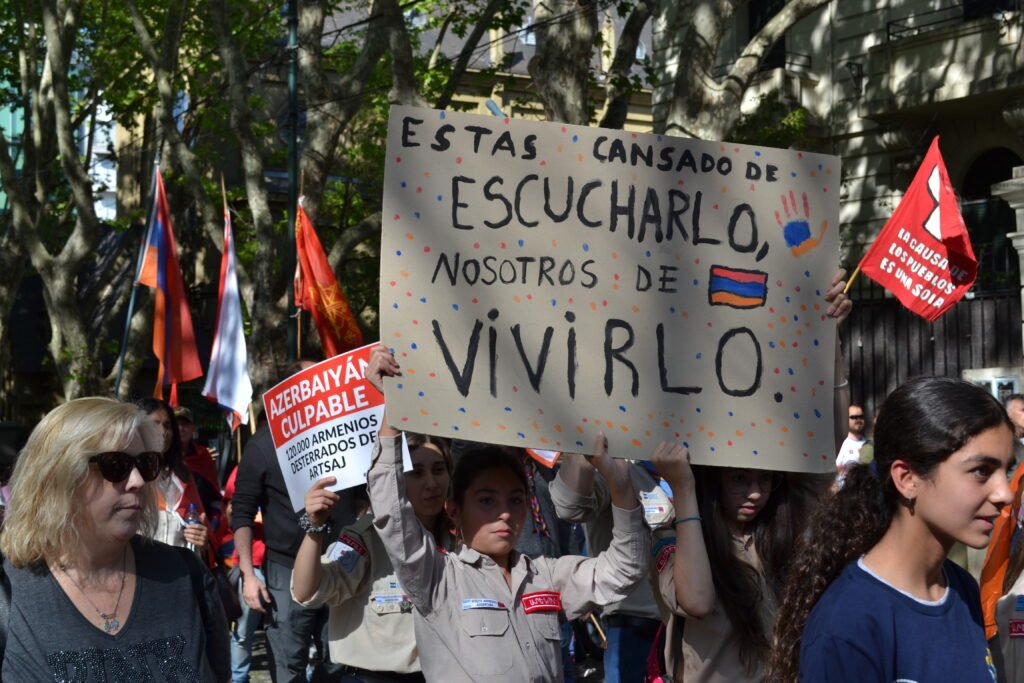 “Are you tired of hearing it? We are tired of living it.”
The Armenian community in Argentina was established mostly by survivors of the Armenian Genocide who arrived in the country at the beginning of the 20th century. According to the Armenian Diaspora Survey conducted in 2019, “The estimated size of the community is between 50,000 and 100,000, made of third, fourth and even fifth generations of Armenians.”
“Will this second genocide against the Armenian people go unpunished again? Does the international community only act if it serves economic interests? The question is rhetorical, of course,” said Professor Rosita Youssefian, former Armenian language teacher and coordinator at the Marie Manoogian Institute of the Armenian General Benevolent Union (AGBU).
Argentina’s government has expressed its solidarity with the Armenians of Artsakh and pledged to send humanitarian aid. On October 6, President of Argentina Alberto Fernandez received a delegation of Armenian community leaders at Casa Rosada. The president announced that Argentina will send a plane to Armenia on October 22 with humanitarian aid and a mission of volunteers to distribute it among the forcibly displaced population of Artsakh.
Armenian community leaders also thanked Fernandez for his statements during the G20 summit on September 9 and at the United Nations, where he denounced the blockade and the Azerbaijani attacks. The last official act of the Artsakh government before the crisis was to send a letter of gratitude to President Fernandez on September 19.
Armenians are fully established in Argentinian society and have a dynamic community life.
There are 11 churches, seven Armenian schools, three scout groups, various dance companies, sports clubs, restaurants and human rights defense organizations in Argentina. There are also branches of the ARF, Homenetmen, ARS and AGBU, two newspapers (Diario Armenia of the Dashnaktsutyun and Sardarabad of Ramgavar) and an office of the Armenian National Committee of South America.
Author information

Matías Romero Raubian
|
The post Armenians of Argentina protest genocide in Artsakh appeared first on The Armenian Weekly.
“Oh, but you don’t exactly look Armenian,” an Armenian lady (who turned out to be a fellow New Yorker), exclaimed with surprise midway into conversation with me while on a packed Paris to Yerevan flight.
I took no offense. I knew exactly what she meant. The stereotypes that continue to dominate Armenian diaspora communities can be quite powerful.
I am part of the Eastern Armenian “new” and post-early 1990s migration wave. She, on the other hand, born and raised in the U.S., comes from what we might call the Western Armenian “old” diaspora formed by migrations from the historic homeland before or immediately after the 1915 Armenian Genocide.
At that moment, perhaps, dressed in the usual New York style (you know the rule—at least one item of dark clothing at all times), busy on my laptop while the flight was still boarding, and despite what I thought was my distinctly Armenian appearance, for her I did not look or sound like a typical “new” implant to the traditional diasporic community of the West. I did not pursue an in-depth questioning on that topic. It was not the first time such an assumption was made about me.
But that interaction made me rethink, within the context of my research on economic development and diaspora, some of the key trends transpiring through the broader global Armenian communities. My reflections also connected with a recent article that appeared in the Armenian Weekly, authored by another New Yorker and a good friend, Kevork Khrimian.
In his piece, Khrimian attempts to produce an answer to what he posits as a practical question: “What can the Diaspora do to improve the economy of Armenia?” He proposes a state-run investment fund that would allow diaspora investors to directly purchase securities in Armenia-based enterprises. Khrimian’s solution is practical and relevant to Armenia’s aspiring level of economic development, although there may be some challenges in implementing it now.
Driven by similar motivations, earlier this year I completed a report for the International Organization for Migration–Armenia (IOM) entitled “Enhancing Development through Diaspora Engagement in Armenia.” My report, distributed to key stakeholders in Armenia and international development organizations active in the country, advances a range of conceptual and policy-centered recommendations as well as a group of applied solutions, focusing on agriculture, tourism, and the science and education sectors, with overall macroeconomic improvements in mind. Leveraging my research of the diaspora phenomenon and post-socialist economies development, the IOM report also benefited immensely from firsthand interviews with a diverse group of investors, entrepreneurs, educators, policymakers and other professionals in the diaspora and in Armenia engaged with the country in some way.
From Ireland to Moldova, New Zealand to Scotland, Mexico to Ghana, Philippines to Greece, India to China and more, there is an almost infinite list of successful case studies with diaspora participation contributing to the home country’s improvement. Each comes with its unique framework and modalities of engagement, many of which I reviewed in the aforementioned IOM report. Yet I also think that before we can talk about any quick policy solutions, we need to tackle the more complex problem of definitions and motivation.
That laborious New York-Yerevan flight, with a stopover somewhere in Europe or Middle East to the remodeled history of the Zvartnots Airport, that some of us take a few times a year, comes with a mind-dumbing jetlag and much sacrifice in terms of time, energy, finances and even health. Still, Armenians from across the world seem to find their way to Armenia each year. Many in the diaspora may not even speak the language or appear Armenian. An outsider might wonder if there are some millennia-old unwritten laws requiring the diaspora’s pilgrimage to the ancestral land, or they may ask if the Armenian diaspora is a monolith thinking and operating in the same breath.
What motivates the Armenian diaspora to involve itself with the modern-day Republic of Armenia and, until recently (words that cannot be uttered without tears), Artsakh? Why should we expect a diaspora-based investor, or a less entrepreneurially minded individual, to part with their hard-earned cash and invest in a development fund in a tucked away Armenia? Why is there an expectation that the Armenian diaspora should be loyal to the modern-day Republic of Armenia?
There are no simple answers to those questions for two reasons. First, each decision by a person or community in the diaspora to engage with Armenia is individual and determined by a personal set of circumstances, experiences, perceptions and existing or newly-formed connections with the country. Yet the problem is much more nuanced than this, requiring more discussion. I believe that nuance can be explained by three key factors: identity, trust and engagement infrastructure (introduced and developed in this academic chapter on the role of diasporas in economic development).
The Armenian diaspora is a far cry from being an intellectual or spiritual monolith. There are no uniform laws governing the diaspora, and there is a wide scattering of ideas in the diaspora. Even at times of crises there are plenty of dissenting voices to all extremes. In fact, in over two decades of my academic research on diaspora, I have yet to come across evidence of a single, unique and uniform determinant as an objective internal factor explaining the diaspora’s sustained connection with its ancestral home. It might be comforting to know that these observations are as true for the Armenians as they are for any other national, ethnic, religious or cultural diaspora. Indeed, a diaspora is a dispersion (as is the original Greek meaning) of people, ideas, social institutions and motivations, and that usually complicates finding a one-size-fits-all policy solution on diaspora engagement across the world.
A survey of the Armenian diaspora that I conducted some time ago (the results of which have since been published in academic publications and in more accessible language elsewhere) brought up the role of socio-economic and cultural identity in the determination of an individual’s immediate social circle within a diasporic community and engagement with Armenia. One of the classical (along with the Jewish and the Greek) diasporas, the Armenian dispersion sees the identity category in a multilayered mosaic of determinants (as explained by the founder of diaspora studies Dr. Khachig Tololyan).
The “old” (pre-1990s) diaspora communities are often built around shared geographic origins and religious, political and cultural views, with roots covering one or more generations. The post-1990s “new” diaspora, with stronger attachment to the Republic of Armenia, has reignited the established “old” communities, while at the same time created its own sub-groups, in turn shaped by the identity factors specific to them (e.g., the Russian-speaking Armenian communities).
Why does this matter? As studies of the modalities of diaspora communities suggest, common identity and shared cultural or historic commonness play a determinant role in the foundation of diaspora’s initial social networks. The initial bond serves as a necessary condition for community’s cohesion and engagement with the ancestral land for some period. However, even if united by common experiences and ideals or religious uniformity, those fragile social associations rarely survive beyond several years, unless supported by a steady guidance and communication (including migration) from the center node or by deeply embedded common ideology, as Sebouh Aslanian’s work on the New Julfa Armenian networks suggests.
The established diaspora networks, strong or weak, in turn, operate and function based on the second factor: trust. The category of trust implies some degree of reliability in any relationship. However, reliability is a product of time and experiential trials in almost any situation. If the identity category helps us discover our connection to our cultural group or ancestral homeland, it is the dialectics of trust that would bear out of this either a one-off engagement or a sustainable (while perhaps rocky) relationship.
Recent research into the mutual recognition and acceptance between the Chinese diaspora and home country nationals helps illustrate the point. Despite the common ethnic and cultural heritage of the subgroup that was the subject of this research, and despite the expatriate team members’ enthusiastic approach, the home country nationals treated their colleagues as outsiders to their social network. Part of a greater whole, internally, within the same ethno-cultural group, divisions based on one’s background and identity translated into reservations on mutual trust, hurting the morale, team coordination and productivity. This example is one of many suggesting that acceptance into a network is not guaranteed simply based on common or shared identity. Nor does earlier migration (leading to the dichotomy between the “old” and the “new”) suggest formation of a culturally involved and economically active diaspora. This contrasts with a simpler view, adopted these days, according to which a diasporan is an in-group member of the larger national network.
An Armenian reading the above, whether in the “old” diaspora, a new transplant into the community or residing in Armenia, should be able to read between the lines. Despite seemingly common heritage and aspirations, our community groups often remain divided based on either confessional or generations-old and political backgrounds, eroding the fragmentary foundations of trust. The conversation opening this essay captures the essence of the challenge.
What can help us overcome these complications within the diaspora and across a wide spectrum of diaspora-Armenia relations? First, let’s realize we are not the only ones going through this continuous cycle of self-discovery. There is a lot for us to learn from the experience of others, just as others are learning from the Armenian diaspora’s successes and failures (as was stated to me once by a policymaker in a newly-established diaspora office of one of the post-socialist economies). In preparing the IOM report, one of my aims was to gather some of the most relevant examples for both sides, the diaspora and the country, to cooperate around. In fact, if we are looking for precise step-by-step recipes to diaspora’s contribution to Armenia’s development, there is no lack of proposals and ready to implement models.
Consider, for example, the Ireland Funds network (and connected financial investment mechanisms) operating since 1976 and dedicated to bolstering Ireland’s economic, cultural, political, educational and community development through engaging the global Irish diaspora and friends of Ireland. Similarly, Ireland runs an Emigrant Support Program funding cultural projects across the diaspora and maintaining strong cultural connection with its communities. Alternatively, there is a more recent example of the Republic of Moldova with several state-led programs that help channel funds and capacity from the dispersed home-town associations abroad back to targeted assistance and development projects.
Through the 1990s, India’s ability to make a complete turnaround in its attitude towards Indians abroad (including towards individuals of Indian background living outside of the homeland for generations) and to proactively engage with the diaspora-led entrepreneurs and cultural groups has resulted in one of the most significant advancements in the country’s economic development. Founded in 1992, The IndUS Entrepreneur (TiE), partnering with the country’s government, spearheaded development of entrepreneurial potential, growing its operations and reach over the past couple of decades. Scotland attempts to connect with its diaspora by way of the uniform business networks of GlobalScot to channel investments into its economy, which is similar to Estonia’s Global Estonian platform offering access to the European Union markets. And the Philippines has one of the most sophisticated labor migration mechanisms and recent initiatives to re-engage its expatriate communities.
Recognizing a wide variety of successful diaspora arrangements across the world, we must also deduce something that is uniform across all of them, and that is what we might call an engagement infrastructure. Each of the above cases offers a clear framework for an individual or a community group to engage with the ancestral homeland and the other way around. The role of a proactive homeland state is pivotal in contributing to creation of the engagement mechanisms, their maintenance, to transparent feedback and adaptation to the diasporan needs and circumstances. As I have written previously, “Countries do not get to choose their diasporas.” Though structurally, some initiatives may first come from the diaspora groups themselves (e.g., cases of India or Mexico), the main burden of adaptability and provision of an operational environment for the diaspora is on the homeland state.
The transactional relationships within diaspora groups and those with Armenia advance periodically as large ocean waves especially in times of crisis. Yet, those waves recede just as fast as the administrative routine and adherence to groups’ boundaries on either side squash the romantic enthusiasm of any individual diasporan.
The responsibility is shared. Here, it is the adaptability of the diaspora groups and proactive participation of the recipient country’s state that determine the outcomes. A pragmatic interaction between the two may help overcome any hesitations caused by the uncertainties of the identity and trust categories. A step in this direction may be an online digital portal connecting groups and individuals between the diaspora and Armenia on topics greater than just private financial investment but also on educational, cultural and social issues, as suggested from the aforementioned survey.
Yet as any established diaspora goes, the challenge for the Armenian community, of course, is that each successive generation of diaspora leaders is either driven by the established modalities of their narrowly defined group or often lack the objective motivation (and maybe resources and time) to inform their work with lessons from the past or from elsewhere. The transactional relationships within diaspora groups and those with Armenia advance periodically as large ocean waves especially in times of crisis. Yet, those waves recede just as fast as the administrative routine and adherence to groups’ boundaries on either side squash the romantic enthusiasm of any individual diasporan.
Indeed, transactionally, there may be a great many scenarios for attracting diaspora capital to Armenia or generating ideas for joint ventures and startups. Some of that may even materialize on a short-term basis. Some, like the fund proposed by Khrimian, may do well attracting large investors seeking to diversify their portfolio and, perhaps for altruistic reasons, considering Armenia. Elsewhere, select niche-sector business-startups and venture funds co-founded with the diaspora might operate to some extent. Individual diaspora investor funded infrastructure and sector-specific may also be launched with varying extents. Examples perhaps are widely known. More speculative ideas, like the infamous diaspora bond, lack the needed robustness and carry significant risks, given the low trust environment, for the country’s ability to continue to finance out of international capital markets.
 ‘Diaspora is part of Armenia’ (Photo: Scout Tufankjian)
However, from the point of view of the diaspora’s contribution to Armenia’s economic development on a national scale, which would be inclusive enough to result in improvement in living standards, higher productivity, higher wages, with sustained and quality job growth, a more long-term sustainable solution that is not focused on narrowly defined private gains is needed. Such a solution appeals to the far wider Armenian diaspora population overcoming the obstacles of familiar community identity and trust. That solution comes as a comprehensive rethinking process of the triangular conceptual complexity of identity, trust and engagement infrastructure, as discussed above. It is only with full understanding of the differences, challenges and opportunities involved while defining a common global Armenian nation goal can any concrete measures be worked out.
In all this, the ideal outcome would be for the homeland to take the initiative to provide a meaningful engagement infrastructure fostering greater trust and transparency. At the same time, for the diasporan groups, forged in shared identity and leading their communities, the task is to overcome ambition and to rediscover their founding mission of service and the common good.
Author information
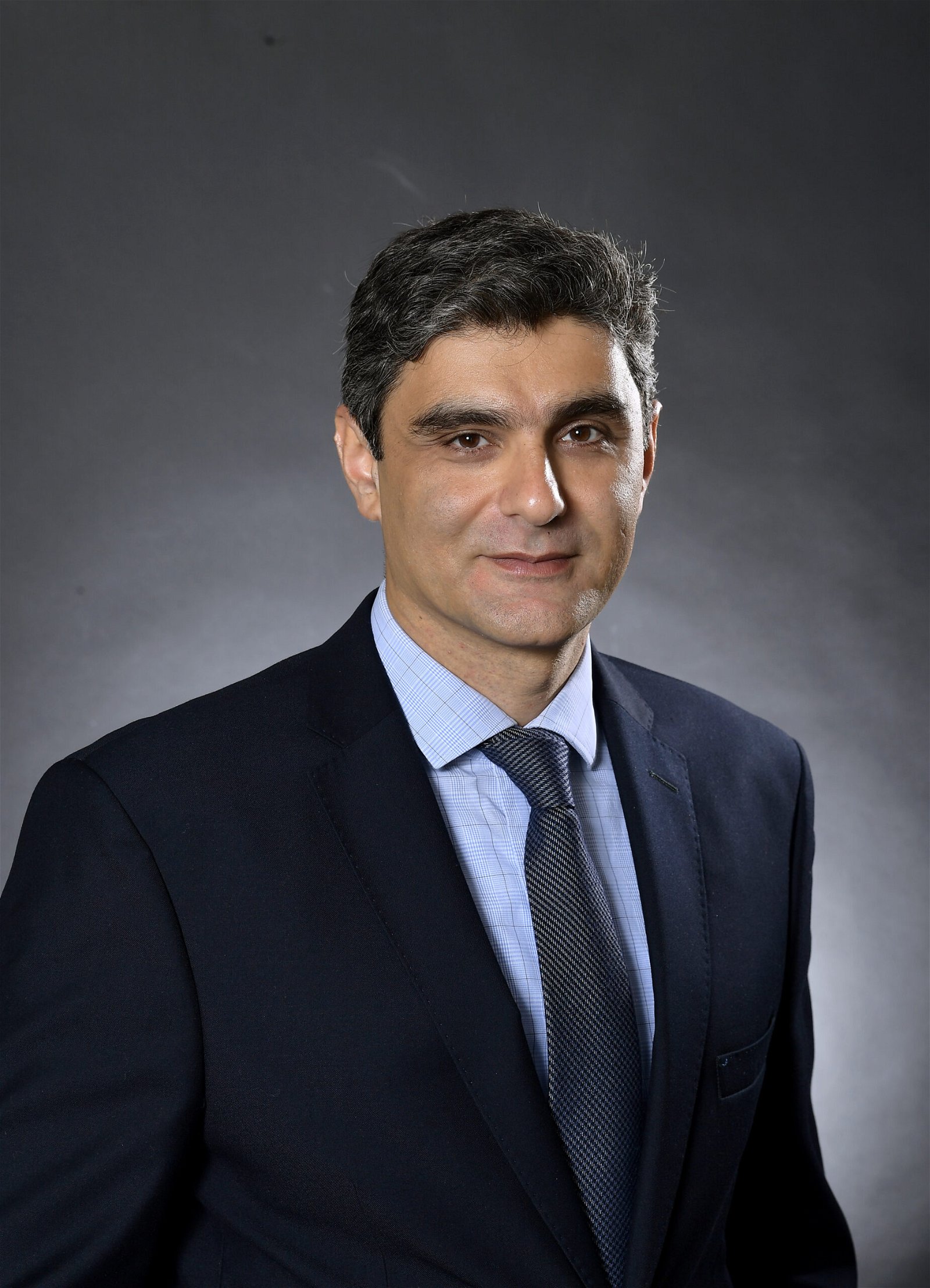
Aleksandr V. Gevorkyan, Ph.D.
Aleksandr V. Gevorkyan, Ph.D. is Henry George Chair in Economics and Associate Professor of Economics at the Department of Economics and Finance of St. John’s University’s Peter J. Tobin College of Business. Dr. Gevorkyan is the author of Transition Economies: Transformation, Development, and Society in Eastern Europe and the Former Soviet Union (Routledge, 2018).
|
The post Diaspora: identity, trust, engagement infrastructure and socio-economic development in the homeland appeared first on The Armenian Weekly.
“When the blood in your veins returns to the sea, and the earth in your bones returns to the ground, perhaps then you will remember that this land does not belong to you. It is you who belong to the land.” –Unknown
The issue of colonization has been tossed around heavily this week. I say tossed around, because sometimes it feels like people weigh in on issues, because they feel forced to and unknowingly take the side that their values do not align with—whether it be Azerbaijan’s ruthless displacement of the Armenian people from their ancestral homeland, the current Palestinian-Israeli conflict, the Russo-Ukrainian War, or the celebration of Indigenous Peoples’ Day on Monday, October 9. If you keep up with the news or have a social media account, I am almost certain that these topics, with the various opinions surrounding situations of this gravity, are all you’re consuming through your preferred media sources.
In 2021, I wrote a brief piece about my thoughts on Indigenous Peoples’ Day. Something I wrote in that piece still resonates today: “[…] As an Armenian, I can draw historical parallels. I know what it feels like to be called an ‘occupier’ by Recep Tayyip Erdoğan. I know how relentless we are in always choosing to fight assimilation. I know that Native Americans feel the same way. All natives, both Armenian and of the Americas, understand that survival lives in our bones, and our respective genocides bind us together. And nevertheless, we are here. And no matter what, we will flourish.”
I know that the lies we were fed were simply a form of propaganda on behalf of the colonizer—and I can relate. Just this month, I have felt the greatest loss in my lifetime. With Artsakh under total control of the enemy, of the colonizer, I feel that my heart has shattered a thousand times over.
As an Armenian-American, I grew up with the falsified narratives of Native Americans in my history and social studies courses—that Native Americans wanted to give up the lands they had spiritual ties to and happily accepted the colonization that unfolded with little to no resistance. When I started attending college, these false perspectives came to light. The Native peoples of America were not happy to leave their homes. They were not happy to be forced to follow a religion they don’t believe in and to adopt a lifestyle they are not accustomed to.
Now, with social media and other sources we can cite for the hockey-stick level of growth when it comes to the amplification of peoples’ voices, I know that the lies we were fed were simply a form of propaganda on behalf of the colonizer—and I can relate. Just this month, I have felt the greatest loss in my lifetime. With Artsakh under total control of the enemy, of the colonizer, I feel that my heart has shattered a thousand times over.
The European nations’ colonization of the Americas heralded the genesis of a devastating era in history. Indigenous communities, who possess an extensive mosaic of cultures and histories dating back thousands of years, experienced the brunt of this turbulent era. Their territories were taken, mainly by brute force, and treaties, in rare instances when they existed, were seldom respected. Displacement of indigenous populations from their ancestral lands was an abominable injustice that still resonates today.
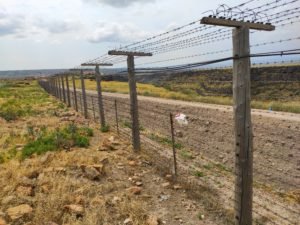 Armenia-Turkey border (Wikimedia Commons)
When it comes to Armenia, a more recent history unfolds under the banner of the late Ottoman Empire and modern-day Turkey. The 1915 Armenian Genocide was a catastrophic event in the annals of human history. It resulted in the systematic extermination of nearly 1.5 million Armenians by means of a ruthless, premeditated campaign of brutality that the international community now universally regards as genocide.
It especially hurts when I think about the Armenian people and Native Americans, because it’s not necessarily about territorial gain or control. We possess a spiritual tie to the land, viewing the natural world as sacred and as a source of guidance and interconnectedness with the rest of the universe. There was a special feeling I felt when I first stepped on Armenian soil. It felt like home, like I was suddenly part of something greater than myself.
Indigenous peoples of the Americas and Armenians have both shown extraordinary cultural resilience. Their fortitude in the face of calamitous losses exemplifies their communities’ immense strength and determination, showcasing an unshakeable dedication to preserving their languages, traditions and identities. Both share a common thread in their disputes over land and territory. Indigenous peoples in the Americas fervently advocate for land restitution and the acknowledgment of their sovereignty, while Armenians have wrestled with conflicts driven by a pan-Turkic goal at the hands of Turkey and Azerbaijan.
Despite the loss of a significant portion of the Armenian population in the 1915 Genocide, I am always left in a state of awe at how the Armenian people have tenaciously held onto their language, traditions and identity. In an uncontrollable situation, we survived. The survival and worldwide revival of the Armenian language and culture is a triumph. I’m not naive. I know we have a lot to cry about. But isn’t it fair, for just a moment, to recognize that we have so much to celebrate as well?
The international recognition of these historical injustices remains a global concern. Calls for reparations are still reverberating on both the indigenous rights platform and within Armenian advocacy, highlighting the persistent wounds of colonization and the need for rectifying historical injustices. While the colonization of Indigenous peoples in the Americas and Turkey’s colonization, followed by genocide, of the Armenian people differ in many ways, they have common themes of relocation, cultural losses and territorial struggles. This Indigenous Peoples’ Day, these histories emphasize the urgency of being cognizant of historical injustices, as well as the critical importance of safeguarding indigenous and historically marginalized communities’ rights and cultures.
Author information
Melody Seraydarian
Melody Seraydarian is a journalist and undergraduate student at the University of California, Berkeley, pursuing a degree in Media Studies with a concentration in media, law and policy. Her column, “Hye Key,” covers politics, culture and everything in between from a Gen-Z perspective. She is from Los Angeles, California and is an active member of her local Armenian community.
|
The post Colonization: The Greatest Evil appeared first on The Armenian Weekly.
Categories