Categories
South Caucasus News

Biden Bans Travel To Energy Conferences: It Didn’t Work In California – OpEd


Biden Bans Travel To Energy Conferences: It Didn’t Work In California – OpEd

The Biden White House is banning senior administration officials from traveling to international energy conferences promoting fuels such as oil, natural gas, and coal. Senior officials must also obtain permission from the White House National Security Council before attending any global energy event.

The ban implies that, on energy or anything else, the federal government always knows best. For all but the willfully blind, it doesn’t. The travel ban effectively proclaims the administration’s views on energy as beyond criticism. They aren’t.

There is a wide body of work on energy, global warming, and such. Science is never “settled,” and the debate is ongoing. If they are to serve the best interests of the people, senior officials need to be familiar with all views on the topic. Travel bans won’t get that done, and they’ve been tried before.

California’s Failed Travel Ban

California’s Assembly Bill 1887 prohibited state-funded travel to any state that has “enacted a law that discriminates on the basis of sexual orientation, gender identify, or gender expression” and so forth. This “discrimination” could be something as simple as restricting biological males from using women’s bathrooms.

AB-1887 banned travel to Alabama, Arizona, Arkansas, Florida, Georgia, Idaho, Indiana, Iowa, Kansas, Kentucky, Louisiana, Mississippi, Montana, North Carolina, North Dakota, Ohio, Oklahoma, South Carolina, South Dakota, Tennessee, Texas, Utah, West Virginia, Wyoming. That comes to 23 states, nearly half the country.

That creates a problem if the state-funded University of California football team should play Ohio State, but there’s more to it. As with climate and energy, LGBTQ issues are a matter of debate.

“Homosexuality and transgenderism are two utterly different phenomena,” explains Bruce Bawer, author of A Place at the Table: The Gay Individual in American Society. According to Bawer, “Gay rights was reformist,” but the transgender movement is “a revolution against reality itself.”

LGBTQ is essentially a construct that ramps up conflict between people based on their perception of reality. AB 1887 upheld and enforced the construct, but Gov. Newsom had a change of heart. In September, the governor signed Senate Bill 447, which effectively repeals AB-1887.

“In the face of a rising tide of anti-LGBTQ+ hate,” Gov. Newsom said, “this measure helps California’s message of acceptance, equality, and hope reach the places where it is most needed.” The reversal could also have something to do with Gov. Newsom’s presidential aspirations. Whatever the case, travel bans are impractical, counterproductive, and contrary to America’s basic freedoms.

Many Californians, weary of high taxes, rising crime, and homeless squalor, are using their freedom to move to other states. As the California Globe reports, between 2020 and 2023, the Golden State lost nearly 700,000 residents. The top inbound states, in order of preference, are Arizona, South Carolina, Tennessee, North Carolina, and Texas, all states previously on California’s travel ban.

Bay Area Assemblyman Rob Bonta, now Gov. Newsom’s attorney general, wanted to punish those who leave the state. In 2019, Bonta authored AB-2088, which aimed to tax former Californians 90 percent of their in-state levy in the first year after they left the state and 80 percent in the second year, phasing out over a decade.

Bonta, a Yale law alum, believed this money grab was legal. His “wealth tax” bill failed to advance, but Californians still have reason to leave California, a high-tax state with a highly volatile tax system.

The Biden White House now implements California-style travel restrictions, even after the Golden State has abandoned them. Maybe the Delaware Democrat will follow Gov. Newsom’s lead and change his mind as November 2024 approaches.

This article was also published in The American Spectator 

Categories
South Caucasus News

Why IMF Lending Continues To Adapt – Analysis


Why IMF Lending Continues To Adapt – Analysis

currency currencies money bills banknotes dollar yuan euro

The world confronts the weakest medium-term growth outlook in three decades amid high debt levels, fragmented trade, and the prospect of higher-for-longer interest rates. In this environment, the IMF is redoubling its efforts to promote stability and growth.

All countries grapple with uncertainty from shocks related to the pandemic, war in Ukraine, and transformational challenges such as climate change and digitalization. Several emerging market and developing countries have shown remarkable resilience. But many—especially low-income countries—are increasingly vulnerable amid tighter financial conditions, limited policy room for maneuver, and dwindling buffers.

These countries also face a funding squeeze, heightened food insecurity, and a slower convergence toward higher living standards. High debt burdens and a sharp increase in debt servicing costs—exceeding 40 percent of revenues in several highly indebted countries—leave little space for social spending and growth-enhancing investment. This adversely impacts debt sustainability and social stability.

The IMF is responding to calls to play an even greater role to support our member countries during these very challenging times, importantly through the provision of balance of payments financing and policy advice.

Crises and channeling

To be sure, the Fund acted to help members address balance-of-payments needs from recent shocks. This includes providing emergency financing and temporarily increasing access limits for Fund arrangements. We approved precautionary financing arrangements and established a Short-term Liquidity Line that serves as a backstop for members with very strong fundamentals. We responded to the global food crisis stemming from Russia’s war in Ukraine by introducing a Food Shock Window in September 2022 to help countries facing urgent balance of payments needs related to food insecurity.

Since the pandemic, we have deployed $1 trillion in global liquidity and reserves through our lending and the 2021 allocation of $650 billion in special drawing rights, or SDRs. We have provided around $320 billion in financing to 96 countries. We have increased five-fold our interest-free financing to 56 low-income countries through our Poverty Reduction and Growth Trust. And we have worked with economically stronger members to channel a significant share of their SDRs to more vulnerable countries, generating around $100 billion in new financing through IMF trusts such as the PRGT and theResilience and Sustainability Trust introduced last year.

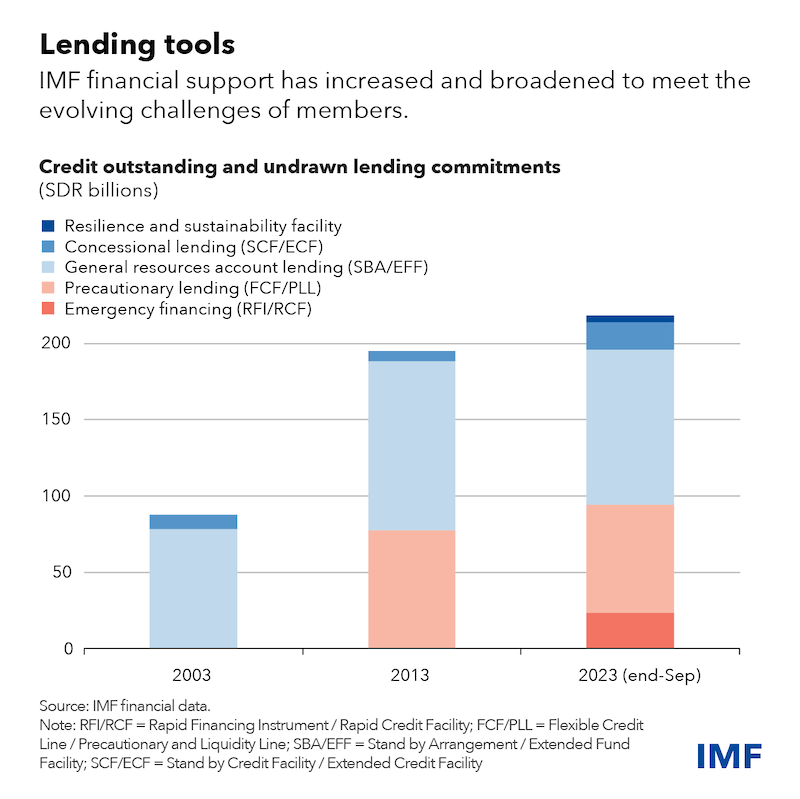
As a result, the IMF has committed unprecedented financial resources to members. As of September, the IMF has lending commitments with 94 countries for about $287 billion, or SDR 218 billion. This includes:

We continuously assess and improve our lending toolkit to ensure that can address today’s and tomorrow’s challenges:

  • Since preventing crises is far less costly than resolving them, we recently reviewed our precautionary instruments—the Flexible Credit Line, the Short-Term Liquidity Line and the Precautionary and Liquidity Line. Reforms seek to improve their agility and capacity and ensure their strong signaling power. Access limits increased for some instruments. Concurrent use will allow users to address different balance-of-payments needs. For the first time, users will not need to articulate a strategy for exit from relatively lower levels of access of the Flexible Credit Line.
  • We also reformed the non-financial Policy Coordination Instrument. This instrument enables countries to signal the quality of their policies, which helps catalyze external financial support from official and private sources. Reforms improve the flexibility and signaling power of the instrument.
  • Work on helping countries in or near debt distress continues, and additional debt policy reforms are under consideration. This includes creditor cooperation and financing assurances, supporting better engagement with the member and creditors, and supporting members undergoing debt restructurings when they face extraordinary circumstances. The IMF also co-chairs the Global Sovereign Debt Roundtable to bring borrowing countries together with both official and non-official creditors.
  • Our forthcoming reviews of our conditionality and recommendations of ourIndependent Evaluation Office on exceptional access will help us strengthen our support to members. They will also ensure that Fund financing continues to help unlock other funding sources elsewhere.

Looking ahead

The IMF is committed to continue supporting member countries through policy advice, capacity development, and lending. The challenge is to support vulnerable countries that have limited fiscal space to implement politically costly reforms. Yet when financing is front-loaded but adjustment and reforms are backloaded, credibility is harder to establish. Securing additional external financing becomes difficult. All this puts at risk the completion of program reviews and the achievement of macroeconomic stabilization.

To help countries undertake and sustain adjustment, reforms and financing are needed that pay off sooner in terms of growth. Where debt concerns are acute, debt restructuring, and more grant financing may also be needed. The Fund is deepening collaboration with the World Bank and other multilateral institutions with expertise in structural reform areas, to suitably calibrate and sequence reforms under their core areas of work.

We need to ensure that the IMF has the resources to effectively exercise its lending function. The successful completion of the ongoing 16th General Review of Quotas will be essential to secure the Fund’s general resources, together with closing remaining fundraising gaps for the PRGT and RST. These will ensure that lending to vulnerable countries can continue in adequate volume and on favorable terms.


Categories
South Caucasus News

Government Is The Hidden Hand Directing The Culture Wars – OpEd


Government Is The Hidden Hand Directing The Culture Wars – OpEd

politics puppet deep state

By J.W. Rich

Recent data from the Pew Research Center shows that from 1994 to 2022, Americans’ views of opposing political parties became increasingly negative. In 1994, only 21 percent of Republicans and 17 percent of Democrats held “very unfavorable” views of the other party. In 2022, that category rose to 62 percent for Republicans and 54 percent for Democrats. If we include those who hold “unfavorable” views, then over 80 percent of both Republicans and Democrats have negative views of the other party.

One of the many undesirable effects of this polarization is an environment in which anything can become a political lightning rod. Whether it involves Dr. Seuss booksMr. Potato Head, or the Barbie movie, controversy seems to lurk around every societal corner. Nothing is safe, nothing is sacred, and anything can be weaponized by one political factor against another. The term often used to describe this perpetual conflict is “culture war”—a depressingly apt term. But through all the angry tweets, op-eds, and “cancel” campaigns, few ask about where these culture wars come from and whether we can end them.

While a complex social event is never the product of just one factor, culture wars generally emerge from one group of people using some form of power to pressure another group into changing its beliefs or behavior. The pressured group may fight back and cause the pressuring group to redouble its efforts. This cycle, if it continues, can broaden into a full-blown culture war.

What does this dynamic look like in practice? Imagine a country where a group of ice cream fanatics decide to make every citizen eat more ice cream. They might try to pass legislation that favors eating ice cream, attack and shame ice cream skeptics, and encourage eating ice cream as a social norm. They would probably win converts, but they would also make enemies (especially the lactose intolerant!). Those who do not wish to eat ice cream would react negatively and maybe try to push an anti–ice cream agenda. Soon, an ice cream culture war could break out, each side pressuring the other to conform to its beliefs.

The catalyst of a culture war is the pressure exerted by one group on another to adopt its ways of thinking and acting. But why do groups elect to use force on others to spread their viewpoints? Prima facie, there is no strong incentive to resort to aggressive evangelism. Societies are built through cooperation, even between those who disagree. The baker sells his bread to members of his political party as well as the opposing party. If he sold bread only to customers who adopted his political beliefs, the market would turn on him. The same incentive to cooperate exists for groups motivated by ideology. While it is certainly in their interest to add to their ranks, doing so in an aggressive and forceful manner is likely to work against them.

The state does not obey the same social norms as its citizens; its injunctions are not optional but coercive in nature. More importantly, such coercion (e.g., taxation, legislation, and law enforcement) does not exist in a vacuum but aims to achieve various ends. Interest groups looking to spread their beliefs can redirect state power to their own purposes. This may involve anything from getting a subsidy for an ideologically friendly company to using state-enforced censorship against ideological enemies.

As the power and reach of a state grows, so too do the opportunities to direct that power. In terms of total spending, the federal government of the United States is the largest in history. It is no coincidence that now, when the power of the state is greater than ever, culture wars are raging all around us. These conflicts are occurring not because people are deciding to fight with one another but because they are compelled to. If there were only free and voluntary associations, then alternative beliefs could coexist. There would be no need to promote, for example, one lifestyle over another, because everyone could live how they see fit.

But state power removes all choice and variety. As the state increases its control over domains like public school curricula and corporate subsidies, fewer ideas and directions are given a chance to succeed. Culture wars fester within such narrowing policy confines because values and beliefs are either represented or excluded.

Conflicts instigated through state power always spill into other areas of society. When the political representation or exclusion of one’s beliefs is at stake, a culture war can become an environment in which any means of defense seems fair game. Social institutions, corporations, and popular media can all be weaponized and wielded against one’s enemies. The result is as familiar as it is exhausting: unending conflict and controversy, with every institution, organization, and event in society politicized and nowhere to hide from the unceasing cross fire.

Culture wars are not created solely by the state, but a state with too much power makes them inevitable. High-minded sentiments about “having conversations” and “understanding the beliefs of others” might sound like appealing options for cooling the tensions of a culture war, but they gravely underestimate the scope of the problem. No amount of civil discussion will remove the divisions created by state power. Until that power is destroyed—or, at the very least, greatly diminished—the culture wars will continue.

About the author: J.W. Rich is an economics student and writer in Charlotte, North Carolina. You can find his other writings on his blog at thejwrich.medium.com.

Source: This article was published by the Mises Institute


Categories
South Caucasus News

Karabakh refugees transform Armenian mountain resort – Yahoo Singapore News


Karabakh refugees transform Armenian mountain resort  Yahoo Singapore News

Categories
South Caucasus News

UN to send mission to Nagorno-Karabakh as exodus nears 100,000 – Egypt Independent


UN to send mission to Nagorno-Karabakh as exodus nears 100,000  Egypt Independent

Categories
South Caucasus News

There are no Azerbaijani citizens among dead and wounded in Israel – AzerNews.Az


There are no Azerbaijani citizens among dead and wounded in Israel  AzerNews.Az

Categories
South Caucasus News

A Progressive Perspective: Senator Menendez – A product of a laissez-fair attitude towards unethical behavior – The Trentonian


A Progressive Perspective: Senator Menendez – A product of a laissez-fair attitude towards unethical behavior  The Trentonian

Categories
South Caucasus News

Biz bits: Wellroot collects over 20000 diapers; Emory University … – Decaturish.com


Biz bits: Wellroot collects over 20000 diapers; Emory University …  Decaturish.com

Categories
South Caucasus News

Loganville church groups, Georgia state senator among those in Israel during brutal attack – FOX 5 Atlanta


Loganville church groups, Georgia state senator among those in Israel during brutal attack  FOX 5 Atlanta

Categories
South Caucasus News

National Voter Registration Day: Here’s how to get signed up in … – Atlanta News First


National Voter Registration Day: Here’s how to get signed up in …  Atlanta News First