Categories
South Caucasus News

Aliyev emphasizes the importance of peace in the South Caucasus during the press conference with Garibashvili … Hamas attack has abruptly altered the picture for Middle East diplomacy … Iran’s Raisi backs Palestinian self-defense, warns Israel … Iran had a hand in Hamas attacks, says the Israeli envoy


Hamas attack has abruptly altered the picture for Middle East diplomacy
posted at 16:22:25 UTC via theguardian.com

6720.jpg?width=1200&height=630&quality=8

As the death toll rises, and the security consequences multiply, Israel is pointing its finger of accusation at Tehran for orchestrating the attacks by Hamas. The attacks may have been born of anger, specifically at the months-long behaviour of the Netanyahu coalition, including the provocations at al-Aqsa mosque, but Iran and the forces it supports have a longer-term strategic goal: to thwart the US-led effort to achieve a normalisation of relations between Saudi Arabia and Israel, a move that would entrench the US in the Middle East – and in Iran’s eyes deprive the Palestinians of their last influential sponsor.

Iran’s goal is to denormalise the region, and make it near-impossible for Saudi Arabia to strike a deal. Israel, by contrast, wants to shrink the Palestinian conflict diplomatically so it gradually becomes an irrelevance, a historical curio such as the Yom Kippur war. The aid it drip-feeds to Gaza via Qatar is one leg of this strategy.

In a speech earlier this week, Iran’s supreme leader, Ayatollah Ali Khamenei, sent a thinly coded warning to Riyadh that any Gulf state that backed the US was backing the wrong horse. “The definitive stance of the Islamic Republic is that the governments which prioritise the gamble of normalisation with the Zionist regime will incur losses,” he said in remarks carried by Iran’s state-run and semi-official media. “As the Europeans say, they are betting on a losing horse. Today, the situation of the Zionist regime is not one that should motivate closeness to it; they shouldn’t make this mistake.”

He was joined on Friday by the head of Islamic Jihad, Ziad al-Nakhala, who said: “Those who rush towards normalisation with the Zionist project must know, and they do know, that this is their acknowledgment that Palestine is not ours, and that Jerusalem with its mosque is not ours.”

timeline

Saudi Arabia, its economy expected to shrink this year according to the World Bank due to oil production cutbacks, has been desperate for foreign investment and craves Israel’s technological dynamism. The United Arab Emirates’ trade with Israel doubled to $2.56bn in 2022 after striking a free trade deal with the country. But Riyadh, now a member of the growing transactional diplomatic tendency, also wants new US defence guarantees, similar if not better to those given to Bahrain in September, and access to civilian nuclear power. It also needs something tangible about the restart of Israeli-Palestinians talks. Antony Blinken, the US secretary of state, was due to discuss all this with Crown Prince Mohammed bin Salman in a regional tour next week.

Now with the start of what could become a regional war, the risk calculations have changed. Hamas has shown its firepower and extended its base beyond Gaza. Far from the conflict shrinking it has been broadened. Riyadh’s initial response to the Hamas assault, a group with which it has few contacts, was the first critical clue of how Riyadh viewed the diplomatic consequences. It was not encouraging for Israel, and nor, given the inflamed passions, could it afford to be.

The Saudi Arabian ministry of foreign affairs noted the unprecedented situation between certain Palestinian factions and the occupation forces and called for restraint on all sides. But it then recalled “its repeated warnings of the dangers of the explosion of the situation as a result of the continued occupation, the deprivation of the Palestinian people of their legitimate rights and the repetition of the systematic provocations against its sanctities [holy sites]”. It urged the international community to restart a credible peace process based on a two-state solution.

Qatar was even less equivocal, saying Israel was “solely responsible for the ongoing escalation due to its continuous violations of the rights of the Palestinian people, including the recent repeated incursions into the al-Aqsa Mosque under the protection of the Israeli police”.

Since then, the Saudi foreign minister has been speaking with Blinken, the EU high representative, Josep Borrell, and every counterpart in the Gulf. The fruits of those talks will be reflected when the UN security council meets in emergency session and hears repeated calls for restraint. But many diplomats privately acknowledge they are paying a price for allowing the Middle East crisis slip to the back of their agenda.

The real diplomatic work will be done in private. In the short term, Turkey and Egypt will act as the mediators. Egypt, itself facing elections in two months, cannot afford mayhem in Gaza. The initial Hamas aim will be to make Israel think twice about the scale of its retribution. The Hamas al-Qassam brigades spokesperson Abu Ubaida said: “The number of [Israeli] prisoners is many times greater than what Benjamin Netanyahu announced, and they are present in all axes in the Gaza Strip, and what happens to the people of the Gaza Strip will happen to them, and beware of miscalculation.”

Hezbollah has also sent a message via Egypt to Israel about the potential consequences of a full-blown assault on Gaza. The US for its part is urging Israel to de-escalate, hold off on a ground assault and rely on measures such as cutting the supply of Gaza’s electricity to force Hamas to negotiate. Inside Israel there are also voices calling for calm, saying that after such a security lapse a unity government is required that will allow Netanyahu to end his disastrous reliance on extremists to stay in power. With the lives of so many hostages at stake, retribution will have to be carefully calibrated.

Netanyahu’s political survival skills are well-known, but it will be hard to avoid blame for such a self-evident intelligence fiasco. Golda Meir was gone as prime minister within six months of the Yom Kippur war, giving way to Menachem Begin and eventually the Camp David agreement with Egypt’s Anwar Sadat in 1978. Right now, it is hard to envisage a repeat of such an optimistic chain of events.

Tehran (AFP) – President Ebrahim Raisi said on Sunday that Iran supports the Palestinians’ right to self-defence and warned Israel must be held accountable for endangering the region, a day after Hamas attacked Israel.

Issued on: 08/10/2023 – 16:28Modified: 08/10/2023 – 16:31

2 min

President Ebrahim Raisi says Iran supports the Palestinian right to self-defence a day after Hamas militants launched a deadly assault on Israel President Ebrahim Raisi says Iran supports the Palestinian right to self-defence a day after Hamas militants launched a deadly assault on Israel © Ed JONES / AFP/File

Palestinian militants from the Iran-backed Islamist group Hamas, which controls the Gaza strip, penetrated Israel at dawn on Saturday under the cover of a massive rocket barrage.

Almost 1,000 people have been killed in the conflict so far, with Israel reporting more than 600 lives lost and Gaza’s health ministry putting its toll at 370 dead.

“Iran supports the legitimate defence of the Palestinian nation,” Raisi said, quoted by state television.

“The Zionist regime (Israel) and its supporters are responsible for endangering the security of nations in the region, and they must be held accountable in this matter.”

He urged Muslim governments to “support the Palestinian nation” while praising “resistance” efforts by Hamas and Islamic Jihad as well as in countries including Syria, Lebanon, and Iraq.

Raisi had spoken earlier with leaders of Hamas and Islamic Jihad, official media said.

State news agency IRNA said he had “discussed the developments in Palestine” in separate phone calls with Islamic Jihad secretary general Ziyad al-Nakhalah and Hamas chief Ismail Haniyeh.

Pro-Palestinian gatherings

The Islamic republic hosted talks with leaders of Hamas and Islamic Jihad in June.

At the time, Raisi said Israel was seeking to normalise ties with more Arab and Muslim countries “to discourage young Palestinians from (seeking to) liberate the occupied territories”, according to the presidency.

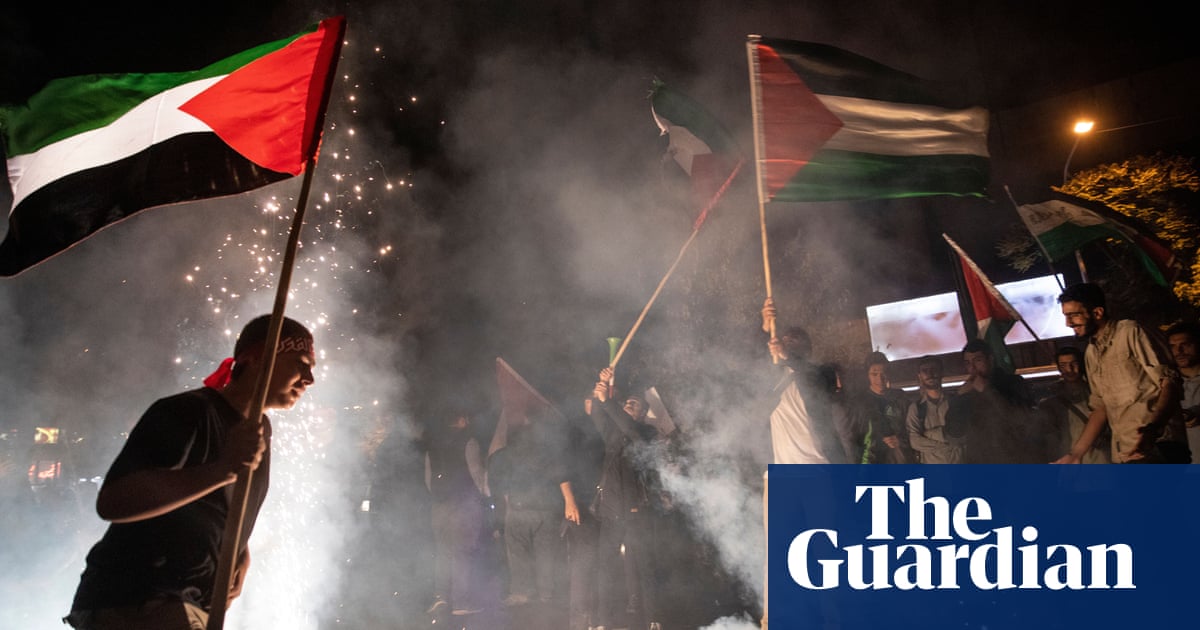
On Saturday, hundreds of people gathered in major cities of Iran, including in Tehran’s Palestine Square, carrying the Palestinian flag.

Billboards celebrating the offensive Hamas has dubbed "Al-Aqsa Flood" have gone up in the Iranian capital Billboards celebrating the offensive Hamas has dubbed “Al-Aqsa Flood” have gone up in the Iranian capital © – / AFP

They also held pictures of Iranian general Qasem Soleimani, who was assassinated in a US drone attack in Baghdad in 2020 after overseeing the Revolutionary Guards’ foreign operations for more than a decade.

Billboards celebrating the offensive Hamas has dubbed “Al-Aqsa Flood” were installed in the capital, including one declaring: “The great liberation operation has begun”.

Crowds in some cities set off fireworks and torched Israeli flags.

Others marched in Palestinian colours while motorists honked their horns in jubilation, as seen in video footage from IRNA.

Iran does not recognise Israel and has made support for the Palestinian cause a centrepiece of its foreign policy since the 1979 Islamic Revolution.

The bitter rivals have engaged in a shadow war for years, with Iran accusing Israel of a series of sabotage attacks and assassinations targeting its nuclear programme.

The United States and Israel have previously accused Iran of using drones and missiles to attack US forces and Israel-linked ships in the Gulf.

© 2023 AFP

Israeli ambassador Naor Gilon on Sunday accused Iran of having a hand in organising the deadly terror attacks that have killed hundreds of people and said the support of countries such as India is needed for Israel’s actions to prevent further atrocities.

Israel Ambassador to India Naor Gilon addresses a press conference in New Delhi on Sunday. (ANI) Israel Ambassador to India Naor Gilon addresses a press conference in New Delhi on Sunday. (ANI)

The surprise attacks by Hamas militants from Gaza on Saturday, including rocket barrages and assaults on towns, killed around 600 Israelis and injured 2,000 more. More than 250 Palestinians were killed as Israeli defence forces targeted Hamas targets in Gaza.

We’re now on WhatsApp. Click to join.

“It’s clear to us that Iran is involved with it. We know for sure about the supplying of weapons, training, and I will not exclude even organising or helping organise this specific attack,” Gilon told a media briefing in Delhi. “Our evidence is very clear…we know of many attempts of Iran to supply weapons to Hamas.”

In an apparent reference to Israel’s efforts to normalise ties with Arab countries through the Abraham Accords, Gilon said the “huge and significant change” being made to West Asia by Israel could be one of the reasons why “countries like Iran and other extremists are trying to derail” this process.

Noting that Israel’s neighbours too perceive Hamas as a “terror organisation”, he said there is convergence of interests and all countries should continue working together against extremism.

Gilon emphasised the importance of support for Israel’s actions from countries such as India but made it clear his country hasn’t sought any specific assistance from the Indian side.

Israel, he said, will need the “very strong support of our Indian friends and India as a very influential country in the world, as a country that knows terrorism and understands the crisis”. He added: “It will be very important for us, to give us the ability to do what we need to do in order to make sure that Hamas will not be able to continue doing atrocities.”

Prime Minister Narendra Modi denounced the terror attacks on Saturday and said India stands in solidarity with Israel. “Deeply shocked by the news of terrorist attacks in Israel…We stand in solidarity with Israel at this difficult hour,” Modi posted on X.

The Israeli envoy ruled out the possibility of mediation at the current juncture, saying it was “time to take action against terror”. He added, “Mediation maybe will come, maybe will not come in future…now it’s time for action.”

Asked about countries such as China that have not specifically condemned the violence and instead highlighted the need for talks leading to the two-state solution, Gilon said Israel expects all countries to speak out against the attacks.

“We expect all countries in the world to, first and foremost, condemn the unprovoked murder and kidnapping of hundreds of Israeli civilians, women, men, elderly, children. This is unacceptable…Terror is terror is terror, anything else but condemnation is justifying the terrorism,” he said.

Gilon acknowledged that the situation has been complicated because the attackers have taken Israeli hostages. “The ability of Israel to inflict pain on an organisation like Hamas is endless. The only thing that is stopping us is not Hamas, it’s the human population that we try, in any way, not to hit,” he said.

Israeli authorities are compiling lists of foreigners and Israelis in areas that were attacked, and have also been contacted by different embassies about missing people, Gilon said. While the attackers had entered some 20 communities on Saturday, they are now present in only a few pockets, where they have been surrounded by Israeli troops.

Meanwhile, India’s representative office in Palestine has issued a public notice in view of the security situation and asked Indian nationals in the region to directly contact the office to address any emergency or assistance. It provided numbers for two 24-hour emergency helplines: Jawwal 0592-916418 and WhatsApp +970-59291641.

The Indian embassy in Israel had issued an advisory on Saturday, urging Indians to exercise caution and avoid movement. There were no immediate reports of any Indian casualties in the fighting. There are some 18,000 Indian citizens in Israel, including 900 students.

A group of 27 Indians from Meghalaya, caught in the conflict zone while on a pilgrimage, safely crossed the border into Egypt through the efforts of the external affairs ministry and the Indian mebassy, Meghalaya chief minister Conrad Sangma posted on X.

Air India suspended all flights between New Delhi and Tel Aviv till October 14 to ensure the safety of passengers and crew, an airline spokesperson said.

SHARE THIS ARTICLE ON

  • ABOUT THE AUTHOR

default.jpg

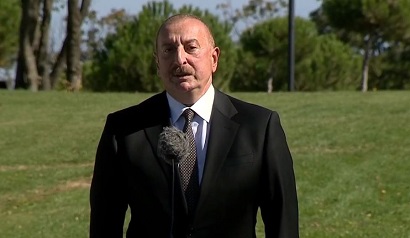
We have done and are doing everything to strengthen our friendship, our partnership between nations, these meetings serve to bring our countries closer and strengthen friendship, Azerbaijani President Ilham Aliyev said at a joint briefing with Georgian Prime Minister Irakli Garibashvili in Tbilisi, Georgian Channel One reports.

During their discussion, Aliyev and Garibashvili also emphasized the significance of peace in the South Caucasus.

“Challenges persist, and issues remain unresolved, peace has not yet been fully established in the South Caucasus, and today we discussed this matter during our conversation with Mr. Prime minister. The South Caucasus is in need of peace, and the time is now. As the Prime Minister has already stated, we consistently support Georgia’s territorial integrity and sovereignty, just as Georgia supports the sovereignty and territorial integrity of Azerbaijan. We consistently stand by each other in international organizations and on all other issues that serve the interests of our countries, our nations, and support each other. This is a fundamental principle of international law, violations of international law and infringements on territorial integrity are absolutely unacceptable, and we are in full agreement on this,” Aliyev stated.

It is worth reminding that during a recent telephone conversation with the head of the European Council, Aliyev discussed the need to “liberate eight Azerbaijani villages occupied by Armenia.”

!

This text available in   Հայերեն and Русский

Print

NT-News-and-Times.png
Selected Articles – The News And Times

As the death toll rises, and the security consequences multiply, Israel is pointing its finger of accusation at Tehran for orchestrating the attacks by Hamas. The attacks may have been born of anger, specifically at the months-long behavior of the Netanyahu coalition, including the provocations at al-Aqsa mosque, but Iran and the forces it supports…
posted 20m ago via theguardian.com
 

Tehran (AFP) – President Ebrahim Raisi said on Sunday that Iran supports the Palestinians’ right to self-defense and warned Israel must be held accountable for endangering the region, a day after Hamas attacked Israel. Issued on: 08/10/2023 – 16:28 Modified: 08/10/2023 – 16:31 2 min President Ebrahim Raisi says Iran supports the Palestinian…
posted 1h ago via rfi.fr
 

Israeli ambassador Naor Gilon on Sunday accused Iran of having a hand in organizing the deadly terror attacks that have killed hundreds of people and said the support of countries such as India is needed for Israel’s actions to prevent further atrocities. Israel Ambassador to India Naor Gilon addresses a press conference in New Delhi on Sunday….
posted 1h ago via hindustantimes.com
 

We have done and are doing everything to strengthen our friendship, our partnership between nations, these meetings serve to bring our countries closer and strengthen friendship, Azerbaijani President Ilham Aliyev said at a joint briefing with Georgian Prime Minister Irakli Garibashvili in Tbilisi, Georgian Channel One reports. During their discussion,…
posted 1h ago via news.am
 

With so much misinformation cavalierly and cynically tossed around, it is vitally important that the societies in the Caucasus benefit from journalism that is fact-checked and unbiased, balanced and sensitive. JAMnews has been giving them just that. A full-fledged newsroom presence in almost every part of the region – committed teams of editors and…
posted 1h ago via jam-news.net
 

Aliyev in Tbilisi On October 8, Azerbaijani President Ilham Aliyev arrived in Georgia with a government delegation on a working visit, which was unexpected for many, as it was not announced in advance. After meeting with Prime Minister Irakli Garibashvili, the Azerbaijani President stated that “peace in the South Caucasus has not been established…
posted 1h ago via jam-news.net
 

Putin, who is celebrating his 71st birthday today, has already held many conversations with foreign leaders.” The phone talks touched on the pertinent issues of the bilateral agenda as well as regional topics. For instance, the development of the situation around Karabakh was discussed with Ilham Aliyev and Nikol Pashinyan,” the press service said, TASS…
posted 1h ago via tasnimnews.com
 

Georgia’s involvement in the peace process between Armenia and Azerbaijan is “the most correct choice”, says the President of Azerbaijan, Ilham Aliyev. Aliyev is visiting Tbilisi together with the government delegation of Azerbaijan. The leaders of the two countries discussed the peace process in the South Caucasus after Azerbaijan restored its sovereignty last month…
posted 2h ago via radiotavisupleba.ge
 

Baku, October 8, AZERTAC On October 7, the president of the European Council, Charles Michel, called the president of the Republic of Azerbaijan, Ilham Aliyev, by telephone. In the course of the telephone conversation, the parties exchanged points of view on regional issues, reports AZERTAC. El jefe de Estado pointed out that including…
posted 4h ago via azertag.az
 
President: If there is an agreement from the Armenian side, heads of our … AZERTAC News
President of the Republic of Azerbaijan Ilham Aliyev and Prime Minister of Georgia Irakli …

AP: An Egyptian policeman opened fire Sunday on Israeli tourists in the Mediterranean city of Alexandria, killing at least two Israelis and one Egyptian, Israeli and Egyptian authorities said. A statement from Egypt’s Interior Ministry said that another person was wounded in the attack at the Pompey”s Pillar site in Alexandria. It provided no further…
 
Charles Michel called al presidente Ilham Aliyev AZERTAC Espanol
 
President Ilham Aliyev: Green energy corridor project will strengthen … News.Az
 
All three countries of South Caucasus should solve regional issues … Agenda.ge
 

The time has come to establish peace in the South Caucasus, President of Azerbaijan Ilham Aliyev said in a joint press statement with Prime Minister of Georgia Irakli Garibashvili in Tbilisi, Report informs via AZERTAC.
posted 4h ago via Report News Agency
 

The Israel Defense Forces (IDF) have eliminated more than 400 Hamas fighters in the Gaza Strip and captured dozens of militants since the escalation of the Palestinian-Israeli conflict, IDF spokesman Daniel Hagari told a briefing on Sunday, Report informs
posted 5h ago via AzeriTimes
 

President of the Republic of Azerbaijan Ilham Aliyev’s one-on-one meeting with Prime Minister of Georgia Irakli Garibashvili has started, Report informs via AZERTAC.
posted 5h ago via AzeriTimes
 
The News And Times Information Network – Blogs By Michael Novakhov – thenewsandtimes.blogspot.com

Categories
Audio Review - South Caucasus News

Dispatch – October 6: Parallel Mothers


A statue of a knight and a panther locked in mortal wrestle graces one of the busiest intersections in Tbilisi, flanked by the prominent works of Soviet brutalist architecture. Every day, the epic battle draws the attention of thousands of commuters who head from the city’s periphery to the center and back. Every day, stuck in traffic, thousands of commuters contemplate the scene as they are stuck in traffic jams. Do they take in its concept? Do they ignore its meaning?

The statue stems from “Poem of a Panther and a Knight,” a folk epic about combat, loss, and grief. The poem begins with a chance encounter between the two during a hunt. Having fought valiantly, both die. So far, so banal. But the second part transitions the point of view of the fallen knight’s grieving mother. Reeling under her tragic loss, alone with her grief, she decides to reach out to the tiger’s mother who, she reasons, mourns “day and night” bitterly, just like her.  

The poem is one in a strand of Georgian literature that simultaneously romanticizes battle and humanizes enemies – even non-human ones, in this case. The trope of sympathy that transcends enmity has melted many hearts in the country that has known perhaps too many bloody battles.

Yet, the battle has been immortalized in stone, and the more humble scene of two grieving mothers embracing each other remained on paper. But a recent attempt to touch a similar nerve in a film elicited a battle cry instead of the intended pacifist reawakening. 


Here is Nini, and the Dispatch to tell you about Georgia’s yet another (this time longer than usual) chase after its own demons.


Walking in your shoes

“Walk on, Lisa” (იარე ლიზა), a movie set against the backdrop of 1990s conflict in Abkhazia, reached big screens around the 30th anniversary of the bitter defeat of the Georgian troops and a perilous flight of hundreds of thousands of ethnic Georgians to safety. The film, directed by prominent filmmaker Nana Janelidze, claims to be based on recollections of those who directly experienced the conflict. It attempts to delve into trauma and reflect on forgiveness and responsibility.

Told in part through poignant Bruegel-inspired animations – one of its most memorable features – the film offers a glimpse into the losses of ethnic Georgians whom the bloody conflict of the early 1990s left with many scars – and without homes. Despite what you hear on social media, the film references Russian responsibility for triggering and escalating the conflict. 

But just like that poem, this is where the film attempts to shift the point of view and show the conflict from the Abkhaz perspective. The film makes it its central theme to own up to alleged crimes committed by Georgian fighters toward the ethnic Abkhaz population and portray the conflict as a shared, mutually inflicted pain. Verses from “Poem of a Panther and a Knight” are recited and eventually become a movie soundtrack.

The story is told from the perspective of the main protagonist, Liza, a present-day ethnically Georgian talk show host. Haunted by her memories of experiencing the conflict first-hand as a war reporter and troubled by the ambiguity of the recollections, Liza embarks on the long and somewhat chaotic journey to contemplate the past and walk in the shoes of the other side of the conflict. As the film and the journey progress, the piece advances the message “forgive me, too,” supposedly seeking reconciliation and sympathy through acknowledgment of mutual blame in the shared trauma.

Usual Complaints

The messages of the film are hardly new. They would periodically come up in peace-oriented discussions and occasional, short-lived attempts to revisit the past. But this time, they were communicated from the silver screen in a dramatic visual, making it hard for the viewer to look away. Undoubtedly, the dramatic backdrop – the war in Ukraine and the mass exodus of Armenians from Nagorno-Karabakh – contributed to the urge to pick on the past traumas to define and/or redefine them.

So the film fell on fertile ground – fertile for the bitterness of the arguments and visceral to the extent that some of the most avid debaters reacted before seeing the film. The discussion took off on social media and took over the mainstream media in a slow-motion storm. The images of heated in-person exchanges emerged from initial screenings. 

Loudest were those unhappy with the film, its content, and its messages. Many, including those who suffered the conflict and displacement, pointed to factual inaccuracies and shared anger at what they saw as the false moral equivalence that its authors drew between the displaced ethnic Georgians and those who forced them to leave. The filmmakers were also accused of exaggerating the crimes allegedly committed by Georgian combatants and not duly documenting the massive ethnic cleansing against ethnic Georgians, who still fail to reclaim their homes. Others complained that the film wrongly generalized the crimes of some fighters to caricature Georgian fighters as war criminals, drug addicts, and looters. From the political quarters, the criticism was that the film underplays Moscow’s role and especially its direct engagement in the conflict, portraying it as primarily an inter-community or inter-ethnic war.

The argument opened a debate about responsibility and agency, the elusive simplicity of defining the enemy, and the complexity of deciphering the layers of social interactions leading to the “hot” conflict. It also revived the persistent contradiction in Georgian society – at least its active part: shall we build bridges and engage directly with the Abkhaz? Or is that effort futile (some say, even comical in its naivety and tragic in its consequence) while the Russian occupation persists and the key conflict to resolve an inter-state conflict with Russia?

Some pushed the idea that while owning up to mistakes may be a good thing in peace efforts, it would be unreasonable to do it until Russia, currently exercising effective control of the region, disappears from the scene (although how exactly that “disappearance” may come about, remained a mystery). 

Art of War/War on Art

In discussions about the violence of the 1990s, Georgians often complain they are being treated as the “oldest child.” After all, why should it always be me who apologizes when the other side, responsible for ethnic cleansing, among others, doesn’t even bother to have that discussion?

It is hard to ignore that posing the question in this manner implies the existence of the “parent,” an impartial or, at least, infinitely more powerful arbiter that one appeals to. Often, the only difference between various political and opinion leaders has been deciding about that arbiter – is it Russia? Is it the U.S.?

The groups backing the reconciliation often maintain that it is a grown-up thing to do and, thus, a sign of democratic maturity, not some kind of an open-ended capitulation. They argue that reaching out has an intrinsic pragmatic value for bolstering the country’s democratic credentials and towards conflict resolution. And both international prestige and resolving that conflict, they say, is what Georgia desperately needs to move forward. Their opponents retort that one ignores the Russian meddling and malevolence at one’s peril.

Or, perhaps, this is all too rational? Perhaps something hides behind that rationality, like the urge to dig deeper and unpack the entire context of the early 1990s, in which – to name one example – the character of violent or looting Georgian in military fatigues is entirely believable? After all, wouldn’t culture scholars agree that repressed trauma and shame from those years may be responsible for much of the present-day turmoil?

And if that is true, perhaps the unprocessed shock of those years makes the current discussions somewhat difficult to follow logically, to discern the reasons behind that pent-up anger, the penchant to label the opponents as agents and traitors, occasional calls to ban the film and punish those who gave money to film it (grotesquely, the current justice minister, irascible Tea Tsulukiani joined the opposition and pointed finger at her predecessor – from the same party).

What are we trying to censor, after all? Our memories? Our feelings of shame and guilt? Or impotence to change what we see as a profoundly unfair state of affairs?

Talk, Lisa

As it often happens, the controversy only aided the box office sales. Curious audiences flocked to the movie theaters. I was among them and can attest that the screening did not conform to the social media frenzy. After the film, the viewers could be seen leaving the room in calm chatter. Some even tried to start clapping (but instantly stopped themselves. Social media pressure?!).

Many seem to be still figuring things out and drawing their own conclusions. It will take time before Georgians can strike a balance between seeking justice for the trauma, admitting their own mistakes, and moving forward.

But after days of heated exchanges, perhaps (finally) there is something to agree on: before reaching out to those we consider (or considered) enemies, we must first learn how to talk to each other.


Categories
South Caucasus News

Dispatch – October 6: Parallel Mothers


A statue of a knight and a panther locked in mortal wrestle graces one of the busiest intersections in Tbilisi, flanked by the prominent works of Soviet brutalist architecture. Every day, the epic battle draws the attention of thousands of commuters who head from the city’s periphery to the center and back. Every day, stuck in traffic, thousands of commuters contemplate the scene as they are stuck in traffic jams. Do they take in its concept? Do they ignore its meaning?

The statue stems from “Poem of a Panther and a Knight,” a folk epic about combat, loss, and grief. The poem begins with a chance encounter between the two during a hunt. Having fought valiantly, both die. So far, so banal. But the second part transitions the point of view of the fallen knight’s grieving mother. Reeling under her tragic loss, alone with her grief, she decides to reach out to the tiger’s mother who, she reasons, mourns “day and night” bitterly, just like her.  

The poem is one in a strand of Georgian literature that simultaneously romanticizes battle and humanizes enemies – even non-human ones, in this case. The trope of sympathy that transcends enmity has melted many hearts in the country that has known perhaps too many bloody battles.

Yet, the battle has been immortalized in stone, and the more humble scene of two grieving mothers embracing each other remained on paper. But a recent attempt to touch a similar nerve in a film elicited a battle cry instead of the intended pacifist reawakening. 


Here is Nini, and the Dispatch to tell you about Georgia’s yet another (this time longer than usual) chase after its own demons.


Walking in your shoes

“Walk on, Lisa” (იარე ლიზა), a movie set against the backdrop of 1990s conflict in Abkhazia, reached big screens around the 30th anniversary of the bitter defeat of the Georgian troops and a perilous flight of hundreds of thousands of ethnic Georgians to safety. The film, directed by prominent filmmaker Nana Janelidze, claims to be based on recollections of those who directly experienced the conflict. It attempts to delve into trauma and reflect on forgiveness and responsibility.

Told in part through poignant Bruegel-inspired animations – one of its most memorable features – the film offers a glimpse into the losses of ethnic Georgians whom the bloody conflict of the early 1990s left with many scars – and without homes. Despite what you hear on social media, the film references Russian responsibility for triggering and escalating the conflict. 

But just like that poem, this is where the film attempts to shift the point of view and show the conflict from the Abkhaz perspective. The film makes it its central theme to own up to alleged crimes committed by Georgian fighters toward the ethnic Abkhaz population and portray the conflict as a shared, mutually inflicted pain. Verses from “Poem of a Panther and a Knight” are recited and eventually become a movie soundtrack.

The story is told from the perspective of the main protagonist, Liza, a present-day ethnically Georgian talk show host. Haunted by her memories of experiencing the conflict first-hand as a war reporter and troubled by the ambiguity of the recollections, Liza embarks on the long and somewhat chaotic journey to contemplate the past and walk in the shoes of the other side of the conflict. As the film and the journey progress, the piece advances the message “forgive me, too,” supposedly seeking reconciliation and sympathy through acknowledgment of mutual blame in the shared trauma.

Usual Complaints

The messages of the film are hardly new. They would periodically come up in peace-oriented discussions and occasional, short-lived attempts to revisit the past. But this time, they were communicated from the silver screen in a dramatic visual, making it hard for the viewer to look away. Undoubtedly, the dramatic backdrop – the war in Ukraine and the mass exodus of Armenians from Nagorno-Karabakh – contributed to the urge to pick on the past traumas to define and/or redefine them.

So the film fell on fertile ground – fertile for the bitterness of the arguments and visceral to the extent that some of the most avid debaters reacted before seeing the film. The discussion took off on social media and took over the mainstream media in a slow-motion storm. The images of heated in-person exchanges emerged from initial screenings. 

Loudest were those unhappy with the film, its content, and its messages. Many, including those who suffered the conflict and displacement, pointed to factual inaccuracies and shared anger at what they saw as the false moral equivalence that its authors drew between the displaced ethnic Georgians and those who forced them to leave. The filmmakers were also accused of exaggerating the crimes allegedly committed by Georgian combatants and not duly documenting the massive ethnic cleansing against ethnic Georgians, who still fail to reclaim their homes. Others complained that the film wrongly generalized the crimes of some fighters to caricature Georgian fighters as war criminals, drug addicts, and looters. From the political quarters, the criticism was that the film underplays Moscow’s role and especially its direct engagement in the conflict, portraying it as primarily an inter-community or inter-ethnic war.

The argument opened a debate about responsibility and agency, the elusive simplicity of defining the enemy, and the complexity of deciphering the layers of social interactions leading to the “hot” conflict. It also revived the persistent contradiction in Georgian society – at least its active part: shall we build bridges and engage directly with the Abkhaz? Or is that effort futile (some say, even comical in its naivety and tragic in its consequence) while the Russian occupation persists and the key conflict to resolve an inter-state conflict with Russia?

Some pushed the idea that while owning up to mistakes may be a good thing in peace efforts, it would be unreasonable to do it until Russia, currently exercising effective control of the region, disappears from the scene (although how exactly that “disappearance” may come about, remained a mystery). 

Art of War/War on Art

In discussions about the violence of the 1990s, Georgians often complain they are being treated as the “oldest child.” After all, why should it always be me who apologizes when the other side, responsible for ethnic cleansing, among others, doesn’t even bother to have that discussion?

It is hard to ignore that posing the question in this manner implies the existence of the “parent,” an impartial or, at least, infinitely more powerful arbiter that one appeals to. Often, the only difference between various political and opinion leaders has been deciding about that arbiter – is it Russia? Is it the U.S.?

The groups backing the reconciliation often maintain that it is a grown-up thing to do and, thus, a sign of democratic maturity, not some kind of an open-ended capitulation. They argue that reaching out has an intrinsic pragmatic value for bolstering the country’s democratic credentials and towards conflict resolution. And both international prestige and resolving that conflict, they say, is what Georgia desperately needs to move forward. Their opponents retort that one ignores the Russian meddling and malevolence at one’s peril.

Or, perhaps, this is all too rational? Perhaps something hides behind that rationality, like the urge to dig deeper and unpack the entire context of the early 1990s, in which – to name one example – the character of violent or looting Georgian in military fatigues is entirely believable? After all, wouldn’t culture scholars agree that repressed trauma and shame from those years may be responsible for much of the present-day turmoil?

And if that is true, perhaps the unprocessed shock of those years makes the current discussions somewhat difficult to follow logically, to discern the reasons behind that pent-up anger, the penchant to label the opponents as agents and traitors, occasional calls to ban the film and punish those who gave money to film it (grotesquely, the current justice minister, irascible Tea Tsulukiani joined the opposition and pointed finger at her predecessor – from the same party).

What are we trying to censor, after all? Our memories? Our feelings of shame and guilt? Or impotence to change what we see as a profoundly unfair state of affairs?

Talk, Lisa

As it often happens, the controversy only aided the box office sales. Curious audiences flocked to the movie theaters. I was among them and can attest that the screening did not conform to the social media frenzy. After the film, the viewers could be seen leaving the room in calm chatter. Some even tried to start clapping (but instantly stopped themselves. Social media pressure?!).

Many seem to be still figuring things out and drawing their own conclusions. It will take time before Georgians can strike a balance between seeking justice for the trauma, admitting their own mistakes, and moving forward.

But after days of heated exchanges, perhaps (finally) there is something to agree on: before reaching out to those we consider (or considered) enemies, we must first learn how to talk to each other.


Categories
South Caucasus News

President of Azerbaijan Ilham Aliyev concluded his working visit to … – AZERTAC News


President of Azerbaijan Ilham Aliyev concluded his working visit to …  AZERTAC News

Categories
South Caucasus News

Präsident Ilham Aliyev: Die Projekte, die von Aserbaidschan und … – AZERTAC Deutsche


Präsident Ilham Aliyev: Die Projekte, die von Aserbaidschan und …  AZERTAC Deutsche

Categories
South Caucasus News

Presidente Ilham Aliyev: “Como dos líderes, estamos estrechando … – AZERTAC Espanol


Presidente Ilham Aliyev: “Como dos líderes, estamos estrechando …  AZERTAC Espanol

Categories
South Caucasus News

With war in Israel, oil traders focus on Iran and the ‘domino effect’ from a possible tightening of sanctions – Fortune


With war in Israel, oil traders focus on Iran and the ‘domino effect’ from a possible tightening of sanctions  Fortune

Categories
South Caucasus News

AZAL resumes flights from Baku to Tel Aviv and back


Starting from October 10, Azerbaijan Airlines resumes flights from Baku to Tel Aviv and back.

Categories
South Caucasus News

Azerbaijan’s leader says his country is ready to hold peace treaty talks with Armenia – The Week


Azerbaijan’s leader says his country is ready to hold peace treaty talks with Armenia  The Week

Categories
South Caucasus News

NPR News: 10-08-2023 12PM EDT


NPR News: 10-08-2023 12PM EDT