
EU High Representative for Foreign Affairs and Security Policy Josep Borrell expressed hope that the leaders of Azerbaijan and Armenia will meet in Brussels and discuss the situation in the region, Report informs via TASS.
Day: October 5, 2023
МИД Грузии выражает обеспокоенность планами размещения базы ВМФ России в Очамчире.
Как указано в заявлении ведомства, подобные действия являются «еще одной провокационной попыткой, направленной на легитимацию незаконной оккупации Абхазии и Цхинвальского региона».
«Выражаем обеспокоенность заявлениями российского оккупационного режима в Сухуми о размещении дополнительной российской военной базы на оккупированных территориях Грузии и включении неделимого Абхазского региона Грузии в инициированные Россией интеграционные процессы.
Подобные действия представляют собой грубое нарушение суверенитета и территориальной целостности Грузии и очередную провокационную попытку легитимизировать незаконную оккупацию Абхазии и Цхинвальского региона.
Международное сообщество решительно поддерживает суверенитет и территориальную целостность Грузии.
Мы призываем Российскую Федерацию соблюдать свои международные обязательства, выполнить соглашение о прекращении огня, заключенное 12 августа 2008 года при посредничестве Европейского Союза, и прекратить незаконную оккупацию неделимых регионов Грузии», — указано в заявлении.
Напомним, в интервью российскому изданию «Известия» де-факто президент Абхазии, рассказал о подписании соглашения, согласно которому, в ближайшее время в Очамчирском районе будет размещена база Военно-морского флота России.
МИД Грузии выражает обеспокоенность планами размещения базы ВМФ России в Очамчире.
Как указано в заявлении ведомства, подобные действия являются «еще одной провокационной попыткой, направленной на легитимацию незаконной оккупации Абхазии и Цхинвальского региона».
«Выражаем обеспокоенность заявлениями российского оккупационного режима в Сухуми о размещении дополнительной российской военной базы на оккупированных территориях Грузии и включении неделимого Абхазского региона Грузии в инициированные Россией интеграционные процессы.
Подобные действия представляют собой грубое нарушение суверенитета и территориальной целостности Грузии и очередную провокационную попытку легитимизировать незаконную оккупацию Абхазии и Цхинвальского региона.
Международное сообщество решительно поддерживает суверенитет и территориальную целостность Грузии.
Мы призываем Российскую Федерацию соблюдать свои международные обязательства, выполнить соглашение о прекращении огня, заключенное 12 августа 2008 года при посредничестве Европейского Союза, и прекратить незаконную оккупацию неделимых регионов Грузии», — указано в заявлении.
Напомним, в интервью российскому изданию «Известия» де-факто президент Абхазии, рассказал о подписании соглашения, согласно которому, в ближайшее время в Очамчирском районе будет размещена база Военно-морского флота России.
Israel has quietly helped fuel Azerbaijan’s campaign to recapture Nagorno-Karabakh, supplying powerful weapons to Azerbaijan ahead of its lightening offensive last month that brought the ethnic Armenian enclave back under its control, officials and experts say.Just weeks before Azerbaijan launched its 24-hour assault on September 19, Azerbaijani military cargo planes repeatedly flew between a southern Israeli airbase and an airfield near Nagorno-Karabakh, according to flight tracking data and Armenian diplomats, even as Western governments were urging peace talks.The flights rattled Armenian officials in Yerevan, long wary of the strategic alliance between Israel and Azerbaijan, and shined a light on Israel’s national interests in the restive region south of the Caucasus Mountains.
For all the latest headlines follow our Google News channel online or via the app.
“For us, it is a major concern that Israeli weapons have been firing at our people,” Arman Akopian, Armenia’s ambassador to Israel, told The Associated Press. In a flurry of diplomatic exchanges, Akopian said he expressed alarm to Israeli politicians and lawmakers in recent weeks over Israeli weapons shipments.“I don’t see why Israel should not be in the position to express at least some concern about the fate of people being expelled from their homeland,” he told AP.Azerbaijan’s September blitz involving heavy artillery, rocket launchers and drones — largely supplied by Israel and Turkey, according to experts — forced Armenian separatist authorities to lay down their weapons and sit down for talks on the future of the separatist region.The Azerbaijani offensive killed over 200 Armenians in the enclave, the vast majority of them fighters, and some 200 Azerbaijani troops, according to officials.There are ramifications beyond the volatile enclave of 4,400 square kilometers (1,700 square miles). The fighting prompted over 100,000 people — more than 80 percent of the enclave’s ethnic Armenian residents — to flee in the last two weeks. Azerbaijan has pledged to respect the rights of ethnic Armenians.Armenian Prime Minister Nikol Pashinyan has termed the exodus “a direct act of an ethnic cleansing.” Azerbaijan’s foreign ministry strongly rejected the accusation, saying the departures are a “personal and individual decision and (have) nothing to do with forced relocation.”
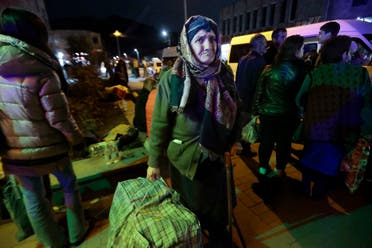
An ethnic Armenian woman from Nagorno-Karabakh carries her suitcase to a tent camp after arriving to Armenia’s Goris in Syunik region, Armenia on September 29, 2023. (AP)
Israel’s foreign and defense ministries declined to comment on the use of Israeli weapons in Nagorno-Karabakh or on Armenian concerns about its military partnership with Azerbaijan. In July, Israeli Defense Minister Yoav Gallant visited Baku, the Azerbaijan capital, where he praised the countries’ military cooperation and joint “fight against terrorism.”
Israel has a big stake in Azerbaijan, which serves as a critical source of oil and is a staunch ally against Israel’s archenemy Iran. It is also a lucrative customer of sophisticated arms.
“There’s no doubt about our position in support of Azerbaijan’s defense,” said Arkady Mil-man, Israel’s former ambassador to Azerbaijan and current senior researcher at the Institute for National Security Studies in Tel Aviv. “We have a strategic partnership to contain Iran.”Although once resource-poor Israel now has plenty of natural gas off its Mediterranean coast, Azerbaijan still supplies at least 40 percent of Israel’s oil needs, keeping cars and trucks on its roads. Israel turned to Baku’s offshore deposits in the late 1990s, creating an oil pipeline through the Turkish transport hub of Ceyan that isolated Iran, which at the time capitalized on oil flowing through its pipelines from Kazakhstan to world markets.Azerbaijan has long been suspicious of Iran, its fellow Shia Muslim neighbor on the Caspian Sea, and chafed at its support for Armenia, which is Orthodox Christian. Iran has accused Azerbaijan of hosting a base for Israeli intelligence operations against it — a claim that Azerbaijan and Israel deny.“It’s clear to us that Israel has an interest in keeping a military presence in Azerbaijan, using its territory to observe Iran,” Armenian diplomat Tigran Balayan said.Few have benefited more from the two countries’ close relations than Israeli military contractors. Experts estimate Israel supplied Azerbaijan with nearly 70 percent of its arsenal between 2016 and 2020 — giving Azerbaijan an edge against Armenia and boosting Israel’s large defense industry.“Israeli arms have played a very significant role in allowing the Azerbaijani army to reach its objectives,” said Pieter Wezeman, senior researcher at the Stockholm International Peace Research Institute, which tracks arms sales.Israeli long-range missiles and exploding drones known as loitering munitions have made up for Azerbaijan’s small air force, Wezeman said, even at times striking deep within Armenia itself. Meanwhile, Israeli Barak-8 surface-to-air missiles have protected Azerbaijan’s airspace in shooting down missiles and drones, he added.Just ahead of last month’s offensive, the Azerbaijani defense ministry announced the army conducted a missile test of Barak-8. Its developer, Israel Aerospace Industries, declined to comment on Azerbaijan’s use of its air defense system and combat drones.
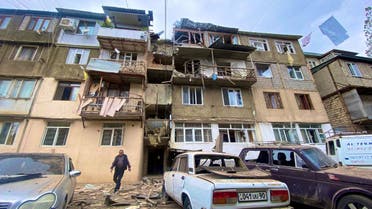
A view shows a damaged residential building and cars following the launch of a military operation by Azerbaijani armed forces in the city of Stepanakert in Nagorno-Karabakh, a region inhabited by ethnic Armenians, September 19, 2023. (Reuters)
But Azerbaijan has raved about the success of Israeli drones in slicing through the Armenian defenses and tipping the balance in the bloody six-week war in 2020.Its defense minister in 2016 called a combat drone manufactured by Israel’s Aeronautics Group “a nightmare for the Armenian army,” which backed the region’s separatists during Azerbaijan’s conflict with Nagorno-Karabakh that year.President Ilham Aliyev in 2021 — a year of deadly Azerbaijan-Armenian border clashes — was captured on camera smiling as he stroked the small Israeli suicide drone “Harop” during an arms showcase.Israel has deployed similar suicide drones during deadly army raids against Palestinian militants in the occupied West Bank.“We’re glad for this cooperation, it was quite supportive and quite beneficial for defense,” Azerbaijani’s ambassador to Israel, Mukhtar Mammadov told the AP, speaking generally about Israel’s support for the Azerbaijani military. “We’re not hiding it.”At a crucial moment in early September — as diplomats scrambled to avert an escalation — flight tracking data shows that Azerbaijani cargo planes began to stream into Ovda, a military base in southern Israel with a 3,000-meter-long airstrip, known as the only airport in Israel that handles the export of explosives.The AP identified at least six flights operated by Azerbaijan’s Silk Way Airlines landing at Ovda airport between September 1 and September 17 from Baku, according to aviation-tracking website FlightRadar24.com. Azerbaijan launched its offensive two days later.During those six days, the Russian-made Ilyushin Il-76 military transport lingered on Ovda’s tarmac for several hours before departing for either Baku or Ganja, the country’s second-largest city, just north of Nagorno-Karabakh.In March, an investigation by the Haaretz newspaper said it had counted 92 Azerbaijani military cargo flights to Ovda airport from 2016-2020. Sudden surges of flights coincided with upticks of fighting in Nagorno-Karabkh, it found.“During the 2020 war, we saw flights every other day and now, again, we see this intensity of flights leading up to the current conflict,” said Akopian, the Armenian ambassador. “It is clear to us what’s happening.”Israel’s defense ministry declined to comment on the flights. The Azerbaijani ambassador, Mammadov, said he was aware of the reports but declined to comment.The decision to support an autocratic government against an ethnic and religious minority has fueled a debate in Israel about the country’s permissive arms export policies. Of the top 10 arms manufactures globally, only Israel and Russia lack legal restrictions on weapons exports based on human rights concerns.“If anyone can identify with (Nagorno-Karabakh) Armenians’ continuing fear of ethnic cleansing it is the Jewish people,” said Avidan Freedman, founder of the Israeli advocacy group Yanshoof, which seeks to stop Israeli arm sales to human rights violators. “We’re not interested in becoming accomplices.”
Read more:
Azerbaijan says detained former Nagorno-Karabakh separatist president Harutyunyan
Russia says it held talks with US and EU on Nagorno-Karabakh ahead of crisis
Armenia says one dead, two wounded in earlier cross-border fire

Gia Volski, the Georgian Parliament’s Vice Speaker, on Thursday said there was “no formal deal” between Russia and Georgia’s Russian-occupied north-western region of Abkhazia following claims by the de facto President of the region of a “new agreement” with Moscow about the deployment of a Russian naval base in the coastal city of Ochamchire.
Bzhania, who last month visited Russia, told Russia’s Izvestia paper on Thursday the new base would be built in Ochamchire “in the near future”.
In his comments, the Georgian lawmaker claimed the subject of the claim was a “certain formality”, and that the Kremlin “sometimes allowed” the de facto President Aslan Bzhania to “talk to someone at a high level, including the President [Vladimir Putin]”.
He also noted Russia’s goal was to “gather strength” amid its ongoing conflict with Ukraine, and retain territories and “strategic facilities” which he said had been “handed over” to Russia by Georgia’s imprisoned former President Mikheil Saakashvili.
Russia is an aggressor and an occupying power, it is one of the sides of the world conflict, therefore you can discuss and evaluate who has brought this misfortune on us”, he told the press.
Volski stressed the Georgian authorities were “obligated” to ensure peace in the country “considering the security threats coming from Russia”.
Gia Volski, the Georgian Parliament’s Vice Speaker, on Thursday said there was “no formal deal” between Russia and Georgia’s Russian-occupied north-western region of Abkhazia following claims by the de facto President of the region of a “new agreement” with Moscow about the deployment of a Russian naval base in the coastal city of Ochamchire.
Bzhania, who last month visited Russia, told Russia’s Izvestia paper on Thursday the new base would be built in Ochamchire “in the near future”.
In his comments, the Georgian lawmaker claimed the subject of the claim was a “certain formality”, and that the Kremlin “sometimes allowed” the de facto President Aslan Bzhania to “talk to someone at a high level, including the President [Vladimir Putin]”.
He also noted Russia’s goal was to “gather strength” amid its ongoing conflict with Ukraine, and retain territories and “strategic facilities” which he said had been “handed over” to Russia by Georgia’s imprisoned former President Mikheil Saakashvili.
Russia is an aggressor and an occupying power, it is one of the sides of the world conflict, therefore you can discuss and evaluate who has brought this misfortune on us”, he told the press.
Volski stressed the Georgian authorities were “obligated” to ensure peace in the country “considering the security threats coming from Russia”.
Japan will start purchasing US-made Tomahawk cruise missiles in fiscal year 2025, a year earlier than originally planned, Defense Minister Minoru Kihara said on Wednesday.
The Tomahawk is a long-range, subsonic cruise missile that can be launched from ships or submarines and can strike targets with high precision. Japan plans to buy about 400 of the latest model Tomahawk Block V missiles and install them on its Aegis-equipped destroyers. The missiles have a range of between 550 and 2,500 kilometers, depending on the variant, and can be used to hit land or maritime targets.
The missile purchase is part of Japan’s efforts to enhance its counterstrike capability and deterrence against potential adversaries in the region. Japan faces multiple challenges, such as North Korea’s development of new quick-strike missiles that can reach Japan in minutes.
Japan’s Prime Minister Kishida Fumio announced the plan to acquire Tomahawk missiles at a House of Representatives Budget Committee session on February 27. He said the public is very interested in the issue and the US will also announce the maximum amount of missiles to be sold to Japan as part of the explanatory process for the US Congress.
Japan’s Defense Ministry is seeking a record budget for the next fiscal year as the pacifist country is set to have some of the highest military spending in the world. Over the next five years, Japan will spend about 5 trillion yen ($37 billion) on standoff, or long-range missiles, with deployment beginning in four years.