Categories
South Caucasus News

The Region in Brief


Armenia

The Ministry of Defense of the Republic of Armenia confirmed on October 2 that one soldier was killed and two others sustained injuries during an Azerbaijani attack on Kut, Gegharkunik. The two wounded soldiers are currently in stable condition and have been safely transported to a military hospital for treatment. The Ministry has condemned Azerbaijan’s reprehensible act of targeting ambulances, a clear violation of international humanitarian law. 

The Armenian National Assembly ratified the Rome Statute on October 3, with 60 votes in favor, 22 against and 0 abstentions. Opposition factions voted against passage of the Rome Statute. Opposition MP of “Armenia Alliance” Artur Khachatryan stated that voting in favor of the statute “is a hostile move against Russia which will have its ramifications, and the consequences and burden will be placed on the people.” 

Azerbaijan

Azerbaijan declined to participate in the scheduled meeting between Armenian Prime Minister Nikol Pashinyan and Azerbaijani President Ilham Aliyev in Granada, Spain on October 5. The meeting was to include Armenia, Azerbaijan, France, Germany and the EU, with the participation of Pashinyan, Aliyev, French President Emmanuel Macron, German Chancellor Olaf Scholz and European Council President Charles Michel. Azerbaijan claimed that this format fostered a hostile atmosphere and insisted on Turkey’s involvement. However, France and Germany opposed this request, leading to Baku’s decision to withdraw from the meeting.

Iran

During a working visit to the Islamic Republic of Iran, Secretary of the Security Council of the Republic of Armenia, Armen Grigoryan, met with  Minister of Foreign Affairs of the Islamic Republic of Iran Hossein Amir Abdollahian. The regional security situation was discussed and it was emphasized that the principle of the inviolability of borders should be respected, and conflicts should be resolved through dialogue. 

Meanwhile, 60 tons of humanitarian aid was delivered from Iran on October 3, including food, hygiene products, blankets and heaters, and more arrived in Syunik to be distributed to the forcibly displaced Armenians of Artsakh.  

Turkey

The Turkish Parliament’s Committee on Public Notices has submitted an application against Armenia’s Metsamor nuclear power plant due to “the expiration of its operational lifespan and associated security risks.” The Turkish Foreign Ministry sent a memorandum to the International Atomic Energy Agency (IAEA) demanding an assessment in line with the safety regulations of the nuclear power plant. This is not the first encroachment of official Turkey against Metsamor, which is Armenia’s sovereign energy source. In August of last year, the Turks held a training exercise in Kars, allegedly “in the scenario of protecting against a possible leak at Metsamor in the event of a seven-point earthquake.” On March 3, during a meeting with the Director General of the IAEA, Azerbaijan’s President Ilham Aliyev said that “the illegal trade of some nuclear materials from the Metsamor nuclear power plant is worrying.”

Author information

Hoory Minoyan

Hoory Minoyan

Hoory Minoyan was an active member of the Armenian community in Los Angeles until she moved to Armenia prior to the 44-day war. She graduated with a master’s in International Affairs from Boston University, where she was also the recipient of the William R. Keylor Travel Grant. The research and interviews she conducted while in Armenia later became the foundation of her Master’s thesis, “Shaping Identity Through Conflict: The Armenian Experience.” Hoory continues to follow her passion for research and writing by contributing to the Armenian Weekly.

|

The post The Region in Brief appeared first on The Armenian Weekly.

Categories
South Caucasus News

(UN)involved in Peace


The recent developments in Artsakh (Nagorno-Karabakh) have given rise to serious concerns within the international community. Artsakh has been targeted by a genocide campaign conducted by Azerbaijan — with the help of brother nation Turkey — against the indigenous Armenian population. With genocide and legal experts alike speaking out against the blatant ethnic cleansing, this genocide is reminiscent of the Armenian Genocide of 1915. It is heartbreaking to accept that despite the passage of more than a century, war crimes materialize under the nose of powerful governmental and intergovernmental organizations. 

Currently, Azerbaijan has illegally detained eight Artsakh officials and Armenian citizens in Baku, including Arayik Harutyunyan, Arkadi Ghukasyan, Bako Sahayan, Davit Babayan, Davit Ishkhanyan, Davit Manukyan, Levon Mnatsakanyan and Ruben Vardanyan, an eerie echo of Red Sunday. On Red Sunday, which took place on April 24, 1915, the Young Turks targeted, deported and murdered Armenian intellectuals and other figures that maintained any form of social, cultural or political influence in Armenia. 

(Photo: Grant is a Grant on Flickr)

The United Nations’ response has been met with criticism. The U.N. mission to Artsakh, led by Vladanka Andreeva, the U.N. Resident Coordinator in Azerbaijan, suspiciously concluded within a single day, issuing a report that has drawn significant scrutiny and skepticism. The team also included Ramesh Rajasingham, the Director of OCHA’s Coordination Division, as well as representatives from the Food and Agriculture Organization, the U.N. Refugee Agency, UNICEF and the World Health Organization.

The report stated that there were “no incidences of violence against Armenian civilians” and “no damage to civilian public infrastructure, including hospitals, schools, housing, or cultural and religious structures” in Stepanakert, the capital of Artsakh. It further declared that they “did not come across any reports – neither from the local population interviewed nor from the interlocutors – of incidences of violence against civilians following the latest ceasefire,” and “[were] struck by the sudden manner in which the local population left their homes and the suffering the experience must have caused.”

This assessment has raised questions about the U.N.’s ability to address the complex humanitarian crisis unfolding in Artsakh. Many have expressed concerns that the organization did not adequately respond to the allegations of ethnic cleansing and genocide, leaving the affected Armenian population in a vulnerable and dire situation. 

The confusion ends and controversy grows when one discovers two things. First, the author of this U.N. report was Rashad Huseynov, an Azerbaijani National Information Officer of the United Nations, generally known to be a mouthpiece for the Aliyev regime – a potential explanation for the U.N.’s rushed approach. The flagrant partial authorship raises doubts about the report’s objectivity, further eroding trust in the U.N.’s ability to provide an unbiased assessment of the situation. 

Second, the mission comes one day after Azerbaijan’s President Ilham Aliyev’s announcement that he donated one million USD to the United Nations Human Settlements Program (U.N.-Habitat) from the Presidential Contingency Fund. 

The U.N. report is countered by photo and video evidence showcasing the damage that has been imposed on civilians and their homes, as well as the number of deaths and illnesses that resulted from the blockade, attacks and so-called “ceasefire.” We have also heard from voices on the ground, actual Armenian civilians – not the Azeri nor the Armenian government – who resided in their ancestral homes and documented the day-to-day horror of the almost year-long blockade and its barbaric “conclusion.” 

The humanitarian crisis in Artsakh has resulted in a significant exodus of ethnic Armenians, with reports suggesting that over 100,000 people have fled the region, many describing the area as a “ghost town.” As few as 50 to 1,000 ethnic Armenians are reported to be left in Artsakh, further underscoring the scale of displacement and suffering experienced by the Armenian population in the region. The sudden departure of tens of thousands of people from their homes has created a profound humanitarian challenge that demands immediate and comprehensive attention from the international community. 

Yet, despite our understanding of how a universal global organization like the U.N. should be approaching a dire situation of this scale, the Armenian people are once again left sorely disappointed in a world that seems willing to tolerate genocidal regimes.

Author information

Melody Seraydarian

Melody Seraydarian

Melody Seraydarian is a journalist and undergraduate student at the University of California, Berkeley, pursuing a degree in Media Studies with a concentration in media, law and policy. Her column, “Hye Key,” covers politics, culture and everything in between from a Gen-Z perspective. She is from Los Angeles, California and is an active member of her local Armenian community.

|

The post (UN)involved in Peace appeared first on The Armenian Weekly.


Categories
South Caucasus News

The female faces of the blockade of Artsakh


A few days before the forced deportation of Artsakh residents

“Eh, tsavd tanem (I’ll bear your pain). There’s so much to think about. You keep asking how women are coping with the blockade. Our children are sleeping hungry. What can we say about us?” said Gayane with a sigh during our conversation a few days before the forced displacement of nearly all of the Armenian residents of Artsakh.

I couldn’t understand half of her words, as the call continued to be marred by poor connectivity. I was trying to piece together the fragments of her words, a mosaic of sounds and sighs that narrated a story of endurance. 

I was planning to prepare an article about the problems with sexual and reproductive health facing the women of Artsakh under blockade. I wanted to create a platform, a safe space, where women would finally be able to talk about themselves and their personal problems and difficulties.

Yet do women have personal space during wars or blockades? Even during peacetime, Armenian women have a huge burden of responsibilities on their shoulders: having children, “multiplying” the nation and raising a patriotic generation. In times of strife, these responsibilities burgeon.

Gayane’s niece gave birth to her second child a few weeks before our conversation. Her first child is four years old. “We don’t know what to do. At least we are able to give tsamak hats (dry bread) to the older one, but this newborn baby only eats breast milk. The poor girl’s milk dried up due to stress and malnutrition. She can’t feed her baby. We can’t even get formula. The poor girl doesn’t know what to do,” said Gayane. Her voice trembling with sorrow, she conveyed that a neighbor, herself a recent mother, was providing sustenance to the newborn.

Aware of the inadequacy of my words, I proposed arranging an online psychological consultation for the young mother. Gayane’s response, delivered with a condescending chuckle, was sobering: “Tsavd tanem, the elder child sleeps with an empty belly, and the newborn’s weight stagnates due to malnourishment. You offer psychological counseling, while people queue for hours just to secure bread, only to discard it in anger and despair, saying that they can’t relate with this mockery anymore. Which psychologist can help in this matter?”

Dr. Armine Barkhudaryan, a gynecologist who worked remotely with Artsakh women for months, remarked on the prevalence of malnutrition and vitamin deficiencies among pregnant women. “I lack concrete data,” she admitted, “but it’s clear that vitamin deficiencies and malnutrition are the chief culprits. Since July, miscarriages have surged to three times their previous numbers compared to the same period last year. Yet, our understanding remains preliminary, and no comprehensive research exists,” said Dr. Barkhudaryan.

Armenian women, in normal circumstances, rarely discuss their needs and predicaments, but during conflict, they often fade into an abstract, selfless existence—devoting themselves entirely to the welfare of other women and children in need.

Mariam (real name changed at the woman’s request), who relocated to Armenia for a challenging pregnancy, found herself struggling to recall the trajectory of her pregnancy during the blockade. Throughout our conversation, she continually expressed deep remorse. “I feel guilty,” she said. “There were many pregnant women in Artsakh enduring the blockade, while I found myself here in Armenia. My baby feeds well now, but others’ infants sleep with empty stomachs. Their mothers lack both breast milk and formula. I feel guilty,” she repeated.

In Armenian society, certain topics, especially during wartime, remain veiled in silence. Among these, perhaps the most untouched, is the issue of unwanted pregnancies and abortions.

Although Dr. Barkhudaryan does not have clear data, she believes that the women in the blockade had access to contraceptives. “The issue is not that women did not have access, but rather, there is a lack of education. Even if there were contraceptives left in pharmacies, many do not know how to use them. I am aware that many women resort to biological contraceptives, not condoms, hormonal contraceptives or intrauterine devices, and in that case the chance of not getting pregnant is 50-50,” she said.

From the start of the blockade, Artsakh women mobilized on an online platform, in a special group where they shared their resources and provided each other with necessary products and help. Naturally, the main topic of group discussions concerned children: women looking for diapers, baby food, clothes and medicine. Very rarely, women also looked for feminine hygiene products, including pads. Such discussions are often accompanied by reproaches and are described as amot (shameful). Artsakhtsi women, however, excel not only in their unity and care, but also through their high sense of solidarity. They protect each other and explain to those who attach such labels that women are already neglected. The basic norms of a woman’s dignified life must be ensured, and that the group was created to serve as a safe space for women, they say. 

According to data from the Women’s Resource Center of Armenia (WRCA), during the blockade women did not have the opportunity to purchase pads and other hygiene products. It was a fundamental problem: with constant water and electricity outages, people were unable to take care of their personal hygiene regularly. According to Anush Poghosyan, Sexual and Reproductive Health and Rights specialist at WRCA, menstrual hygiene is a basic human right and is essential for women’s health and well-being. “During the blockade, women’s right to a dignified life was violated. Women from Artsakh did not have access to basic household items like hot water and electricity. All that does have a horrible effect on women’s sexual and reproductive health,” said Poghosyan.

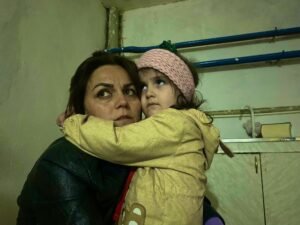
Mother and child shelter in a bunker (Siranush Sargsyan/Twitter)

A few days after the forced deportation of Artsakh residents

In Armenia, each day unfolds with uncertainty, making even the simplest of plans a distant luxury. A problem that was important a few hours ago gives way to a bigger problem that has just emerged.

As I write these words, my compatriots in Artsakh are being uprooted from their homes, leaving behind cherished gardens and the graves of their loved ones. I write these words mechanically, and Gayane is constantly in my mind. Is she in Stepanakert or on the road that stretches for kilometers to Goris? Is her niece able to feed her child? Where did she take shelter with her four-year-old and newborn children?

I am afraid to call Gayane, Mariam and others. What should I tell them? I don’t know what I should ask them. I was never taught at school, home or university what to ask people in such cases. I was only taught that Artsakh is ours…

Perhaps, in a moment of levity, I’ll offer them online psychological counseling once more, if only to share a fleeting moment of laughter before the tears return. I yearn to ask how they are, even though I already know the answer. I just want to call and say that I want to hug them tight, that I feel and understand them, yet I am paralyzed by fear and despair. I am at a loss for words, unsure of how to aid my sisters from Artsakh.

Author information

Yelena Sargsyan

Yelena Sargsyan

|

The post The female faces of the blockade of Artsakh appeared first on The Armenian Weekly.


Categories
South Caucasus News

Georgia: Activists to gather at the back entrance of the Parliament … – Crisis24


Georgia: Activists to gather at the back entrance of the Parliament …  Crisis24

Categories
South Caucasus News

Ghana’s gold increases risks for Russian-backed coup – Robert Lansing Institute


Ghana’s gold increases risks for Russian-backed coup  Robert Lansing Institute

Categories
South Caucasus News

AP Headline News – Oct 04 2023 21:00 (EDT)


28013281


Categories
South Caucasus News

AP Headline News – Oct 04 2023 20:00 (EDT)


28013281


Categories
South Caucasus News

Kazakh Minister Admits To List Of People Barred From Entering Country Over Comments – Radio Free Europe / Radio Liberty


Kazakh Minister Admits To List Of People Barred From Entering Country Over Comments  Radio Free Europe / Radio Liberty

Categories
South Caucasus News

Kazakh President Assures Germany His Country Follows Sanctions Regime Against Russia – Radio Free Europe / Radio Liberty


Kazakh President Assures Germany His Country Follows Sanctions Regime Against Russia  Radio Free Europe / Radio Liberty

Categories
South Caucasus News

Armenia’s Ombudswoman presents issues regarding rights of … – NEWS.am


Armenia’s Ombudswoman presents issues regarding rights of …  NEWS.am