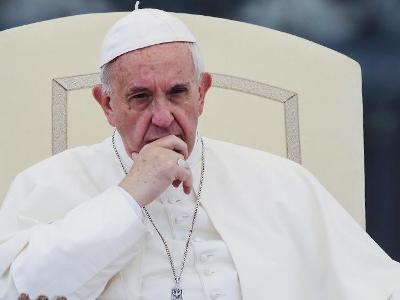
Pope Francis called during the Sunday prayer on Azerbaijan and Armenia to dialogue on the situation of forcibly displaced people from Nagorno-Karabakh, Rai Radio 1 reports.
He also prayed for “suffering Ukraine and all lands wounded by war”.
More than 100,000 people left their homes in Nagorno-Karabakh and fled to Armenia after Azerbaijan’s September 19 military aggression against Karabakh.
Pope Francis called during the Sunday prayer on Azerbaijan and Armenia to dialogue on the situation of forcibly displaced people from Nagorno-Karabakh, Rai Radio 1 reports.
He also prayed for “suffering Ukraine and all lands wounded by war”.
More than 100,000 people left their homes in Nagorno-Karabakh and fled to Armenia after Azerbaijan’s September 19 military aggression against Karabakh.
On September 28, the president of the self-declared republic of Nagorno-Karabakh, Samvel Shahramanyan, announced that it would cease to exist on January 1, 2024. According to a decree that he has signed, all state institutions will have been dissolved by this date.
It follows Azerbaijan’s military takeover of Nagorno-Karabakh and the subsequent flight of large parts of the ethnically Armenian population, a dramatic turn in the long-running conflict over the region, which revolves largely around the question of the disputed region’s independence. Azerbaijan, which is predominantly Muslim, is supported by Turkey, while Russia has acted as a protective power for Armenia, which is majority Christian.
Geopolitical consequences
The self-proclaimed Nagorno-Karabakh Republic, which declared independence in 1991, has a predominantly Armenian population but is located on Azerbaijani territory. According to international law, it belongs to Azerbaijan, not Armenia.
Armenia has never recognized the breakaway republic. Even though some consider the region to be an “inseparable part” of Armenia, draft laws to recognize Nagorno-Karabakh’s independence have been blocked in the Armenian parliament and by the government.
The conflict has geopolitical relevance far beyond the two states due to several major oil and gas pipelines in the region that transport millions of barrels a day from the Caspian Sea to Turkey’s Mediterranean coast. Since Russia’s full-scale invasion of Ukraine in February 2022, Azerbaijan has been supplying the EU with more gas.
Disputed for centuries
The conflict between Armenians and Azerbaijanis has its origins in the seventh century, when Christian Byzantines fought for control against Muslim Arabs. Under later Ottoman rule, the Armenian population looked to Russia for protection.
As Christian Armenians came under pressure from Persia in the 18th century, the Russian tsarina, Catherine the Great, issued letters of protection for them.
After Nagorno-Karabakh came under Russian control as a result of the Russo-Persian War of 1804 to 1813, the Christian Armenian population received preferential treatment over the Turkic Muslims of the wider region, later known as Azerbaijanis.
Armenian Genocide
The Armenian Genocide of 1915-1916 in the Ottoman Empire led many Armenians to flee to Nagorno-Karabakh, and exacerbated the conflict with the Azerbaijani population. In March 1918, there were pogroms against Azerbaijanis, and then there were anti-Armenian pogroms in the Azerbaijani capital Baku. In 1920, pogroms in the city of Shusha in Nagorno-Karabakh claimed the lives of over 30,000 Armenians.
After the fall of the Russian Empire, the Russian Revolution, and the First World War, the region continued to be disputed between Armenia and Azerbaijan, which both enjoyed a brief period of independence.
In 1922, Armenia, Azerbaijan and Georgia formed the Transcaucasian Socialist Federative Soviet Republic, but it was dissolved in 1936 and disintegrated into individual Soviet republics. However, riots and pogroms between Armenians and Azerbaijanis did not stop.
There have been tens of thousands of casualties on both sidesImage: AP/dpa/picture alliance
Collapse of Soviet Union
In the wake of the collapse of the Soviet Union in 1991, Armenia and Azerbaijan declared their independence. The region of Nagorno-Karabakh followed suit on September 3, 1991. Two months later, Azerbaijan lifted its autonomy and launched an energy blockade.
The conflict escalated again and in early 1992, there were more mass killings in both Azerbaijani and Armenian villages. On May 12, 1994, a cease-fire agreement came into force that strengthened Nagorno-Karabakh.
Some 35,000 people are estimated to have died in the 1990s and over 1.1 million were displaced.
A Second Nagorno-Karabakh War broke out in 2020 after which the region suffered major territorial losses despite support from Armenia. The war came to an end due to a cease-fire agreement brokered by Moscow that helped Azerbaijan regain parts of the disputed territory.
From the Armenian perspective, Azerbaijan at no time guaranteed autonomy to Nagorno-Karabakh. Azerbaijan, on the other hand, stated repeatedly that it recognized “broad autonomy” for the region, but not independence.



 There have been tens of thousands of casualties on both sidesImage: AP/dpa/picture alliance