
Day: September 29, 2023
20:52, 30 June 2023
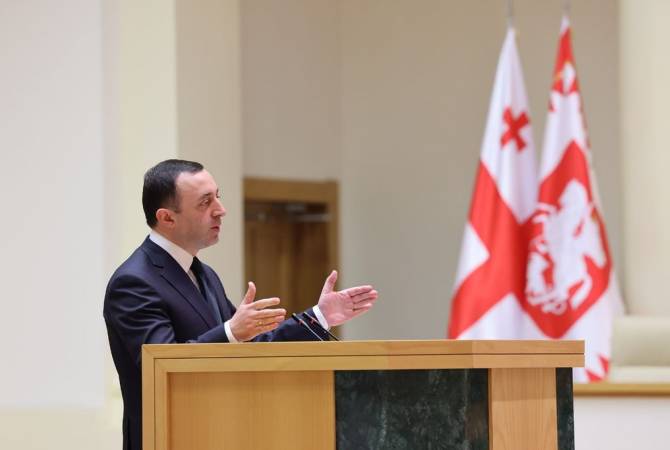
YEREVAN, JUNE 30, ARMENPRESS. Georgia has shown that it is capable of being an effective mediator in the relations between Azerbaijan and Armenia and is ready to re-engage in the process if necessary, ARMENPRESS reports, citing “Sputnik-Georgia”, Prime Minister Irakli Garibashvili said in the Parliament of Georgia.
“Two years ago, we showed the first concrete results of the mediation between Azerbaijan and Armenia, in which I was personally involved. It was, so to speak, one of the exemplary mediations in the region,” Garibashvili said.
The Prime Minister expressed Georgia’s readiness to continue playing the role of a mediator.
“I want to once again publicly reaffirm our full readiness from this podium. If necessary, we are ready to be involved once again as a mediator in the ongoing negotiations between the two countries, our friends,” Garibashvili stated.
20:52, 30 June 2023
YEREVAN, JUNE 30, ARMENPRESS. Georgia has shown that it is capable of being an effective mediator in the relations between Azerbaijan and Armenia and is ready to re-engage in the process if necessary, ARMENPRESS reports, citing “Sputnik-Georgia”, Prime Minister Irakli Garibashvili said in the Parliament of Georgia.
“Two years ago, we showed the first concrete results of the mediation between Azerbaijan and Armenia, in which I was personally involved. It was, so to speak, one of the exemplary mediations in the region,” Garibashvili said.
The Prime Minister expressed Georgia’s readiness to continue playing the role of a mediator.
“I want to once again publicly reaffirm our full readiness from this podium. If necessary, we are ready to be involved once again as a mediator in the ongoing negotiations between the two countries, our friends,” Garibashvili stated.
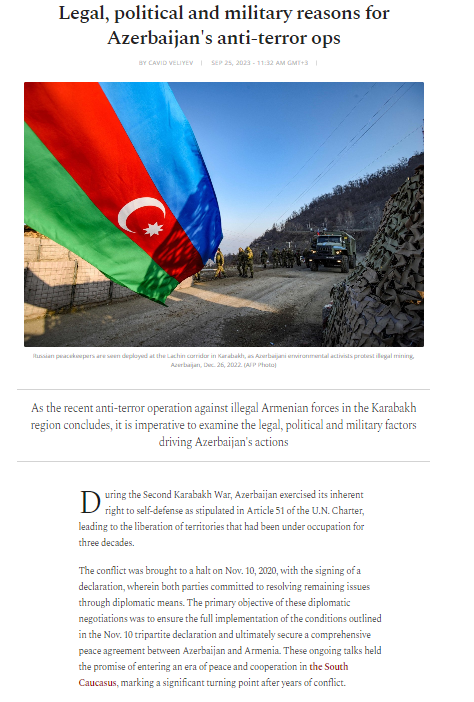
During the Second Karabakh War, Azerbaijan exercised its inherent right to self-defense as stipulated in Article 51 of the U.N. Charter, leading to the liberation of territories that had been under occupation for three decades.
The conflict was brought to a halt on Nov. 10, 2020, with the signing of a declaration, wherein both parties committed to resolving remaining issues through diplomatic means. The primary objective of these diplomatic negotiations was to ensure the full implementation of the conditions outlined in the Nov. 10 tripartite declaration and ultimately secure a comprehensive peace agreement between Azerbaijan and Armenia. These ongoing talks held the promise of entering an era of peace and cooperation in the South Caucasus, marking a significant turning point after years of conflict.
However, concerns arose as the Armenian side failed to fulfill many of the agreed-upon commitments, including the fourth article of the Nov. 10 tripartite declaration, which called for the removal of armed Armenian forces from Azerbaijani territory in Karabakh. This deviation from the agreed-upon terms increased the risk of renewed conflict in the region. In addition, illegal armed groups in the Karabakh region of Azerbaijan initiated attacks on Azerbaijani armed forces.
Consequently, Baku was compelled to launch an anti-terrorist operation on Sept. 19 aimed at disarming these illegal armed units. Last week’s military operation, which lasted for 23 hours and 47 minutes, culminated in the surrendering of the illegal armed forces and the dismantling of the self-proclaimed administration in Karabakh. It is important to note that the Azerbaijani side had valid legal, political, and military justifications for initiating this operation.
Legal reasons
While Armenians and their supporters frame the issue of the occupation of Azerbaijani lands as a political and propaganda tool, it is fundamentally rooted in international law. The Azerbaijani position’s strength lies in its alignment with international legal principles. In this context, Azerbaijan’s decision to launch an anti-terrorist operation was firmly grounded in three key legal foundations: First, 1993 resolutions adopted by the U.N. Security Council; second, the tripartite declaration; and third, international recognition of the region as Azerbaijani territory.
The U.N. Security Council resolutions adopted in 1993 stressed on the immediate and unconditional withdrawal of armed Armenian forces from the occupied territories of Azerbaijan, including Karabakh. During the 44-day Second Karabakh War, the Azerbaijani army successfully liberated some portions of these territories. The fourth article of the tripartite declaration stipulated that the Russian Federation’s peacekeeping contingent would be deployed in conjunction with withdrawing Armenian armed forces from the remaining occupied areas. However, although three years have passed since the tripartite declaration, Armenian armed forces had not left the region nor been removed by Russian peacekeeping troops or Armenia. This meant that the conditions of the U.N. Security Council resolutions adopted in 1993 and the Nov. 10 tripartite declaration were not fulfilled.
On the other hand, Karabakh has always been internationally recognized as Azerbaijani territory. An important milestone in the process occurred during an agreement reached in Prague on Oct. 6, 2022, where both parties committed to recognizing the principles of territorial integrity by the Alma-Ata Declaration of 1991. By signing this declaration, Azerbaijan and Armenia reaffirmed their recognition of Karabakh as Azerbaijani territory.
Subsequently, during ongoing peace negotiations, Armenian Prime Minister Nikol Pashinyan publicly acknowledged the territorial integrity of Azerbaijan, including Karabakh. This statement was seen as a significant step. Russian President Vladimir Putin indicated that all matters related to Karabakh were resolved with Pashinyan’s recognition, thereby implying that the anti-terrorist operation was well within Azerbaijan’s jurisdiction.
Furthermore, Hikmet Hajiyev, Assistant to the President of the Republic of Azerbaijan, had made it clear prior to the operation that Azerbaijan would not tolerate any gray areas or illegal armed forces on its sovereign territory. This stance was reiterated by Foreign Minister Ceyhun Bayramov during a U.N. Security Council meeting on Sept. 21, where he emphasized that no state could tolerate the presence of illegal armed forces on its territory.
Adding to the legitimacy of Azerbaijan’s anti-terrorist operation, U.S. Secretary of State Anthony Blinken personally engaged with President Ilham Aliyev, seeking to understand Azerbaijan’s conditions for halting the operation. This interaction indicated that the operation was being considered legitimate from the perspective of the United States. In summary, the international community’s recognition of Karabakh as Azerbaijani territory, combined with the statements and actions of key political figures and leaders, underscores the legitimacy of Azerbaijan’s anti-terrorist operation in Karabakh in the context of international law.
Political reasons
This operation launched against terrorism in Karabakh had three political reasons. First of all, Armenia’s demand for an international mechanism. Although Armenia had verbally recognized Karabakh as Azerbaijani territory, it sought the establishment of an international mechanism to protect the rights and security of Karabakh Armenians. This implied a desire to transfer Azerbaijani sovereignty in the region to an international entity. Essentially, Armenia aimed to resurrect a mechanism similar to the old Minsk Group to bolster these demands. To exert pressure on Azerbaijan and bolster its position, Armenia maintained the presence of approximately 10,000 illegal armed forces in the area.
Furthermore, Armenia attempted to reinforce these illegal armed groups by sending weapons and personnel through routes outside of Azerbaijan’s control, particularly during the period when the Lachin road was not under Azerbaijani authority. The involvement of Armenian citizens as armed forces in Azerbaijan’s Karabakh region was proved by video evidence provided by Azerbaijani border troops.
Additionally, the situation in Karabakh was further complicated by the presence of illegal armed groups who had effectively held the civilian population hostage. These armed groups provided political support to separatist elements in the region, who were in direct contravention of international agreements by demanding a special status for Karabakh and refusing to acknowledge Azerbaijani sovereignty. The separatists in Karabakh vehemently opposed direct talks between Azerbaijani-Karabakh Armenians, which had begun following the decision made in Prague in 2022 and received support on other international platforms. Instead, they insisted on the involvement of mediators.
The first meeting between Azerbaijani and Karabakh Armenian representatives took place in Khojaly on March 1, with the mediation of Russian peace troops. Subsequently, the Azerbaijani side proposed that these meetings continue without a mediator and be held in Baku for a more direct dialogue. However, the Karabakh separatists declined this proposal. It is noteworthy that an agreement had been reached at the level of foreign ministers of Azerbaijan and Armenia in Moscow for a direct meeting to be held in Yevlakh, a city in Azerbaijan. Unfortunately, the separatist forces in Karabakh declined at the last moment. In essence, both Armenia and the separatist elements in Karabakh were persistently disregarding agreed-upon decisions and using illegal armed forces as a protective shield.
On Sept. 9, 2023, separatists in Khankendi held a new so-called presidential election in the region to “renew their legitimacy.” After the 2020 war, the separatists’ attitudes completely failed and they thought that they would get different results with new faces in these new so-called elections. However, these elections backfired and international organizations and states condemned these elections and declared that they recognized the region as Azerbaijani territory. On the other hand, President Aliyev stated that the illegal elections held in Karabakh were against the verbal agreement reached between the parties.
As a matter of fact, the first demand of the newly elected so-called president was special status for separatists. Therefore, the presence of armed forces in the region increased the so-called administration’s desire to use the status quo in the region to its advantage.
Military reasons
On the other hand, although Armenia was defeated in the 44-day war, it was making plans for a new war with Azerbaijan. While the Nikol Pashinyan administration was playing for time to prevent any results in the ongoing peace talks with Azerbaijan, Armenia was preparing for a favorable geopolitical environment. In parallel with this, experts and politicians close to the government or the opposition in Armenia, it was argued that Armenia, like Azerbaijan, could wait 20 or 30 years and eventually take back Karabakh. Therefore, Armenia was planning to play for time, strengthen itself militarily and economically, and then launch a new attack. As a matter of fact, its efforts towards armament increased recently and it has been intensifying its activities to increase the human potential to fight.
Illegal Armenian armed forces in Karabakh were constantly threatening Azerbaijan militarily. They laid mines on newly constructed roads in the regions liberated from occupation, and interfered with the electronic systems of planes flying over Azerbaijan and wounded two Azerbaijani soldiers in Aghdam the day before the operation began. On the same day, as a result of their sabotage actions, seven Azerbaijani police officers were martyred as a result of the mines laid on the Fuzuli-Shusha road. The main purpose here is to threaten the reconstruction works in the regions of Azerbaijan liberated from occupation, to prevent the civilian population from returning to their own lands, and to gain deterrent power. Therefore, these were the factors that made the military anti-terrorist operation necessary.
The anti-terrorist operation that was launched primarily aimed at military targets, and areas with civilians were not targeted. Strategic heights were captured in a short span of time and supply routes of the illegal armed groups were cut off. This caused them to surrender within one day. The establishment of Azerbaijani sovereignty in Karabakh and the beginning of the integration process of Karabakh Armenians into Azerbaijan led to the elimination of one of the most important obstacles to lasting peace between Azerbaijan and Armenia.
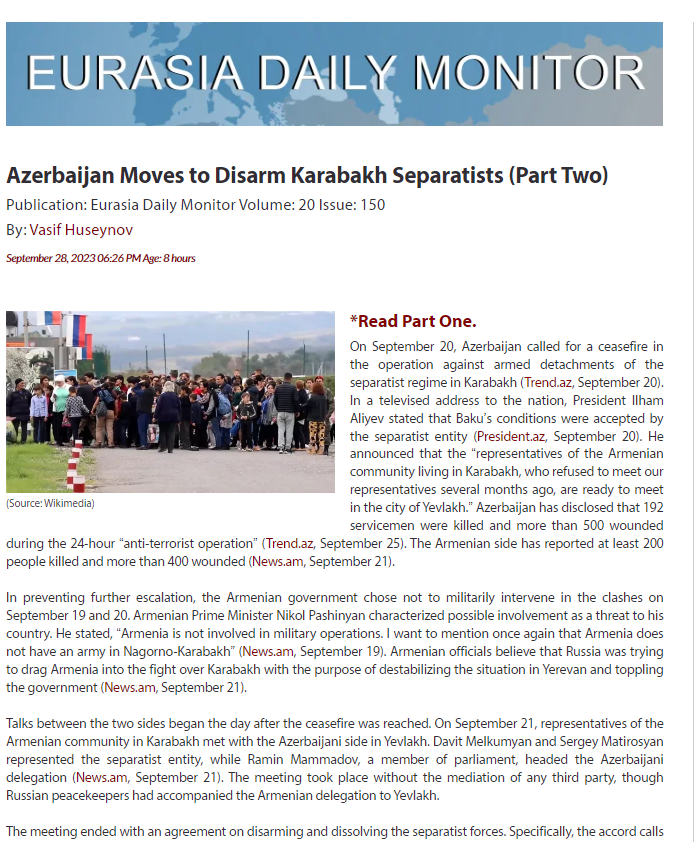
On September 20, Azerbaijan called for a ceasefire in the operation against armed detachments of the separatist regime in Karabakh (Trend.az, September 20). In a televised address to the nation, President Ilham Aliyev stated that Baku’s conditions were accepted by the separatist entity (President.az, September 20). He announced that the “representatives of the Armenian community living in Karabakh, who refused to meet our representatives several months ago, are ready to meet in the city of Yevlakh.” Azerbaijan has disclosed that 192 servicemen were killed and more than 500 wounded during the 24-hour “anti-terrorist operation” (Trend.az, September 25). The Armenian side has reported at least 200 people killed and more than 400 wounded (News.am, September 21).
In preventing further escalation, the Armenian government chose not to militarily intervene in the clashes on September 19 and 20. Armenian Prime Minister Nikol Pashinyan characterized possible involvement as a threat to his country. He stated, “Armenia is not involved in military operations. I want to mention once again that Armenia does not have an army in Nagorno-Karabakh” (News.am, September 19). Armenian officials believe that Russia was trying to drag Armenia into the fight over Karabakh with the purpose of destabilizing the situation in Yerevan and toppling the government (News.am, September 21).
Talks between the two sides began the day after the ceasefire was reached. On September 21, representatives of the Armenian community in Karabakh met with the Azerbaijani side in Yevlakh. Davit Melkumyan and Sergey Matirosyan represented the separatist entity, while Ramin Mammadov, a member of parliament, headed the Azerbaijani delegation (News.am, September 21). The meeting took place without the mediation of any third party, though Russian peacekeepers had accompanied the Armenian delegation to Yevlakh.
The meeting ended with an agreement on disarming and dissolving the separatist forces. Specifically, the accord calls for “the [full] withdrawal of the remaining units and servicemen of the Armed Forces of Armenia” and “the disbandment and complete disarmament” of the separatist regime. This will include the removal of heavy weapons and other military equipment from the territory of Karabakh (News.am, September 21). The two sides also agreed to hold further meetings in mapping out the reintegration of the region into Azerbaijan and ensuring the rights and security of the Armenians within the Constitution of Azerbaijan. According to Baku, the Azerbaijani representatives responded positively to requests to provide fuel, food and other assistance to the Armenians in Karabakh (Turan, September 21).
After the Yevlakh meeting, Russian peacekeepers reported that the separatist regime had started handing over their weapons to Azerbaijan (News.am, September 22). The peacekeeping contingent reported that “the armed forces of Karabakh are leaving their positions within the framework of the agreements reached at the meeting held in Yevlakh.” Another meeting between Samvel Shahramanyan, the leader of the separatist entity, and Ali Nagiyev, head of Azerbaijan’s State Security Service, was reportedly held on September 23. The local Armenian journalist who first reported on this meeting asserted that “it is regrettable” that the separatist leaders had earlier refused to negotiate with Baku (News.am, September 23).
The restoration of Azerbaijan’s control over the area has been followed by the exodus of many local Armenians to Armenia via the Lachin checkpoint. Humanitarian aid has been delivered to the region via Russian peacekeepers and the International Committee of the Red Cross (Armenpress.am; News.am, September 23). Baku also sent two trucks containing 40 tons of food and sanitary products as well as two trucks full of bread to the Armenian residents (Turan, September 22). On September 24, Azerbaijan restored the electricity supply to Karabakh, disconnecting the region from Armenia’s energy grid and connecting it with that of Azerbaijan (Azertag, September 24).
Steps are being taken to reassure those Armenians remaining in Karabakh. The Azerbaijani media interviewed some Armenians at the Lachin checkpoint. The respondents spoke positively of their past co-existence with Azerbaijanis during the Soviet period, and some refuted claims about their coerced expulsion (Qafqazinfo.az, September 25). Pashinyan declared that “at this moment, there is no direct danger” to Armenians living in Karabakh and insisted that the Armenians in Karabakh “live in safety and dignity” there (Armenpress.am, September 21). Declaring that his government has already prepared places to accommodate 40,000 families, he emphasized that Yerevan’s “Plan A is not to de-Armenianize” Karabakh (News.am, September 22).
Meanwhile, Baku has launched the reintegration process of Karabakh into Azerbaijan’s legal framework. One major step in this direction was the creation of a working group with the participation of various government agencies to resolve social, humanitarian, economic and infrastructure issues in Karabakh (Report.az, September 23). Baku also promised amnesty to the Armenian fighters in Karabakh who agree to lay down their arms. “With regard to former militaries and combatants … we are envisaging an amnesty or alluding to an amnesty as well,” said Azerbaijani presidential aide Hikmet Hajiyev (TASS, September 22).
Baku is also upbeat about the prospects for a peace treaty with Armenia. In his address on September 20, Aliyev commended Armenia’s reaction to the clashes in Karabakh and found it constructive for the future of the peace process (President.az, September 20). According to Azerbaijani government representative Elchin Amirbekov, a five-point draft peace plan has been prepared in accordance with international law and mutual respect for Azerbaijan’s and Armenia’s respective territorial integrity and sovereignty (News.am, September 21). Speaker of the Armenian Parliament Alen Simonyan has not ruled out the possibility of signing a peace treaty at the European Union–mediated summit to be held in Granada, Spain, on October 5 (News.am, September 25).
It is yet early to conclude that Baku and Yerevan will finally sign a peace treaty and that outside powers will play a constructive role in the talks. The Russian side has voiced its optimism regarding a future agreement. According to Russian presidential spokesman Dmitry Peskov, “All prerequisites exist for signing a peace treaty between Armenia and Azerbaijan” (News.am, September 21). Whether Russia and other external actors will continue to support the process moving forward remains an open question.
https://jamestown.org/program/azerbaijan-moves-to-disarm-karabakh-separatists-part-two/
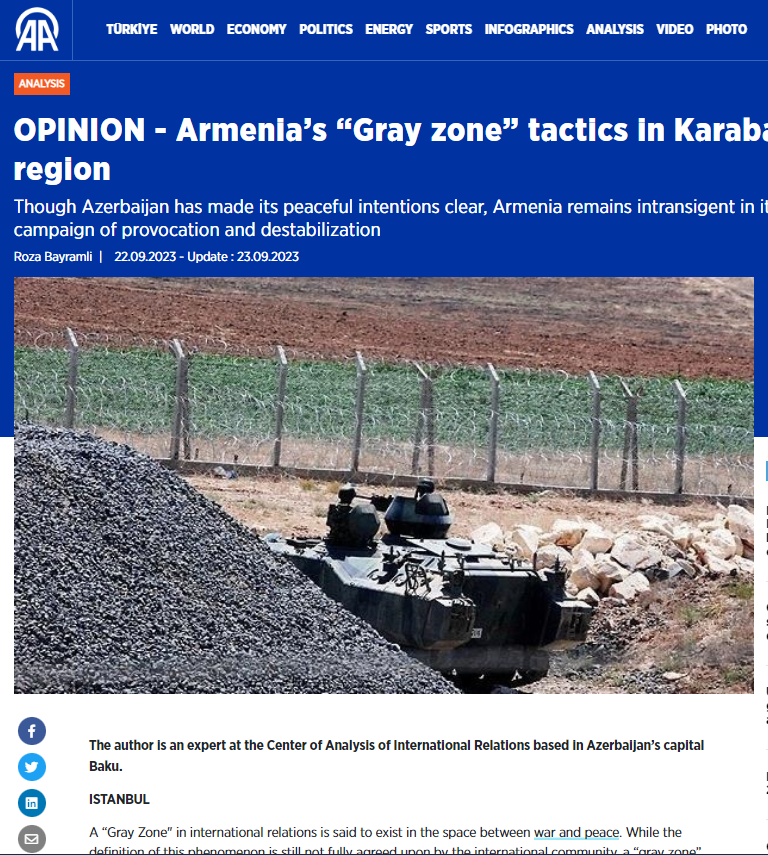
A “Gray Zone” in international relations is said to exist in the space between war and peace. While the definition of this phenomenon is still not fully agreed upon by the international community, a “gray zone” emerges when a nation instigates discreet campaigns of aggression by non-military and paramilitary state and non-state agents that do not quite meet the threshold of open armed conflict. This murky intermediary phase gives rise to a variety of economically and socially hostile tactics, from cyberattacks and disinformation campaigns to mercenary operations and targeted assassinations, aiming to disrupt, destabilize, weaken, or intimidate an adversary by exploiting any vulnerabilities of the target state.
It can be argued that “gray zones” have always been a part of international competition – superpowers hounded each other through proxy wars, destabilizing insurgencies, and legal and information warfare for centuries. But with the advent of the nuclear age, as the risks of escalation to open war have risen to include the threat of total extinction, countries began to advance their national goals almost exclusively through carefully and covertly carried out small-scale acts of aggression.
Gray zone tactics
During the Cold War, both Eastern and Western blocs primarily relied on ploys typical of the “gray zone.” Since then, with the advance of globalization and the emergence of the Internet, and consequently social media, the available means and attack vectors have multiplied exponentially. The potential for abuse in the interconnected and transparent modernity is near infinite.
The Cove, the Australian Army’s professional military education platform, lists as contemporary “gray zone” activities interference in the internal politics of the state, media manipulation, dissemination of disinformation, violation of the sovereign borders of the state, cyber intrusions into government and industry computer networks, espionage, foreign interference, and hostile rhetoric in diplomacy. The international policies of China and Russia provide a plethora of examples of such tactics.
In February-March 2014, the Russian Federation successfully carried out a massive “gray zone” campaign of significant economic pressure, dissemination of disinformation, manipulation of social networks and the media, bribery of key persons, and diplomatic maneuvering prior to ever deploying boots on the ground in the annexation of Crimea.
UK-based analyst and writer on European security issues Ben Nimmo described Russia’s “gray zone” policy in Crimea as a “4D model,” which stands for: [3]
1. Dismiss: Weakening and vilifying the target, denying the truth and discrediting the criticism,
2. Distort: Falsifying the facts and fabricating evidence,
3. Distract: Responding to accusations of aggression by counter-accusations against critics (also known as “whataboutsim”),
4. Dismay: Threatening the opposition with extreme retaliation and disastrous consequences.
Gray zone tactics are also exemplified by the Chinese People’s Liberation Army’s “unrestricted war” and “three warfares” strategies, which blur the lines between war and peace by promoting non-military political, legal, and social means of achieving national goals.
Armenian ‘grey zone’ tactics
After a brutal war in the early 1990s, for 30 years the Karabakh region of the Republic of Azerbaijan was under the occupation of Armenia, and an estimated one million ethnic Azerbaijanis were forced from their homes while the Armenian side laid mines on thousands of square miles of occupied Azerbaijani territory around a small community of ethnic Armenians connected to the Armenian Republic by a single road called “Lachin-Khankendi.” A total of 3,385 victims of Armenian mines have been registered by the Mine Action Agency of the Republic of Azerbaijan since 1991.
The end of the second Karabakh war in November 2020 should have meant the withdrawal of the Armenian military and the de-mining of the Karabakh region of Azerbaijan. Instead, since the end of the war the list of victims of Armenian mine terror grew by over 300 people – 251 injured and 55 killed – as Armenian paramilitaries living in the Karabakh region of the Republic of Azerbaijan continue to lay traps along the perimeter of the liberated territory as reported by Hikmet Hajiyev, adviser to the Azerbaijan president. This systematic policy of terror, further evidenced by the refusal by the Armenian side to provide a complete map of the minefields to Azerbaijan, is but one manifestation of the Armenian version of “gray zone” tactics.
At the end of the 44-day war, Azerbaijan regained control over most of the previously occupied territories, and the prime minister of Armenia publicly recognized the country’s territorial integrity. Thus, Armenians living in the Karabakh region of the Republic of Azerbaijan have become full legal citizens of the Republic. However, integration of ethnic Armenians into the political, economic, and social spectrum of life in Azerbaijan has proven to be impossible as long as the Armenian side continues its persistent “gray zone” aggressions.
Armenian disinformation campaign
As part of a disinformation campaign, starting in June 2023 the Armenians have been complaining to the international community about the alleged “blockade” making the delivery of food into the region “impossible,” leaving out the fact that the entry of aid from Azerbaijan had been inhibited by Armenian residents of Karabakh obstructing the Aghdam-Khankendi road with concrete blocks. Despite this, on Aug. 29, the Azerbaijan Red Crescent Society sent humanitarian aid from Baku with 40 tons of flour products to meet the needs of people of Armenian origin living in Karabakh along the Aghdam-Khankendi road only to be rebuffed again.
The local Armenians, misled by the subversive rhetoric of Armenian leadership, categorically reject offered relief efforts and refuse direct negotiations with the Azerbaijani government. Emboldened by nationalist propaganda, the Armenian residents also violated the agreement that the Agdam-Khankendi and Lachin-Khankendi roads would be opened simultaneously this Sept. 1.
Azerbaijan has repeatedly stated that the Armenian residents of Karabakh are citizens of the country, and that it would not like to politicize the issue of the delivery of humanitarian aid. At the same time, Azerbaijan will not allow separatism within its borders.
The integration of Armenian residents of Karabakh into the populace of Azerbaijan is an important step towards establishing lasting peace in the region. Armenia’s interference with the peace processes through destructive propaganda instead needlessly exacerbates the tensions in the region. Before the first Karabakh war, Azerbaijanis and Armenians were historically documented to have lived in peace and harmony as neighbors in Karabakh. Russians, Georgians, and representatives of dozens of national minorities currently live in Azerbaijan as full-fledged members of society, and people of Azerbaijan are ready to welcome Armenians of Karabakh back into the fold. Furthermore, the use of the Agdam-Khankendi road, an effective route for logistics and transport, would give the Armenians of Karabakh access to all markets of Azerbaijan, as well as neighboring countries.
Though Azerbaijan has repeatedly made its intentions clear to establish peace at the border, Armenia remains intransigent in its campaign of provocation and destabilization in the treacherous “gray zone.”
https://www.aa.com.tr/en/analysis/opinion-armenia-s-gray-zone-tactics-in-karabakh-region/2998793