
This Week in ACC Volleyball The ACC
Day: September 27, 2023
Categories
NPR News: 09-27-2023 11PM EDT
Categories
Bad Neighbor
To best understand the obstacles to peace in Artsakh, one just needs to look at the contents found in the Azerbaijani education system, which not only reflect the Azerbaijani government’s general attitude toward the Armenian nation but also serve as a powerful force perpetuating the vicious cycle of Armenophobia among Azerbaijani youth. The falsification of history and the aggression toward Armenians are vividly pronounced not only in the history textbooks of Azerbaijan but across a wide spectrum of subjects and disciplines, among which literature is a very powerful one.
When reading the Azerbaijani fairy tale Bad Neighbor by Gulzar Ibrahimova, a well-known and celebrated writer in Azerbaijan and the Vice Rector for Scientific Affairs at Baku Eurasian University, one can easily categorize Armenians as villains and Azerbaijanis as victims. The tale starts with the phrase, “Once upon a time, there was a state called Atropatena. This was the previous name of Azerbaijan.” Ironically, Atropatena is a historical area and an ancient state in the northwest of present-day Iran. It corresponds to the territory of Iranian Azerbaijan, which has nothing to do with the current territory and population of the Republic of Azerbaijan. The misleading name may make someone believe otherwise—exactly as the Azerbaijani Republic intended. In May 1918, when the three countries of the South Caucasus declared their independence, the eastern region (which was mainly populated by Muslims and Tatars) wanted to give the region the name, “Eastern and the Southern Trans-Caucasian Republic.” However, the major party at the time, Musavat, with its Pan-Turkic leanings, succeeded in naming it Azerbaijan. Persians protested this decision, as the Persian government argued that Azerbaijan was part of Persia, and the country and the territory east of the South Caucasus (northeast of the Arax river) had never been part of Iranian Azerbaijan. Despite this, after the Bolsheviks occupied the region, Soviet leaders did not attempt to change the name of Azerbaijan. They played the “Southern Azerbaijani card” against Iran.
The fairy tale continues: “Rulers and kings of many countries considered it an honor to decorate their palaces with tableware and jugs made by skilled craftsmen from Atropatena.” With this sentence, the writer establishes the reputation of a country that has a skilled and renowned tradition of craftsmanship, where the “Atropatena people were very hardworking and their skills and efficiency were famous all over the world.” The writer then tells us about Rovshan, a hard-working Azerbaijani craftsman who spares no effort for his family and for his love interest Goncha. He works day and night to pay the bride-dowry for his beloved Goncha, and their love story seems to gradually evolve into a success, before we are introduced to the Armenian villain Vardan (a common Armenian name of Middle Persian origin).
The writer introduces Vardan as a scammer: “Vardan was Armenian. He was expelled from his native land for scam, came to Rovshan’s native town and settled in the old house next to Rovshan’s.” Vardan was a shoemaker, but no one purchased his shoes as they were too expensive, creating a contrast with Rovshan’s character, whose products were in such high demand that “merchants fought to buy them.” Vardan becomes envious of Rovshan’s success and, no matter how much Rovshan tries to help Vardan, the Armenian scammer does not appreciate the kind-hearted Azeri craftsman’s help and “was thinking hard about how to seize Rovshan’s money and was making insidious plans.” Throughout the entire story, Rovshan trusts Vardan unconditionally, but at the end, as Rovshan stoops down to view the bottom of a well, “Vardan pushed him from behind and threw him down to the bottom.” Vardan is presented not only as an envious scammer, willing to steal Rovshan’s fortune, but also as a liar and murderer. “He [Rovshan] did so much good to Vardan that it never occurred to him that Vardan would treat him perfidiously,” the tale reads, to justify Rovshan’s kindness and naivety and reiterate Vardan’s ingratitude and evilness.
At the end of the tale, Goncha manages to save Rovshan’s life. Despite all the harm that Vardan caused him, however, Rovshan decides not to kill Vardan, and instead simply expels the scammer from the town. This ending serves three purposes: first, it highlights the unconditional kindness of the Azerbaijani craftsman who, unlike the villainous Armenian, decided not to commit murder; second, it shows that despite all the harm caused by the Armenians, Azeris will triumph in the end; third, it implies, on a subtextual level, that the “perfidious” Armenians will one day be expelled from Azerbaijani lands. It is important to mention that Bad Neighbor is considered as a “model of modern literary works for children.” According to Professor G. Namazov, it aims to instill “patriotism, sincerity, honesty and purity of soul” in children. It is included in the learning aids for pedagogical university students, as well as in the school curriculum.
The plot of this fairy tale would not be so severe and alarming if it was the only fairy tale portraying Armenians as the villains. Unfortunately, the evil nature of Armenians is a recurring theme in Azerbaijani fairy tales. In another fairy tale, Gulzar Ibrahimova’s Story of Ilham and Fariza, Armenians unite with the Russians and attack “the inhabitants of the nomads’ camp with the aim of murder and robbery. […] The locals did not have time to take up arms while the Armenians and Russians set fire to the Azerbaijanis’ houses, with neither children nor old people spared. They mercilessly killed everyone in their path.” Ironically, throughout history Russians have oftentimes united with Turks and Azeris to attack the Armenian population. During the 2020 Artsakh War, although Russia is officially considered Armenia’s political and military ally, Russian President Vladimir Putin’s government played the double-faced game of selling weapons to Azerbaijan and making decisions that favored Azerbaijan’s political agenda. Russia’s deceitful attitude toward Armenia was also well pronounced in the Soviet times (in fact, the conflict between Armenia and Azerbaijan was initiated by the Soviet Union’s decision to annex Artsakh to the newly formed Republic of Azerbaijan). Presenting Armenians as allies of Russia who together attack the Azeris is an interesting dynamic, which, I believe, neither Putin nor Stalin’s governments have been aware of.
There is something else that I find particularly ironic and hilarious in this fairy tale. “The inhabitants of the nomads’ camp, Azerbaijanis, always considered the Armenians their younger brothers and Russians their elder brothers, so they were thunderstruck by their treachery and betrayal.” The writer’s choice to refer to Armenians as “young brothers” and to Russians as “elder brothers,” as intentless and random as it may be perceived at the surface level, supports the Azerbaijani political agenda of presenting Armenians as a newly-formed nation, with no history or heritage to trace back to. The author could have simply said “Azerbaijanis always considered the Armenians and Russians as their brothers,” but she specifically chose the words “young” and “elder.”
Azerbaijani poems are not as subtle and subtextual. Jabir Novruz’s poem “Three-year-old Asker,” for example, has lines as blatantly violent as, “As soon as he wakes up/ He takes the gun/ My little grandson/ Kills, slaughters the enemy every day,” and territorial claims as unjustifiable and threatening as, “Fight, my little hero/ Because sooner or later/ You should take not only Karabakh/ But also lair of blood Yerevan.” Another poem, Ruslan Novres’s “Armenian,” encourages the reader to kill without hesitation: “If he is sleeping in his cradle, slaughter him quickly, don’t drag it out/ Find a knife, a sharp one!/ The Armenian is a scum!” Phrases like this are found not only in Azerbaijani poems but also in their proverbs, among which a popular one is: “Harda gördün erməni Vur başına gülləni” (meaning “Wherever you meet an Armenian, put a bullet through his head”). Unfortunately, such aggressive statements are voiced not only by adults but also by Azeri children. It therefore comes as no surprise that educators can hold an image of a soldier with a gun in front of children and glorify the soldier as a “hero” for killing Armenian “enemies.”
The Azerbaijani government has succeeded in the formation of territorial nationalism, which would perhaps not be as detrimental if it wasn’t grounded on some other nation’s territory.
Such an upbringing instills hatred and violence in children and results in individuals like Ramil Safarov, an Azerbaijani lieutenant who murdered a 26-year-old Armenian lieutenant. Safarov “struck Markaryan 16 times with an ax, almost decapitating him. Following the murder, he walked over to another Armenian officer’s room, hoping to commit a second murder, but found his door locked.” Ironically enough, Safarov and Markaryan “were in Hungary for a NATO-sponsored Partnership for Peace English-language course in 2004.” When commenting on Safarov’s act, Azerbaijani MP Ganira Pashayeva said: “This is a great event not only for Azerbaijanis living in Azerbaijan, but for the whole Turkish people living inside and outside Azerbaijan.” According to the BBC, “Ramil Safarov was given a hero’s welcome on his return to Azerbaijan last week. As well as an official pardon from President Ilham Aliyev, he was promoted to the rank of major, given a flat and all the pay he had lost since his arrest eight years ago [he was arrested in Hungary, but later released].” Unfortunately, this is not a poem, nor a proverb, nor a dystopian sci-fi film. Perhaps, Gulzar Ibrahimova should revisit her fairy tales and change the roles.
The Azerbaijani government has succeeded in the formation of territorial nationalism, which would perhaps not be as detrimental if it wasn’t grounded on some other nation’s territory. The Azerbaijani government has failed drastically in the upbringing of morally and emotionally healthy citizens, for whom the murder of a young person is not a cause for punishment but rather an occasion for pride and praise. This moral and psychological downgrade has, in the short term, benefited the Azerbaijani government’s political and financial interests and elongated the life of the Aliyev clan. Yet once the common enemy Armenia is destroyed (God forbid) and there is no more unifying national objective, the moral downgrade may turn against Aliyev’s government and lead to detrimental violence among Azerbaijanis themselves, which the Azerbaijani population should be well aware and careful of. At the end of the day, the Azerbaijani national identity has been constructed only in relation to the Armenian identity, and destroying the base will sooner or later result in the collapse of the sixth-floor balcony.
Author information
Milena Baghdasaryan
Milena Baghdasaryan is a graduate from UWC Changshu China. Since the age of 11, she has been writing articles for a local newspaper named Kanch (‘Call’). At the age of 18, she published her first novel on Granish.org and created her own blog, Taghandi Hetqerov (‘In the Pursuit of Talent’)—a portal devoted to interviewing young and talented Armenians all around the world. Baghdasaryan considers storytelling, traveling and learning new languages to be critical in helping one explore the world, connect with others, and discover oneself. Milena currently studies Film and New Media at New York University in Abu Dhabi.
|
The post Bad Neighbor appeared first on The Armenian Weekly.
BOSTON, Mass.—The Armenian National Committee of America (ANCA) Eastern Region will recognize the accomplishments of its 2023 ANCA Leo Sarkisian summer interns – Olivia Abajian (NY), Vahagn Boudakian (NY), Tsoline Gevorkian (MA), Emma Lopez (CT), Ruby Topalian (MD) and Nver Saghatelyan (MD) – at this year’s 17th Annual ANCA Eastern Region Endowment Fund Awards Program, United for Artsakh, at the Royal Sonesta Boston Hotel on Saturday, October 7, 2023.
Founded in 1986, the ANCA LSI program is named in memory of the late ANCA Eastern Region community leader Leo Sarkisian. LSI provides students from both the eastern and western U.S. and Canada with an opportunity to participate in a six-week intensive program in Washington, D.C., designed to give them the tools to advance issues of concern to the Armenian-American community on the federal, state and local level. Now in its 36th year, the program has hundreds of alumni worldwide.
During their six-week stay in the nation’s capital, interns participated in various activities carefully planned by the ANCA office in Washington, D.C. In fact, in three days, interns visited 535 offices encouraging members to cosign a letter led by Representative Barbara Lee (D-CA) to cease all military aid to Azerbaijan – their efforts acquired 54 cosponsors for the letter, setting the course for what the rest of their internship would entail. The remaining weeks would encompass multiple lectures by several key members of Washington’s Armenian-American political elite, who offered the interns their experiences in a variety of fields, encompassing state government, journalism, lobbying, consulting and ambassadorship.
Interns for the LSI program are selected through a competitive application process, with their acceptance being based on several criteria, including academic excellence, demonstrated leadership and community involvement. Interns are provided with room and board in the ANCA Aramian House, donated by generous sister donors Martha and Sue Aramian and Margo Aramian Regan.
The Eastern Region interns from this year’s internship all shared a collective focus on advancing the Armenian Cause in the political, economic and social realms of society as they brought a wealth of experience from their professional and educational backgrounds. The interns shared a range of passion, encompassing the collective fields of government and politics, international relations, psychology, sociology, political science, international studies, economics, and Middle Eastern and European languages and cultures, all of which form a strong foundation for the next generation of activists and the future of the Armenian-American community.
“The many talents and accomplishments of our youth, as well as their drive and motivation, make me confident in the future of the ANCA and Hai Tahd. I have the pleasure of recognizing the interns at this year’s awards dinner and hope my words will continue to empower them and encourage our youth to join the tireless fight for justice for Artsakh, Armenia and the Armenian nation,” said Steve Mesrobian, ANCA Eastern Region Board member.
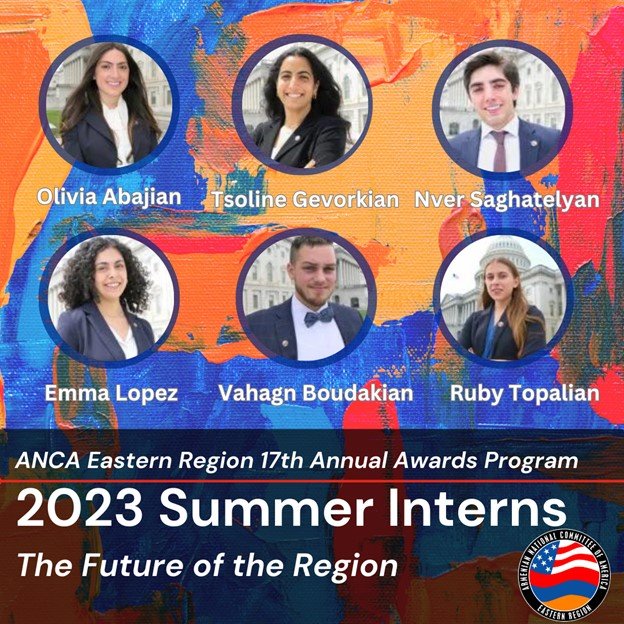 The future of the region – this year’s ANCA Leo Sarkisian Internship interns – will be honored at the 17th Annual Awards Program, United for Artsakh at the Royal Sonesta Hotel on Saturday, October 7.
The 2023 ANCA Leo Sarkisian Eastern Region interns recognized at the Awards Program are Olivia Abajian, Vahagn Boudakian, Tsoline Gevorkian, Emma Lopez, Ruby Topalian and Nver Saghatelyan.
Olivia Abajian is a current freshman at the University of Maryland, majoring in government and politics with a concentration in international relations. Abajian is the editor-in-chief of the Terrapin Yearbook and a member of Phi Sigma Sigma. Bringing her Armenian background onto campus, she is also a member of UMD’s Armenian Students Association and an active member of the AYF-YOARF “Hyortik” Chapter at home.
Vahagn Boudakian, who is pursuing a major in political science with a minor in psychology at Brooklyn College CUNY, actively contributed to refugee relief efforts following the 2020 war and contributed to the war efforts. He is hopeful to employ the new skills acquired from the internship to “further the cause of Armenia’s progress.”
Tsoline Gevorkian, a lifelong member of the AYF, currently serves as the treasurer of the Middlesex County West AYF Chapter. At the University of Vermont, she studies psychology and sociology as a rising junior. Gevorkian credits the internship for allowing her to gain more knowledge about American politics and giving her more confidence toward one day hosting her own AYF educational lecture. It was more important – and a source of pride – that she could spend her summer “fighting for our brothers and sisters in Artsakh and for an Azad Angakh Miatsyal Haiastan.”
Emma Lopez, who recently graduated from the University of Massachusetts Amherst with a degree in political science, wore many hats at her local Armenian Students Association, where she served as vice president, secretary and social media manager. At her home parish, St. George Armenian Church, she is an active member of the local ACYOA, where she also regularly volunteers in community events. She looks forward to using her new skills and experiences to enrich her home community.
Nver Saghatelyan, a student at John Hopkins University, is majoring in international studies and economics. He saw the internship as an opportunity to familiarize himself with the dynamics of American politics and to bring his new lessons back home to Armenia and Artsakh, where he hopes to use these experiences to “challenge the status quo and contribute to peaceful resolutions in contrast to the ongoing tensions and violence.”
Lastly, Ruby Topalian, a rising sophomore at Trinity College Dublin, is pursuing a dual bachelor’s program through Columbia University. At Trinity College Dublin, she studies Middle Eastern and European languages and cultures, especially focusing on Arabic and Italian. At Columbia, she studies political science. According to her, the internship reconnected her to her Armenian heritage, and as an editor on multiple campus publications, she looks forward to leveraging her position to encourage her peers to become educated about Armenian-American issues, hoping that her efforts will create more activists for the Armenian Cause.
Hosted by the ANC of Eastern Massachusetts, the evening will feature a cocktail reception and silent auction beginning at 6 p.m. and a seated dinner and an awards program at 7 p.m. During the dinner presentation, the region will present deserving honorees with awards, including the inaugural ANCA Eastern Region Excellence in Education Award to Houry Boyamian; the inaugural ANCA Eastern Region Advocacy Award to Dr. Michael Rubin; the ANCA Eastern Region Vahan Cardashian Award to lifelong activists Joseph Dagdigian of the ANC of Merrimack Valley and Barkev Kaligian of the ANC of Eastern Massachusetts; and the ANCA Eastern Region Freedom Award, which will be presented to Congresswoman Katherine Clark.
“While the evening will be appropriately somber given the current situation in Artsakh, we are depending on our community to fully support the ANCA Eastern Region’s fundraiser, which will be dedicated to the people of Artsakh and the work we must do together for the continued existence of Artsakh and Armenia,” said Ara Nazarian, ANCA Eastern Region Endowment Fund Awards Program committee chair.
For more information about this year’s Awards Program and to purchase tickets, please visit https://givergy.us/ancaer or email ergala@anca.org.
Author information
The Armenian National Committee of America Eastern Region is part of the largest and most influential Armenian American grassroots organization, the ANCA. Working in coordination with the ANCA in Washington, DC, and a network of chapters and supporters throughout the Eastern United States, the ANCA-ER actively advances the concerns of the Armenian American community on a broad range of issues.
|
The post ANCA Eastern Region Summer Interns to be Honored at 17th Annual Awards Program appeared first on The Armenian Weekly.
On the heels of the Weekly’s conversation with Nyree Derderian, chair of the Armenian Relief Society (ARS) Central Executive Board, the Armenians of Artsakh, already enduring the disastrous outcome of Azerbaijan’s months-long blockade and subsequent attacks, suffered more deaths and injuries from a fuel blast. True to its more than 100-year history of devotion and service to the Armenian people and homeland, the ARS immediately extended condolences and expressed readiness to help.
The ARS is scheduled to hold its quadrennial international convention in Yerevan in a few weeks. While there was initial concern regarding the safety of the delegates and guests, in light of Azerbaijan’s attacks on Artsakh and the unrest in Yerevan, the board decided to move forward with the convention. In the four years since this board was elected, the ARS has sprung into action for Armenians in need five times: Lebanon for economic strife, globally for the pandemic, Lebanon for food shortages, Lebanon for relief from the explosion, and Artsakh beginning with the 2020 war, in that order.
“If we as the Armenian Relief Society are in solidarity with the people and are on the ground, our convention can not only serve to assess our activities for the last four years, it can turn into what we do best, which is reaching out and providing humanitarian assistance,” Derderian said.
The organization has been planning and preparing to meet the needs of the Armenians from Artsakh prior to their arrival in Armenia by the thousands. The ARS will conduct an assessment of the primary and secondary needs of those arriving in Armenia. In contrast to the 2020 war, explained Derderian, the Armenians from Artsakh are being “forcefully deported” with no concrete plan for their future. “The approach needs to be different from helping someone who has been stricken by war with the hope of returning,” Derderian said, explaining that there must be respect and understanding of what the people are bringing with them and what they have left behind.
During the 2020 war, the ARS promised to provide assistance to 1,000 displaced families from Artsakh, amounting to $1 million in aid, through its “Stand with an Artsakh Family” program. Donors pledged $250 per month for four months. According to Derderian, the ARS was ultimately able to assist more than 1,000 families through the generosity of its members and supporters. In fact, she said that over the last three years, the ARS has spent approximately $6 million on projects in Artsakh with humanitarian aid, as well as providing assistance through shipments from afar under the ARS name.
Derderian noted that for the first time in three wars, the International Committee of the Red Cross (ICRC) is physically registering every Armenian from Artsakh arriving in Armenia through Kornidzor. This will provide critical information for the ARS, which is in contact with the ICRC, to determine the assistance needed, both immediately and in the long term.
Derderian was quick to note the natural and immediate instincts of ARS members, sharing a story from besieged and blockaded Artsakh at the beginning of the Azeri attacks on September 19. ARS members sheltering in their office in Stepanakert found the means to get some flour. They knew that the ARS Soseh Kindergarten in Stepanakert was being used as a shelter – one of the purposes for which it was built. They put their lives at risk to acquire the flour and make bread to provide nutrition to those in the shelter.
“We have maintained constant contact with our members in Artsakh from the start of the blockade as much as possible without putting them at risk,” Derderian said. Conversations with ARS members in Artsakh always end with reassurances and motivation for their fellow ARS members globally. “They were asking us to continue to struggle for them. The fact that they have not lost hope when all seems lost means that we don’t have the right to lose hope,” Derderian said. “We have to do everything in our means possible, and impossible, to make sure that they come out of this situation feeling like someone cares.”
 With that mission firmly in mind, the ARS immediately issued a call to help the Armenians of Artsakh forcibly displaced from their homeland.
There are also thousands of students from Artsakh who are currently studying in Armenia who feel abandoned and have lost contact with their families. The ARS is initiating a plan to provide aid to those students.
While the ARS is conducting its needs assessment, Derderian noted that the organization always provides immediate sustenance. “We are A to Z,” she said, stating that the ARS will find those displaced from their homes in Artsakh a place to live, provide food and medical attention. “We are a volunteer force to be reckoned with,” Derderian stated. She remarked on the adept ability of ARS members to raise funds and spread the word, often better than organizations with more resources than the ARS.
In the last few days, the Central Executive Board held an online meeting with all of the ARS entities’ executive boards to discuss the current situation in Artsakh and Armenia and what the role of the ARS globally is to support the people during this critical time. The ARS in Armenia is “organized on the ground and putting steps forward to have the readiness to reach out to the Artsakhtsis coming into Armenia,” Derderdian said.
“The ARS has been doing this for 113 years. We have a mechanism that works and are always learning from that mechanism,” Derderian said. “If you want to donate to the people of Artsakh, donate to the ARS – an organization you can trust to bring programs to fruition.”
Author information

Pauline Getzoyan
Editor
Pauline Getzoyan is editor of the Armenian Weekly and an active member of the Rhode Island Armenian community. A longtime member of the Providence ARF and ARS, she also is a former member of the ARS Central Executive Board. A longtime advocate for genocide education through her work with the ANC of RI, Pauline is co-chair of the RI branch of The Genocide Education Project. In addition, she has been an adjunct instructor of developmental reading and writing in the English department at the Community College of Rhode Island since 2005.
|
The post The ARS stands ready to assist the Armenians of Artsakh appeared first on The Armenian Weekly.
Calling Pashinyan’s Remarks ‘Unacceptable Attacks,’ Moscow Warns Yerevan – Asbarez.com Asbarez Armenian News