
Day: September 27, 2023
On September 27, Tbilisi City Court Judge Nino Shcherbakovi ruled on the cases of human rights defenders and activists who were arrested on June 2 for holding banners and wearing T-shirts with the name of Prime Minister Irakli Garibashvili, with only one letter of his first name changed to evoke an association with male genitalia.
A group of protesters had rallied on June 2 in solidarity with Beka Grigoriadis, who was detained on the same site a day earlier as he was trying to set up a tent to protest against the detention of his son, Lazare Grigoriadis.
According to the judge’s decision, the case against Saba Brachveli (lawyer of the Open Society Foundation – Georgia), Eduard Marikashvili (Chairman of the Georgian Democracy Initiative), and activists Nika Romanadze and Grigol Prangishvili was closed under Article 173 of the Administrative Code for disobeying a police officer. They were found guilty of petty hooliganism and fined 500-500 GEL. As for the activist Nodar Sikharulidze, he was fined for 2000 GEL.
Before making her decision, Judge Nino Shcherbakovi questioned four policemen and five participants of the rally. The hearings also examined video evidence, none of which showed resistance to police or verbal abuse.
In addition, Saba Brachveli’s human rights defenders filed a request with the Prosecutor’s Office to open an investigation into his deliberate illegal arrest and the false testimony of police officer Davit Keshelashvili. Saba Brachveli and his lawyers claim that the order to arrest Brachveli was issued by the deputy head of the patrol police, Sergi Bzishvili, and that Keshelashvili was not present at the Parliament. They asked for Bzishvili to be questioned, but the judge did not agree. In the case of Eduard Marikashvili, the credibility of the witness’s testimony was also questioned.
Also Read:
National flags are lowered to half-mast at government buildings as Georgia commemorates the 30th anniversary of the fall of Sokhumi on September 27, 1993, marking the end of armed conflict in Abkhazia in 1992-1993.
To honor the victims, Georgian Prime Minister Irakli Garibashvili, the Cabinet Ministers, Mayor of Tbilisi, opposition leaders as well as the members of public have paid tributes at the memorial of the fallen Georgian soldiers on Tbilisi’s Heroes Square.
“This war has left a devastating mark in our country – ethnic cleansing has turned hundreds of thousands into refugees in their own homeland and, most lamentably, many of our compatriots have tragically fallen victim to it,” the Prime Minister is quoted in a statement published by the Government Administration. “The de-occupation of the Russia-occupied regions and the country’s unification remain the main challenge facing our state and society,” Garibashvili added, and reiterated Georgia’s commitment to the peaceful resolution of the conflict.
Kakha Kaladze, Mayor of Tbilisi and the General-Secretary of the ruling Georgian Dream party wrote that “peace and development have no alternative” for the reunification of Georgia.
Tea Akhvlediani, State Minister for Reconciliation and Civic Equality said this day is the embodiment of Georgia’s “immeasurable pain…reviving the tragic history of hundreds of thousands, which was caused by Russia-instigated military actions in the 90s.” Akhlediani also recalled the years of mutually respectful and peaceful coexistence of the Georgian and Abkhazian peoples, which she said was the basis for building lasting peace and reconciliation.
The opposition also reacted to the anniversary. According to Irakli Pavlenishvili of the United National Movement (UNM), “today we have a chance not to waste this dedication of spirit and a chance to use this geopolitical reality and restore out territorial integrity.”
The European Georgia’s Giga Bokeria commented saying that Russia carried out military aggression and committed genocide against Georgians but this fact was wrongly classified as ethnic conflict. According to Bokeria, Georgia now has a prove its truth.
Aghmashenebeli Strategy’s Giorgi Vashadze noted that the reunification of the country is the highest value, and the main factor on this path is the strength of Georgia within the EU and the NATO.
The US Embassy in Georgia also reacted, saying that “on the 30th anniversary of the fall of Sukhumi to Russian-backed forces, the Chargé D’ Affaires Alan Purcell and the U.S. military personnel honored the memory of tens of thousands who died. In addition to the countless lives lost, this tragedy resulted in hundreds of thousands of people losing their homes. We remember September 27, 1993, the day of the fall of Sukhumi.”
Tbilisi dispatched troops to the Autonomous Republic of Abkhazia in summer 1992 to protect the Abkhazia section of the Russian-Georgian railway.
The government troops were forced to withdraw from the region in September 1993, following the attack on Sokhumi on September 16, 1993, by Abkhaz militants and mercenaries from the Russian Federation. The attack has occurred in violation of the July 27 ceasefire that envisaged the withdrawal of heavy Georgian weaponry from Sokhumi and its surroundings.
September 27 is associated in Georgia with the loss of control over Abkhazia and the ethnic cleansing of Georgians that occurred in that region. Reportedly, more than 12,000 people died during the armed conflict. Around 300,000 remain displaced to this day.
Also Read:
- 27/09/2022 – Georgia Marks 29 Years Since the Fall of Sokhumi
On September 27, Tbilisi City Court Judge Nino Shcherbakovi ruled on the cases of human rights defenders and activists who were arrested on June 2 for holding banners and wearing T-shirts with the name of Prime Minister Irakli Garibashvili, with only one letter of his first name changed to evoke an association with male genitalia.
A group of protesters had rallied on June 2 in solidarity with Beka Grigoriadis, who was detained on the same site a day earlier as he was trying to set up a tent to protest against the detention of his son, Lazare Grigoriadis.
According to the judge’s decision, the case against Saba Brachveli (lawyer of the Open Society Foundation – Georgia), Eduard Marikashvili (Chairman of the Georgian Democracy Initiative), and activists Nika Romanadze and Grigol Prangishvili was closed under Article 173 of the Administrative Code for disobeying a police officer. They were found guilty of petty hooliganism and fined 500-500 GEL. As for the activist Nodar Sikharulidze, he was fined for 2000 GEL.
Before making her decision, Judge Nino Shcherbakovi questioned four policemen and five participants of the rally. The hearings also examined video evidence, none of which showed resistance to police or verbal abuse.
In addition, Saba Brachveli’s human rights defenders filed a request with the Prosecutor’s Office to open an investigation into his deliberate illegal arrest and the false testimony of police officer Davit Keshelashvili. Saba Brachveli and his lawyers claim that the order to arrest Brachveli was issued by the deputy head of the patrol police, Sergi Bzishvili, and that Keshelashvili was not present at the Parliament. They asked for Bzishvili to be questioned, but the judge did not agree. In the case of Eduard Marikashvili, the credibility of the witness’s testimony was also questioned.
Also Read:
National flags are lowered to half-mast at government buildings as Georgia commemorates the 30th anniversary of the fall of Sokhumi on September 27, 1993, marking the end of armed conflict in Abkhazia in 1992-1993.
To honor the victims, Georgian Prime Minister Irakli Garibashvili, the Cabinet Ministers, Mayor of Tbilisi, opposition leaders as well as the members of public have paid tributes at the memorial of the fallen Georgian soldiers on Tbilisi’s Heroes Square.
“This war has left a devastating mark in our country – ethnic cleansing has turned hundreds of thousands into refugees in their own homeland and, most lamentably, many of our compatriots have tragically fallen victim to it,” the Prime Minister is quoted in a statement published by the Government Administration. “The de-occupation of the Russia-occupied regions and the country’s unification remain the main challenge facing our state and society,” Garibashvili added, and reiterated Georgia’s commitment to the peaceful resolution of the conflict.
Kakha Kaladze, Mayor of Tbilisi and the General-Secretary of the ruling Georgian Dream party wrote that “peace and development have no alternative” for the reunification of Georgia.
Tea Akhvlediani, State Minister for Reconciliation and Civic Equality said this day is the embodiment of Georgia’s “immeasurable pain…reviving the tragic history of hundreds of thousands, which was caused by Russia-instigated military actions in the 90s.” Akhlediani also recalled the years of mutually respectful and peaceful coexistence of the Georgian and Abkhazian peoples, which she said was the basis for building lasting peace and reconciliation.
The opposition also reacted to the anniversary. According to Irakli Pavlenishvili of the United National Movement (UNM), “today we have a chance not to waste this dedication of spirit and a chance to use this geopolitical reality and restore out territorial integrity.”
The European Georgia’s Giga Bokeria commented saying that Russia carried out military aggression and committed genocide against Georgians but this fact was wrongly classified as ethnic conflict. According to Bokeria, Georgia now has a prove its truth.
Aghmashenebeli Strategy’s Giorgi Vashadze noted that the reunification of the country is the highest value, and the main factor on this path is the strength of Georgia within the EU and the NATO.
The US Embassy in Georgia also reacted, saying that “on the 30th anniversary of the fall of Sukhumi to Russian-backed forces, the Chargé D’ Affaires Alan Purcell and the U.S. military personnel honored the memory of tens of thousands who died. In addition to the countless lives lost, this tragedy resulted in hundreds of thousands of people losing their homes. We remember September 27, 1993, the day of the fall of Sukhumi.”
Tbilisi dispatched troops to the Autonomous Republic of Abkhazia in summer 1992 to protect the Abkhazia section of the Russian-Georgian railway.
The government troops were forced to withdraw from the region in September 1993, following the attack on Sokhumi on September 16, 1993, by Abkhaz militants and mercenaries from the Russian Federation. The attack has occurred in violation of the July 27 ceasefire that envisaged the withdrawal of heavy Georgian weaponry from Sokhumi and its surroundings.
September 27 is associated in Georgia with the loss of control over Abkhazia and the ethnic cleansing of Georgians that occurred in that region. Reportedly, more than 12,000 people died during the armed conflict. Around 300,000 remain displaced to this day.
Also Read:
- 27/09/2022 – Georgia Marks 29 Years Since the Fall of Sokhumi
Michael Novakhov’s favorite articles on Inoreader
NPR News: 09-27-2023 11AM EDT
posted at 15:37:02 UTC by NPR via NPR: Hourly News Summary Podcast
NPR News: 09-27-2023 11AM EDT
Former state minister of Nagorno-Karabakh arrested by Azerbaijan – The Guardian
posted at 15:40:01 UTC via “Nagorno-Karabakh” – Google News
Сontinuous illegal presence of Armenian military forces in Azerbaijan couldn’t go on endlessly – official
posted at 15:43:13 UTC via AzerNews – News from Azerbaijan, Business, Energy, Analysis
There is no way that this continued illegal presence of Armenian armed forces in the sovereign territory of Azerbaijan, as well as fake “state structures” could continue to exist, Representative of the President of the Republic of Azerbaijan for Special Assignments Elchin Amirbayov told BBC, Azernews reports.
 image/jpeg elchin_emirbeyov_200923.jpg
image/jpeg elchin_emirbeyov_200923.jpg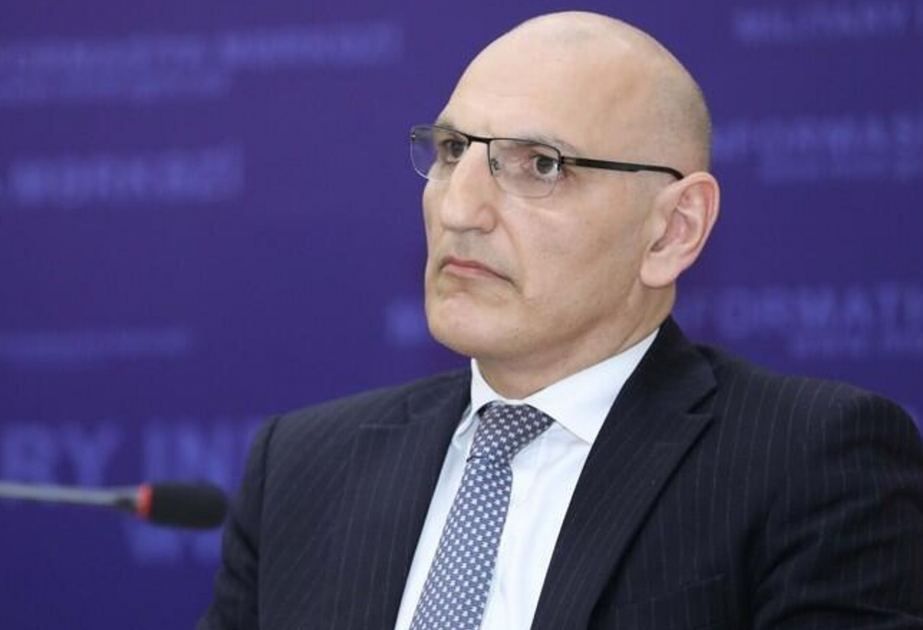
Azerbaijan Arrests Former Artsakh State Minister Ruben Vardanyan … – Asbarez Armenian News
posted at 15:51:44 UTC via “lachin corridor” – Google News
Azerbaijan Arrests Former Artsakh State Minister Ruben Vardanyan … Asbarez Armenian News
BBC reports from Nagorno-Karabakh border amid panic – BBC
posted at 15:57:43 UTC via “Armenia” – Google News
Hakan Fidan mulls regional issues with Armenian FM
posted at 16:06:22 UTC via Report News Agency
A telephone conversation took place between the foreign ministers of Türkiye and Armenia, Hakan Fidan and Ararat Mirzoyan
image/jpeg 963ec2fd-f1bd-3bac-90bf-1280276ada39_490.jpg
image/jpeg 963ec2fd-f1bd-3bac-90bf-1280276ada39_490.jpg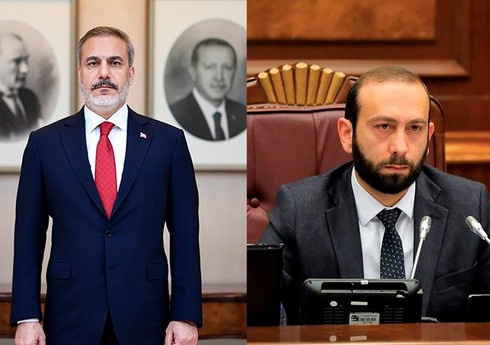
Booby traps being neutralized in Karabakh region of Azerbaijan
posted at 16:06:22 UTC via Report News Agency
The Azerbaijani army’s engineer-sapper units are taking measures on clearing the territory of mines and unexploded ordnance in the Karabakh region
image/jpeg 519a1c77-78bc-3e1d-872b-6575c1d8b1dc_490.jpg
image/jpeg 519a1c77-78bc-3e1d-872b-6575c1d8b1dc_490.jpg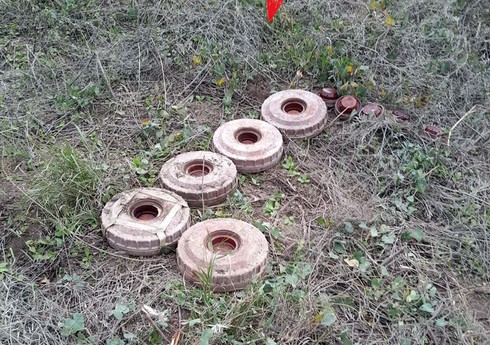
Azerbaijan arrests former Karabakh leader as Armenian exodus grows – The Independent
posted at 16:08:19 UTC via “South Caucasus News” – Google News
Azerbaijan’s victory in Nagorno-Karabakh opens the door to new conflicts in the Caucasus – EL PAÍS USA
posted at 16:08:52 UTC via “South Caucasus” – Google News
EL PAÍS USA
Death toll rises in blast that killed dozens of Armenian refugees
posted at 17:46:21 UTC via abcnews.go.com
LONDON — At least 68 people were killed and 105 are still missing from an explosion that tore through a makeshift gas station being used by ethnic Armenians on Monday night as thousands sought to flee the disputed enclave of Nagorno-Karabakh, according to local authorities.
The newly revised death toll followed a statement earlier from Armenia’s health minister, Anahit Avanesyan, saying 125 bodies from people killed in the blast had been brought to Armenia.
But Avanesyan later said those bodies were casualties from fighting. The Stepanakert Forensic Medical Examination Bureau in the enclave’s regional capital said Tuesday the number of confirmed dead from the gas station blast remained at 68, with nearly 300 injured.
Many of the injured have been evacuated to Armenia, carried by Armenian and Russian military helicopters, local officials said. Avanesyan said most of the patients had extremely severe to severe injuries.
The explosion and fire ripped through the fuel store on Monday night as hundreds of refugees were lining up for gas for their vehicles to leave Nagorno-Karabakh, according to local officials.
Thousands of ethnic Armenians have been leaving the enclave following a successful military offensive last week by Azerbaijan that defeated the local Armenian authorities and restored Azerbaijan’s rule over the region.

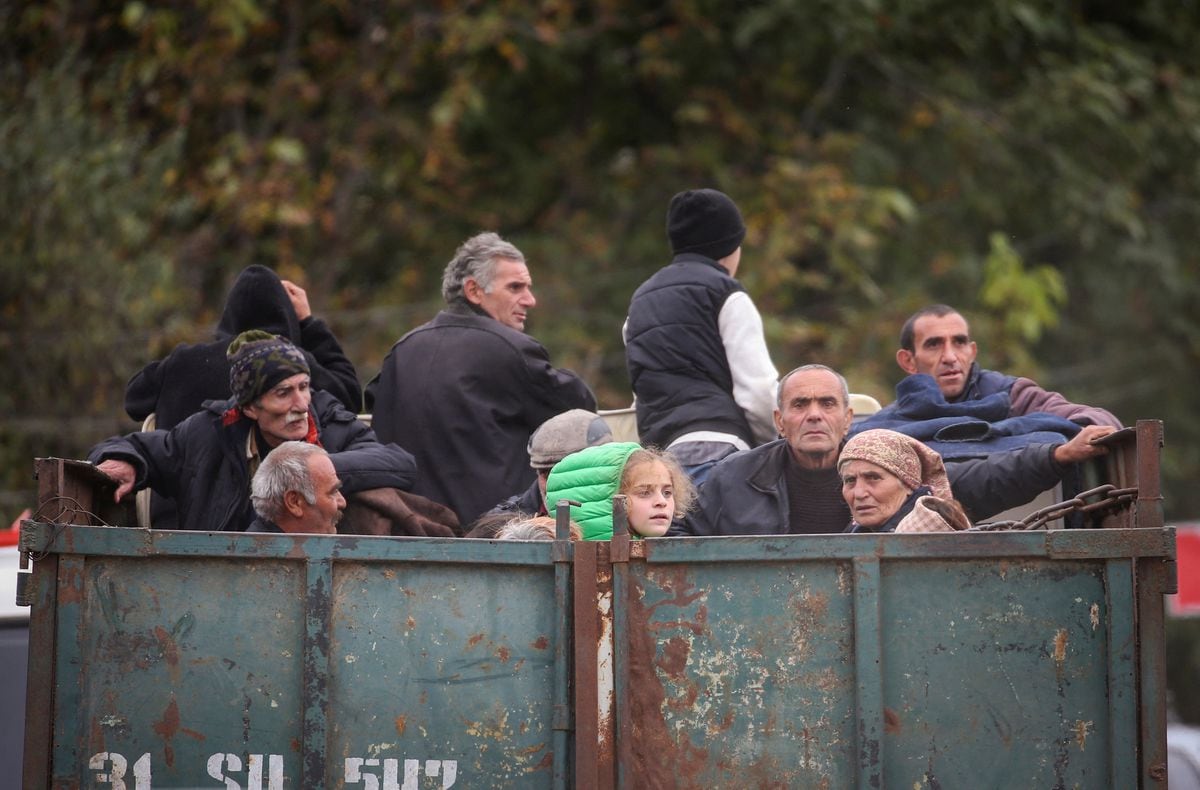
Ethnic Armenians from Nagorno-Karabakh sit in a truck on their way to Goris in Syunik region, Armenia, on Tuesday, Sept. 26, 2023.
More than 28,000 people have crossed from Nagorno-Karabakh into Armenia since Sunday, according to a statement from Armenia’s government. It’s feared the enclave’s entire population — estimated at 120,000 — may seek to flee in the coming days.
Armenia’s prime minister on Monday said what was happening was the “ethnic cleansing” of Nagorno-Karabakh’s Armenian population.
Long traffic jams of people seeking to leave were visible snaking miles along the only road out of Nagorno-Karabakh to a checkpoint in the “Lachin Corridor” that links the enclave to Armenia.
Nagorno-Karabakh has been at the center of a decadeslong conflict between Armenia and Azerbaijan. Internationally recognized as Azerbaijan’s territory, the two countries fought a bloody war over the enclave amid the collapse of the Soviet Union, in which Armenia backed local ethnic Armenian separatists, who succeeded in establishing control over most of the region. Hundreds of thousands of Azerbaijani civilians were driven from the region during that war.
Azerbaijan reopened the conflict in 2020, launching a full-scale war that decisively defeated Armenia and forced it to largely abandon its claims to Nagorno-Karabakh. Russia helped broker a truce and dispatched a peacekeeping force there that remains deployed. Last week, Azerbaijan launched a new offensive that swiftly forced the Nagorno-Karabakh Armenian’s leadership to surrender.

Medics of the Russian peacekeeping troops treat people injured in an explosion at a fuel depot outside Stepanakert, in an unknown location in Nagorno-Karabakh, a region inhabited by ethnic Armenians, in this still image from video published Sept. 26, 2023.
Russian Defence Ministry via Reuters
Since then thousands of ethnic Armenians have been preparing to leave the enclave, which has been under Azerbaijani blockade for nine months, unwilling to live under Azerbaijan’s rule and fearing they will face persecution.
Western countries, including the United States, France and Germany, have expressed concern for Nagorno-Karabakh’s Armenian population and warned Azerbaijan it bears responsibility for their rights and security.
The Biden administration has dispatched Samantha Power, currently administrator of USAID and senior another State Department official to Armenia to express U.S. support for the country amid the crisis.
Power on Tuesday visited the checkpoint at Armenia’s border with Nagorno-Karabakh where refugees have been arriving, and called for international monitors and aid groups to be given access to the enclave and for Azerbaijan to facilitate the evacuation of injured civilians from there.
“It is absolutely critical that independent monitors as well as humanitarian organizations get access to the people in Nagorno-Karabakh who still have dire needs,” Power told journalists at the checkpoint. “There are still tens of thousands of Ethnic Armenians there living in very vulnerable conditions,” announcing the U.S. would provide $11.5 million in humanitarian assistance that would include everything from food to psychiatric support.

A medic of the Russian peacekeeping troops treats a man injured in an explosion at a fuel depot outside Stepanakert, in an unknown location in Nagorno-Karabakh, a region inhabited by ethnic Armenians, in this still image from video published Sept. 26, 2023.
Russian Defence Ministry via Reuters
Power, who has been a high-profile campaigner for human rights, said she was in Armenia to also hear testimonies from people fleeing Nagorno-Karabakh and that she would be reporting back to the Biden Administration as it considers how to respond to the crisis.
Power and the Acting Assistant Secretary for Europe and Eurasian Affairs, Yuri Kim met with Armenia’s prime minister Nikol Pashinyan on Monday. Power delivered a letter from President Joe Biden in which he expressed condolences for the loss of life in Nagorno-Karabakh and promised help on addressing humanitarian needs.
“I have asked Samantha Power, a key member of my cabinet, to personally convey to you the strong support of the United States and my Administration for Armenia’s pursuit of a dignified and durable regional peace that maintains your sovereignty, independence, territorial integrity, and democracy,” the letter read.
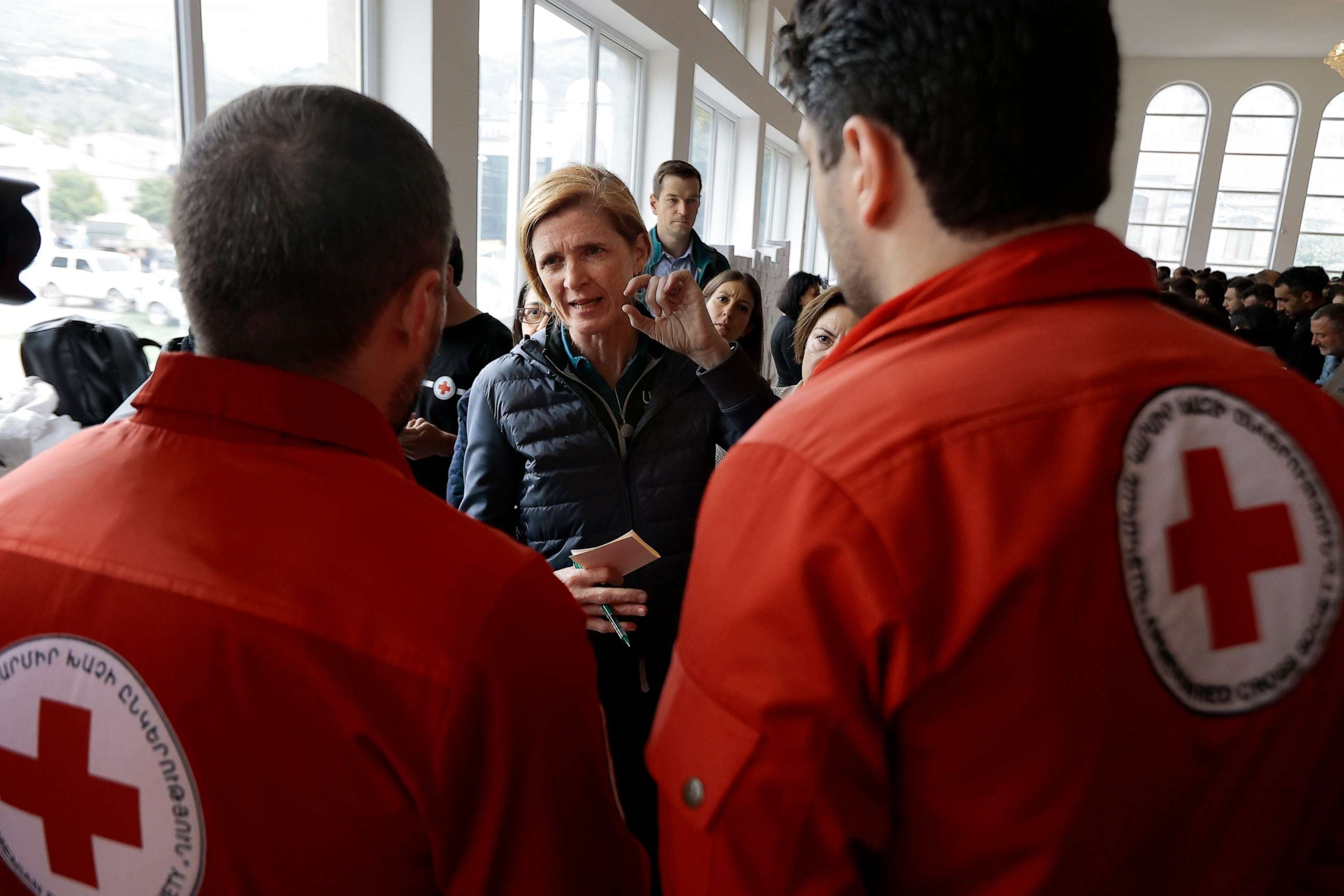
U.S. Agency for International Development Administrator Samantha Power, center, speaks to the Red Cross members while visiting ethnic Armenians from Nagorno-Karabakh at a temporary camp in Armenia’s Goris in Syunik region, Armenia, on Tuesday, Sept. 26, 2023.
Pashinyan told Power the international community and Armenia had failed to prevent the “ethnic cleansing” of Nagorno-Karabakh’s Armenians.
“Unfortunately, at the moment the process of the ethnic cleansing of Armenians in Nagorno-Karabakh is continuing, it is happening right now. It’s a very tragic fact. We tried to inform the international community that this ethnic cleansing would happen, but, unfortunately, we did not manage to prevent it,” Pashinyan told Power and Yuri Kim, the State Department’s acting assistant secretary for Europe and Eurasian Affairs, according to the prime minister’s press service.
Armenia and Azerbaijan were due to hold talks mediated by the European Union in Brussels on Tuesday, the first talks between the sides since Azerbaijan’s retook Nagorno-Karabakh.

Refugees queue in vehicles near the border town of Kornidzor, arriving from Nagorno-Karabakh, on Sept. 26, 2023.
Alain Jocard/AFP via Getty Images
Monday’s blast at the fuel station added a horrific complication to the exodus from Nagorno-Karabakh, with local authorities pleading for people to hold off leaving as the traffic-choking the roads out was preventing the evacuation of the severely injured.
Helicopters from Armenia’s capital, Yerevan, were reported to have flown to Nagorno-Karabakh to help evacuate some of the worst injured. A long line of ambulances was also filmed by Russian media crossing into the enclave.
The enclave’s Armenian health authorities said the hospitals in the enclave, already short of medicine and other equipment, were not equipped for the disaster.
Russia’s peacekeeping contingent said it was also providing medical assistance and showed videos of its soldiers evacuating some of the injured.
Armenian Exodus Passes 50000 as US Presses Azerbaijan on Safety – Bloomberg
posted at 16:13:19 UTC via “Yuri Kim” – Google News
AP Headline News – Sep 27 2023 10:00 (EDT)
posted at 14:34:17 UTC by The Associated Press via Associated Press Bulletins
NPR News: 09-27-2023 10AM EDT
posted at 14:36:23 UTC by NPR via NPR: Hourly News Summary Podcast
NPR News: 09-27-2023 10AM EDT
‘Where are France, America and Charles Michel?’ Armenians rage … – POLITICO Europe
posted at 14:37:20 UTC via “South Caucasus” – Google News
‘Where are France, America and Charles Michel?’ Armenians rage … POLITICO Europe
President Ilham Aliyev receives US delegation
posted at 14:43:17 UTC (updated on Wed Sep 27, 2023 16:13) via AzerNews – News from Azerbaijan, Business, Energy, Analysis
President of the Republic of Azerbaijan Ilham Aliyev has received U.S President’s special representative, Administrator of the United States Agency for International Development (USAID) Samantha Power, U.S Acting Assistant Secretary of State for European and Eurasian Affairs Yuri Kim and US State Department’s Senior Advisor for Caucasus Negotiations Louis Bono.
image/jpeg 169582355247993954_1200x630.jpg
image/jpeg 169582355247993954_1200x630.jpg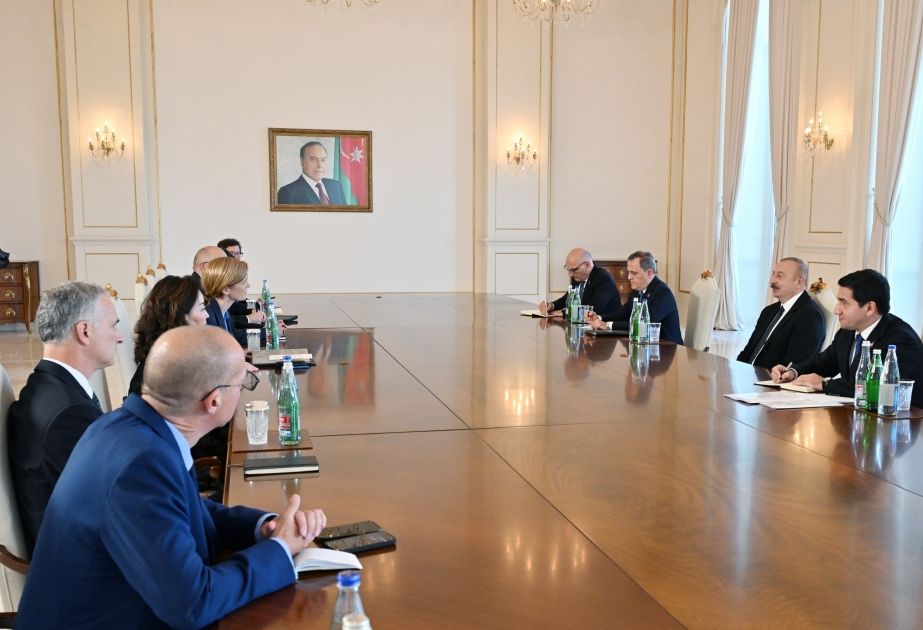
Azerbaijan says it has detained Ruben Vardanyan, the former head of Nagorno-Karabakh’s separatist government – ABC News
posted at 14:48:56 UTC via “Azerbaijan” – Google News
President Ilham Aliyev receives US delegation – AzerNews.Az
posted at 14:54:45 UTC via “Ilham Aliyev” – Google News
President Ilham Aliyev receives US delegation AzerNews.Az
Former Nagorno-Karabakh leader arrested as half of population flee to Armenia
posted at 15:42:25 UTC via thenationalnews.com
The former head of Nagorno-Karabakh’s separatist government was arrested as he tried to cross into Armenia on Wednesday, Azerbaijani authorities said.
Ruben Vardanyan was one of more than 50,000 people to cross into Armenia from the separatist region, almost half of its 120,000 population, since Azerbaijan lifted its nine-month blockade on the enclave on Sunday.
It marks a fundamental shift in ethnic control of lands that had been disputed by mostly Christian Armenians and predominantly Muslim Azerbaijanis for the past century.
Despite Azerbaijan’s promises to respect the rights of the region’s ethnic Armenians, they have rushed to flee the region en masse, fearing reprisals.
It follows Azerbaijan’s 24-hour blitz last week to reclaim control of the region, involving heavy artillery, rocket launchers and drones, which forced the separatist authorities to agree to lay down weapons and sit down for talks on Nagorno-Karabakh’s “reintegration” into Azerbaijan.
Mr Vardanyan, a billionaire businessman who made his fortune in Russia where he owned a major investment bank, moved to Nagorno-Karabakh last year and served as the head of the regional government for several months before stepping down this year.
Azerbaijan’s border security service said Mr Vardanyan was escorted to the country’s capital of Baku and handed over to “the relevant state bodies”. It posted a picture of him being held by two border guards next to a helicopter.
His wife Veronika Zonabend said on his Telegram channel that he had been arrested while trying to flee. She asked for people’s “prayers and support for my husband’s safe release”.
:quality(70)/d27020bajtkr6c.cloudfront.net/09-27-2023/t_e03b255805fb4e6395414e18376a3957_name_RC2YG3ACAUD9)
It was not known on what grounds Mr Vardanyan had been held but Azerbaijan has signalled it will seek to prosecute prominent figures in the Karabakh leadership.
“We have accused elements of the criminal regime and we will bring them to justice,” Azeri President Ilham Aliyev said last week, without naming anyone or specifying any crime.
Kremlin spokesman Dmitry Peskov refused to comment on the arrest of Mr Vardanyan, who renounced his Russian citizenship after moving to Nagorno-Karabakh.
Armenia’s attempts to absorb the rush of ethnic Armenians come with officials still trying to identify the whereabouts of more than 100 people reported missing in a fuel depot blast on Monday that claimed 68 lives.
:quality(70)/cloudfront-eu-central-1.images.arcpublishing.com/thenational/P74W3RRWDQJDGH36IMSGMB6UQ4.jpg)
:quality(70)/cloudfront-eu-central-1.images.arcpublishing.com/thenational/V7LFYVQCAPGW4OVGSDYPBFLVPA.jpg)
:quality(70)/cloudfront-eu-central-1.images.arcpublishing.com/thenational/5EXCGYZ6JAFDGQFMOR4NSEUQT4.jpg)
:quality(70)/cloudfront-eu-central-1.images.arcpublishing.com/thenational/A4SK5JIOMRITSU626QG7M6RYLA.jpg)
:quality(70)/cloudfront-eu-central-1.images.arcpublishing.com/thenational/QP2UWJGBB7C4QMTCY2IHN534UM.jpg)
:quality(70)/cloudfront-eu-central-1.images.arcpublishing.com/thenational/4GOBE5UGSFXYPJDXLHJ4WSPF2U.jpg)
:quality(70)/cloudfront-eu-central-1.images.arcpublishing.com/thenational/7ZENTK276VAS5D3P3NEYAWH33I.jpg)
:quality(70)/cloudfront-eu-central-1.images.arcpublishing.com/thenational/75QSBH73AIDTZRQF3HS5OTXWXE.jpg)
:quality(70)/cloudfront-eu-central-1.images.arcpublishing.com/thenational/C64KB4XD3PXYLR5UKLGIM4H7QA.jpg)
:quality(70)/cloudfront-eu-central-1.images.arcpublishing.com/thenational/HJMPCSGHIXNBNJEYL2U5HAQ7UI.jpg)
:quality(70)/cloudfront-eu-central-1.images.arcpublishing.com/thenational/WH6HHYRQHK3QNIA3LZF5W7ATH4.jpg)
Ethnic Armenians from Nagorno-Karabakh sit in the back of a vehicle after crossing the border on their way to an Armenian Ministry of Foreign Affairs registration centre in Kornidzor, Armenia. EPA
The fireball erupted as refugees were stocking up on fuel for the long drive along the mountain road leading to Armenia.
Azerbaijan’s Health Ministry said a total of 192 Azerbaijani troops have been killed and 511 wounded in the offensive in Nagorno-Karabakh. One Azeri civilian also died in the hostilities, the ministry said.
Nagorno-Karabakh officials earlier said at least 200 people on their side, including 10 civilians, were killed and more than 400 were wounded in the fighting.
Azerbaijan’s swift onslaught followed a nine-month blockade of the road connecting Nagorno-Karabakh with Armenia. The Armenian government in Yerevan claimed the closure denied basic food and fuel supplies to the enclave’s residents, while Azerbaijan countered by alleging the Armenian government was using the road for mineral extraction and transporting illicit weapons to the region’s separatist forces.
The Armenian government on Wednesday said it had received 50,243 Nagorno-Karabakh refugees since Azerbaijan’s lightning offensive.
:quality(70)/cloudfront-eu-central-1.images.arcpublishing.com/thenational/S2DBUOTPCJA4LBDYIJENTIHONQ.png)
It has prepared living arrangements for 40,000 families since last week’s fighting broke out.
Armenian Prime Minister Nikol Pashinyan’s spokeswoman said late on Tuesday the government had so far been able to find housing for only 2,850 people.
Western governments fear a humanitarian disaster and are pressing for Azerbaijan to allow international observers into Karabakh to monitor its treatment of the resident population.
“What is needed now is transparency and the eyes and ears of the international community on the spot,” German Foreign Minister Annalena Baerbock posted on X, formerly Twitter.
“It would be a sign of confidence that Azerbaijan is serious about its commitments to the security and well-being of the people of Nagorno-Karabakh if it allows international observers.”
independent political analyst Boris Navasardyan said: “The influx of refugees will have a serious impact on the domestic political situation in Armenia.”
The Red Cross and the UN’s refugees agency are trying to organise immediate help.
Moscow is now firing daily barbs at Mr Pashinyan for his vow on Sunday to pivot away from Armenia’s long-standing alliance with the Kremlin.
Mr Pashinyan has blamed Russia for failing to avert the Azerbaijani offensive and called Armenia’s current foreign security alliances “ineffective” and “insufficient”.
The comments underscored the extent to which the Kremlin’s influence has shrunk across former Soviet republics since it became bogged down in its war on Ukraine.
But Moscow still has an important military base in Armenia and has indicated that it will try to keep Yerevan in its sphere of influence.
Russia’s Foreign Ministry on Wednesday said Moscow expected “all agreements on developing bilateral co-operation … to continue to be implemented” in full.
Former Nagorno-Karabakh leader arrested as half of population flee … – The National
posted at 14:55:56 UTC via “Armenia” – Google News
Former Nagorno-Karabakh State Minister Ruben Vardanyan detained by Azerbaijan
posted at 15:01:04 UTC by Ismi Aghayev via OC Media
Azerbaijan has detained Nagorno-Karabakh’s former state minister, Ruben Vardanyan, as he attempted to cross the Lachin checkpoint into Armenia.
Vardanyan, a Russian-Armenian businessperson and billionaire, was detained on Wednesday, as announced by Azerbaijan’s State Border Service. The announcement stated that Vardanyan had illegally entered Azerbaijan, and cited his work as Nagorno-Karabakh’s state minister as factors in his arrest.
The Border Service stated that Vardanyan is currently in Baku, and is awaiting a decision by ‘the relevant state authorities’.
Vardanyan’s arrest was confirmed by his wife, Veronika Zonabend, via his Twitter account on Wednesday afternoon.
‘My husband, Ruben Vardanyan, the philanthropist, businessman, and former Minister of State of Artsakh (Nagorno-Karabakh) was arrested and detained by the Azerbaijani authorities at the border this morning as he tried to leave with thousands of Armenians’, wrote Zonabend.
Speaking to Russian newspaper RBC, Zonabend clarified that Vardanyan was detained while crossing the Hakari Bridge, where an Azerbaijani checkpoint has been located since April.
The Armenian government has reportedly applied to the European Court of Human Rights (ECHR), demanding that Baku provide information on Vardanyan’s location and condition.
Ruben Vardanyan was appointed Minister of State by Nagorno-Karabakh’s then-President Arayik Harutyunyan in November 2022, and given substantially wider powers than his predecessorw. While previous state ministers only coordinated the work of four ministries, Vardanyan oversaw all ministries.
His appointment proved controversial from the beginning, in part due to his business links in Russia. Vardanyan also gained attention and notoriety for his frequent live broadcasts from Nagorno-Karabakh during the first months of the blockade, and for repeated criticism of him by the Azerbaijani authorities.
In February, Vardanyan was dismissed from his post by Harutyunyan. Nagorno-Karabakh’s then-President stated that the decision was attributable to ‘strategic’ differences in his and Vardanyan’s approaches to internal and external issues, although some speculated that the move was also aimed at appeasing Azerbaijan.
Following his dismissal Vardanyan remained vocal in Nagorno-Karabakh’s politics, with Harutyunyan’s resignation in August coming soon after Vardanyan had demanded that he step down.
[Read more: Arayik Harutyunyan resigns as president of Nagorno-Karabakh]
Harutyunyan’s successor, Samvel Shahramanyan, was alleged by several political commentators to represent a political group consolidated by Vardanyan.
For ease of reading, we choose not to use qualifiers such as ‘de facto’, ‘unrecognised’, or ‘partially recognised’ when discussing institutions or political positions within Abkhazia, Nagorno-Karabakh, and South Ossetia. This does not imply a position on their status.
The post Former Nagorno-Karabakh State Minister Ruben Vardanyan detained by Azerbaijan appeared first on OC Media.
The News And Times Information Network – Blogs By Michael Novakhov – thenewsandtimes.blogspot.com
Categories