
Day: September 27, 2023
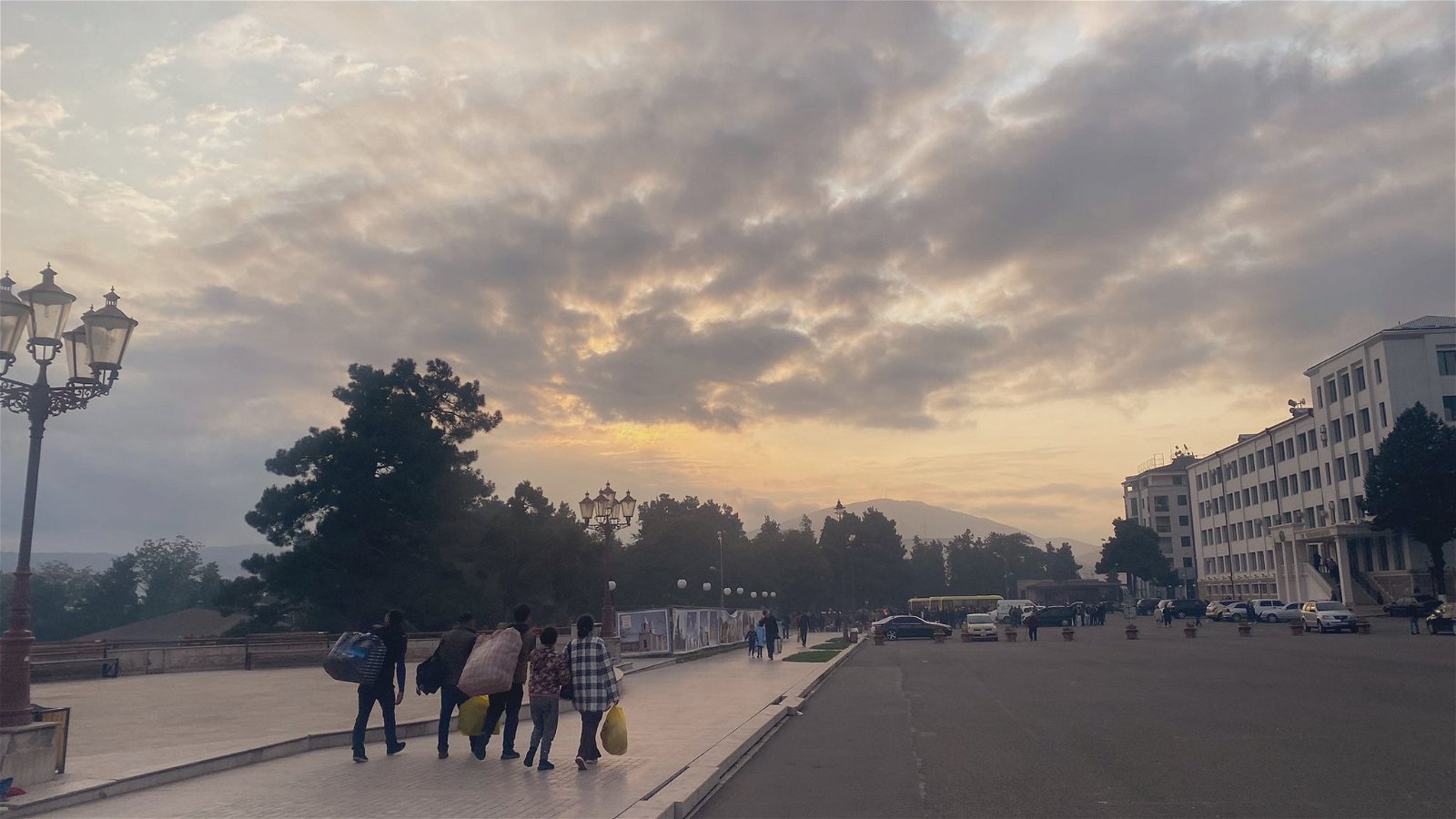 Artsakh civilians walk through Stepanakert carrying their belongings (Photo: Siranush Sargsyan)
My homeland is not a suitcase, and I am no traveler.
I wrote this article on the day of the “ceasefire.” The title is a line from a poem by Mahmoud Darwish called, “Diary of a Palestinian Wound.”
I am a proud Armenian-American, born and raised in Los Angeles. I stand on the backs of millions of ancestors who fought for my survival. I stand alongside millions of brothers and sisters who will not surrender.
The word “genocide” was first coined by Holocaust survivor and lawyer Raphael Lemkin in 1944. It consists of the Greek prefix “genos,” meaning race or tribe, and the Latin suffix “cide,” meaning “killing.” The term was specifically created to describe the Armenian Genocide perpetrated by the Young Turk regime of the Ottoman Empire in 1915 and the lack of international provisions against war crimes that Lemkin noticed as a young law student.
As Lemkin observed, the world was silent in the face of the Armenian Genocide, allowing it to sneakily occur under humanity’s nose and become a case study with which other atrocities would be compared. As one of the first genocides of the twentieth century, it paved the way for the Holocaust of the Jewish people under Adolf Hitler’s justification, “Who, after all, speaks today of the annihilation of the Armenians?” Yet in our modern world, marked by its incessant flow of information and the almost vapid need to look politically in-the-know, the bizarre beauty of it all is that humanitarian crises rarely go unnoticed.
In Washington, the Russo-Ukrainian war has dominated foreign policy discussions since early 2022. Yet, out of line with the call of “Never Again” – a phrase commonly chanted at Armenian Genocide protests – the blockade imposed on the estimated 120,000 Armenians of Artsakh has intensified in spite of the legally binding order of the International Court of Justice that required Azerbaijan to “take all measures at its disposal to ensure the unimpeded movement of persons, vehicles and goods along the Lachin Corridor in both directions.”
The blockade, which has obstructed the Berdzor, or Lachin, corridor – called the “road of life” – has barred the entry and exit of people and basic necessities, such as food, supplies and medication. The corridor is the only road that links Armenia with the Republic of Artsakh. It has been blocked with the purpose of delegitimizing the government of Artsakh, annexing the region to Azerbaijan through concessions from the Armenian side, and ethnically cleansing the indigenous Armenians that have inhabited the land for generations. As stated by Hikmat Hajiyev, Assistant to the President of the Republic of Azerbaijan and the Head of the Department of Foreign Policy Affairs of the Presidential Administration, this will finalize the “integration” of the Armenian people into Azerbaijan, a feat that is only possible through a forced mass exodus, one that is reminiscent of the death marches of 1915.
After over nine months of living under the blockade, on September 19, the Armenian people were woken up from their nightmare by air sirens and drone strikes and greeted with a military offensive at the hands of the expansionist Azerbaijan. Labeled an “anti-terrorist operation” by Baku’s Defense Ministry, the purpose of the attack was to restore constitutional order through a high volume of destruction of civilian infrastructure, as well as through killing and injuring a steadily increasing number of civilians.
Prior to the onslaught, former International Criminal Court Chief Prosecutor Luis Moreno Ocampo and former U.N. Special Advisor on the Prevention of Genocide Juan Méndez warned that Azerbaijan’s efforts violated the United Nations Genocide Convention, with Ocampo even writing in a statement that the “genocide against Armenians should not be the collateral damage of the Ukrainian war.” Alongside Ocampo and Méndez, numerous international law and genocide experts, as well as United States elected officials, have affirmed that the coordinated campaign of ethnic cleansing against the Armenians of Artsakh by Azerbaijan amounts to genocide.
“Only pressure from the world community can prevent ethnic cleansing and genocide,” wrote Congressman Brad Sherman (D-CA 32nd District) on X, formerly Twitter. “Legally, Artsakh has as much right to independence as Kosovo, as both were once autonomous regions within a republic – and both faced ethnic cleansing.”
The tragic events in Artsakh should serve as a reminder that human rights must never be compromised or ignored. Following this ceasefire, President Joe Biden and the United States’ response will exhibit if the recognition of the genocide in 2021 that asked the people of this country to “renew [their] shared resolve to prevent future atrocities from occurring anywhere in the world” stands true, or if it was a meaningless promise to silence our cries for justice.
Today, I lost my ancestral lands. To many, it may very well just be a convoluted dispute in an obscure place. I don’t blame you if you feel that way, but just know to many, Artsakh is not a far-away, distant concept found on the pages of history books. It is land that we have had the honor and the privilege to know. It is land that we have walked upon, land we have built our homes on, land that we have felt joy and pain on. It is a place generations of Armenians have sacrificed themselves for.
All I can say is this: having had the privilege to experience its freedom means that we will do anything to safeguard it.
Author information
Melody Seraydarian
Melody Seraydarian is a journalist and undergraduate student at the University of California, Berkeley, pursuing a degree in Media Studies with a concentration in media, law and policy. Her column, “Hye Key,” covers politics, culture and everything in between from a Gen-Z perspective. She is from Los Angeles, California and is an active member of her local Armenian community.
|
The post My homeland is not a suitcase, and I am no traveler appeared first on The Armenian Weekly.
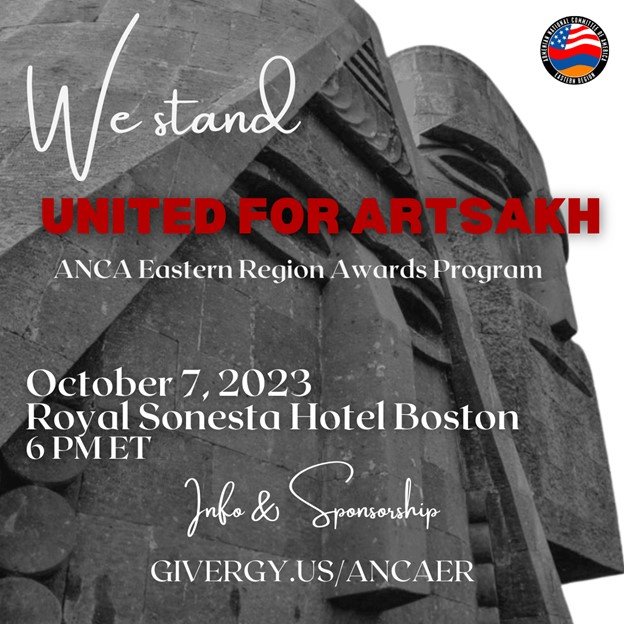 While our hearts and minds are heavy due to last week’s loss of life and land in Artsakh, we stand firmly with our Artsakh brothers and sisters, determined to enter a new phase of Hai Tahd work in the days and months ahead to secure their safety and security.
Given that our efforts across the legislative and executive branches must continue more than ever, we will host the ANCA Eastern Region Annual Awards Program, United for Artsakh, as planned on October 7 at the Royal Sonesta Boston Hotel.
While the evening will be appropriately somber, we depend on our community to fully support the ANCA Eastern Region’s mission to fight for the continued existence of Artsakh and Armenia.
With Azerbaijan’s use of military force on September 19-20, its continuing provocations, as well as Azerbaijan’s demands for Artsakh’s 120,000 men, women and children to “integrate” into the very society that has subjected them to a genocidal starvation campaign for months, the ANCA Eastern Region needs your support so that its network of 34 local ANCs across the eastern region’s 31 states can keep sounding the alarm in the halls of Congress, our state legislatures, local governments and in the public square by:
- Demanding emergency humanitarian assistance to the Armenians of Artsakh through coordination with United Nations agencies and ensuring the continued operation of the Berdzor/Lachin Corridor as a humanitarian route so that Artsakh’s population is not dependent on Azerbaijan’s genocidal regime.
- Demanding enforcement of Section 907 of the FREEDOM Support Act to sanction Azerbaijani officials under the Global Magnitsky Act and make clear to Azerbaijan that its acts of aggression will not continue to be rewarded.
- Demanding that the United Nations Security Council establish a mandate and peacekeeping mission that secures and protects Artsakh’s vulnerable Armenian population consistent with obligations under the U.N. Genocide Convention, recognizing that Azerbaijan cannot be trusted with the rights and security of Artsakh’s population.
Please join us on Saturday, October 7 to support the ANCA Eastern Region’s annual fundraiser. Only with the support of our community can our work continue, especially with so much now at stake. For more information, contact er_awards@anca.org.
Fraternally yours,
ANCA Eastern Region and ANCA Eastern Region Endowment Fundraising Committee
Author information
The Armenian National Committee of America Eastern Region is part of the largest and most influential Armenian American grassroots organization, the ANCA. Working in coordination with the ANCA in Washington, DC, and a network of chapters and supporters throughout the Eastern United States, the ANCA-ER actively advances the concerns of the Armenian American community on a broad range of issues.
|
The post ANCA Eastern Region: United for Artsakh appeared first on The Armenian Weekly.