
AMAA Armenia Medical Mission Shares God’s Love Through … Asbarez Armenian News
Day: September 27, 2023
PARAMUS, N.J.—A team of 42 volunteers and professionals on July 6 left for a 10-day Medical Mission trip to Armenia. For the past 14 years, Dr. Albert and Susan Phillips have organized and led medical teams to Armenia. Because of the large number of those wanting to serve this year, the Mission was split into two teams. Sue and Allison Phillips led a team that returned to the Lori Valley to serve in Vanadzor and Stepanavan and bused in patients from the local villages. Dr. Al and his daughter and son-in-law, Michelle and Jay Graham, took a team to Gyumri. This was the first time the Medical Mission went to Gyumri, expanding the Mission’s impact in Armenia.
The patients were triaged, then examined by the doctors and provided medication for up to a year, all the while sharing God’s love through service to those less fortunate. Because of the AMAA’s investment in the Medical Mission outreach, the AMAA has employed Armenian doctors, pharmacists and other personnel who worked alongside the volunteers from the United States and after the team departs, they provide follow up on the patients. It has become a wonderful synergy of professionals working for one purpose; to ease the suffering of our Armenian brothers and sisters and to share God’s love for them. As in previous years, dentists treated and educated the youth at both locations producing noticeable improvement in dental hygiene and reduced decay.
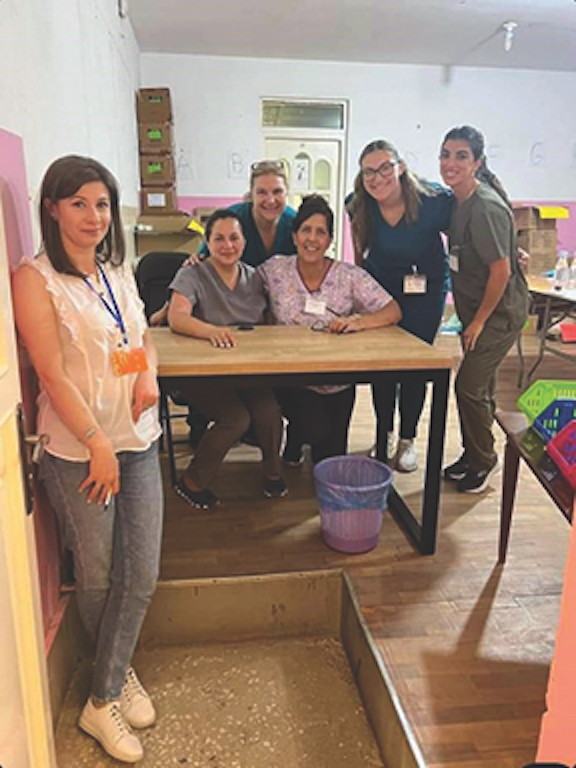 Pharmacy in Vanadzor clinic
This year, the Medical Mission saw 1,132 patients and the dentists treated 325 patients. Each patient first passed through the clinic to have their vital signs collected and urine tested. If necessary, an EKG was performed. From there, nurses and medical students interviewed the patients to collect a preliminary history. If necessary, blood work was taken, and ultrasound evaluations were performed.
An optometrist was added this year and provided an additional evaluation, screening hundreds of patients for glaucoma and finding many who needed treatment. From the triage area, patients were seen by the team of physicians and medical practitioners and were examined and prayed over. Prescriptions were given for a large variety of conditions, primarily for hypertension, diabetes, and heart disease. Patient prescriptions were filled, and they received counseling on their medications from the pharmacists.
At the clinic, patients were invited to church services where team members and the local church pastoral staff shared the Good News of Jesus Christ.
With the help of their Armenian counterparts, the Medical Mission ran exceptionally well again this year. The Mission is a team effort, where all participants, both professionals and non-professionals, become essential parts of a well-tuned machine, whose motivation is to serve God in a very tangible way. The Mission would not be possible without the faithful team of Armenian translators who serve faithfully each year.
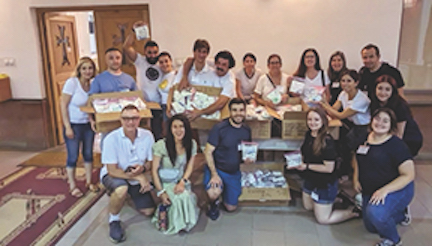 Medical Mission Vanadzor and Stepanavan Team
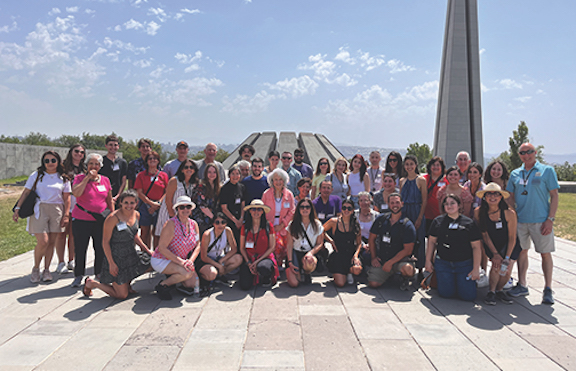 Medical Mission Team at Dzidzernagapert Memorial in Yerevan
The Mission has a lasting impact on those who participate and will guarantee a bright future for the AMAA by encouraging another generation of support and interest in the AMAA. Dr. Al and Sue wanted to publicly thank the leadership of the AMAA under the direction of AMAA Executive Director/CEO Zaven Khanjian and President Nazareth Darakjian, MD for their support on so many fronts and our AMAA Armenia colleagues led by Aren Deyirmenjian.
The Medical Mission will return to Armenia for its 15th mission in 2024. If you have a desire to serve or want more information, please go to the amaa.org website and look for the Armenia Medical Mission link under the projects tab. Medical and non-medical, Armenian or non-Armenian speaking volunteers are welcome to apply. Consider joining the team and make a difference in Armenia in the name of Jesus Christ.
Founded in 1918, the Armenian Missionary Association of America serves the spiritual, educational, and social needs of Armenian communities in 24 countries around the world including Armenia and Artsakh. For additional information, you may visit the website.
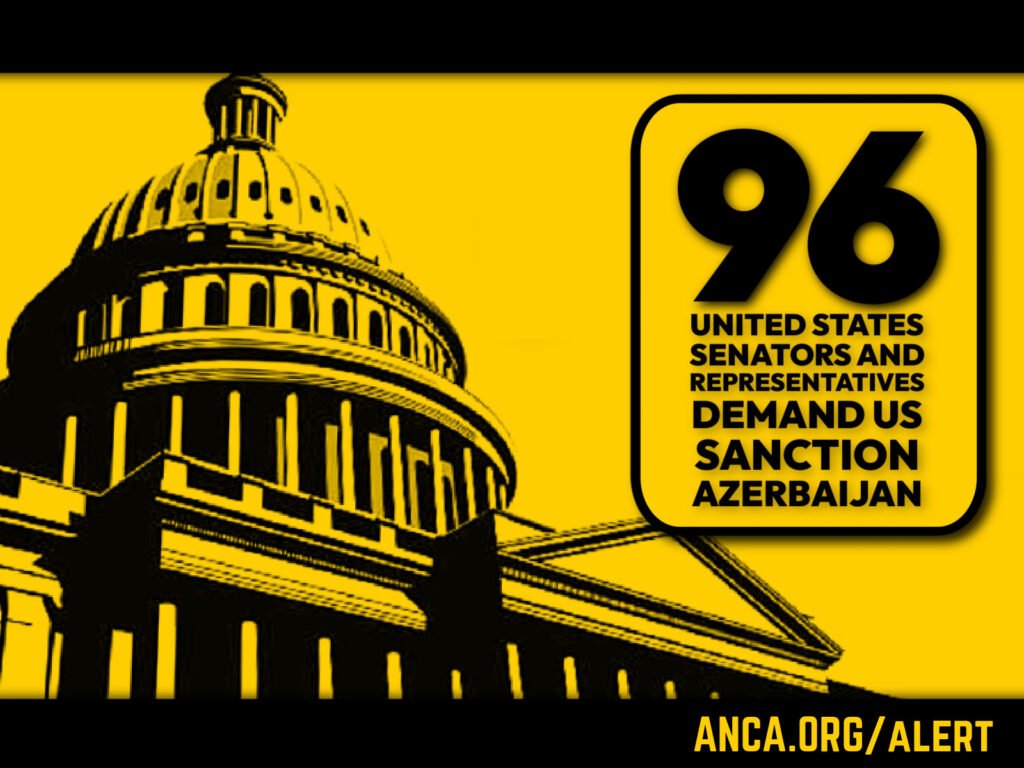 96 U.S. Senate and House members demand Biden Administration sanction Azerbaijan over Artsakh attack and blockade
WASHINGTON, D.C.—A bipartisan group of 96 U.S. Senate and House members have called on Secretary of State Antony Blinken and Treasury Secretary Janet Yellen to apply their discretionary authority under the Global Magnitsky Human Rights Accountability Act to sanction Azerbaijani leaders responsible for the brutal blockade and attacks on Artsakh’s (Nagorno Karabakh) 120,000 indigenous Armenian Christian population, reported the Armenian National Committee of America (ANCA).
“President Biden needs to stop rewarding genocide and start holding its perpetrators accountable. That begins with cutting off military aid to Azerbaijan and enforcing sanctions against its leaders for ethnically cleansing 120,000 indigenous Armenians from their ancient Artsakh homeland,” stated Armenian National Committee of America Executive Director Aram Hamparian.
POLITICO’s National Security Daily was the first to report on the powerful letter led by Senators Sheldon Whitehouse (D-RI) and Bill Cassidy (R-LA) and Representatives Seth Magaziner (D-RI), Gus Bilirakis (R-FL) and Frank Pallone (D-NJ).
The 96 lawmakers stress, “in order to hold Azerbaijan accountable for its actions in blockading and assaulting Nagorno-Karabakh, we respectfully request that your departments exercise existing authorities under the Global Magnitsky Act to impose targeted sanctions on the individuals in the Aliyev government that are responsible for or participated in the violation of human rights in Nagorno-Karabakh.”
The Senate and House members stated, “These actions represent a gross violation of human rights and the perpetration of violent conflict, which both pose a direct assault on American values and interests. The perpetrators of these human rights violations must be held to account by the United States.”
Joining Senators Whitehouse and Cassidy and Representatives Magaziner, Bilirakis, and Pallone in cosigning the letter to Secretaries Blinken and Yellen are:
Senators Tammy Baldwin (D-WI), Richard Blumenthal (D-CT), Cory Booker (D-NJ), Sherrod Brown (D-OH), Robert Casey (D-PA), Catherine Cortez-Masto (D-NV), Richard Durbin (D-IL), Dianne Feinstein (D-CA), John Fetterman (D-PA), Tim Kaine (D-VA), Edward Markey (D-MA), Jeff Merkley (D-OR), Christopher Murphy (D-CT), Alex Padilla (D-CA), Gary Peters (D-MI), Jack Reed (D-RI), Jacky Rosen (D-NV), Marco Rubio (R-FL), Debbie Stabenow (D-MI), Elizabeth Warren (D-MA), Peter Welch (D-VT), and Ron Wyden (D-OR).
Representatives Jake Auchincloss (D-MA), Don Beyer (D-VA), Lisa Blunt Rochester (D-DE), Julia Brownley (D-CA), Cori Bush (D-MO), Salud Carbajal (D-CA), Tony Cardenas (D-CA), Joaquín Castro (D-TX), Jim Costa (D-CA), Danny Davis (D-IL), Madeleine Dean (D-PA), Lloyd Doggett (D-TX), Anna Eshoo (D-CA), Adriano Espaillat (D-NY), Dwight Evans (D-PA), Charles Fleischmann (R-TN), Jesus Garcia (D-IL), Dan Goldman (D-NY), Jimmy Gomez (D-CA), Josh Gottheimer (D-NJ), Val Hoyle (D-OR), Jonathan Jackson (D-IL), Ro Khanna (D-CA), Dan Kildee (D-MI), Andy Kim (D-NJ), Raja Krishnamoorthi (D-IL), Greg Landsman (D-OH), Barbara Lee (D-CA), Susie Lee (D-NV), Ted Lieu (D-CA), Stephen Lynch (D-MA), Nicole Malliotakis (R-NY), Tom McClintock (R-CA), James McGovern (D-MA), Rob Menendez (D-NJ), Grace Meng (D-NY), Jared Moskowitz (D-FL), Grace Napolitano (D-CA), Donald Norcross (D-NJ), Eleanor Holmes Norton (D-DC), Chellie Pingree (D-ME), Katie Porter (D-CA), Mike Quigley (D-IL), Jamie Raskin (D-MD), Deborah Ross (D-NC), C.A. Dutch Ruppersberger (D-MD), Linda Sanchez (D-CA), John Sarbanes (D-MD), Janice Schakowsky (D-IL), Adam Schiff (D-CA), Brad Sherman (D-CA), Mikie Sherrill (D-NJ), Christopher Smith (R-NJ), Abigail Spanberger (D-VA), Haley Stevens (D-MI), Eric Swalwell (D-CA), Shri Thanedar (D-MI), Dina Titus (D-NV), Rashida Tlaib (D-MI), Paul Tonko (D-NY), Norma Torres (D-CA), Lori Trahan (D-MA), David Trone (D-MD), David Valadao (R-CA), Maxine Waters (D-CA), Bonnie Watson Coleman (D-NJ), Susan Wild (D-PA), and Nikema Williams (D-GA).
The full text of the bi-cameral congressional letter is provided below and available here:
#####
September 26, 2023
The Honorable Antony J. Blinken Secretary of State
U.S. Department of State
2201 C Street, NW
Washington, DC 20520
The Honorable Janet Yellen
Secretary of the Treasury
U.S. Department of the Treasury
1500 Pennsylvania Avenue, NW
Washington, DC 20220
Re: Nagorno-Karabakh
Dear Secretaries Blinken and Yellen,
We urge the Departments of State and Treasury to immediately exercise discretionary authority to impose sanctions under the Global Magnitsky Human Rights Accountability Act (Global Magnitsky Act, Title XII, Subtitle F of P.L. 114-328; 22 U.S.C. §10101 et seq.) on individuals in the government of Azerbaijan associated with the military attacks against and brutal blockade of Nagorno-Karabakh. These actions represent a gross violation of human rights and the perpetration of violent conflict, which both pose a direct assault on American values and interests. The perpetrators of these human rights violations must be held to account by the United States.
Since December 12, 2022, Azerbaijan has blocked the Lachin Corridor, the only route connecting Armenia with Nagorno-Karabakh, depriving some 120,000 Armenians of freedom of movement and access to food, medication, hygiene products, and other commercial goods. The blockade’s effects are particularly acute for at-risk groups, such as children, elderly people, people with disabilities and chronic health conditions, whose access to healthcare services is severely limited or disrupted. Local journalists have reported a rise in miscarriages and premature births due to pregnant women not having access to proper nutrition and prenatal care. Azerbaijan has also undermined the region’s gas and electricity supply, impacting the functioning of medical and educational institutions and cutting heat as yet another winter approaches.
After over nine months of trying to starve out the ethnic Armenian population in Nagorno- Karabakh, the Azerbaijani military launched a full-scale assault on the region on September 19, resulting in a ceasefire and the capitulation of the local government on September 20. This attack has exacerbated concerns about the worsening of the humanitarian crisis, and statements from the government of Azerbaijan about “re-integration” raise the specter of ethnic cleansing and cultural genocide. Additionally, an explosion at a fuel station killed at least 125 civilians and wounded nearly 300 as thousands of ethnic Armenians fled Nagorno-Karabakh in fear of violence from Azerbaijani forces. This horrific incident tragically underscores the urgent need for humanitarian aid and access.
America is a world leader on international human rights and must continue to serve as a mediating force and supporter of peace in the region. In order to hold Azerbaijan accountable for its actions in blockading and assaulting Nagorno-Karabakh, we respectfully request that your departments exercise existing authorities under the Global Magnitsky Act to impose targeted sanctions on the individuals in the Aliyev government that are responsible for or participated in the violation of human rights in Nagorno-Karabakh.
Sincerely,
Author information
The Armenian National Committee of America (ANCA) is the largest and most influential Armenian-American grassroots organization. Working in coordination with a network of offices, chapters and supporters throughout the United States and affiliated organizations around the world, the ANCA actively advances the concerns of the Armenian American community on a broad range of issues.
| Twitter |
The post 96 U.S. Senate and House lawmakers call on Biden administration to sanction Azerbaijani leaders for Artsakh blockade and attacks appeared first on The Armenian Weekly.
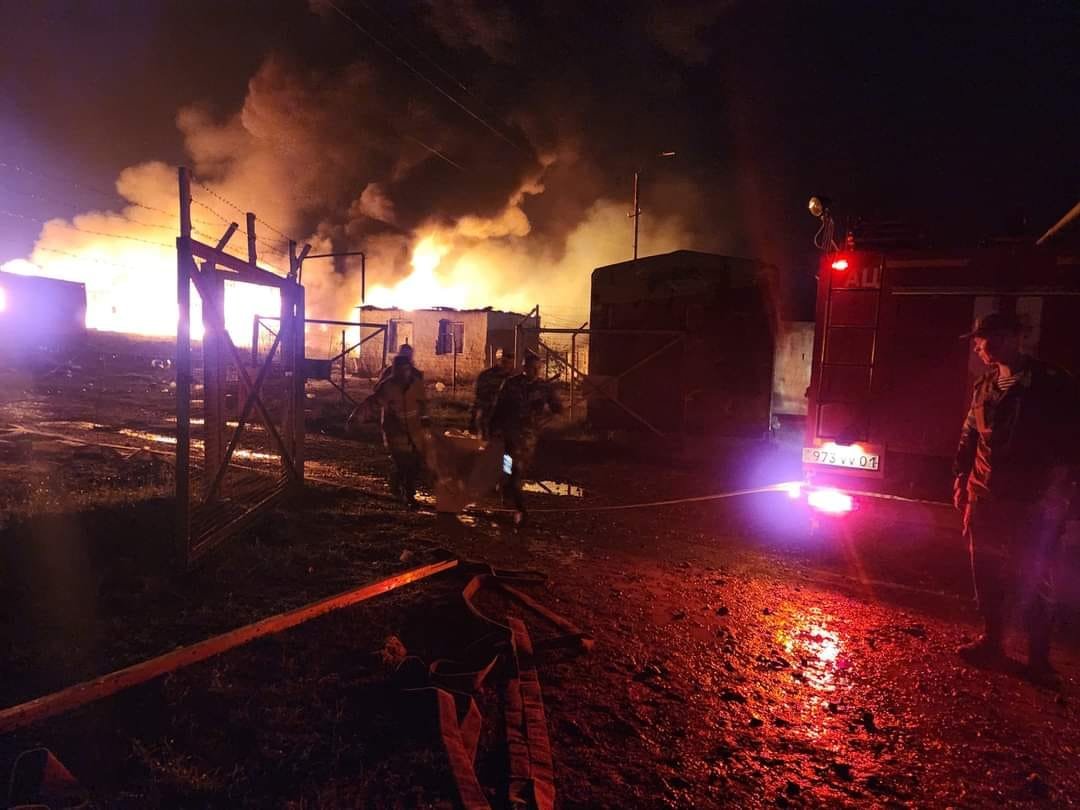 Fuel storage facility near Stepanakert explodes (NKR InfoCenter, September 25)
YEREVAN—Amidst the humanitarian crisis in Artsakh and Azerbaijan’s national policy of the ethnic cleansing of its Armenian population, forcing thousands to flee their homeland, a powerful explosion ripped through a fuel storage facility near Stepanakert on Monday.
Hundreds of people were lining up at the fuel facility where the blast occurred, because they had been promised fuel – a scarcity during the over nine-month long blockade – for their cars in order to move to Armenia.
As a result of the explosion, 290 patients were admitted to different hospitals with various degrees of burns. According to the Ministry of Health of Artsakh, at least seven patients have died in the hospital. Dozens are still in critical condition. 13 unrecognized bodies were transferred to the Bureau of Forensic Examination. Many people are considered missing, because they were burned as a result of the explosion.
Former State Minister and Human Rights Ombudsman of Artsakh Artak Beglaryan reported that on Tuesday, 168 patients wounded in the fuel depot explosion were evacuated to Yerevan – 96 by Armenian and Russian helicopters and 72 by Armenian ambulances with the support of the International Committee of the Red Cross. There are 68 confirmed deaths. Meanwhile, the bodies of 125 soldiers who gave their lives protecting Artsakh were transferred to Armenia on Wednesday. According to consolidated data from requests to information centers in Artsakh, the fate of 105 Armenians as a result of the explosion is unknown.
The situation in the hospitals of #Stepanakert is absolutely catastrophic!
Shortages of medical staff, panic, people trying to find their loved ones from the blast. Very high number of injured individuals.
— Siranush Sargsyan (@SiranushSargsy1) September 25, 2023
Weekly contributor Siranush Sargsyan said that the situation in Artsakh’s hospitals following the explosion is “catastrophic.” “Shortages of medical staff, panic, people trying to find their loved ones from the blast,” she wrote on X (formerly Twitter).
The explosion took place hours after the second round of talks between Azerbaijani officials and Artsakh representatives was held Monday in the town of Ivanyan, just north of Stepanakert. The first round was held last week in Yevlakh, where an agreement was reached on the withdrawal of the remaining units and servicemen of the Armed Forces of Armenia from Artsakh, the disbandment and complete disarmament of the Artsakh Defense Army, and the removal of heavy equipment and weapons from the territory of Artsakh.
The agreement was reached 24 hours after Azerbaijan launched an assault on Artsakh on September 19, heavily shelling civilian settlements and infrastructure. Azerbaijan’s military offensive and bombardment of civilians claimed many lives, enabled mass displacement and triggered turmoil across the region.
Another major humanitarian crisis is looming on the horizon. As of Wednesday afternoon, about 50,000 Armenians have been forced to flee their homes in Artsakh in the fear of living under Azerbaijani rule, among a population of 120,000. Although Azerbaijan has made numerous statements about the “peaceful integration” of ethnic Armenians into Azerbaijani society, decades of conflict and atrocities and recent events have proven otherwise.
Multiple videos circulating on Telegram channels show inhumane acts carried out by Azerbaijani soldiers against ethnic Armenian civilians, soldiers and establishments. Two Azerbaijani soldiers fired at a 13th-century monastery in the village of Charektar in the Shahumyan region of Artsakh, Caucasus Heritage Watch reported on X on Wednesday. “Such attacks are a direct violation of the International Court of Justice’s provisional measure on Armenian cultural heritage and must be investigated and brought to justice,” the organization said in a statement.
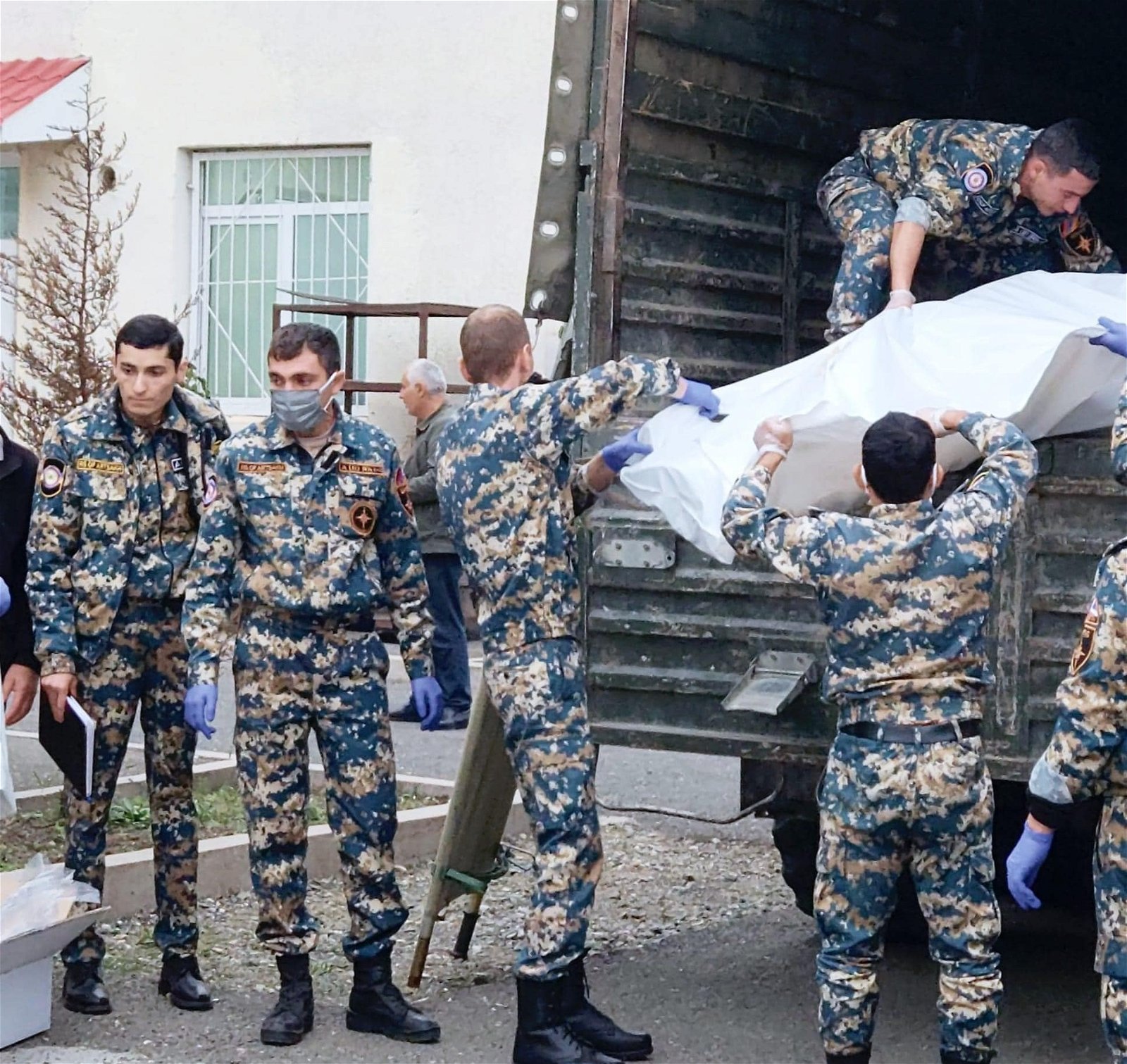 Artsakh search and rescue operation searches for people’s remains (NKR InfoCenter, September 26)
While the ethnic cleansing policy of Azerbaijan continues to threaten the lives of the ethnic Armenians remaining in the region, thousands of families have been forced to flee their homes, only taking items of importance – leaving their family homes and their livelihood behind. In order to honor his memory and prevent its desecration by Azerbaijan, citizens have reportedly removed the monument of the national hero Monte Melkonyan in the Martuni region of Artsakh and plan to take it with them to Armenia.
The mass exodus of Armenians from Artsakh is only the start of another serious humanitarian crisis. As families flee to save their and their children’s lives from another genocide, traffic jams on the road to Kornidzor have already caused the death of an elderly man.
Following long hours of travel, Armenians from Artsakh must go through the checkpoint illegally placed by Azerbaijan on the Hakari Bridge at the entrance to the Berdzor (Lachin) Corridor to reach the registration and first aid centers that have been set up by the Red Cross and local organizations.
The small village of Kornidzor in Armenia’s southernmost Syunik region has become the first stop on the way of the forced migration of Armenians from Artsakh. Due to the shortage of fuel and buses, thousands of people arrive in Armenia sitting in the back of trucks.
The first point of registration for the people of Artsakh was in the town of Goris until Tuesday night, when humanitarian organizations announced that due to the high volume of individuals coming from Artsakh, the resources in Goris have reached capacity, and the new point of registration will now be in Vayk.
Volunteers on the ground in Syunik advise all Armenians to register their problems in detail at the registration points including medical, psychological and domestic. They also advise that all individuals request a medical examination and that those who are collecting aid send warm clothes that can be distributed to the people during registration ahead of the cold winter months.
As this humanitarian crisis unfolds, the Armenian Weekly will continue to follow developments and provide firsthand reporting on families displaced from Artsakh.
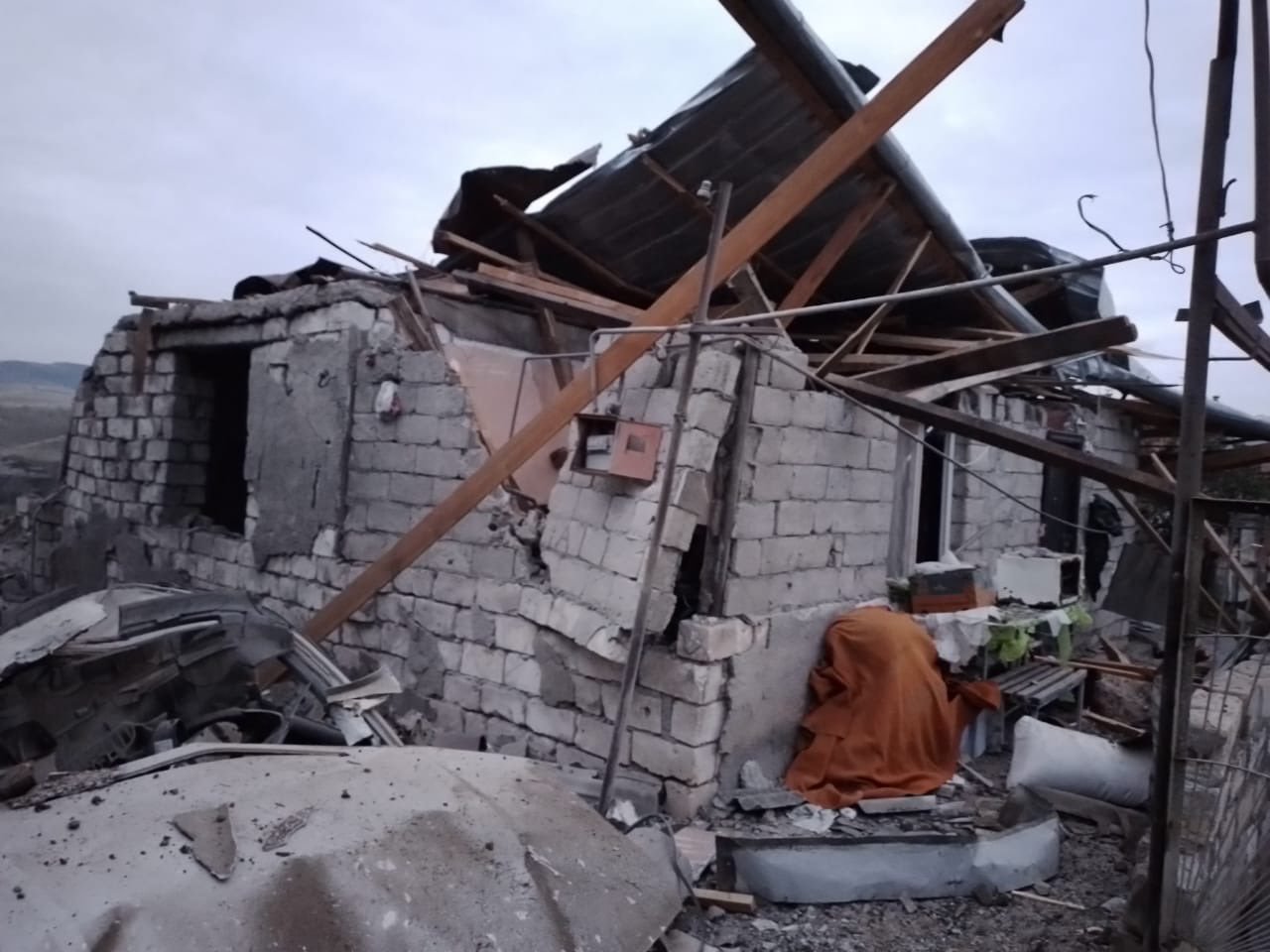 House destroyed by Azerbaijani shelling in Berqadzor of Askeran region (Artsakh Ombudsman, September 24)
Author information

Hoory Minoyan
Hoory Minoyan was an active member of the Armenian community in Los Angeles until she moved to Armenia prior to the 44-day war. She graduated with a master’s in International Affairs from Boston University, where she was also the recipient of the William R. Keylor Travel Grant. The research and interviews she conducted while in Armenia later became the foundation of her Master’s thesis, “Shaping Identity Through Conflict: The Armenian Experience.” Hoory continues to follow her passion for research and writing by contributing to the Armenian Weekly.
|
The post Azerbaijan continues ethnic cleansing of Artsakh’s Armenians appeared first on The Armenian Weekly.