
Suspected peeping Tom returns to same home nine times in a month, Georgia police say Tacoma News Tribune
Day: September 26, 2023
The Southern Gas Corridor (SGC) aims to increase and diversify Europe’s energy supply by bringing gas resources from the Caspian Sea to European markets. Continuing her series analyzing energy issues in post-Soviet states, including in Uzbekistan, Moldova, and Kazakhstan, the author answers key questions about the economics of Caspian gas in this article.
The SGC is a route from the Caspian region to Europe, proposed in 2008[1] to reduce Europe’s dependency on Russian gas.[2] It consists of the South Caucasus Pipeline (SCP) and its expansion (SCPX), the Trans-Anatolian Natural Gas Pipeline (TANAP), and the Trans-Adriatic Pipeline (TAP).
Source: https://www.sgc.az/en.
The SGC’s role as a gas supplier to the EU—though still small—is increasing. During the 2022 energy crisis, gas deliveries via the SGC to Europe increased by more than 40 percent, from around 8 billion cubic meters (bcm) in 2021 to 11.4 bcm in 2022, going above the TAP pipeline’s nominal capacity of 10 bcm.[3] The SGC’s share in total EU gas imports was 3.4 percent in 2022 up from 2.4 percent in 2021.[4]
In July 2022, the European Union (EU) and Azerbaijan signed a Memorandum of Understanding (MoU) on a strategic partnership with an ambitious commitment to double the capacity of the SGC to deliver at least 20 bcm of gas to the EU annually by 2027.
Azerbaijan, with its giant Shah Deniz field that started production in 2006, is the only source of gas for the SGC so far. For many years, the country supplied gas only to Georgia[5] via SCP and then to Turkey via TANAP. It was only when the TAP was launched, as an extension of the SGC in 2020, that Azerbaijan started supplying gas directly to the EU. The TAP starts at the Greek-Turkish border, runs through Greece, Albania, crosses the Adriatic Sea and connects to Italy’s natural gas network.
Gas deliveries to Italy and Greece began immediately after the commissioning of the TAP.[6] Deliveries to Bulgaria began in 2022[7] and in 2023, Azerbaijan started gas supplies to Romania[8] with plans to start deliveries to Hungary and Serbia by the end of the year.[9] All of these flows have been enabled by the completion of the EU-funded Interconnector Greece-Bulgaria pipeline in October 2022.
The SGC’s total investment amounts to $40 billion.[10] It is an international mega-project with many stakeholders. Azerbaijan participates in all parts of the supply chain and Turkey provides crucial transit to Europe in all parts except TAP. Several Western companies, including BP, have a stake in the project along with—surprisingly—Russian LUKOIL and Iranian NICO that together control nearly 30 percent of the upstream investments and the SCP (Table 1).
The promised doubling of gas deliveries from Azerbaijan to the EU in four years would require huge investments in the SGC’s infrastructure expansion (including in all sections of the corridor), estimated at $6.3-$9.3 billion[11] and further upstream investments in additional gas production in Azerbaijan. So far, according to the forecast approved by the government in 2021, Azerbaijan is expected to increase its output by only 3 bcm until 2026,[12] likely leading to volumes falling short of the additional10 bcm needed to fulfil the new MoU. In theory, a Shah Deniz extension together with the other projects such as ACG Deep, Absheron Phase 1 and Ümid,[13] could add about 13.5 bcm of incremental gas production for export, but these projects would require additional investments of more than $10 billion.[14]
Investment at this scale is unlikely to materialize without long-term guarantees of investment returns. Azerbaijan itself can hardly ensure the required investments, while the EU—with its ambitious decarbonization targets and plans to phase out long-term contracts[15]—is not supporting the contract structures to justify upstream and midstream capital expenditures. European commercial companies are also not keen to make long-term commitments given the uncertainty related to the future of European gas demand. There are fundamental doubts about whether Europe needs so much additional gas from Caspian, likely more expensive than other supplies (such as the LNG[16] that will become available starting 2025) and that new pipeline projects could become stranded assets by the mid-2030s.
It remains uncertain whether Azerbaijan can simultaneously boost production for export and meet its growing domestic needs. Domestic consumption of natural gas stood at about 13 bcm in 2021 and is expected to grow to 15-16 bcm by 2027.[17] So far, Azerbaijan has addressed this issue by importing gas from Russia as well as from Turkmenistan via Iran. However, the deal with Russia, signed last November to supply approximately 1 bcm of gas to Azerbaijan over five months, was not extended in 2023[18] after the EU raised concerns about increased gas exports from Russia to Azerbaijan.[19]
Meanwhile, Azerbaijan’s dependency on Turkmenistan is deepening. An initial deal for annual 1,8-2,1 bcm of gas swaps from Turkmenistan to Azerbaijan via the Iranian pipeline system was signed in December 2021,[20] with the volumes doubled in June 2022.[21][22] This August, the Iranian Ambassador in Turkmenistan emphasized the potential to increase gas swaps from 7-7,5 million cubic meters per day (mcm/day) to up to 20 mcm/day.[23]
The problem of where to find the additional roughly 10 bcm of gas for the SGC could be solved by building the Trans-Caspian pipeline from Turkmenistan to Azerbaijan. The Trans-Caspian pipeline project was initiated by Turkmenistan in November 2007, as part of its diversification plans away from Russia and as construction of a gas pipeline from Turkmenistan to China started. These discussions gradually come to naught, most likely because of Turkmenistan’s concerns about Chinese complaints about the country failing to deliver on its commitments. In 2022, when Russia cut gas supplies to Europe, the project regained the interest of the EU after years of Turkmenistan asking for Western financing for it. The initial project envisaged 30 bcm annual capacity and an estimated construction cost of $5 billion or more. Latest estimates suggest that a lighter version of the project, to be built over 24 months at a relatively modest cost of $500-800 million, could deliver 10-12 bcm of gas annually.[24] An expected announcement about it when the presidents of the three Turkic states—Turkmenistan, Turkey, and Azerbaijan—met in Turkmenistan last December[25] did not materialize,[26] but in May, Azerbaijan’s President Ilham Aliyev confirmed that his country would provide technical assistance turning the focus on Turkmenistan: “this decision must be made by the owners of these resources [Turkmenistan]. We cannot initiate this project, and we cannot finance it. We can only be a transit country.”[27]
There have long been doubts about whether Turkmenistan is really planning to join the Trans-Caspian project and provide additional gas volumes for the SGC, but in July, Turkmen authorities clarified their position[28] calling the Trans-Caspian pipeline “an absolutely realistic project, justified from an economic point of view, capable of making a tangible contribution to ensuring energy security in Eurasia.” Turkmenistan now says that it is committed to the strategy of diversifying energy flows and will cooperate with partners in the implementation of the Trans-Caspian pipeline project.
Following the statement, a Turkmen envoy met with president of the European commission, Ursula von der Leyen, expressing Turkmenistan’s readiness to “develop effective cooperation between Turkmenistan and the EU.”[29] Continuing this diplomatic shift, Turkmenistan signed a political agreement (not a binding one) to supply Turkmen gas to Hungary in August.[30] Favorable political declarations notwithstanding, the prospects of a Trans-Caspian pipeline are still quite remote. Based on existing infrastructure, Turkmenistan may only be able to supply up to 5 bcm/year from the Petronas’ owned offshore Block I fields.[31] Most of the country’s untapped production potential is far from the Caspian at the Galkynysh field in the southeast. Turkmenistan recently committed to more than double its natural gas exports to China—to 65 bcm/year—via the expansion of the Turkmenistan-Uzbekistan-Tajikistan-Kyrgyzstan-China gas pipeline, synchronized with the second stage of the Galkynysh field development.[32]
An additional concern is that Turkmenistan is responsible for the world’s largest number of methane emitting fossil fuel facilities,[33] not acceptable for the EU given its methane strategy.
Moreover, a key obstacle again, as with Azerbaijan, is the unwillingness of international commercial enterprises to provide project financing considering the uncertainty of future European gas demand.
The geopolitics of Caspian gas are just as complex, as the author will discuss in her next article.
[1] EU (2008) Communication from the Commission COM (2008) 781 dated 13 November 2008: Second Strategic Energy Review: An EU Energy Security and Solidarity Action Plan. Brussels: EU; http://eur-lex.europa.eu/LexUriServ/LexUriServ.do?uri=COM:2008:0781:FIN:EN:PDF.
[2] The current configuration emerged from several competing project proposals, including the Nabucco pipeline.
[3] https://energy.ec.europa.eu/news/commissioner-simson-azerbaijan-co-chair-9th-southern-gas-corridor-advisory-council-2023-02-03_en; https://ec.europa.eu/commission/presscorner/detail/en/ip_22_4550
[4] https://energy.ec.europa.eu/topics/energy-security/diversification-gas-supply-sources-and-routes_en
[5] https://www.bp.com/en_ge/georgia/home/who-we-are/scp.html
[6] https://www.tap-ag.com/infrastructure-operation/history-timeline#period-12977
[7] https://www.tap-ag.com/infrastructure-operation/history-timeline#period-12977
[8] https://caliber.az/post/130979/
[9] https://www.argusmedia.com/en/news/2456293-hungarys-mvm-signs-deal-for-100mn-m-of-azeri-gas
[10] https://www.bp.com/en/global/corporate/news-and-insights/reimagining-energy/southern-gas-corridor-special-feature.html; https://minenergy.gov.az/en/qaz/sahdeniz-yatagi; https://www.sgc.az/en/project/scp; https://www.tap-ag.whicom/about-tap/taps-shareholders; https://www.tanap.com/en/shareholders
[11] Gulmira Rzayeva, “Expansion of the Southern Gas Corridor pipelines and future supplies to Europe,” Oxford Institute for Energy Studies, NG-180, April 24, 2023, 9, https://books.google.co.uk/books/about/Expansion_of_the_Southern_Gas_Corridor_P.html?id=EpwT0AEACAAJ&redir_esc=y
[12] https://interfax.az/view/852215
[13] https://www.spglobal.com/commodityinsights/en/ci/research-analysis/will-azerbaijan-meet-europes-2027-gas-demand-deadline.html
[14] Gulmira Rzayeva, “Expansion of the Southern Gas Corridor pipelines and future supplies to Europe,” Oxford Institute for Energy Studies, NG-180, April 24, 2023, 9, https://books.google.co.uk/books/about/Expansion_of_the_Southern_Gas_Corridor_P.html?id=EpwT0AEACAAJ&redir_esc=y
[15] https://www.energyintel.com/0000017d-beef-d2b5-a1fd-bfefc7620001
[16] https://www.energypolicy.columbia.edu/publications/beyond-spot-vs-long-term-europes-lng-contracting-options-for-an-uncertain-future/
[17] https://www.eiu.com/n/azerbaijans-gas-exports-to-the-eu-face-challenges/
[18] https://eurasianet.org/azerbaijans-russian-gas-deal-raises-uncomfortable-questions-for-europe; https://www.eiu.com/n/azerbaijans-gas-exports-to-the-eu-face-challenges/
[19] https://www.europarl.europa.eu/doceo/document/P-9-2022-003854_EN.html#:~:text=There%20are%20reports%20that%20Gazprom,and%20March%202023%5B1%5D
[20] https://www.bbc.com/azeri/region-59413187
[21] https://www.newscentralasia.net/2023/04/16/nigc-iran-recorded-a-surge-in-gas-swap-from-turkmenistan-to-azerbaijan/
[22] https://eurasianet.org/turkmenistan-iran-azerbaijan-gas-swaps-surge
[23] https://az.sputniknews.ru/20230813/iran-narastil-svopovye-postavki-turkmenskogo-gaza-v-azerbaydzhan-457668115.html
[24] https://www.intellinews.com/pannier-how-putin-may-have-leant-on-turkmenistan-to-spike-gas-for-europe-plan-265579/
[25] https://www.intellinews.com/pannier-how-putin-may-have-leant-on-turkmenistan-to-spike-gas-for-europe-plan-265579/; https://eurasianet.org/turkmenistan-smashing-time
[26] https://www.intellinews.com/analysts-say-turkmenistan-told-us-diplomats-it-s-not-interested-in-caspian-gas-to-europe-connector-project-wants-major-pipeline-265227/
[27] https://eurasianet.org/turkmenistan-iran-azerbaijan-gas-swaps-surge
[28] https://mfa.gov.tm/en/news/3969
[29] https://mfa.gov.tm/en/news/3977
[30] According to Peter Szijjarto, Hungary’s minister of foreign affairs and foreign economic relations, “On the part of Turkmenistan, the political will and political intention is absolutely clear for Hungary to become one of the directions of potential supplies of Turkmen gas to Europe and one of the transit countries.” https://orient.tm/en/post/58762/szijjarto-said-budapest-and-ashgabat-have-concluded-political-agreement-gas-supplies.
[31] https://www.spglobal.com/commodityinsights/en/ci/research-analysis/will-azerbaijan-meet-europes-2027-gas-demand-deadline.html
[32] https://www.enerdata.net/publications/daily-energy-news/turkmenistan-plans-more-double-gas-exports-china-65-bcmyear.html#:~:text=Turkmenistan%20plans%20to%20more%20than%20double%20its%20natural%20gas%20exports,gas%20pipeline%2C%20currently%20under%20construction; https://www.reuters.com/markets/commodities/china-prioritising-turkmenistan-over-russia-next-big-pipeline-project-2023-05-24/
[33] https://www.theguardian.com/environment/2023/mar/06/revealed-1000-super-emitting-methane-leaks-risk-triggering-climate-tipping-points
In the past few days there has been a steady stream of ethnic Armenians fleeing the contested region of Narogno-Karabakh. Azerbaijan launched a 24-hour assault on the Armenian enclave, which is surrounded by Azerbaijani territory, on September 19 and, following a ceasefire brokered the following day, refugees have been allowed to leave via the narrow Lachin corridor, which connects the enclave with Armenia.
As of September 26, 19,000 people had made the crossing since it was opened on September 24. It is expected that many of the estimated 120,000 Karabakhi Armenians will leave for Armenia. Meanwhile, 20 people were killed and about 350 injured in an explosion at a petrol station in the enclave’s main highway out of Stepanakert, its capital.
The Armenian prime minister, Nikol Pashinyan, has accused Azerbaijan of ethnic cleansing in the region – something denied by Azerbaijan which described the conflict as an “anti-terror” operation ans said that the majority Armenian population would be integrated into Azerbaijan and their rights respected.
But it appears that the exodus of dispossessed Armenians will continue and they are an angry population. They are angry at Azerbaijan for the shelling which forced them to flee. They are angry at Turkey for supporting and arming Azerbaijan. Oddly, they are not angry at Russia whose lack of attention emboldened Azerbaijan to take action against them. In fact, some of the refugees from Nagorno-Karabakh are expected to make their way to Russia via Armenia.
Armenian anger
Mainly they are angry at the Armenian government as are many of their compatriots in Armenia itself. But the mass protests have been more an expression of hopelessness than of defiance. Nagorno-Karabakh – where there has been an ethnic Armenian population since 200BCE – is lost and many people blame their leader. Witnessing refugees arrive has upped the emotional ante.
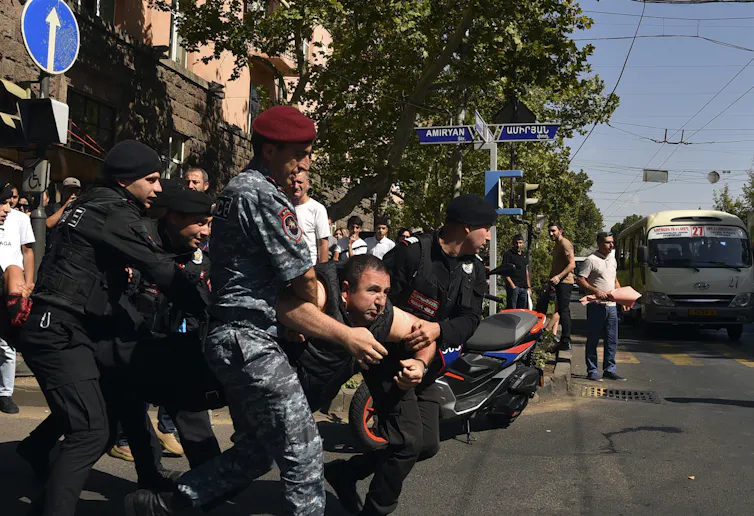
Anger: protesters in the streets of Yerevan, Armenia, September 2023. EPA-EFE/Narek Aleksanyan
The response from Armenian prime minister, Nikol Pashinyan, has been brutal. Up to 350 protesters were detained and some reportedly badly beaten by security forces. Pashinyan has implied that it is the Kremlin who instigated the riots. But, even if Russian media’s coverage is hostile towards Pashinyan, Armenians themselves have plenty of grievances against their prime minister.
The unrest follows riots in 2020 over the loss of territory and prestige after the second Karabakh war. During the conflict, Azeri forces reoccupied large tracts of territory previously occupied by Armenia.
So Pashinyan was already unpopular even before the most recent Azeri military action – his approval ratings as of June 2023 were very low – only 14% expressed trust in him and 72% gave his performance a negative rating. But there is little cohesion among opposition groups beyond a desire for Pashinyan’s resignation.
A friendship soured
Russian relations with Armenia have been shaky for some time. After the invasion of Ukraine, Moscow pivoted towards Turkey, Azerbaijan’s sponsor, as it deemed the relationship more valuable in terms of mitigating the effects of western sanctions.
To a degree this was a rational calculation, but there’s a personal element as well. Vladimir Putin never warmed to Pashinyan, who gained power in 2018 after popular protests ousted the Kremlin-friendly leadership of Serzh Sargsyan. But Armenia’s close relationship with Russia goes back centuries, so the two leaders managed to get along.
Things began to really sour between Russia and Armenia in 2023, when Armenia, refused to host military exercises by the Collective Security Treaty Organisation (CSTO), instead inviting the US military to train there. The highly symbolic visit by Armenian first lady, Anna Hakobyan, to Ukraine in early September seems to have been the last straw. Armenia, it seems, no longer counted Russia as a friend or a force to be reckoned with.
What happens next
Azerbaijan has not achieved all of its goals yet. It aims to open direct ground links to its enclave embedded in Armenia, the Nakhichevan Autonomous Republic, which has a population of just under 450,000. This would also give mainland Azerbaijan direct access to Turkey rather than transit routed through Iran.
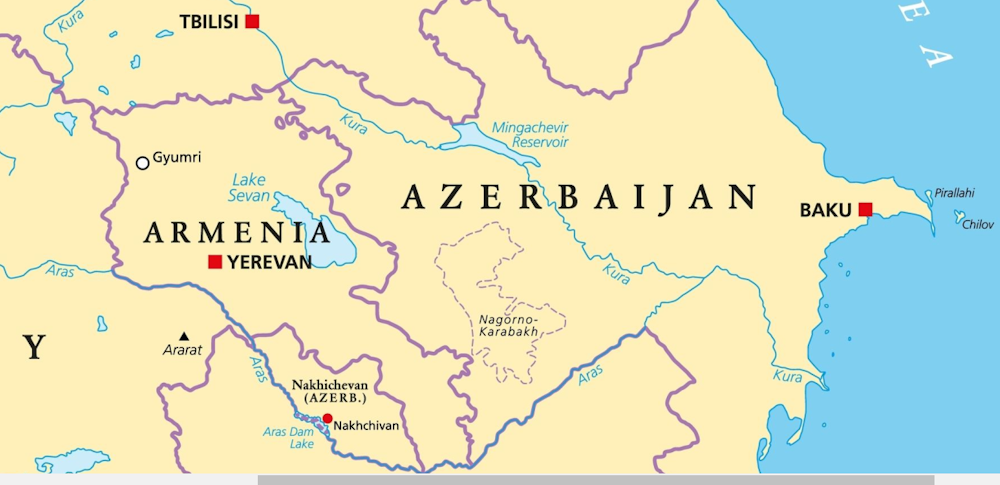
Turbulent region: Azerbaijan and Armenia showing the territories of Nagorno-Karabakh and Nakhchivan. Peter Hermes Furian/Shutterstock
Proposals for the “Zangezur corridor” are bitterly opposed by Armenia as it would effectively block the country’s border with Iran. The issue has rankled since the first Karabakh war in 1991, after which the two populations were only linked by air travel. Part of the agreement that halted the second Karabakh war in 2020 included allowing free transit through Zangezur, but this was never implemented. Now the idea is back on the table, raised by Azeri president Ilham Aliyev at a meeting with Turkish president, Recep Tayyip Erdoğan on September 25, when they met in Nakhichevan.
This will bring Iran into play as the route of any corridor between Azerbaijan and Nakhichevan would go along its border. Some sort of deal addressing Iran’s security concerns will need to be reached – and this is very likely to involve Moscow as one of Tehran’s close allies. So, Moscow appears to have taken a conscious decision to abandon Armenia for closer relations with Azerbaijan and Turkey and the opportunity to act as a power broker with Iran. In Putin’s eyes, no doubt, Pashinyan is disposable. He can wait until a different, more amenable leader, comes to power.
Armenia’s pivot to the west, meanwhile, appears almost inevitable. The country is likely to withdraw from the CSTO and apply to join Nato and request visa-free travel to the EU. But the manner in which Pashinyan is putting down protests will make many potential allies in the west uncomfortable.
The situation is only made more complex by Europe’s dependence on Azerbaijan for gas and its strategically important location in the Middle Corridor Eurasian trade route between China and Europe. The west can still play a valuable role in brokering peace between Armenia and Azerbaijan. But for any lasting settlement to stick, Russia and Turkey will have to be involved, instead of becoming its spoilers. This is a problem with many moving parts.
We are in Konya with the special support of the Turkish Ministry of Culture and, the capital of the ancient Seljuk state, the land of Maulana Jalaluddin Rumi and many other divines, friends of Allah – the country that raises the flag of Islam on its soil. This city, which has preserved its antiquity, gives a person the feeling of living in the 10th-12th centuries at the very first sight.

Hikmet Hajiyev, foreign policy adviser to Azerbaijan’s President Ilham Aliyev and Vaqif Sadiqov, Ambassador of the Republic of Azerbaijan to Belgium and Luxembourg and Head of Mission to EU talk to reporters in Brussels, Belgium September 26, 2023. REUTERS/Bart Biesemans Acquire Licensing Rights
BRUSSELS, Sept 26 (Reuters) – Azerbaijan has no intention of taking military action to create a land corridor in southern Armenia, the foreign policy adviser to Azerbaijan’s president said on Tuesday.
Azerbaijan’s military operation last week to take control of the ethnic Armenian-dominated enclave of Nagorno-Karabakh has stoked Armenian fears that Baku may now use force to create a corridor through Armenia to Azerbaijan’s Nakhchivan exclave.
But Hikmet Hajiyev, foreign policy adviser to Azerbaijani President Ilham Aliyev, said Baku only wanted to create transport links to Nakhchivan through Armenia, which he said would benefit both countries and the wider region.
“Azerbaijan doesn’t have any military goals or objectives on the sovereign territory of the Republic of Armenia, that’s … completely out of Azerbaijan’s agenda,” he told Reuters.
“Our suggestion to Armenia is about building connectivity lines, transport lines, in a very peaceful manner,” he said, speaking in Brussels after EU-hosted talks with his Armenian counterpart, Armen Grigoryan, and European officials.
Hajiyev’s comments came the day after Aliyev held talks with his Turkish counterpart Tayyip Erdogan at which he hinted at the prospect of creating such a land corridor, which would also give Azerbaijan a direct link to close ally Turkey.
An influential Telegram channel linked to Karabakh Armenians called “Re:public of Artsakh” said Aliyev’s words looked ominous.
“The new target of Azerbaijan and Turkey is Syunik (a province in southern Armenia through which such a corridor would pass). They are already openly declaring it. Active preparations for war are underway,” it said.
At the Brussels talks, officials discussed a possible meeting between Aliyev and Armenian Prime Minister Nikol Pashinyan at a European summit in Granada, Spain, on Oct. 5.
The EU said in a statement after the talks that it “believes that the possible meeting in Granada should be used by both Yerevan and Baku to reiterate publicly their commitment to each other’s territorial integrity and sovereignty”.
The Armenian government made no immediate comment on the talks.
Reporting by Andrew Gray; Editing by Alex Richardson
Our Standards: The Thomson Reuters Trust Principles.
Andrew is a senior correspondent for European security and diplomacy, based in Brussels. He covers NATO and the foreign policy of the European Union. A journalist for almost 30 years, he has previously been based in the UK, Germany, Geneva, the Balkans, West Africa and Washington, where he reported on the Pentagon. He covered the Iraq war in 2003 and contributed a chapter to a Reuters book on the conflict. He has also worked at Politico Europe as a senior editor and podcast host, served as the main editor for a fellowship programme for journalists from the Balkans, and contributed to the BBC’s From Our Own Correspondent radio show.