Categories
Audio Review - South Caucasus News

Six Remain in Custody over Opposition Assault


The Tbilisi City Court has remanded in custody six defendants charged with an organized assault on an opposition member of the Tbilisi City Council (Sakrebulo), Irakli Edzgveradze. The defendants include Tato Khundadze, the Tbilisi City Hall employee, and Elgudza Shukakidze, the brother of a Georgian crime boss Nodar Shukakidze.

Following the court session, Prosecutor Mariam Begiashvili said that before the detention some of the defendants had attempted to cross the state border to escape justice. She said there was a real risk that the defendants would flee justice if released.

Irakli Edzgveradze was assaulted on September 22. He was physically attacked near his home in the Gldani district shortly after leaving the Sakrebulo meeting. Edzgveradze linked the incident to a confrontation with Kote Zarnadze, a member of the Georgian Dream party, during the Council session earlier that day. He claims that a group of people linked to the national football team were involved in the attack.

Also Read:


Categories
Audio Review - South Caucasus News

Commentary | Amendments to the Defense Code are Discriminatory


Watchdogs criticize the amendments to the Defense Code adopted by the Parliament on September 21. Twelve civil society groups, united in the “No to Phobia!” platform, say the amendments are discriminatory and do not meet human rights standards.

What do the amendments do?

The amendments to the Defense Code

  • Remove specific grounds for deferment of military service,
  • Expand the pool of individuals subject to non-military alternative service and include clergy in this category.
  • Being a priest or studying to become one will no longer serve as grounds for deferring military service UNLESS one belongs to the Georgian Orthodox Church (GOC).

The GOC clergy and students are exempted from both military and alternative service by the Constitutional Agreement (also called “Concordat”), which supersedes the law.

Discriminatory?

The Orthodox Church is the dominant religious group in Georgia. The law’s stated legitimate objective is to minimize the evasion of military service. Yet, the watchdogs argue, it creates conditions where a larger group – GOC clergy – are fully exempted, while the smaller one – all other religious groups – are pushed into alternative service.

The watchdogs argue that the amendments create an unjustified difference in treatment between, on the one hand, the clergy of the Orthodox Church, who are fully exempted from military service, and, on the other hand, the clergy of all other religious organizations/unions, who are obliged to perform non-military alternative service. They say this provision breaches the right to be treated equally and protected by the Constitution, and the exemption given to the GOC is discriminatory without justifiable grounds.

Other concerns?

‘The watchdogs argue that the legislative changes are also legally problematic from the point of view of protecting religious freedom, personal data, and the right to privacy.

To decide whether a citizen is exempt from military service, the administration would have to collect data on their religious denomination and store that data in the military reserve’s electronic database. The compulsory disclosure of this information would violate the freedom of faith and religion and the right to privacy.

The watchdogs also note that the explanatory note to the draft Defense Code suggests that one of the reasons for the controversial differentiation in conscription may be to prevent “unscrupulous and fictitious” religious organizations from helping individuals avoid military service. However, this seems to imply that all religious organizations except the Orthodox Church are declared “unscrupulous and fictitious.” This contradicts the principles of freedom of belief and neutrality towards religious organizations that the state is supposed to uphold, making it an illegitimate reason to restrict the rights of individuals.

Constitutional law claim?

Watchdogs refer to the decision of the Constitutional Court, according to which, although one of the valid reasons for implementing differential treatment is to ensure the recognition of the unique historical role of the Orthodox Church in Georgia, as stipulated in Article 8 of the Constitution, the same article “does not aim to strengthen the religious privileges of Orthodoxy, and the granting of a certain right to the Church does not imply the prevention of the enjoyment of the same right by other religious organizations.”

In other words, while the Constitutional Agreement exempts the GOC from military service, this exemption is without prejudice to the rights of other religious institutions to enjoy the same right if the principle of equality of treatment were to be followed. According to the watchdogs, the legislator’s decision to apply the exemption exclusively violates the principles of the Constitution.


Categories
South Caucasus News

Six Remain in Custody over Opposition Assault


The Tbilisi City Court has remanded in custody six defendants charged with an organized assault on an opposition member of the Tbilisi City Council (Sakrebulo), Irakli Edzgveradze. The defendants include Tato Khundadze, the Tbilisi City Hall employee, and Elgudza Shukakidze, the brother of a Georgian crime boss Nodar Shukakidze.

Following the court session, Prosecutor Mariam Begiashvili said that before the detention some of the defendants had attempted to cross the state border to escape justice. She said there was a real risk that the defendants would flee justice if released.

Irakli Edzgveradze was assaulted on September 22. He was physically attacked near his home in the Gldani district shortly after leaving the Sakrebulo meeting. Edzgveradze linked the incident to a confrontation with Kote Zarnadze, a member of the Georgian Dream party, during the Council session earlier that day. He claims that a group of people linked to the national football team were involved in the attack.

Also Read:


Categories
South Caucasus News

Commentary | Amendments to the Defense Code are Discriminatory


Watchdogs criticize the amendments to the Defense Code adopted by the Parliament on September 21. Twelve civil society groups, united in the “No to Phobia!” platform, say the amendments are discriminatory and do not meet human rights standards.

What do the amendments do?

The amendments to the Defense Code

  • Remove specific grounds for deferment of military service,
  • Expand the pool of individuals subject to non-military alternative service and include clergy in this category.
  • Being a priest or studying to become one will no longer serve as grounds for deferring military service UNLESS one belongs to the Georgian Orthodox Church (GOC).

The GOC clergy and students are exempted from both military and alternative service by the Constitutional Agreement (also called “Concordat”), which supersedes the law.

Discriminatory?

The Orthodox Church is the dominant religious group in Georgia. The law’s stated legitimate objective is to minimize the evasion of military service. Yet, the watchdogs argue, it creates conditions where a larger group – GOC clergy – are fully exempted, while the smaller one – all other religious groups – are pushed into alternative service.

The watchdogs argue that the amendments create an unjustified difference in treatment between, on the one hand, the clergy of the Orthodox Church, who are fully exempted from military service, and, on the other hand, the clergy of all other religious organizations/unions, who are obliged to perform non-military alternative service. They say this provision breaches the right to be treated equally and protected by the Constitution, and the exemption given to the GOC is discriminatory without justifiable grounds.

Other concerns?

‘The watchdogs argue that the legislative changes are also legally problematic from the point of view of protecting religious freedom, personal data, and the right to privacy.

To decide whether a citizen is exempt from military service, the administration would have to collect data on their religious denomination and store that data in the military reserve’s electronic database. The compulsory disclosure of this information would violate the freedom of faith and religion and the right to privacy.

The watchdogs also note that the explanatory note to the draft Defense Code suggests that one of the reasons for the controversial differentiation in conscription may be to prevent “unscrupulous and fictitious” religious organizations from helping individuals avoid military service. However, this seems to imply that all religious organizations except the Orthodox Church are declared “unscrupulous and fictitious.” This contradicts the principles of freedom of belief and neutrality towards religious organizations that the state is supposed to uphold, making it an illegitimate reason to restrict the rights of individuals.

Constitutional law claim?

Watchdogs refer to the decision of the Constitutional Court, according to which, although one of the valid reasons for implementing differential treatment is to ensure the recognition of the unique historical role of the Orthodox Church in Georgia, as stipulated in Article 8 of the Constitution, the same article “does not aim to strengthen the religious privileges of Orthodoxy, and the granting of a certain right to the Church does not imply the prevention of the enjoyment of the same right by other religious organizations.”

In other words, while the Constitutional Agreement exempts the GOC from military service, this exemption is without prejudice to the rights of other religious institutions to enjoy the same right if the principle of equality of treatment were to be followed. According to the watchdogs, the legislator’s decision to apply the exemption exclusively violates the principles of the Constitution.


Categories
South Caucasus News

Parliament Speaker highlights Georgian-Romanian ties, EU goals


papuashvili-romaniansenate-bygeo.jpg


Categories
Audio Review - South Caucasus News

Russia Calls Pashinian’s Criticism Of Moscow Over Situation In Nagorno-Karabakh ‘Unacceptable’


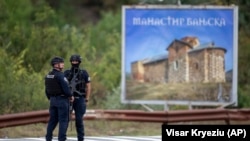
Kosovar police officers secure a road leading to the monastery in the village of Banjska on September 24.

Kosovar police officers secure a road leading to the monastery in the village of Banjska on September 24.

Authorities in Kosovo say the situation around a Serbian Orthodox monastery complex in the mostly Serb-populated north of the country was calm on September 25, which President Vjosa Osmani has declared a day of mourning, after a tense standoff following an assault over the weekend by a “heavily armed” group that led to the death of one police officer and three suspected assailants.

The KosovaPress news agency quoted the deputy director of the Kosovo Police for the north, Veton Elshani, as saying police searches for some of the assailants who fled the area ended late on September 24. He did not say when they would resume.

The incident occurred early on September 24 when Kosovo Police were in a standoff with some 30 attackers dressed in security- or military-like uniforms who may have ties to the Orthodox monastery complex in the village of Banjska, where the deadly encounter began around 2:30 a.m. local time, sparking vague accusations of involvement by neighboring bitter rival Serbia.

During the standoff, Kosovar police said three attackers had been killed and six people arrested, including two of the attackers and four others found to be in possession of radio communications equipment and had discovered a “significant amount” of weapons, ammunition, and other equipment.

Details remained scarce and it wasn’t immediately clear how the remaining suspected assailants may have escaped or where they were heading.

Serbian President Aleksandar Vucic, in a speech late on September 24, said he was sorry that a police officer was killed, but he blamed the Kosovar leader, saying that ethnic Serbs there “did not want to suffer [Prime Minister Albin] Kurti’s terror any longer.”

“I do not want to justify the murder of an [ethnic] Albanian policeman in any way, nor can I justify it. It is an act of condemnation and it is something that no one needed,” the Serbian president said.

He denied that Belgrade was involved in the overnight incident and said two of those killed were from North Mitrovica, without providing their identities. He also vehemently stated that Serbia would “never” recognize the independence of Kosovo, its former province, “neither formally nor informally.” He did add, however, that Belgrade was willing to talk to Pristina.

Kurti earlier told a news conference that “there are at least 30 heavily armed people, professionals, military and police, who are under the siege of our police forces and whom I invite to surrender to our security bodies.”

He said Kosovar security authorities and prosecutors would scramble “to understand more about these uniforms.”

“It seems that this is a well-organized action, which is why it is more dangerous, because it suggests that there are groups on the ground who are interested in causing violence and are ready to organize and find weapons that will enable them to do so,” Charles Kupchan, a professor at Georgetown University and former director of European affairs at the U.S. National Security Council in the administrations of Bill Clinton and Barack Obama, told RFE/RL.

Serbia does not recognize the 2008 declaration of independence of its mostly ethnic Albanian former province, with many ethnic Serbs in Kosovo following suit while remaining dependent on so-called parallel structures that Pristina regards as illegal.

EU foreign policy chief Josep Borrell said he “condemn[s] in the strongest possible terms the hideous attack by an armed gang against Kosovo Police officers in Banjska/Banjske” and said more innocent lives were in danger “in ongoing hostilities” around the monastery.

He said the EU’s peacekeeping force, EULEX, was “on the ground” as a second security responder and was in touch with authorities and with NATO KFOR peacekeepers.

Western officials mediating talks with Serbia and Kosovo have signaled frustration since negotiations this month that also involved Serbia’s Vucic failed to achieve a breakthrough on normalization.

Those talks are part of a decade-long U.S. and EU diplomatic push toward formalized relations and to repair some of the wounds from bloody internecine wars in the 1990s after the breakup of Yugoslavia.

In May and June, Kurti ignored outside warnings and tried to forcibly install four mayors in Serb-majority northern municipalities following boycotted by-elections to fill posts vacated by protesting Serbs.

The resulting tensions erupted into violence that injured dozens of NATO KFOR peacekeepers and some ethnic Serbian protesters.


Categories
Selected Articles

Russia Calls Pashinian’s Criticism Of Moscow Over Situation In Nagorno-Karabakh ‘Unacceptable’


Kosovar police officers secure a road leading to the monastery in the village of Banjska on September 24.

Kosovar police officers secure a road leading to the monastery in the village of Banjska on September 24.

Authorities in Kosovo say the situation around a Serbian Orthodox monastery complex in the mostly Serb-populated north of the country was calm on September 25, which President Vjosa Osmani has declared a day of mourning, after a tense standoff following an assault over the weekend by a “heavily armed” group that led to the death of one police officer and three suspected assailants.

The KosovaPress news agency quoted the deputy director of the Kosovo Police for the north, Veton Elshani, as saying police searches for some of the assailants who fled the area ended late on September 24. He did not say when they would resume.

The incident occurred early on September 24 when Kosovo Police were in a standoff with some 30 attackers dressed in security- or military-like uniforms who may have ties to the Orthodox monastery complex in the village of Banjska, where the deadly encounter began around 2:30 a.m. local time, sparking vague accusations of involvement by neighboring bitter rival Serbia.

During the standoff, Kosovar police said three attackers had been killed and six people arrested, including two of the attackers and four others found to be in possession of radio communications equipment and had discovered a “significant amount” of weapons, ammunition, and other equipment.

Details remained scarce and it wasn’t immediately clear how the remaining suspected assailants may have escaped or where they were heading.

Serbian President Aleksandar Vucic, in a speech late on September 24, said he was sorry that a police officer was killed, but he blamed the Kosovar leader, saying that ethnic Serbs there “did not want to suffer [Prime Minister Albin] Kurti’s terror any longer.”

“I do not want to justify the murder of an [ethnic] Albanian policeman in any way, nor can I justify it. It is an act of condemnation and it is something that no one needed,” the Serbian president said.

He denied that Belgrade was involved in the overnight incident and said two of those killed were from North Mitrovica, without providing their identities. He also vehemently stated that Serbia would “never” recognize the independence of Kosovo, its former province, “neither formally nor informally.” He did add, however, that Belgrade was willing to talk to Pristina.

Kurti earlier told a news conference that “there are at least 30 heavily armed people, professionals, military and police, who are under the siege of our police forces and whom I invite to surrender to our security bodies.”

He said Kosovar security authorities and prosecutors would scramble “to understand more about these uniforms.”

“It seems that this is a well-organized action, which is why it is more dangerous, because it suggests that there are groups on the ground who are interested in causing violence and are ready to organize and find weapons that will enable them to do so,” Charles Kupchan, a professor at Georgetown University and former director of European affairs at the U.S. National Security Council in the administrations of Bill Clinton and Barack Obama, told RFE/RL.

Serbia does not recognize the 2008 declaration of independence of its mostly ethnic Albanian former province, with many ethnic Serbs in Kosovo following suit while remaining dependent on so-called parallel structures that Pristina regards as illegal.

EU foreign policy chief Josep Borrell said he “condemn[s] in the strongest possible terms the hideous attack by an armed gang against Kosovo Police officers in Banjska/Banjske” and said more innocent lives were in danger “in ongoing hostilities” around the monastery.

He said the EU’s peacekeeping force, EULEX, was “on the ground” as a second security responder and was in touch with authorities and with NATO KFOR peacekeepers.

Western officials mediating talks with Serbia and Kosovo have signaled frustration since negotiations this month that also involved Serbia’s Vucic failed to achieve a breakthrough on normalization.

Those talks are part of a decade-long U.S. and EU diplomatic push toward formalized relations and to repair some of the wounds from bloody internecine wars in the 1990s after the breakup of Yugoslavia.

In May and June, Kurti ignored outside warnings and tried to forcibly install four mayors in Serb-majority northern municipalities following boycotted by-elections to fill posts vacated by protesting Serbs.

The resulting tensions erupted into violence that injured dozens of NATO KFOR peacekeepers and some ethnic Serbian protesters.

Categories
Selected Articles

Moscow Rebuffs Armenian PM’s Claims of Betrayal


82557__9937ae7bc6a96b2db360e3faf7010e3e.

Russia’s Foreign Ministry said Monday that it rejects Armenian Prime Minister Nikol Pashinyan’s accusation that his country was abandoned by Moscow after Azerbaijan last week launched a military operation in the disputed territory of Nagorno-Karabakh.

Pashinyan on Sunday blasted the Russian-Armenian strategic partnership as “insufficient,” signaling a major foreign policy shift away from its traditional ally.

He spoke days after Armenia’s rival Azerbaijan claimed full control over Nagorno-Karabakh after a lightning offensive.

“Pashinyan’s address contains unacceptable attacks on Russia and causes nothing but rejection,” Russia’s Foreign Ministry said in a statement.

“Yerevan’s leadership is making a huge mistake by deliberately trying to destroy Armenia’s multifaceted and centuries-old ties with Russia,” it added, characterizing Pashinyan as “short-sighted” and “inconsistent.”

Moscow also accused Pashinyan of “systemically” undermining Russian-Armenian ties, claiming that Yerevan risks becoming “a hostage of the West’s geopolitical games.”

Armenia is a member of the Collective Security Treaty Organization, a Russia-led group of six former-Soviet republics that pledges to protect other members under attack. 

But Moscow refused to come to Armenia’s aid amid Baku’s most recent attacks, arguing that Yerevan had itself recognized Nagorno-Karabakh as part of Azerbaijan following a ceasefire in the 2020 war.

Armenia hosts a Russian military base in its second-largest city of Gyumri, while Russian peacekeepers were deployed in the region after the 44-day war in 2020.

The Kremlin said earlier Monday that it was unclear how long Russian peacekeepers would remain in Nagorno-Karabakh after Azerbaijan’s victory.

“[Russian peacekeepers] are on Azerbaijan’s territory. . . contributing to the establishment of dialogue between the Armenian community of Nagorno-Karabakh and the Azerbaijani authorities,” Kremlin spokesman Dmitry Peskov told reporters.


Categories
South Caucasus News

Maldives follow Saudi lead in restoring ties with Iran – The Times of Israel


Maldives follow Saudi lead in restoring ties with Iran  The Times of Israel

Categories
South Caucasus News

Iran’s Hajimousaei Snatches Silver: 2022 Asian Games – Tasnim News Agency


Iran’s Hajimousaei Snatches Silver: 2022 Asian Games  Tasnim News Agency