
Categories
Selected Articles

With Victory Assured, Azerbaijan Now Seeks ‘Reintegration’ Of Karabakh Armenians


As Azerbaijan moves swiftly toward retaking full control of the region of Nagorno-Karabakh, the territory’s ethnic Armenian population is facing a deeply precarious future.

The Azerbaijani government has said it has a plan to “reintegrate” the Armenians into the Azerbaijani state following its victory in a one-day offensive and the surrender of Karabakh’s de facto ethnic Armenian leadership. But Baku still hasn’t offered specifics about what reintegration might mean — and its promises to protect the rights and security of its possible new Armenian citizens have little credibility among a traumatized and frightened Karabakh population.

Representatives of the central government from Baku and Karabakh Armenians on September 21 began working out the terms of a new arrangement following the Azerbaijani offensive, which Nagorno-Karabakh authorities say has killed at least 200 people, including 10 civilians, and wounded more than 400. (RFE/RL could not independently confirm the casualty figures.) While there were no immediate results from the talks, negotiations are slated to continue.

“A whole host of questions still need to be resolved,” David Babaian, an adviser for foreign policy to the separatist government’s de facto leader Samvel Shahramanian, told Reuters following the meeting with the Azerbaijanis. “We do not know what guarantee of security our people will get. This needs to be resolved.”

WATCH: Security forces have detained more than 80 people amid anti-government protests in the Armenian capital of Yerevan.

In the immediate aftermath of the assault, uncertainty reigned in Karabakh. Many Karabakh Armenians wrote on social media that they had been separated from family members during the offensive. There were sporadic reports of continued fighting. The Russian peacekeeping contingent in the territory said it had evacuated more than 5,000 people from the regions of Martakert, Martuni, and Askeran after Azerbaijani forces advanced into those regions. As of late night on September 21, the peacekeepers said they were hosting 704 displaced people at their base at the airport in Khojaly.

Azerbaijan has said six Russian peacekeepers were killed during Baku’s military offensive. According to the country’s Prosecutor-General’s Office, five were killed “by mistake” by Azerbaijani forces and one by Karabakh Armenian fighters.

Azerbaijani forces have not yet moved into the capital of the territory, known as Stepanakert in Armenian and Xankendi in Azerbaijani. Public services and administration are, for now, still being operated by the self-proclaimed Nagorno-Karabakh Republic (NKR), which has governed the territory since the early 1990s, after Armenian separatists defeated Azerbaijan in the first war between the two sides.

A generation of ethnic Armenians in Karabakh has now grown up under the NKR’s rule, as it maintained control of the territory with Armenia’s backing. Diplomatic efforts to resolve the conflict after the first war brought little progress.

IN PHOTOS: An estimated 10,000 evacuees are seeking shelter without basic living conditions in basements, while others have massed at an airport in hopes of fleeing to Armenia.


Concerns Grow For Humanitarian Situation Of Nagorno-Karabakh Evacuees


Photo Gallery:

Following a lightning military offensive by Azerbaijani forces in the disputed territory of Nagorno-Karabakh, an estimated 10,000 evacuees are seeking shelter without basic living conditions in basements, while others have massed at an airport in hopes of fleeing to Armenia.

The two sides fought another war in 2020 that lasted six weeks before a Russian-brokered cease-fire effectively recognized the loss of Armenian control over large parts of the NKR-controlled territory. With its one-day offensive this week, Azerbaijan forced a surrender that included the full disarmament and disbandment of the NKR’s armed forces. It is not clear how much longer the NKR itself — which Azerbaijan regards as a criminal junta — will survive. Azerbaijan has promised that the Armenians of Karabakh can continue to live in the territory. But if there is any viable future for the ethnic Armenian population in Karabakh, it would represent an exception to the established pattern of zero-sum territorial control and ethnic cleansing in the Caucasus.

When Armenia won the war in the 1990s, all of the more than 600,000 ethnic Azerbaijanis who had been living in the territory that the Armenians took were forced to flee. Armenians who had been living in the territories Azerbaijan retook in 2020 were also driven out and have not been able to return. In the separatist territories of South Ossetia and Abkhazia there remain only small, beleaguered pockets of ethnic Georgian inhabitants following successive wars there; the large majority of former Georgian residents were also forced to flee.

WATCH: Thousands of ethnic Armenians gathered at Nagorno-Karabakh’s only airport seeking protection and possible transit to Armenia.

Until 2020, Azerbaijan repeatedly promised that if Armenia agreed to peacefully return the territories it had taken during the first war, then the Armenians of the region would enjoy “the highest possible autonomy” within Azerbaijan. Baku offered examples like the culturally German Tyrol district of Italy and the culturally Swedish Aland Islands in Finland. As soon as the 2020 war began, though, the promise was revoked. “We offered them autonomy…but they rejected everything,” Azerbaijani President Ilham Aliyev said during the war. Immediately after the fighting ended with Armenia’s capitulation, he then vowed: “To hell with the status, the status has gone to the grave, the status has disappeared, it is gone.”

Since that 2020 victory, Azerbaijan has refused to publicly discuss what sort of arrangements the Karabakh Armenians could receive under Azerbaijani rule. State-connected think tanks have occasionally proposed models of coexistence, but Azerbaijani officials would say only that the Karabakh Armenians would be treated as any other citizens of Azerbaijan.

Following the recent offensive and the NKR’s capitulation, some Azerbaijani officials have spoken more openly about a plan.

Hikmet Hajiyev, a senior foreign policy adviser to Aliyev, has said a plan is “ready.” Aliyev himself promised the Karabakh Armenians that “all their rights will be guaranteed: educational rights, cultural rights, religious rights, and municipal electoral rights, because Azerbaijan is a free society.”

On September 22, Hajiyev told Reuters that members of the Karabakh armed forces who lay down their weapons may be given amnesty. To many observers, though, the promises are too little and too late and to be taken at face value. Many suspect the Azerbaijani promises are simply window dressing for what would amount to another ethnic cleansing. “The Karabakh Armenians are not just any minority. They have a specific history of conflict, and they have very serious security concerns. So, I think a project to reintegrate them into Azerbaijan would require painstaking negotiations, transitional arrangements, real thinking about security guarantees, and so on,” said Laurence Broers, an associate fellow at the London-based Chatham House’s Russia and Eurasia Program, said. “What we’re seeing is that these negotiations are taking place after very severe and asymmetric episodes of violence.”

As a result, “the commitments that Azerbaijan is making are not seen as credible by the wider population in Armenia,” Broers added. “The most likely outcome that we’ll see in the coming weeks and months is a substantial outflow of people to Armenia.”

For now, while some Karabakh Armenians have gone to the airport in Stepanakert seeking protection from Russian peacekeepers and possible transit, many have said they were not allowed. Some have said it is the Russian peacekeepers who are not allowing them to leave. Armenia’s government, meanwhile, says it has made preparations for an evacuation but has not deemed such a step necessary. “We don’t want to talk about this, because we believe that the Armenians of Nagorno-Karabakh should live in their homes, in their homeland, in dignified and safe conditions,” Armenian Prime Minister Nikol Pashinian said in a video address to the nation on September 21. “At this moment, our assessment is that there is no direct threat to the civilian population of Nagorno-Karabakh.” It is not clear how many Armenians will want to leave Karabakh, either temporarily or permanently. “The overwhelming majority of the people here do not want to live as part of Azerbaijan, [and] I do not know what will happen,” Babaian said.

Given the dire humanitarian situation in Karabakh following nine months of a blockade by Azerbaijan that preceded the military offensive, many observers called for people to be allowed to evacuate.

The “next few days will be crucial in determining whether [there] will be a significant outflow of population from the region, if not complete exodus of the ethnic Armenian population,” wrote Carey Cavanaugh, a former U.S. negotiator in the Armenia-Azerbaijan talks, on X, the platform formerly known as Twitter. “Those who wish to leave Azerbaijan should be afforded that option. The international community should help facilitate their safe and secure departure from Nagorno-Karabakh and assist with their reception in Armenia.” Armenians should be allowed to at least temporarily leave Karabakh, said Philip Gamaghelyan, a longtime peace activist in the region and professor of Peace Studies at the University of San Diego. “The absolute priority is to provide the opportunity for safe passage for full evacuation of the Armenians of Nagorno-Karabakh at this stage,” he said in a September 21 online discussion. “There has been nothing done for the last three years, and especially the last nine months [of the blockade], to in some form prepare them for integration or coexistence. So, at this point, to believe that they could live safely and with some rights is very hard to imagine.” But after a “break” in Armenia, Azerbaijan should be given the chance to “prove [skeptics] wrong” and provide a suitable environment. “And then, yes, we can organize a safe return,” Gamaghelyan said.

But a temporary evacuation could turn permanent, warned Lala Darchinova, an activist and a co-editor, along with Gamaghelyan, at the Caucasus Edition journal. “As much as I don’t want to see Karabakh without Azerbaijanis, I don’t want to see Karabakh without Armenians,” she said in the same online discussion. “So, evacuation…is a very big question for me, whether people would be able to come back. But it’s a very difficult situation, because in the short term, what is the alternative for these people?”
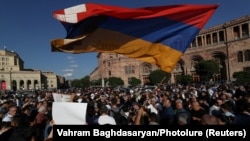

Protests In Yerevan Follow Azerbaijani Attacks As Karabakh Residents Seek Shelter


Photo Gallery:

Armenians took to the streets to demand Prime Minister Nikol Pashinian resign after Azerbaijan launched what it called an “anti-terrorist operation” targeting ethnic Armenian military positions in Nagorno-Karabakh that left at least 32 people dead and more than 200 wounded.

One factor that would likely complicate a mass exodus would be Russia. “Whether Karabakh Armenians remain or not is also unfortunately tied into geopolitical calculations around the continued Russian presence, because if there is no Armenian community remaining in Karabakh, then there is no justification for a Russian peacekeeping mission,” Chatham House’s Broers said. “It might be in Russia’s interests to see some symbolic presence there.” In a September 21 phone call with Aliyev, Russian President Vladimir Putin “emphasized the importance of ensuring the rights and security of the Armenian population of Karabakh,” the Kremlin reported. Broers said many Karabakh Armenians are unlikely to want to move to Armenia, even if their homes come under Azerbaijani control. “For many Karabakh Armenians, resettling in Armenia is not an attractive option,” he said, given Armenia’s history treating refugee Armenians as second-class citizens. “They’re really in a position of choosing between lesser evils.” The near-term future of Armenians in Karabakh is likely to be comparable to that of Serbs in Kosovo, said Shujaat Akhmadzada, a nonresident research fellow at the Baku-based Topchubashov Center, which focuses on international relations and security. That is, “there is antagonism, communities do not visit each other, they have their own symbolism in their own villages. Hopefully there is no violence, but there are occasional, let’s say antagonistic, interactions,” he said in a separate September 21 online discussion, organized by the online platform Bright Garden Voices. In the longer term, he said the situation may be comparable to that of Armenians in Turkey or Georgia.

Whatever the Azerbaijani government offers to the Karabakh Armenians it is likely to be merely for show, argued Anna Ohanian, a political science professor at Stonehill College.

“Considering that Azerbaijan is using coercive tactics, coercive strategies, the postwar conditions for Armenians who decide or are able or want to stay in Azerbaijan is not going to be pretty,” she said during the Bright Garden Voices event. “There could be some pretense for a while, in the short term, creating some sort of Potemkin villages here and there,” she said.


Categories
South Caucasus News

Humanitarian aid begins to arrive in Nagorno-Karabakh enclave – Euronews


Humanitarian aid begins to arrive in Nagorno-Karabakh enclave  Euronews

Categories
South Caucasus News

NPR News: 09-23-2023 7PM EDT


NPR News: 09-23-2023 7PM EDT

Categories
South Caucasus News

New Analysis Released of Climate Security Risks in Iran and … – HSToday


New Analysis Released of Climate Security Risks in Iran and …  HSToday

Categories
South Caucasus News

World News in Brief: Healthcare crisis in DRC, Türk slams Iran hijab law, welcomes new India bill boosting women – UN News


World News in Brief: Healthcare crisis in DRC, Türk slams Iran hijab law, welcomes new India bill boosting women  UN News

Categories
South Caucasus News

Russian peacekeepers, ICRC deliver humanitarian aid to Nagorno-Karabakh


Categories
South Caucasus News

ICRC evacuates victims of Azeri attack from Martakert to Stepanakert


Categories
South Caucasus News

Menendez steps down as Foreign Relations chairman after indictment


Sen. Bob Menendez (D-N.J.) will step down from his position as chairman of the Senate Foreign Relations Committee following an indictment that was unsealed on Friday, The Hill reports.

Senate Majority Leader Chuck Schumer (D-N.Y.) announced the move Friday afternoon.

Under Democratic Conference rules, a member in a leadership position or with a chair must resign if charged with a felony, but can be reinstated if the charges are cleared or dropped to a lesser charge.

“Bob Menendez has been a dedicated public servant and is always fighting hard for the people of New Jersey. He has a right to due process and a fair trial,” Schumer said in the statement.

“Senator Menendez has rightly decided to step down temporarily from his position as Chairman of the Foreign Relations Committee until the matter has been resolved.” 

Sen. Ben Cardin (D-Md.), as the most senior Democrat on the panel, is likely to move into the chairmanship role. Cardin announced in May that he will retire at the end of his term in 2025 and it’s possible that the third-ranking Democrat on the committee, Sen. Jeanne Shaheen (D-N.H.), could also be considered for the chair.

The committee is unlikely to see any major hiccups in operations if Menendez is allowed to retain his seat on the committee while not serving as chair.

Menendez faces three counts, including conspiracy to commit extortion under color of official right, a charge for public officials who take bribes in return for official acts, with allegations of bribery linked to his work on the committee. He was charged alongside his wife, Nadine Menendez, and three other businesspeople.


Categories
South Caucasus News

Azerbaijan’s ethnic cleansing policy against Nagorno-Karabakh part of a bigger picture, Armenian FM tells UN


The ethnic cleansing policy against Nagorno-Karabakh is just a part of a bigger picture. In this regard we clearly see an intention to involve the Republic of Armenia in military actions thus widening the geography of hostilities into our sovereign territories, Armenian Foreign Minister Ararat Mirzoyan said addressing the UN General Assembly.

He said Azerbaijan has a hidden agenda when it comes to unblocking regional transport and economic communications.

“The so-called “corridor” logic promoted by Baku and their hidden and open sponsors is aimed at undermining the sovereignty and territorial integrity of Armenia and justifying its territorial claims. The narrative generated by them along with the use of force by Azerbaijan both against the Republic of Armenia and the people of Nagorno-Karabakh shows that forcefully imposing on Armenia an extraterritorial corridor, a corridor that will pass through the territory of Armenia but will be out of our control can be the next target. This is unacceptable for us and should be unacceptable for the international community,” Minister Mirzoyan stated.

Below is Foreign Minister Ararat Mirzoyan’s speech in full: 

Honorable Mr. President, 

Excellences,

Ladies and Gentlemen,

First of all, let me congratulate Mr. Dennis Francis on assuming the Presidency of the 78th session of the United Nations General Assembly.

I will not be the first and definitely not the last speaker in this august body who will identify global threats for democracies, challenges for security, violations of the principles and purposes of the UN Charter, including non-use of force and peaceful resolution of conflicts, as a main source of instability and tension in the world.

The devastating developments of the past years, which disrupted the security architecture in the world and especially in Europe, have significantly damaged multilateralism. If a couple of years ago we were contemplating the decline of multilateralism, today we see erosion of that very tenet and its foundation such as international law, human rights and cooperative security.

This is not just a theoretical inference but a reality with which the Armenian people in the South Caucasus are coping for the last three years. The repetitive aggression of Azerbaijan against the sovereign territory of the Republic of Armenia and military attacks against the people of Nagorno-Karabakh significantly disrupts peace and stability in our region, massively violates human rights and humanitarian law representing existential threat for Armenians.

My government, having a sincere belief and aspiration to establish peace and stability in our region, has made significant and duly recorded efforts to this end. Alas, we do not have a partner for peace but a country who openly declares that “Might has Right” and constantly uses force to disrupt the peace process. Literally a year ago, from this very stage the PM of Armenia presented the fact of aggression and occupation of the Republic of Armenia’s sovereign territories by neighboring Azerbaijan. Since then, the situation has deteriorated even more and today I have to present yet another very recent act of large-scale offensive, this time against the indigenous people of Nagorno-Karabakh, in blatant violation of the international law and Trilateral Statement of November 9, 2020. 

It happened this week and the timing was not accidental. It shows open disregard and defiance of Azerbaijan against the international community who gathered here in New York. The message is clear: “you can talk about peace and we can go to war and you will not be able to change anything.” The 120,000 people, whose sole aspiration is to live and create in peace and dignity in their ancestral homeland and who have already been suffering under the more than 9-month blockade and siege by Azerbaijan, were subjected to military attack by tens of thousands of troops. In the course of this inhumane attack, the whole territory of Nagorno-Karabakh, Stepanakert and other towns and settlements came under intense and indiscriminate shelling with heavy weaponry such as rockets, artillery, combat UAVs, aviation, including prohibited cluster munition. 

This atrocious large-scale offensive which claimed hundreds of lives, including of women and children, was cynically defined as a local counter terrorist operation. According to the recent information there are confirmed cases of more than 200 killed and 400 wounded, including among civilian population, women and children, also accepted by the Azerbaijani Ministry of Foreign Affairs. The fate of hundreds of people is uncertain.

As I speak today, 30 percent of the population of Nagorno-Karabakh is displaced. The entire population of Nagorno-Karabakh remains without any means of subsistence, as just limited humanitarian assistance has been able to enter into Nagorno-Karabakh. There is no food, no medicine, no shelter, no place to go, separated from their families, terrorized and scared for their lives.

Ladies and Gentlemen,

The policy and actions of Azerbaijan for the last 10 months, evidently demonstrate the pre-planned and well-orchestrated nature of this mass atrocity. On December 12, 2022, Azerbaijan blockaded the Lachin corridor – the only road, the lifeline connecting Nagorno-Karabakh to Armenia and the outer world, in blatant violation of its obligations under the international humanitarian law and the Trilateral Statement of 9 November 2020. The blockade was further consolidated by the installation of illegal check-point since April 23, as well as with the complete cessation of any movement, even for humanitarian aid through the Corridor since June 15.

More than 9 months-long blockade of Nagorno-Karabakh caused a severe shortage of food, medical supplies, fuel and other essential goods, almost depleting the resources necessary for the survival of the population. The blockade was accompanied by deliberate disruption of electricity and natural gas supplies, further exacerbating the situation into a full-fledged humanitarian crisis.

I would like to emphasize that on 22 February, 2023 the International Court of Justice indicated a provisional measure, according to which “Azerbaijan shall take all measures to ensure unimpeded movement of persons, vehicles and cargo along the Lachin corridor in both directions”. This order was later reconfirmed by the Court’s order of 6 July. 

A number of partner states, international organizations, including UN Special Rapporteurs, the International Committee of the Red Cross, Human Rights Watch, Freedom House, Amnesty International, Transparency International had been continuously voicing an alarm about the deteriorating situation on the ground. Moreover, on August 16, during the emergency meeting of the United Nations Security Council conveyed by the request of Armenia, the majority of UNSC member states expressed clear position regarding the need to unblock the Lachin corridor and halt the suffering of the people of Nagorno-Karabakh and ensure their fundamental human rights. Whereas, in response to these clear-cut calls, Azerbaijan has worsened its inhumane actions by launching this military attack against the people of Nagorno-Karabakh. 

On September 21, 2023, the United Nations Security Council gathered once again to discuss the devastating situation in Nagorno-Karabakh. The majority of the UNSC members expressed their position regarding the imperative of cessation of hostilities by Azerbaijan, opening of the Lachin corridor, ensuring international humanitarian access and addressing the rights and security of the people of Nagorno-Karabakh. 

Ladies and Gentlemen, 

The chronology of truly devastating developments in our region come to prove that the issues cannot be addressed merely with statements and generic calls. Armenia has repeatedly warned the international community about the need for concrete and practical action, including the dispatching of a UN inter-agency needs assessment and fact-finding mission to Nagorno-Karabakh. But the international community, the United Nations failed to come to the rescue of people for the last 9 months, 285 days.

The use of starvation as a method of warfare, depriving people of their means of subsistence, obstruction and denial of humanitarian access of UN agencies, hindering the ICRC humanitarian activities, constitute early warning signs of an atrocity crime. A number of international human rights organizations, lawyers, genocide scholars, reputable independent experts, including the former ICC Prosecutor and the former Special Advisor of the UN Secretary-General on the Prevention of Genocide have already characterized the situation on the ground in Nagorno-Karabakh as a risk of genocide. Just yesterday, the Special Advisor of the UN Secretary-General on the Prevention of Genocide Alice Wairimu Nderitu stressed and I quote: “Military action can only contribute to escalate what is already a tense situation and to put the civilian population in the area at risk of violence, including risk of genocide and related atrocity crimes. All efforts need to be made to prevent violence and sustain peace”, end of quote.

Let me draw your attention to the fact that after failure of preventing Genocide in Rwanda, the United Nations managed to create mechanisms for prevention, thus making the “never again” a meaningful pledge. But today we are at the brink of another failure.

The people of Nagorno-Karabakh, trapped in this inhumane blockade and hostilities inflicted by Azerbaijan and under the threat of their very existence, still hope that prevention will not remain a feature of language, but will become a line of actions.

The claims that the United Nations is not present on the ground, so has no capacity to verify the situation cannot be an excuse for inaction. The United Nations is a universal body, which should stand with the victims of mass atrocity crimes all over the world regardless of the status of territory instead of delivering dismissive statements.

We are hopeful that the international community, namely the UN will demonstrate a strong political will to condemn the resumption of hostilities and targeting of civilian settlements and infrastructure and demand full compliance with obligations under the international humanitarian law, including those related to the protection of civilians, in particular women and children, and critical civilian infrastructure․

The international community should undertake all the efforts for an immediate deployment of an interagency mission by the UN to Nagorno-Karabakh with the aim to monitor and assess the human rights, humanitarian and security situation on the ground. The unimpeded access of the UN agencies and other international organizations to Nagorno-Karabakh in line with the humanitarian principles is an imperative. In this regard we also stress the need to ensure full cooperation of the parties in good faith with the International Committee of the Red Cross to address the consequences of the military attack, including the removal and identification of the bodies, search and rescue of missing personnel and civilians, release of POWs, safe and unimpeded delivery of humanitarian assistance, in strict compliance with the international humanitarian law.

Azerbaijan must finally adhere to its legally binding obligations and ensure freedom of movement of persons, vehicles and cargo, along the Lachin corridor, in line with the ICJ orders. 

We firmly believe that relevant mechanisms must be introduced to ensure the return of persons displaced in the course of the recent military attack, as well as persons and refugees displaced as a result of 2020 war, to their homes in the territory of Nagorno-Karabakh and adjacent regions under the monitoring and control of the UN relevant agencies, as it was foreseen in the Trilateral Statement of November 9, 2020.

A sustainable and viable international mechanism for preventing the ethnic cleansing of the indigenous population of Nagorno-Karabakh and for ensuring dialogue between representatives of Nagorno-Karabakh and official Baku to address the issues related to rights and security of the Armenians of Nagorno-Karabakh is an imperative. Furthermore, excluding punitive actions against NK political and military representatives and personnel should be guaranteed. 

We also believe that the international community must demand the exit of any Azerbaijani military and law-enforcement bodies from all civilian settlements in NK to exclude panic, provocations and escalation, endangering civilian population and create a possibility for a United Nations-mandated Peacekeeping Force to keep stability and security in Nagorno-Karabakh.

Ladies and Gentlemen,

The ethnic cleansing policy against Nagorno-Karabakh is just a part of a bigger picture. In this regard we clearly see an intention to involve the Republic of Armenia in military actions thus widening the geography of hostilities into our sovereign territories. 

The unwillingness of Azerbaijan to genuinely and constructively engage in the peace process with Armenia, including to recognize the territorial integrity of the Republic of Armenia, withdraw its Armed forces from the occupied territories of Armenia, delimitate the Armenian-Azerbaijani interstate borders based on the latest available maps from 1975 corresponding with Almaty 1991 declaration, create a demilitarized zone along the interstate border, clearly illustrates the mentioned intentions.

Likewise, Azerbaijan has a hidden agenda when it comes to unblocking regional transport and economic communications. As a landlocked country, Armenia is vitally interested in implementation of the agreement on the unblocking of all the regional communications on the basis of sovereignty, national jurisdiction, equality and reciprocity. Armenia is a long-standing advocate of the inclusive and equitable transport connectivity with the view to promote trade, cooperation and people-to-people contacts, whereas our neighbors continue to impose the three decades-long blockade of Armenia, as part of its well-established policy of economic coercion of my country. The so-called “corridor” logic promoted by Baku and their hidden and open sponsors is aimed at undermining the sovereignty and territorial integrity of Armenia and justifying its territorial claims. The narrative generated by them along with the use of force by Azerbaijan both against the Republic of Armenia and the people of Nagorno-Karabakh shows that forcefully imposing on Armenia an extraterritorial corridor, a corridor that will pass through the territory of Armenia but will be out of our control can be the next target. This is unacceptable for us and should be unacceptable for the international community. 

Mr. President,

Despite all the challenges Armenia continues to engage in the negotiations to achieve normalization of relations and establishment of lasting peace in the region and supports the efforts of the international partners to this end. Respect for territorial integrity and sovereignty within the internationally recognized borders, addressing the underlying causes of the conflict, namely the rights and security of the people of Nagorno-Karabakh are the foundation of a lasting peace. 

In the end, let me state that the people of Armenia will firmly stand for our sovereignty, independence and democracy and will overcome the hybrid-war unleashed against us.

I thank you.


Categories
South Caucasus News

Azerbaijan’s ethnic cleansing policy against Nagorno-Karabakh part … – en.armradio.am


Azerbaijan’s ethnic cleansing policy against Nagorno-Karabakh part …  en.armradio.am