
S. Korea Too Strong for Iran at U-17 WAC Qualifiers Tasnim News Agency
Day: September 21, 2023

These days Armenia’s relationship with Russia is looking more like a hostage situation than a strategic partnership.
On September 19, as Azerbaijan was waging its massive assault on Nagorno-Karabakh, Russia’s first reaction was to call on both sides to stop fighting and suggest that Armenia had brought about the situation itself.
A short time later, former Prime Minister Dmitri Medvedev chided the Armenian prime minister for blaming Moscow for Yerevan’s problems, “flirting with NATO,” and engaging in a modest outreach to Ukraine. “One can guess what fate awaits him…” Medvedev concluded ominously (his ellipsis).
Medvedev’s aide, Oleg Osipov, asked to elaborate on his boss’s comment the following day, put it even more starkly: “In case someone didn’t understand, Russia has been and will be the guarantor of the very existence of Armenia as a state and of the Armenian nation. God has willed it thus.”
Armenia has been overwhelmingly reliant on Russia since the dissolution of the Soviet Union. It is a member of the Russia-led regional military and economic blocs – the Collective Security Treaty Organization (CSTO), and the Eurasian Economic Union (EAEU). It hosts a large Russian military base in Gyumri and several other smaller Russian military installations. And its economic dependence on Russia has only grown since the latter launched its war on Ukraine.
Nonetheless, Russia’s interests appear increasingly more aligned with Azerbaijan’s than Armenia’s. For one, Russia shares a border with Azerbaijan and needs it for a north-south trade corridor to the Persian Gulf necessitated by Western sanctions over the Ukraine invasion.
Perhaps more significantly, both are repressive authoritarian states whose leaders are at liberty to engage in transactional politics with nothing but the faintest pretensions to democracy and human rights.
And now Russia is the sole outside mediator in a Baku-Stepanakert talks process that appears set to end three decades of ethnic Armenian de facto control of Nagorno-Karabakh.
Armenian-Russian relations began to sour in earnest in spring 2018 when the so-called “velvet revolution” swept away the Russia-aligned kleptocratic old guard and brought the young reformer Nikol Pashinyan to power.
Pashinyan was at pains to assure Moscow that his agenda was not geopolitical, vowing that Armenia would stay in the EAEU and CSTO and keep the Russian base.
Russia accepted Pashinyan but never trusted him, seeing his rise to power in the context of other “color revolutions” in what it considers its backyard that brought pro-Western regimes to power.
In 2020, when Azerbaijan launched its offensive to take back the lands it lost in the First Karabakh War in the early 1990s, Russia did not intervene on Armenia’s behalf. (Indeed, though it has obligations to protect Armenia through the CSTO and a bilateral defense agreement, Nagorno-Karabakh was recognized as Azerbaijani territory.) Moscow stepped in only to broker a ceasefire that saw Baku regain most of the territories previously held by Armenian forces and the deployment of a 2,000-strong Russian peacekeeping contingent in Nagorno-Karabakh for a term of five years.
A fragile status quo held on the ground for roughly the next two years.
Armenia and Azerbaijan engaged in periodic peace talks on two separate tracks that were not coordinated with each other; one mediated by Russia and the other by the United States and the European Union. They never advanced very far, though, due to fundamental differences on the fate of Nagorno-Karabakh’s Armenian population.
But during that time — in fact, just two days before Russia launched its full-scale invasion of Ukraine in February 2022 — Baku and Moscow formalized an “alliance” that one observer said aimed to “ensure that Azerbaijan did not get involved in any Western anti-Russian campaign.”
Azerbaijan then began a series of deft maneuvers in the new reality created by the Russia-Ukraine war. It has supported Ukraine’s territorial integrity and sent humanitarian aid there. And it has simultaneously helped Western countries cut themselves off from Russia, including through the provision of natural gas, and helped Russia break out of the resulting isolation.
Baku also took advantage of Russia’s preoccupation with Ukraine, launching a series of cross-border attacks on the territory of Armenia in September 2022. Pashinyan appealed to Russia and the CSTO for help but none was forthcoming.
Anti-Russian sentiment grew in Armenia, pushing Yerevan to seek whatever help it could in the West. Russian media narratives accordingly turned sharply against Armenia.
Over the ensuing months, Armenia refused to host a CSTO exercise and later formally downgraded its participation in the alliance.
In May, during the course of the peace talks, Armenian Prime Minister Pashinyan explicitly announced that Yerevan was ready to recognize Nagorno-Karabakh as part of Azerbaijan provided that international security guarantees were provided to the region’s Armenian population.
Then in July, Russia for the first time declared that the Armenians of Karabakh must accept Azerbaijani rule (while making no reference to international mechanisms ensuring their security).
By early September Armenian leaders began questioning out loud the efficacy of the partnership with Russia. Pashinyan said that betting on Russia for its security was a “strategic mistake.” This was followed by a visit by Anna Hakobyan, Pashinyan’s wife, to a summit in Kyiv and the first delivery of the first Armenian humanitarian aid to Ukraine since the war began.
And then two weeks later came Azerbaijan’s all-out offensive on Nagorno-Karabakh. Armenian society was plunged in despair, with protesters in Yerevan directing their outrage at both Russia and Pashinyan’s government.
Yerevan-based commentator Eric Hacopian voiced what many Armenians were thinking when he told the local outlet CivilNet that the attack was “obviously coordinated between Baku and Moscow. The objective of Baku is to get an ethnically cleansed Artsakh [Nagorno-Karabakh] back under its complete control, and the object of the Russians is to overthrow the Armenian government.”
Now, the likely end of ethnic Armenian rule over Nagorno-Karabakh would seem to free up Armenia to break away from Russia and seek friendships in the West. But Moscow still has its levers.
Whether or not there actually is coordination between Russia and Azerbaijan, Moscow can use the threat of further Azerbaijani incursions against Yerevan. After all, it has already shown its willingness to shirk its treaty obligations to Armenia.
And then there’s Baku’s long-standing demand for the establishment of a “Zangezur corridor” through Armenia connecting mainland Azerbaijan with its exclave Nakhchivan. The notion was born out of the Russian-brokered ceasefire agreement that ended the 2020 war, the ninth point of which stipulated that Armenia would “guarantee the security of transport connections” to Nakhchivan “in order to arrange unobstructed movement of persons, vehicles and cargo in both directions.” Russian border guards would be responsible for “overseeing” the route.
Azerbaijan has interpreted that provision to mean a road that cuts through Armenian territory with movement unhindered by any Armenian supervision, e.g. customs controls. (Armenia disagrees.)
In recent months, Baku stepped back on its demands for the establishment of the corridor and chose instead to focus on retaking Karabakh. But early this month the Azerbaijani foreign minister spoke of a “plan B” for making it happen.
It is easy to see a scenario where Russia comes to share Azerbaijan’s interpretation of the ceasefire provision and presses Armenia to accept a corridor running through its territory over which it has no sovereignty.

The problem of telephone communication in the Republic of Artsakh is caused due to the operation of insufficient number of stations, which will be possible to organize if there is electricity supply or fuel. Karabakh Telecom CJSC said in a statement issued on Thursday.
“Now the Karabakh Telecom company is doing everything possible to ensure the quality of the communication service in the current situation,” the statement reads.
Since Azerbaijan’s military aggression against Nagorno-Karabakh on September 19, there has been no or poor telephone/mobile communication in the country that has made things even worse.

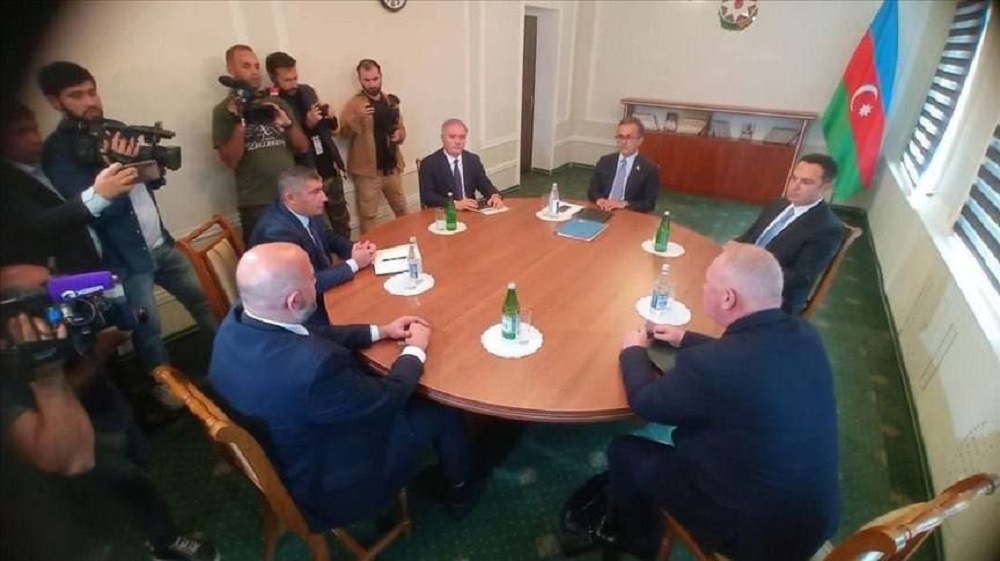
Meeting in Yevlakh
A meeting between representatives of official Baku and the Karabakh Armenian community was held today in the Azerbaijani town of Yevlakh.
According to a statement made by Azerbaijan prior to the meeting, the negotiators were to discuss the reintegration of the Karabakh Armenian population into Azerbaijani society.
- “This is far from ethnic cleansing”: Experts from Baku on the counter-terrorist operation
- “NK Armenians’ right to live in their homes must be ensured by Russia” – Pashinyan
- War in Karabakh: Azerbaijan declared anti-terrorist operation, September 20
The Karabakh Armenian delegation was headed by the leader of the “Democratic Party of Artsakh” David Melkumyan, and the Azerbaijani delegation was headed by MP Ramin Mammadov.
The meeting lasted more than two hours. There were no statements on its results.
“Negotiations between Karabakh Armenians and Azerbaijan may lead to a peace treaty between Baku and Yerevan that will end the conflict,” an Azerbaijani representative said after the meeting in Yevlakh.
In turn, the representative of Karabakh Armenians said that “there is no final agreement with Baku, it is necessary to agree on details”.
“It is difficult to expect the resolution of all problems between Karabakh Armenians and Azerbaijan in one meeting,” said Elchin Amirbekov, the Azerbaijani president’s representative for special assignments. “I believe that today’s talks in Yevlakh are the first of many meetings,” he told Sky News Arabia television.
Statement of the Presidential Administration of Azeraijan
Azerbaijani Presidential Administration on the results of the meeting in Yevlakh:
- the meeting was held in a positive and constructive manner;
- issues related to the reintegration of the Armenian population of Karabakh on the basis of the Constitution and laws of the AR, as well as the restoration of infrastructure and organization of activities were discussed;
- the reintegration plan was handed over to the Armenian representatives;
- the necessity of promptly taking measures on disarmament and transfer of equipment was emphasized;
- representatives of Karabakh Armenians asked for help with fuel and food;
- the Azerbaijani side plans to provide humanitarian support, fuel, heating systems in kindergartens and schools, emergency medical aid and fire-fighting services in the nearest future.