Categories
Selected Articles

Key Democrat chafes at US response to Armenia-Azerbaijan crisis


menendezrobert_041823gn01_w.jpg?w=1280

Sen. Bob Menendez (D-N.J.) expressed frustration Thursday with the Biden administration’s lack of urgency in addressing what the United States has described as a “rapidly deteriorating humanitarian situation” in Nagorno-Karabakh, a hotly disputed region at the center of rising tensions between Armenia and Azerbaijan.  

Menendez, while chairing of a Senate Foreign Relations Committee hearing on the crisis, said he was “amazed” by the responses from Yuri Kim, the acting assistant secretary for the State Department’s Bureau of European and Eurasian Affairs.  

“I have been doing this for 31 years. I am amazed sometimes at what the department comes before this committee and says,” he said at the end of the hearing.  

The senator’s frustration centered on the administration’s application of Section 907 of the United States Freedom Support Act, which bans direct support to the Azerbaijani government. However, Kim listed various reasons that ban has been waived, mainly to bolster Azerbaijan’s anti-terror efforts and secure its border with Iran.  

Menendez argued that the U.S. was only helping the regime of Azerbaijan’s authoritarian President Ilham Aliyev, whom the senator blamed for a blockade that has cut off Karabakh in apparent violation of a 2020 truce between Azerbaijan and Armenia.  

“I have repeatedly expressed my deep opposition about waiving Section 907 of the Freedom Support Act, allowing the United States to send assistance to his regime,” he said. “This clearly alters the balance of military power between Azerbaijan and Armenia in Aliyev’s favor. I think Azerbaijan’s actions over the past three years have vindicated my skepticism.” 

Earlier this year, Azerbaijani troops began a blockade of the Lachin corridor, which has reportedly led to the starvation of indigenous Armenians in the semi-autonomous Nagorno-Karabakh.  

The U.S. State Department released a statement Sept. 10 warning of the “urgent need” for humanitarian supplies in the region, but it avoided assigning direct blame.  

“The United States is deeply concerned about the rapidly deteriorating humanitarian situation in Nagorno-Karabakh,” the statement reads. “We note that humanitarian supplies are positioned near both the Lachin and Aghdam routes, and we repeat our call for the immediate and simultaneous opening of both corridors to allow passage of desperately needed humanitarian supplies to the men, women, and children in Nagorno-Karabakh. We also urge leaders against taking any actions that raise tensions or distract from this goal. The use of force to resolve disputes is unacceptable.” 

When Menendez asked Kim why Aliyev refused to open to corridor despite numerous promises to do so, Kim responded, “We can have that conversation in a different setting, sir.” 

Menendez shook his head before saying, “What would be classified?” 

“I’ll give you an unclassified answer: He won’t open the corridor because he is trying to subjugate these people by starvation or by the threat of starvation and subject them to his will,” the senator continued.  

In renewing the Section 907 waiver, the Biden administration has argued that targeted U.S. assistance is not undermining broader efforts to broker lasting peace between Armenia and Azerbaijan, who fought a 44-day war over Nagorno-Karabakh in 2020.  

Yet the Armenian American community sees the extension of the waiver as a betrayal following Biden’s historic decision in 2021 to recognize, for the first time, the Armenian Genocide. 

Menendez has been a consistent opponent of the waiver, and while the waiver is up for renewal, Menendez said he is doubtful the administration will change its stance.  

Menendez delivered remarks on the Senate floor Tuesday urging the Biden administration to take immediate action in holding Aliyev accountable for the blockade, which has the characteristics of genocide, according to Article II of the U.N. Genocide Convention.  

So far, there is one reported death amid severe food shortages in Nagorno-Karabakh, with many more expected to follow without immediate assistance. Kim noted that with U.S. pressure, one truck has made it through the blockade with humanitarian aid.  

“One truck is not mercy,” Menendez said. 

That truck was also Russian, which was cause for concern for members of the committee. Moscow mediated the 2020 ceasefire, but Kim said it was proving to be an unreliable broker.  

Russia is Armenia’s sole provider of energy and has a military presence in the country. Kim said the crisis offered the U.S. an opportunity to rebalance Armenia’s geopolitical relationships in America’s favor, as Armenians become disillusioned with Russia as an ally amid the Ukraine war.

“[Armenians] are beginning to have second thoughts about having invited Russian troops onto their territory, relying on Russia as their sole source of energy, [and] hosting Russian military installations in their lands,” Kim said. 

While Kim repeatedly reassured the committee that the State Department is working hard to reopen the corridor and avoid impending genocide, Menendez was unconvinced.  

“I just hope you’ll tell the secretary [of State] on my behalf: I would hate to see this administration stand by and allow ethnic cleansing to take place on their watch and under their eye,” Menendez said. 

Copyright 2023 Nexstar Media Inc. All rights reserved. This material may not be published, broadcast, rewritten, or redistributed.

Categories
Selected Articles

Nagorno-Karabakh: Red Cross gets aid through Azerbaijan – DW – 09/18/2023


66807228_6.jpg

09/18/2023September 18, 2023

Azerbaijan’s breakaway Nagorno-Karabakh region has been cut off from much-needed supplies since December, when Azerbaijan closed the one road connecting the region to ally Armenia, saying it was an arms smuggling route.

The International Committee of the Red Cross (ICRC) on Monday said it had finally been allowed to send trucks full of food and medicine to Nagorno-Karabakh, a breakaway ethnic-Armenian region in Azerbaijan.

“We are extremely relieved that many people reliant on humanitarian aid will finally receive much-needed support in the coming days,” said Ariane Bauer, ICRC regional director for Europe and Central Asia.

Nagorno-Karabakh has been kept from receiving aid from ally Armenia since last December, when Azerbaijan closed the vital Lachin corridor — which the enclave, internationally recognized as part of Azerbaijan, has relied on as a pipeline of support from Armenia since the end of a 1994 separatist war.

Azerbaijan in control of Nagorno-Karabakh’s lifeline to Armenia

During a six-day war in 2020, Azerbaijan regained some territories ceded in 1994, taking control of, among others, the region where the corridor is located.

As a result of the closure, the enclave’s 120,000 residents have suffered severe shortages of food and medicine.

“Health structures are lacking medical supplies. People are queueing for hours for bread. They urgently need sustained relief through regular humanitarian shipments,” said the ICRC’s Bauer. She said she hoped goods could be shipped, “not just today but in the weeks to come, so that we can regularly get aid to those who need it.”

The shipments were made possible by a deal between the belligerents and arrived via two routes: the Lachin corridor to Armenia in the southwest, and the Aghdam Road to Azerbaijani-held territory in the northeast.

Azerbaijain has repeatedly demanded Karabakh reopen its access to the region via the Aghdam Road, which separatists have kept closed since 1988. Karabakh, however, has remained hesitant, claiming Azerbaijan is simply seeking to take control of the enclave.

Karabakh authorities said in a statement that 23 tons of flour had arrived on Monday, as well as medical and hygiene supplies, adding that the deliveries were a “small drop” of what was needed. They also cautioned that people should not infer the roads were now entirely open.

Ongoing Armenia-Azerbaijan tensions after 2020 fighting

Tensions between Azerbaijan and Armenia remain high, with the two regularly exchanging fire across their highly-fortified, closed border. Meanwhile, both sides have sought to blame each other for the ongoing stand-off.

Armenia, which last month requested the UN Security Council convene an emergency meeting to address humanitarian conditions in Nagorno-Karabakh, says Azerbaijan is amassing troops.

In turn, Azerbaijan says it is being forced to take “urgent measures” to stop Karabakh forces from further fortifying the border.

js/msh (AP, Reuters)


Categories
Selected Articles

Humanitarian aid enters Nagorno-Karabakh via Armenia, Azerbaijan


Published On 18 Sep 202318 Sep 2023

Trucks loaded with humanitarian aid have entered Azerbaijan’s breakaway region of Nagorno-Karabakh after Armenian separatists and the central government agreed to use roads linking it to Armenia and Azerbaijan, according to Baku.

Armenia has accused Azerbaijan of causing a months-long humanitarian crisis in Nagorno-Karabakh after Baku last year blocked the sole road linking the mountainous region with Armenia. It is called the Lachin corridor, and Russian peacekeepers police it.

Azerbaijan has rejected the accusation, arguing that Nagorno-Karabakh could receive all the supplies it needs via Azerbaijan.

Baku said separatist authorities had simply refused its proposal to simultaneously reopen both the Lachin corridor and the Aghdam road, which connects Nagorno-Karabakh with the rest of Azerbaijan.

Map of Armenia, Azerbaijan, Nagorno-Karabakh

On Monday, the “simultaneous passage of the Red Cross cars was ensured” through the Lachin corridor and the Aghdam road, Hikmet Hajiyev, foreign policy adviser to Azerbaijan President Ilham Aliyev said on social media.

“The whole international community once again witnessed that there was no so-called blockade but deliberate self-blockade, weaponisation and politisation of humanitarian issues and theatrical dramas,” he said.

“[Thanks to] a humanitarian consensus between the decision-makers, the International Committee of the Red Cross (ICRC) is today bringing shipments of wheat flour and essential medical items to people in need via the Lachin Corridor and the Aghdam road,” the ICRC said.

Nagorno-Karabakh residents, who are predominately ethnic Armenian, “urgently need sustained relief through regular humanitarian shipments. This consensus has allowed our teams to resume this lifesaving work”, said Ariane Bauer, ICRC’s regional director for Europe and Central Asia.

The European Union and United States have called for the reopening of the Lachin and Aghdam routes for humanitarian aid as Nagorno-Karabakh experienced shortages of food and medicine.

The months-long crisis as well as Baku’s deployment of troops near Nagorno-Karabakh and along the border with Armenia have sparked fears of a new all-out conflict between the arch-foes, who have fought two wars for control of the region.

Six weeks of fighting ended in 2020 with a Russian-brokered truce. The ceasefire saw Armenia cede swathes of territory it had controlled since the 1990s.

The two sides have been unable to reach a lasting peace settlement despite mediation efforts by the European Union, United States and Russia.

Source: AFP


Categories
Selected Articles

Aid supplies to Nagorno-Karabakh resume after separatists reach accord with Azerbaijan


Months-long tensions in Nagorno-Karabakh eased a notch on Monday as aid supplies resumed following agreement between Armenian separatists and the Baku government, Azerbaijan and the Red Cross said.

Issued on: 18/09/2023 – 10:12

2 min

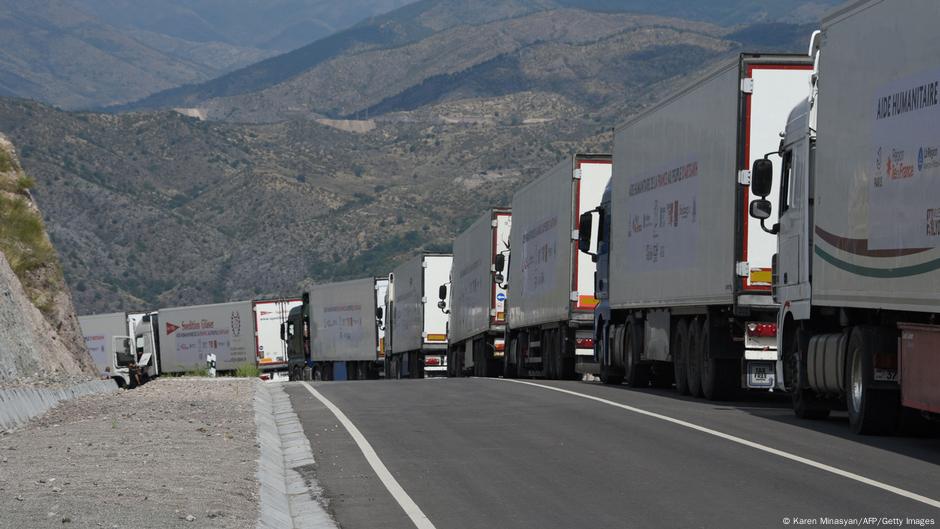
In this photo taken on August 30, 2023, lorries carrying humanitarian aid for Nagorno-Karabakh are seen near the entrance to the Lachin corridor, the region's only land link with Armenia.
In this photo taken on August 30, 2023, lorries carrying humanitarian aid for Nagorno-Karabakh are seen near the entrance to the Lachin corridor, the region’s only land link with Armenia. © Karen Minasyan, AFP

Armenia has accused Azerbaijan of fuelling a humanitarian crisis in Nagorno-Karabakh after Baku last year blocked the sole road linking the mountainous region with Armenia, the Lachin corridor policed by Russian peacekeepers.

The closure has led to shortages of food and medicine in the region, with Yerevan accusing Baku of pursuing the “policy of ethnic cleansing.”

Azerbaijan has rejected the accusation, arguing Nagorno-Karabakh could receive all the supplies it needed via Azerbaijan.

Baku has said that the separatist authorities had simply refused its proposal to simultaneously reopen both the Lachin corridor and the Aghdam road which connects Nagorno-Karabakh with the rest of Azerbaijan.

The months-long crisis as well as Baku’s deployment of troops near Nagorno-Karabakh and along the border with Armenia have sparked fears of a fresh all-out conflict between the arch-foes locked in a decades-long dispute over the region.

On Monday the “Simultaneous passage of the Red Cross cars was ensured” through the Lachin corridor and the Aghdam road, Hikmet Hajiyev, foreign policy advisor to Azerbaijan’s President Ilham Aliyev said on social media.

“The whole international community once again witnessed that there was no so-called blockade but deliberate self-blockade, weaponisation and politisation of humanitarian issues and theatrical dramas (…),” he said.

‘Lifesaving work’

International Committee of the Red Cross said that thanks to “a humanitarian consensus between the decision-makers, the International Committee of the Red Cross (ICRC) is today bringing shipments of wheat flour and essential medical items to people in need via the Lachin Corridor and the Aghdam road.”

Nagorno-Karabakh residents “urgently need sustained relief through regular humanitarian shipments. This consensus has allowed our teams to resume this lifesaving work,” said Ariane Bauer, ICRC’s regional director for Europe and Central Asia.

The European Union and United States have called for the reopening of Lachin and Aghdam routes for humanitarian aid.

Azerbaijan’s Armenian-populated enclave was at the centre of two wars between Armenia and Azerbaijan – in 2020 and in the 1990s.

Six weeks of fighting ended in autumn 2020 with a Russian-brokered truce that saw Armenia cede swathes of territory it had controlled since the 1990s.

There have been frequent clashes at the two countries’ shared border despite the ongoing peace talks between Baku and Yerevan under the mediation of the European Union and United States.

Armenia and Azerbaijan have said they are committed to the conflict’s peaceful settlement, but the negotiations have so far failed to bring about a breakthrough.

When the Soviet Union collapsed in 1991, ethnic Armenian separatists in Karabakh broke away from Azerbaijan. The ensuing conflict claimed some 30,000 lives.

(AFP)


Categories
Selected Articles

Azerbaijan reaffirms commitments to resolving ongoing issues with Armenia through peaceful means


thumbs_b_c_353b8078850fad6b767c2d376c3e2

ANKARA / BAKU

Azerbaijan has reiterated its commitment to resolving ongoing issues with Armenia through peaceful means but has raised concerns about Yerevan’s financial support for the “so-called regime in Karabakh,” which Baku says is not contributing to peace.

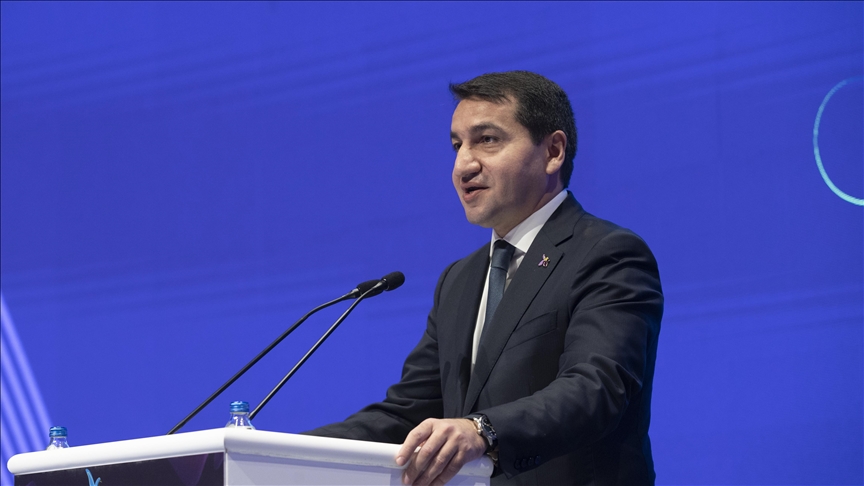
Adviser to the Azerbaijan president, Hikmet Hajiyev, emphasized Baku’s responsible standing in the international community in an interview published on Saturday by Russia’s state-run TASS news agency, asserting that Azerbaijan consistently operates within the framework of its constitution and international law, always striving for peaceful resolutions to existing challenges.

Regarding potential compromises in negotiations with Yerevan, Hajiyev said Baku would not engage in discussions that jeopardize its territorial integrity and sovereignty, whether with Armenia or any other third party.

On the peace process and regional developments between Azerbaijan and Armenia, he highlighted the negotiations based on five fundamental principles, including mutual recognition of territorial integrity and sovereignty.

He pointed out that recent actions by the Armenian government, particularly Armenian Prime Minister Nikol Pashinyan’s congratulatory message to the “self-proclaimed regime in Karabakh,” have seriously harmed the process.

While Armenia has made public statements recognizing Azerbaijan’s territorial integrity, the president’s advisor noted that Armenia’s financial support for the “so-called regime in Karabakh and the so-called regime’s presidential election have not contributed to peace.”

Stop interference in Azerbaijan’s internal affairs

Hajiyev raised concerns about provocations by the Armenian army along the border and in Karabakh but reaffirmed Azerbaijan’s commitment to the peace process. He urged Armenia not to meddle in Azerbaijan’s internal affairs and to respect its sovereignty.

The peace process has been hindered by Armenia’s continued support for an illegal regime on Azerbaijani territory, he said, emphasizing the need for opening the Aghdam and Lachin roads and calling for an end to Armenia’s policies that stymie regional dialogue.

Armenia’s policy of supporting the illegal regime that holds 30,000 ethnic Armenian citizens living in Karabakh hostage in Azerbaijan must come to an end, the president’s advisor said, adding that there is no room for “gray areas” in Azerbaijan.

He emphasized that any attempt to intervene in Azerbaijan’s internal affairs by proposing international mechanisms for dialogue with the ethnic Armenian minority in Karabakh would be futile.

He discussed the potential opening of the Zengezur Corridor, emphasizing that it would primarily benefit Armenia. However, if Armenia refuses to cooperate, Azerbaijan is actively exploring alternative projects with other regional partners.

The advisor expressed hope for a peace treaty by the end of the year and called on Armenia to take the main step toward recognizing Azerbaijan’s territorial integrity, including Karabakh, by signing a peace agreement.

Separatist Armenians in the Karabakh region of Azerbaijan held self-proclaimed elections last week to choose a new separatist president — a move that was not recognized by many, including Azerbaijan, Türkiye, the US, and the UK as well as the European Union.

Relations between Azerbaijan and Armenia have been tense since 1991 when the Armenian military occupied Nagorno-Karabakh, a territory internationally recognized as part of Azerbaijan, and seven adjacent regions.

In the fall of 2020, Azerbaijan liberated several cities, villages, and settlements from Armenian occupation during 44 days of clashes. The war ended with a Russia-brokered cease-fire.

Tensions between the two nations, however, continue despite ongoing talks over a long-term peace agreement.

On Wednesday, Armenia’s Defense Ministry announced that the joint US-Armenian military exercise Eagle Partner 2023 will be held on Armenian territory on Sept. 11-20.

Anadolu Agency website contains only a portion of the news stories offered to subscribers in the AA News Broadcasting System (HAS), and in summarized form. Please contact us for subscription options.


Categories
Selected Articles

Azerbaijan demands Armenia to withdraw its forces from Karabakh


thumbs_b_c_ade898f2ca7d978004f85d775cc5a

BAKU, Azerbaijan

Baku on Monday demanded Armenia to immediately withdraw its armed forces from the Azerbaijani territory of Karabakh, and abolish the military and administrative structure of the so-called regime in the region. 

Relations between Azerbaijan and Armenia have been tense since 1991 when the Armenian military occupied Karabakh, a territory internationally recognized as part of Azerbaijan, and seven adjacent regions.

In the fall of 2020, Azerbaijan liberated several cities, villages, and settlements from Armenian occupation during 44 days of clashes. The war ended with a Russia-brokered cease-fire.

Tensions between the two nations, however, continue despite ongoing talks over a long term peace agreement.

In a special briefing for diplomats on the current situation in Karabakh, the Azerbaijani Foreign Ministry said that despite Azerbaijani efforts through international partners, Armenia and the so-called regime established on Azerbaijan’s sovereign territory continue to harm the normalization process, and reject all proposals to reduce tensions.

The ministry argued that the recent holding of “presidential elections” in the region was a provocative act.

There are more than 10,000 Armenian armed forces loyal to the so-called regime in Karabakh, it said, adding that the forces have over 100 tanks and other armored vehicles, more than 200 heavy artillery weapons, including volley rocket systems, and more than 200 mortar systems.

It added that Armenian forces have violated the tripartite declaration signed on Nov. 10, 2020, and Yerevan is preparing for a new attack.

Like every country in the world, Azerbaijan has the right to defend its sovereignty and territorial integrity according to international law, the ministry said. It urged Armenia to stop its military activities, give up its “revengeful plans,” stop violating Azerbaijan’s sovereignty and territorial integrity, and stop supporting separatism and terrorism in the Karabakh region.

*Writing by Gozde Bayar

Anadolu Agency website contains only a portion of the news stories offered to subscribers in the AA News Broadcasting System (HAS), and in summarized form. Please contact us for subscription options.


Categories
South Caucasus News

Judge to hold hearing on ex-DOJ official’s request to move Georgia … – WISH TV Indianapolis, IN


Judge to hold hearing on ex-DOJ official’s request to move Georgia …  WISH TV Indianapolis, IN

Categories
South Caucasus News

Iran’s $6bn hostage deal is part of a broader diplomatic strategy – The Economist


Iran’s $6bn hostage deal is part of a broader diplomatic strategy  The Economist

Categories
South Caucasus News

How Iran can use the $6 billion involved in the release of 5 Americans – CNN


How Iran can use the $6 billion involved in the release of 5 Americans  CNN

Categories
South Caucasus News

President Aliyev Spotlights Digital Silk Way Project at Central Asian … – Caspian News


President Aliyev Spotlights Digital Silk Way Project at Central Asian …  Caspian News