
Day: September 18, 2023

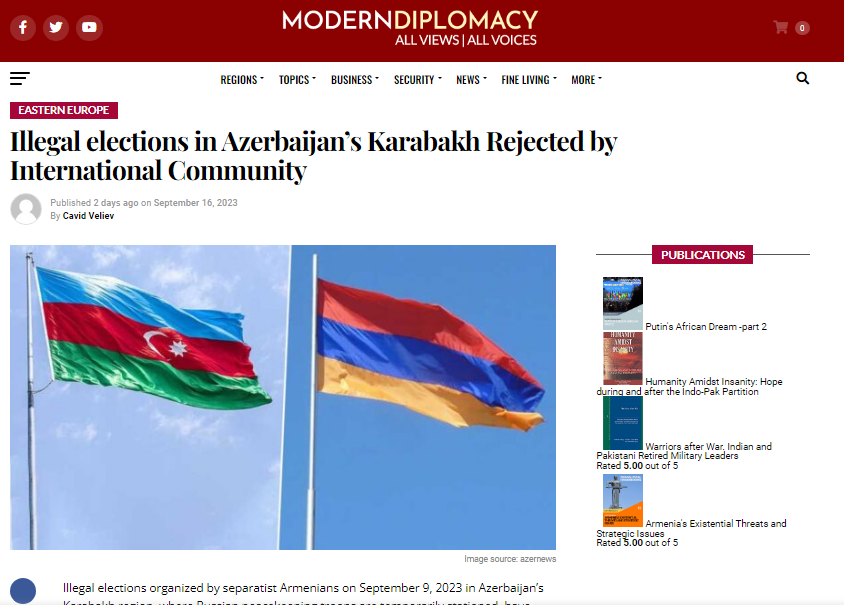
Illegal elections organized by separatist Armenians on September 9, 2023 in Azerbaijan’s Karabakh region, where Russian peacekeeping troops are temporarily stationed, have added a new level of tension in the region. The fact that these sham elections took place at a time when Azerbaijan and the international community were putting forward demands and proposals for the reintegration of Karabakh Armenians into Azerbaijan caused a serious reaction. The elections were held by the separatists in an effort to win support from outside, but they instead increased international support for Azerbaijan’s territorial integrity.
The Azerbaijani Ministry of Foreign Affairs made a call, requesting that these false elections be condemned. States including the United States, UK, Ukraine , Uzbekistan, Turkey, Georgia, Kazakhstan, Kyrgyzstan, Hungary, as well as international organizations such as the Organization of Islamic Cooperation (OIC), the European Union (EU), the Organization of Turkic States (OST), responded to this request by not recognizing the elections and supporting the territorial integrity of Azerbaijan. The Turkish Foreign Minister stated that “these sham elections are a gross violation of international law, including UN Security Council resolutions and OSCE principles.” According to the foreign ministry of the Republic of Uzbekistan, Uzbekistan strongly supports Azerbaijan’s sovereignty and territorial integrity, condemns any interference in its internal affairs, and does not recognize the so-called presidential elections in Karabakh. While commenting on the so-called “presidential elections,” Stéphane Dujarric, Spokesperson for the Secretary-General, recalled Security Council resolutions affirming Azerbaijan’s sovereignty and territorial integrity, as well as the call for its complete respect.
Meanwhile, State Department Spokesman Matthew Miller stated at a press conference that the US does not recognize Karabakh as “an independent and sovereign state,” and hence does not accept the results of the so-called presidential election. “So-called “presidential elections” in Khankendi have no legal ground,” Secretary General of the Council of Europe Marija Pejcinovic Burić said on social media platform 9, 2023.
While everyone was waiting for the reaction of Prime Minister of Armenia Nikol Pashinyan, he said that there was nothing to congratulate.
Following these sham elections, Russian Federation President Vladimir Putin declared that Nikol Pashinyan closed the issue by acknowledging Azerbaijan’s territorial integrity and stating that the integration of Karabakh Armenians into Azerbaijan should go smoothly. This statement from the leader of a state, that is a strategic ally of Armenia, has peacekeepers in Karabakh, and has dominated the South Caucasus for the previous 200 years on the principle of divide and rule, was critical. The fact that Russia officially proposed to transfer Armenia Kalbajar and Lachin districts, as well as the former Nagorno-Karabakh Autonomous Region, to Armenia while Karabakh was under occupation signified that the situation was now acknowledged even by Russia.
The international community’s reaction to sham elections reflected both the requirement of international law and the demand of the diplomatic negotiations that have been ongoing for the past three years. Azerbaijan’s demands in this direction have been acknowledged internationally throughout the continuing diplomatic negotiations. One of the primary objectives of the three-year-long negotiations has been the elimination of the illegal structure that still exists in Karabakh, as well as the Karabakh Armenians’ preference for the integration process with Azerbaijan.
The Azerbaijani side had offered meeting aimed at integrating Karabakh Armenians into Azerbaijan and resolving their economic and social problems. In fact, President of Azerbaijan Ilham Aliyev appointed an Azerbaijani MP born in Karabakh as a representative to meet with Karabakh Armenians in February 2023. The first meeting took place on March 1, 2023, in the town of Khojaly, with the assistance of Russian peacekeepers. Later, Azerbaijan invited them to Baku, but they declined, expecting that Russia would “save” them.
In the following months, the need for the integration of Karabakh Armenians into Azerbaijan was strongly supported at meetings between the two countries’ foreign ministers in Arlington in May and Moscow in July as well as at meetings between the leaders in Brussels in June. Indeed, the parties agreed to meet at Yevlakh during the Moscow meeting, but the Armenians of Karabakh gave up at the last minute. It is also important to remember that there are Armenians in Karabakh who desire to have dialogue with Azerbaijan. But they were taken into custody. Ruben Vardanyan, a radical separatist who was brought to Karabakh from Russia, in one of the video interviews he gave suggested that individuals who engage in dialogue with Azerbaijan without the “government’s” consent should be shot. Following the illegal elections, several Armenian experts predict that there would be internal conflict in the region due to disagreements between separatists.
As a result, by staging sham elections, the separatist Armenians in Karabakh actually achieved the opposite goal, and support for Azerbaijan’s territorial integrity grew on a global scale. In fact, the process leading to the signing of a final peace agreement between Azerbaijan and Armenia can be accelerated by the integration of Karabakh Armenians into Azerbaijan. International actors who want the region to return to true peace and normalcy must now actively help the reintegration process.
However, the efforts to achieve peace and normalcy in the region are being blocked by Armenia’s and Karabakh’s separatists’ marginal demands, which are rejected by both Azerbaijan and the international community. The reality of the 30-year occupation has changed since 2020, but unfortunately neither Armenia nor the separatists in Karabakh want to acknowledge this.
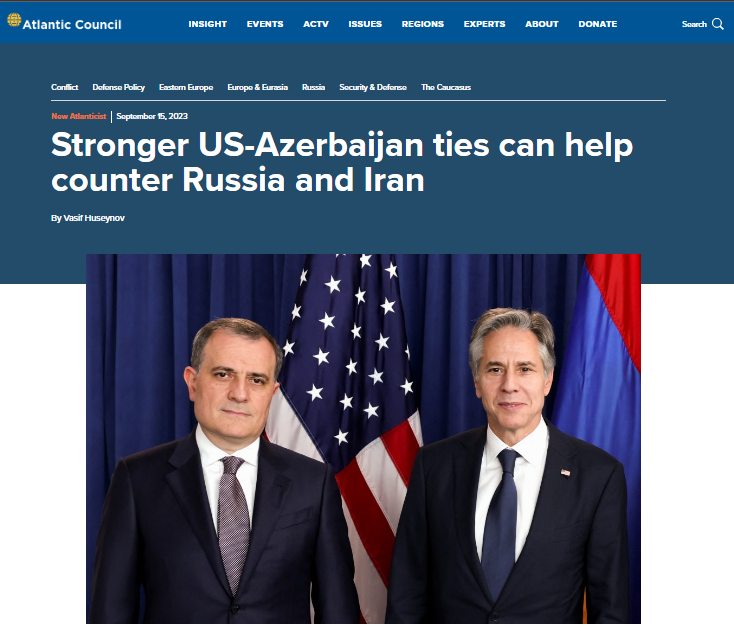
Russia’s war against Ukraine has wrought major upheaval across Eurasia, forcing countries to search for new partners as they seek security and stability. Some Eurasian countries are looking to strengthen ties with the United States to maintain regional security and to develop new economic opportunities. Azerbaijan, for example, has sought to further its partnership with the United States on the two countries’ shared strategic interests.
Relations between the United States and Azerbaijan have historically centered on energy transit, most significantly the Baku-Tbilisi-Ceyhan oil pipeline and the Southern Gas Corridor. In July 2022, Baku signed a new memorandum of understanding with the European Union (EU) to increase Azerbaijani gas exports to the EU from 12 billion cubic meters (bcm) per year to 20 bcm by 2027. Officials in Brussels certainly see the importance of diversifying energy imports away from Russia—European Commission President Ursula von der Leyen called Azerbaijan a “reliable” partner in the bloc’s renewed emphasis on energy security.
But Azerbaijan’s geography means it is also a gateway to the countries of Central Asia and the Trans-Caspian International Transport Route (TITR), also known as the Middle Corridor, that connects Europe with China via Central Asia and the South Caucasus. The Middle Corridor provides Europe with a critical alternative to trade routes that pass through Russia and Belarus, the so-called Northern Corridor.
At the same time, the Middle Corridor provides the inverse opportunity for Central Asian countries to reduce dependency on transit through Russia to the European market. It is in Washington’s strategic interest to help develop alternative trade routes between Europe and Central Asia that minimize opportunities for Russian malign interference along the way.
Moreover, Azerbaijan and the United States share a set of strategic interests that may only grow in the coming years. Washington should resist the calls from some commentators to distance itself from Baku. Russia’s war on Ukraine has shaken stability in the South Caucasus, and Moscow may try to claw back influence in the region at the expense of regional peace and security. Greater US engagement with Baku should reinforce a platform for peace between Azerbaijan and Armenia. Stronger US-Azerbaijan ties can also help counter threats to shared interests emanating from Moscow and Tehran.
Delicate peace talks
The United States has been a major mediator between Armenia and Azerbaijan since the early years of the two countries’ conflict over the Karabakh region of Azerbaijan that began in the 1990s. This mediating role gained new importance and urgency following the Second Karabakh War, which ended in November 2020 with Azerbaijan liberating Karabakh and much of its surrounding territory.
While the situation remains tense, leaders in both Armenia and Azerbaijan have worked hard to build lasting peace. Baku and Yerevan have reached important achievements to this end, with one set of peace talks mediated by Russia and a second negotiating platform with the EU and the United States. The turning point came in May, when Armenian Prime Minister Nikol Pashinyan recognized Karabakh as part of Azerbaijan in the EU-mediated summit in Brussels, following US-mediated talks weeks earlier between the two countries’ foreign ministers in Washington. There are even signs the long-standing dispute over access to the Lachin road is improving, with new reports that humanitarian aid is reaching Karabakh via the Aghdam road.
The peace process is, however, fraught with major challenges.
Some political groups in Armenia and in the diaspora continue to pressure the Pashinyan government against acknowledging Azerbaijan’s internationally recognized sovereignty over Karabakh. Separatist leadership in Karabakh refuses to integrate the region into Azerbaijan and recently undertook unrecognized “elections.” These authorities also receive financial and diplomatic support from Kremlin-connected individuals.
A peace treaty signed via Western mediation and built upon the recognition of Karabakh as part of Azerbaijan would deal a severe blow to Russia’s influence in the region. Such a treaty would create preconditions for the withdrawal of Russia’s peacekeeping mission from the Karabakh region where it was deployed after the 2020 war and, generally, deprive Moscow of one lever of influence against Baku.
This contradiction in the interests of Azerbaijan and Russia has at times strained relations between them. By voicing a plan not to extend the Russian peacekeeping mission beyond 2025 and by investing more in the Western-mediated track of negotiations, Baku regularly challenges Russia’s policies vis-à-vis the peace process.
Message to Moscow and Tehran
Azerbaijan stands out as a rare post-Soviet state that has provided humanitarian and political support to Ukraine in the context of the country’s fight against Russian aggression. Azerbaijan has so far sent almost thirty million dollars’ worth of humanitarian aid, including free fuel to ambulances and vehicles operated by the State Emergency Service of Ukraine and power transformers and generators. Azerbaijan’s independent foreign policy course has drawn “bewilderment” from Russia’s foreign ministry and nuclear threats from its political circles.
The Azerbaijani government’s stance on Russia’s war of aggression against Ukraine contrasts with the policies of two of its neighbors, Armenia and Iran. Investigations and media reports in Europe and the United States have uncovered how Armenia and some other post-Soviet countries have been assisting Russia to import prohibited goods. Officials both in the United States and the EU have listed Armenia among the states that help Russia to circumvent Western sanctions. Armenia only belatedly sent a small package of humanitarian aid to Ukraine in early September.
Iran has been one of Russia’s most strident military allies in its war, providing Moscow with thousands of Shahed drones that terrorize Ukrainian civilians and helping the Kremlin evade Western sanctions. In October 2022, an Iranian military commander Yahia Rahim Safav reportedly said that Armenia may buy Shahed drones. Baku has long opposed Tehran’s brazenly aggressive foreign policy, even as Iran’s ties with Armenia and Russia may be growing. Significantly, Baku has also redoubled its support for Israel—a major US ally—despite Iran’s anti-Israel threats and increasingly militaristic posture in the region.
The time is right for the United States to strengthen its relationship with Azerbaijan and take the historic opportunity to pursue peace and break ground on a new template for regional stability.
Azerbaijani Foreign Minister Jeyhun Bayramov and Iranian Foreign Minister Hossein Amirabdollahian engaged in a telephone conversation to delve into key issues related to bilateral relations and the ever-evolving regional landscape following the recent conflicts, according to Azerbaijan in Focus, reporting Turan.
The press service of the Ministry of Foreign Affairs reported that during the call, the ministers embarked on a comprehensive discussion, addressing a range of matters pertaining to both their bilateral and regional agendas. They also delved into the current situation in the region during the post-conflict period, assessing the implications and challenges that have arisen.
Foreign Minister Bayramov underscored that despite Azerbaijan’s efforts to propose peaceful solutions and initiatives aimed at fostering regional stability, the Armenian leadership continued to engage in military and political provocations that undermined these efforts. He pointed out the contradiction between Armenian Prime Minister Nikol Pashinyan’s statements regarding support for Azerbaijan’s territorial integrity and sovereignty, including the Karabakh region, and his congratulatory message to the so-called regime on September 2. The ministers emphasized the importance of condemning the illegal activities of the so-called regime, which Armenia has established under the guise of “elections.” Moreover, the presence of over 10,000 Armenian Armed Forces in the region was identified as a significant threat, prompting a discussion on the imperative of their withdrawal from Azerbaijani territories and disarmament.
Notably, the ministers explored the outcomes of recent meetings involving the co-chairs of the Azerbaijan-Iran state commission on economic, trade, and humanitarian cooperation. These discussions laid the groundwork for the next steps to be taken in advancing cooperation between the two nations.
Both sides expressed appreciation for the contributions of high-level meetings and inter-agency contacts that have transpired between Azerbaijan and Iran in recent weeks. Such engagements have played a pivotal role in further bolstering the bilateral relationship.
In addition to these bilateral matters, the ministers dedicated a portion of their conversation to discussing measures necessary for the full normalization of relations between their respective countries.
The post Baku informed Tehran about the 10,000-strong Armenian army group in Karabakh appeared first on Azerbaijan In Focus.
The Caspian Pipeline Consortium (CPC) is ready to increase transportation volumes to 83 million tons per year, according to Azerbaijan in Focus, reporting Trend, citing a source at the company.
The CPC pipeline system is one of the largest investment projects in the energy sector with the participation of foreign capital in the CIS. It is unique in its own way, especially in the current political and economic situation in the region and the world. The length of the Tengiz – Novorossiysk oil pipeline is 1,511 km. More than two-thirds of all Kazakh oil exports, as well as raw materials from Russian fields, including those located in the Caspian Sea, are transported along this route.
Light oil of the CPC Blend grade has 0.54 percent sulfur and API density of 44.5. Shippers’ interests are monitored by the company’s Petroleum Quality Bank. Initially, the CPC system was conceived for deliveries mainly to the Mediterranean region, but for about 10 years now, supplies have gone far beyond its borders. CPC oil goes to markets around the world, to refineries in different countries.
Transportation of oil via the CPC oil pipeline and its loading onto tankers from remote mooring facilities in the Novorossiysk area began in 2001. In 2022, the total amount of oil shipped exceeded 800 million tons; in May 2023, an 8,000-ton tanker was filled with oil at the CPC Marine Terminal.
As the company said, taking into account shareholders’ plans to increase oil production in Western Kazakhstan, CPC has been implementing a Bottleneck Elimination Program (BEP) since 2018 to increase the throughput of the oil pipeline. The total budget of the BEP is more than $600 million. Currently, the main facilities of the BEP have been built and put into operation, thanks to which the CPC has actually achieved readiness to transport oil in the amount of up to 72.5 million tons per year through the territory of Kazakhstan and up to 83 million tons per year through the territory of Russia.
Thus, by the end of 2023, the Consortium plans to complete work on the remaining BEP facilities, in 2024 to begin replacing pipeline sections in the Atyrau and Astrakhan regions, and in 2026 to replace two remote mooring devices at the Marine Terminal.
Speaking about operating results, the company said that, in the first half of 2023, 32 million tons of oil were transported via the Tengiz-Novorossiysk oil pipeline, which 3 percent more than the same period in 2022. Previously, the company’s management reported that by the end of 2023, pumping in the amount of 61-62 million tons of oil was forecast.
CPC shareholders include Federal Agency for State Property Management represented by Transneft PJSC (trust management) – 24 percent, CPC Company – 7 percent, KazMunayGas – 19 percent, Kazakhstan Pipeline Ventures LLC – 1.75 percent, Chevron Caspian Pipeline Consortium Company – 15 percent, LUKARCOB.V. – 12.5 percent, Mobil Caspian Pipeline Company – 7.5 percent, Rosneft-Shell Caspian Ventures Limited – 7.5 percent, BG Overseas Holdings Limited – 2 percent, Eni International N.A. N.V. S.ar.l. – 2 percent and Oryx Caspian Pipeline LLC – 1.75 percent.
As CPC said, in the current situation, communications with shareholders from different countries are not a problem.
“An algorithm for making corporate decisions via secure communication channels has been developed, and face-to-face meetings are held in countries where all shareholders can be present – Kazakhstan, the UAE, Türkiye,” the CPC said.
The post Caspian Pipeline Consortium eyes to boost annual transportation volumes appeared first on Azerbaijan In Focus.
