
Georgia Earns Seven Titles at Debbie Southern Furman Fall Classic … Georgia Bulldogs
Day: September 18, 2023
Georgia accuses ex-official of plotting from Ukraine to oust Tbilisi government
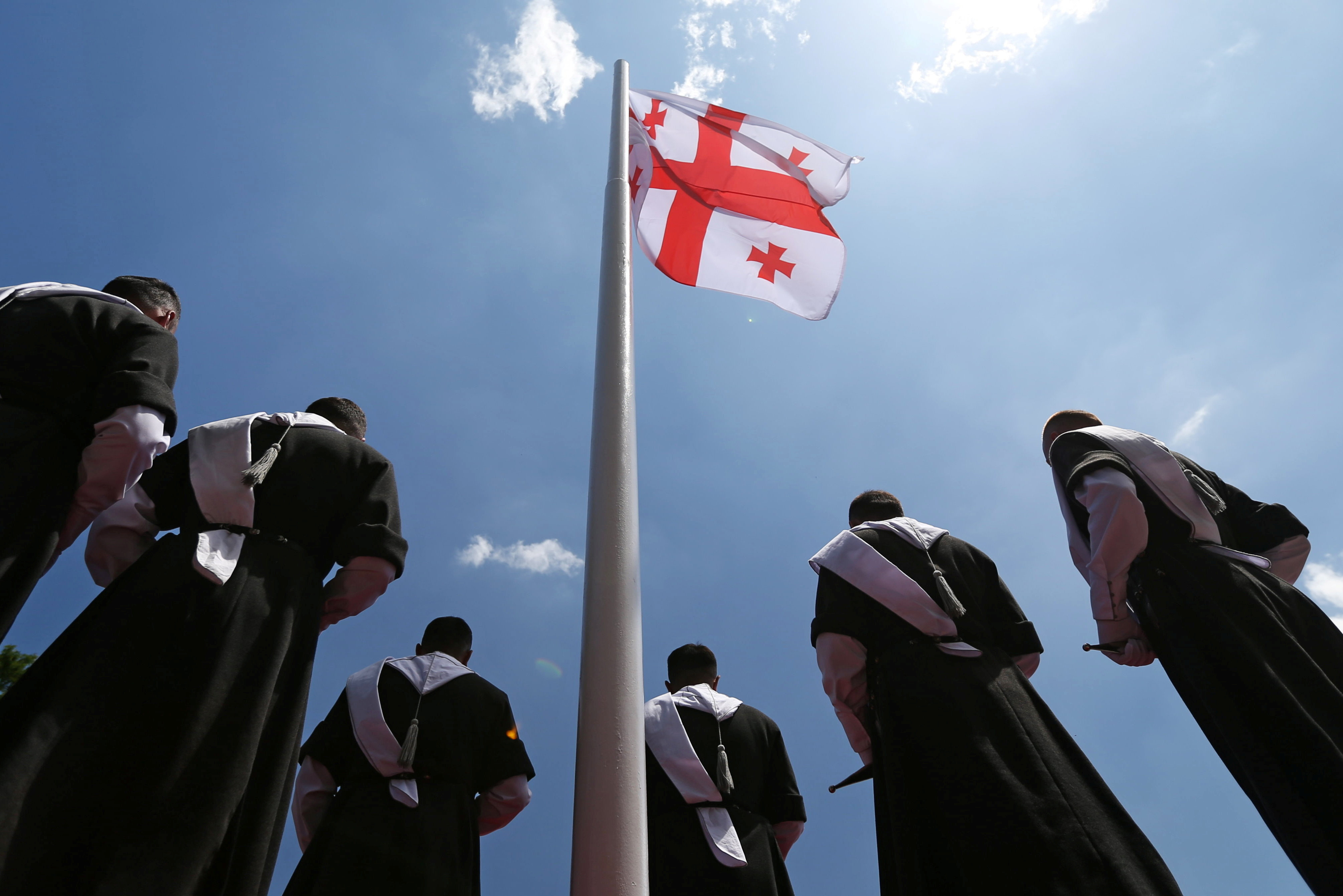
Men wearing traditional clothes stand next to the Georgian flag during the Independence Day celebrations in Tbilisi, Georgia May 26, 2022. REUTERS/Irakli Gedenidze Acquire Licensing Rights
TBILISI, Sept 18 (Reuters) – Georgia on Monday accused a former deputy interior minister of plotting from Ukraine to overthrow the Tbilisi government, testing ties with Kyiv as Georgia deepens its relations with Russia.
The State Security Service said it had been monitoring a group led by Giorgi Lortkipanidze, who it alleged was working as deputy head of Ukrainian military intelligence and is a former member of a strongly pro-Western Georgian government.
“According to confirmed and verified information, the implementation of the plan – developed by Giorgi Lortkipanidze – would involve a rather large group of Georgian fighters in Ukraine and a part of Georgian youth,” the service said in a statement.
It did not provide evidence, and in Kyiv, foreign ministry spokesperson Oleg Nikolenko said Tbilisi was “trying to demonise Ukraine” for domestic reasons.
“The Ukrainian state did not interfere, does not interfere and does not plan to interfere in the internal affairs of Georgia,” he wrote on Facebook.
Andriy Yusov, spokesman for Ukrainian military intelligence, said it had never had a Giorgi Lortkipanidze as deputy head, though he declined to say whether it employed such a person.
The Georgian statement said the alleged plotters planned to channel frustration among young Georgians if the European Union failed to grant their country candidate status at an EU summit in mid-December.
Georgia says it is committed to joining the EU. But it was denied candidate status last year, with Brussels saying it must reduce political polarisation and improve state institutions. Since then, EU officials say it has, if anything, slid back.
Relations with Europe have also suffered since the beginning of the war in Ukraine as Tbilisi has avoided blaming Moscow, even though Georgia’s population is heavily pro-Ukraine.
Many Georgians resent Russia’s backing for the breakaway regions of Abkhazia and South Ossetia, and Georgians are well-represented among foreigners fighting for Ukraine.
Though Tbilisi has shipped humanitarian aid to Ukraine, it has declined to impose sanctions on Russia, and in May allowed direct flights to and from its vast neighbour for the first time since 2019.
The same month, Prime Minister Irakli Garibashvili blamed the expansion of the western NATO alliance for Russia’s invasion of Ukraine. In December, the chair of the ruling party suggested that Georgians fighting in Ukraine could lose their citizenship.
Kyiv has also criticised Georgia for imprisoning Mikheil Saakashvili, a pro-Western former president who acquired Ukrainian nationality.
The Georgian State Security Service named a former bodyguard to Saakashvili as one of the alleged conspirators, along with the commander of a Georgian unit fighting in Ukraine.
Reporting by Felix Light; Editing by Kevin Liffey
Our Standards: The Thomson Reuters Trust Principles.
We welcome today’s simultaneous shipment of humanitarian goods along the Lachin corridor and the Aghdam roadway into Nagorno-Karabakh, an approach President Aliyev and I recently discussed. These deliveries of critically needed supplies are an important step forward, and we encourage the sides to engage in direct talks and focus on ways to increase the flow of humanitarian supplies to the population of the region. The United States remains committed to supporting efforts between Armenia and Azerbaijan to resolve long-standing issues and achieve a dignified and durable peace.
5 Americans freed from Iran headed to US – ABC News
5 Americans freed from Iran headed to US ABC News
According to officials, an important component of the planned swap, $6 billion that had been blocked in South Korea, reached Qatar on Monday and will be used to exchange prisoners between Iran and the United States. The planned discussion will take place immediately before Ebrahim Raisi, the hardline president of Iran, speaks at the UN General Assembly…
Georgia accuses ex-official of plotting from Ukraine to oust Tbilisi … Reuters
Opinion | Poland Is the New West Germany in NATO The Wall Street Journal
Full transcript – https://naregseferian.com/2023/08/13/nagorno-karabakh-conflict-overview-analysis-resources/ *Suggested Resources* Arsène Saparov – From Conflict to Autonomy in the Caucasus: The Soviet Union and the Making of Abkhazia, South Ossetia and Nagorno Karabakh (Routledge, 2015) https://www.routledge.com/From-Conflict-to-Autonomy-in-the-Caucasus-The-Soviet-Union-and-the-Making/Saparov/p/book/9781138476158…
The United Nations Security Council convened on Thursday to address the current developments in Azerbaijan’s #Karabakh region at the request of #Armenia. #Türkiye reaffirmed its commitment to bolstering peace negotiations between Baku and Yerevan. #Breakingnews #WorldNews #LiveBroadcast #LiveStream 🔴 Watch Anews live stream on YouTube for…
Armenia is calling on the United Nations Security Council to address a worsening humanitarian crisis in Nagorno-Karabakh, a region of Azerbaijan home to ethnic Armenians that has been under a blockade for eight months. Armenia and Azerbaijan have fought multiple wars over the territory since the collapse of the Soviet Union, most recently in 2020. Azerbaijan…
At a recent UN Security Council meeting, several countries have called for the Lachin Corridor to be reopened – and urged Armenia and Azerbaijan to normalize their relations after decades of armed conflict. The Lachin Corridor is Armenia’s only connection to enclave Nagorno-Karabakh, and carries essential aid to the region. The Corridor has been blocked…
Returning back to the Caucasus for a full episode for the first time since the Caucasian Wars (Episode 49), this episode discusses the increasing tensions in the Caucasus region during the final years of the Soviet Union and the various wars and politics surrounding the independent South Caucasus. We will touch on the Nagorno-Karabakh Wars and the affect…
This is a South Caucasus and North Caucasus documentary – about South Ossetia, South Caucasus. Welcome to our YouTube channel! In this video, we focus on South Ossetia, a region situated in the captivating South Caucasus. Join us as we delve into the unique culture, history, and landscapes of this intriguing part of the world. South Ossetia,…
Armenia said it was willing to resolve disputes with Azerbaijan over the region of Nagorno-Karabakh. Yerevan’s statement followed Moscow summoning the Armenian ambassador to present a protest about what it said were “unfriendly steps” in the South Caucasus. Armenia said it was committed to the settlement of all outstanding issues with Azerbaijan purely…
Nagorno-Karabakh Road Reopening Deal In Limbo | Azerbaijan Claims Armenian Units Fired At Its Troops
Azerbaijan has denied that Baku had reached a deal with Nagorno-Karabakh to simultaneously reopen roads to Azerbaijan and Armenia. A foreign policy advisor to Azerbaijani President said Baku had offered to simultaneously reopen the roads but the “illegal regime” in Karabakh had refused. Azerbaijan claims Armenian units opened small arms fire on Azerbaijani…
Sign up to Brilliant (the first 200 sign ups get 20% off an annual premium subscription): https://brilliant.org/tldrglobal/ In the last few days, Azerbaijan has deployed thousands of troops to the Armenian border amidst their ongoing siege of Nagorno-Karabakh. So in this video, we break down the history of the region and why Azerbaijan may regain…
When Azerbaijan blocked the only road that links Nagorno-Karabakh with Armenia, Russia was expected to help. But Russian President Vladimir Putin said there are “no problems with Armenia.” Now Armenia is looking away from Russia, and toward the US. Subscribe: https://www.youtube.com/user/deutschewelleenglish?sub_confirmation=1 For more news go…
Вместе с Бениамином Погосяном подвели итоги очень напряженной и богатой событиями недели – от проезда русской фуры по агдамской дороги и разговора Пашиняна с Эрдоганом, до слушаний в конгрессе США и реакции на них армянской и азербайджанской сторон. 00:00 всем привет и слава Украине 00:40 слушания в конгрессе США – что поняли в Армении 09:00 что…
submitted by /u/Ok-Ratio-7872 [link] [comments]
Political prisoners in Azerbaijan In Azerbaijan, an activist arrested on charges of drug trafficking complains about the conditions of detention in a detention center. According to him, he is held together with 21 other arrestees in a cell for ten people. Aikhan Israfilov, a jailed functionary of the Trade Union Confederation “Workers’ Table”, is…
Вместе с Бениамином Погосяном подвели итоги очень напряженной и богатой событиями недели – от проезда русской фуры по агдамской дороги и разговора Пашиняна с Эрдоганом, до слушаний в конгрессе США и реакции на них армянской и азербайджанской сторон. 00:00 всем привет и слава Украине 00:40 слушания в конгрессе США – что поняли в Армении 09:00 что…
The inquiry comes five years after the Justice Department dropped its corruption case against Mr. Menendez, a New Jersey Democrat.
Unlike her husband, Nadine Menendez has lived a mainly private life. Investigators appear focused on the possibility that she or the senator received undisclosed gifts.
FBI: Did Baku play any role in the new investigation of Senator Menendez? It smells like it. FBI: Are Senator Menendez and his new Armenian wife Nadine Arslanian in the crosshairs of the Azerbaijani Intelligence Service? #FBI #Baku #SenatorMenendez FBI: Did Baku play any role in the new investigation of Senator Menendez? It smells like it. – Google…
Lying Journo Elnur Enveroglu and his bunch of lies … Bribed by Armenian lobbyists, Menendez puts Washington in awkward position before Bakuposted at 05:13:43 UTC via azernews.azIn order to get updated of the latest situation in Armenia and Garabagh, where the separatist forces are still located, it is no longer necessary to search for the Armenian…
Pashinyan doubts Baku has real political will for direct dialogue with Stepanakertposted at 20:58:01 UTC via armenpress.am 11:33, 17 September 2023YEREVAN, SEPTEMBER 17, ARMENPRESS. Prime Minister Nikol Pashinyan on Sunday said he was unsure that Azerbaijan actually has the political will to start direct dialogue with Stepanakert despite Baku’s public…
Georgia’s Lasha Talakhadze claims 7th World Weightlifting Champion titleposted at 17:50:24 UTC via azernews.azGeorgia’s Weightlifting Olympic Champion, European Champion and record-breaking athlete Lasha Talakhadze became a seven-time winner of the World Championship on Sunday, after winning the event in Saudi Arabia’s capital city of Riyadh, Azernews reports,…
-Michael Novakhov12 minutes agoFuck you, stupid FACEBOOK! Censor your own stinky ass, motherfuckers! (They removed my posts on this subject, although these posts referred to the articles printed in the mainstream media. They did that because they are bribed by the Azeri Nazis. FBI: Investigate Facebook, and NOW!)-Selected Articles – Michael Novakhov’s…
Since 2012, the small Middle Eastern country of Azerbaijan has invited hundreds of state lawmakers from Arizona and across the United States to take all-expenses paid trips halfway around the world to see the country firsthand. The Azerbaijan government has paid for at least 20 trips for Arizona lawmakers, not to mention their guests or spouses,…
House Speaker Nancy Pelosi receives flowers from Armenian Prime Minister Nikol Pashinyan during a meeting in Yerevan, Armenia, in September. REUTERS The U.S. is stepping up its diplomacy in Eurasia’s South Caucasus region following the recent clashes that killed at least 280 soldiers along the Armenia-Azerbaijan border, including National Security…
Earlier this week, the FBI raided the Laredo, Texas, home of Rep. Henry Cuellar. According to ABC News, the raid was made in connection with an ongoing investigation linked to Azerbaijan. While little is known about this specific FBI probe, which CNN reported involves the Department of Justice’s Public Integrity Section, Cuellar’s relationship to Azerbaijan…
The Wall Street Journal journalists Corinne Ramey and James Fanelli write that the wife of US Senator Bob Menendez, Nadine Arslanian, is drawing scrutiny in a federal probe, Report informs. Investigators are examining whether Nadine Arslanian received gifts or services from individuals who sought favors from New Jersey’s senior senator. Armenianophile…
The G.O.P. has lost a commitment to solving the nation’s problems and become purposeless.
Senate Foreign Relations Committee Chairman Robert Menendez (D-NJ) WASHINGTON, D.C. –Under intense grilling today by the U.S. Senate Foreign Relations Committee, a mid-level Biden-Harris administration aide repeatedly dodged direct questions about the State Department’s failure to break Azerbaijan’s genocidal blockade of Artsakh – even refusing,…
In order to get updated of the latest situation in Armenia and Garabagh, where the separatist forces are still located, it is no longer necessary to search for the Armenian press. The Senate of the United States of America has almost become the daily newspaper of Armenia – giving fresh tiding; whatever the situation is inside, the same atmosphere…
11:10, 17 September 2023 YEREVAN, SEPTEMBER 17, ARMENPRESS. Armenia and Azerbaijan do not plan to sign any document during the forthcoming meeting within the framework of the European Political Community Summit in Granada on October 5, Prime Minister Nikol Pashinyan has said. “Unfortunately, not,” Pashinyan told reporters when asked whether or…
NEW YORKTurkish President Recep Tayyip Erdogan received Georgian Prime Minister Irakli Garibashvili at the Türkevi Center, or Turkish House, in New York City on Sunday, where they discussed the importance of implementing the Middle Corridor.Erdogan highlighted the swift operationalization of the Baku-Tbilisi-Kars railway as a key priority, according…
Armenian separatists in Azerbaijan’s breakaway enclave of Nagorno-Karabakh on Sunday agreed on delivery of humanitarian supplies through the territory controlled by Baku, marking the first step towards de-escalation in the volatile region. Issued on: 17/09/2023 – 22:11 1 min A view shows an Azerbaijani checkpoint at the entry of the…
The Georgian National Tourism Administration hosted a popular Dutch traveller, writer and photographer Chris Schalkx in the country to explore tourist potential and promote Georgia to international visitors through social media, the GNTA said on Friday, Azernews reports, citing Agenda.
Azerbaijan’s exports of crude oil products grow by 64% News.Az
Azerbaijan falsely accuses Nagorno-Karabakh of jamming aircraft GPS ARMENPRESS
A total of 234,553 people or 28.46 percent of eligible voters participated in the election of the Yerevan City Council, the Central Electoral Commission informs. Below are the results by administrative district.
Tension persists on the Armenian-Azerbaijani border and on the Artsakh contact line, Armenian Foreign Minister Ararat Mirzoyan told news outlet “Azatutyun.” “Basically, we have always said that in case of such unpredictable behavior from Azerbaijan, tension should always be expected, both in Nagorno-Karabakh and on the borders of the Republic of Armenia,”…
Azerbaijan lets Russian aid into Nagorno-Karabakh Guardian Nigeria
11:33, 17 September 2023 YEREVAN, SEPTEMBER 17, ARMENPRESS. Prime Minister Nikol Pashinyan on Sunday said he was unsure that Azerbaijan actually has the political will to start direct dialogue with Stepanakert despite Baku’s public statements. Asked on the possible launch of an international mechanism for dialogue between Stepanakert and Baku,…
Pashinyan doubts Baku has real political will for direct dialogue with Stepanakert ARMENPRESS
1 wounded in Nagorno-Karabakh after Azerbaijan opens gunfire using 23mm anti-aircraft autocannon ARMENPRESS
Ukrainian soldiers prepare to fire from the 2C22 Bohdan self-propelled howitzer toward Russian positions in eastern Ukraine. Kyiv said it was continuing offensive operations against Russian forces in the east and south as alarms sounded throughout Ukraine on September 16, while Ukrainian President Volodymyr Zelenskiy thanked…
Karabakh Leaders Say Agreement Made On Simultaneous Aid Shipments Through Agdam, Lachin Radio Free Europe / Radio Liberty
Ethnic-Armenian authorities of Azerbaijan’s breakaway region of Nagorno-Karabakh have agreed on procedures for two simultaneous routes of delivery of Russian-provided humanitarian aid, the International Committee of the Red Cross and separatist leaders said on September 17.
Lasha Talakhadze had to work hard to win his seventh straight world title, and he will have to work harder yet to hold off his challengers, according to his coach. Five men in the super-heavyweight A Group, the final session of the 2023 IWF World Championships in Riyadh, made a total of 450kg or more to put Talakhadze under more pressure than usual….
The Azerbaijan Red Crescent Society welcomes the agreement on the delivery of goods to the territory of Azerbaijan, where the Russian peacekeeping contingent is temporarily deployed, along the Agdam-Khankendi and Lachin-Khankendi roads by vehicles of the International Committee of the Red Cross, Azernews reports citing Azerbaijan Red Crescent Society.
The grand presentation of the famous composer Arif Malikov’s “Legend of Love” ballet at the Heydar Aliyev Palace is several hours away, Azernews reports.
By AFP – Agence France Presse September 17, 2023 Order Reprints Print Article Armenian separatists in Azerbaijan’s breakaway enclave of Nagorno-Karabakh on Sunday agreed on delivery of humanitarian supplies through the territory controlled by Baku, marking the first step towards de-escalation in the volatile region. Armenia…
Armenian Prime Minister Nikol Pashinyan. Gwynner Dyer argues he is fooling himself if he thinks the U.S. or Russia will help Armenia in its current predicament. Torstar file photo
Georgia’s Weightlifting Olympic Champion, European Champion and record-breaking athlete Lasha Talakhadze became a seven-time winner of the World Championship on Sunday, after winning the event in Saudi Arabia’s capital city of Riyadh, Azernews reports, citing Agenda. Talakhadze has claimed three gold medals in the +109 kg weight category after…
Work is underway to organize a meeting between official representatives of Artsakh and Azerbaijan, says the message spread by the Artsakh Information Headquarters. “We also inform you that the mediators are working to organize a meeting with the official representatives of Artsakh and Azerbaijan in order to alleviate the tense humanitarian and security…
The Azerbaijani Defense Ministry has prepared a video summary of the events that took place throughout the week.
Iran will not allow its historical route with Armenia to be closed Armenia News
Azerbaijan ready to organize parallel use of Agdam-Khankendi and … Trend News Agency
White House national security adviser Jake Sullivan met with Chinese Foreign Minister Wang Yi in Malta this weekend, Beijing and Washington said on Sunday, as the world’s two largest economies seek to stabilize troubled relations. Both sides held “candid, substantive and constructive” talks during multiple meetings held Sept. 16-17, according to…
Azeri accusations of Armenia torpedoing peace talks and laying mines are total lies – Ambassador-at-Large Edmon Marukyan ARMENPRESS
Azerbaijan falsely accuses Nagorno-Karabakh of breaching ceasefire ARMENPRESS
On September 17, at around 6:20 p.m., the Azerbaijani armed forces violated the ceasefire in the Martakert region using small arms and ZU 23-2 system.One Armenian soldier was wounded as a result of ceasefire violation. His life is not in danger.The incident was reported to the command of the peacekeeping troops of the Russian Federation.At the same…
Armenia intensifies provocations against Azerbaijan – AZERTAC AZERTAC News
Azerbaijan’s Hirkan Forest added to UNESCO World Heritage Lıst … AZERTAC News
Հետևե՛ք NEWS.am-ին սոցիալական ցանցերում՝ Telegram – https://bit.ly/newsamtl Facebook – http://bit.ly/2KnWOhr Twitter – http://bit.ly/2x2ixml Instagram – http://bit.ly/2x2jefr NEWS.am Style – http://bit.ly/2Ncs5EA Տեսացանկեր՝ ԼՈՒՐԵՐԻ ԹՈՂԱՐԿՈՒՄ – https://bit.ly/3KqTPD4 ՈՒԺԻ ԳՈՐԾՈՆ | FACTOR OF POWER – https://bit.ly/3KqTPD4 Օրվա գլխավոր լուրերը՝…
Selected Articles – Michael Novakhov’s favorite articles on Inoreader – The News And TimesIlham Aliyev is the Azeri NAZIIlham Aliyev is the Azeri NAZI Ilham Aliyev is the Azeri NAZI – Google Search https://t.co/hbPOAY4SRY https://t.co/hcflWVkVzu | https://t.co/6RNDrLHCin… South Caucasus News | #SouthCaucasus #News | #SouthCaucasusNews Armenia – #Armenia,…
Ilham Aliyev is the Azeri NAZI Ilham Aliyev is the Azeri NAZI – Google Search https://t.co/hbPOAY4SRY https://t.co/hcflWVkVzu | https://t.co/6RNDrLHCin… South Caucasus News | #SouthCaucasus #News | #SouthCaucasusNews Armenia – #Armenia, Azerbaijan – #Azerbaijan, Georgia – #Georgia, #SouthCaucasusFederation,… pic.twitter.com/9GOHef1BXm— Michael Novakhov…
Azerbaijan’s Aliyev is a Strategic Liability, Not an Assetposted on Sep 16 2023 10:57:18 UTC via nationalinterest.orgIlham Aliyev, President of Azerbaijan for nearly eighteen years, sits atop a mirage. Azerbaijan’s capital Baku exudes wealth. Luxury boutiques like Bulgari, Christian Dior, Gucci, and Trussardi line Neftchiler Avenue across Primorsky…
Featured PostsBlinken: US is deeply concerned about rapidly deteriorating humanitarian situation in KarabakhSeptember 11, 2023Blinken calls for simultaneous opening of Lachin and Aghdam routesSeptember 11, 2023Azerbaijan Denies Deal Reached to Reopen Karabakh-Armenia RoadSeptember 10, 2023Geopolitical transformation in the South CaucasusSeptember 9,…
With Friends Like Theseposted at 12:33:57 UTC via cepa.orgTurkey’s brinksmanship in the South Caucasus puts a spotlight on tensions within NATO.On Friday, the foreign ministers of Armenia and Azerbaijan flew to Moscow for ceasefire talks. A “humanitarian ceasefire” was announced earlier this week, but at the time of writing appears to have broken down….
Selected Articles – The News And Times – 1:18 PM 9/16/2023#SouthCaucasus The problems of the South Caucasus are larger and deeper than the most visible of them Nagorno-Karabakh conflict and the Armenia – Azerbaijan hostilities. There are more than 50 distinct ethnic groups in this region, and they should be seen and heard from also. The ethnic groups…
US Senior Advisor for Caucasus Negotiations meets Azerbaijani FMposted at 16:34:42 UTC via news.amSenior Advisor to the US State Department for Negotiations in the South Caucasus, Louis Bono, met with Azerbaijani Foreign Minister Jeyhun Bayramov, the Press Service of the Azerbaijani Foreign Ministry reports.“During the meeting, the situation in the…
#SouthCaucasus The problems of the South Caucasus are larger and deeper than the most visible of them Nagorno-Karabakh conflict and the Armenia – Azerbaijan hostilities. There are more than 50 distinct ethnic groups in this region, and they should be seen and heard from also. The ethnic groups of the Caucasus are the unique precious stones in God’s…
Activists protest in front of the U.N. Office in Yerevan, Armenia, on Aug. 16. (Karen Minasyan/AFP/Getty Images)The firsthand accounts are harrowing. There’s no food on shelves in stores. Children stand for hours in bread lines to help feed their families. Mothers walk for miles in search of cooking oil and other provisions. Electricity, gas and water…
Azerbaijani FM says US repeating Armenia’s claims is unacceptableposted at 12:14:56 UTC via azeritimes.comThe Minister of Foreign Affairs of Azerbaijan, Jeyhun Bayramov, met with the US State Department Senior Advisor for Caucasus Negotiations, Louis Bono, Report informs.Jeyhun Bayramov discusses peace process between Azerbaijan and Armenia with US…
The Pharaoh – Фараон (aka Ilham Aliyev – #IlhamAliyev)posted at 11:27:48 UTC by Michael Novakhov (Mike Nova) via The News And Times The Pharaoh – Фараон Почему в Америке полицейских называют фараонами?Город делился на околотоки, в каждом был свой надзиратель, стоявший на перекрестке или на главной улице. Народ прозвал полицейских «фараонами», потому…
The Pharaoh – Фараон Почему в Америке полицейских называют фараонами?Город делился на околотоки, в каждом был свой надзиратель, стоявший на перекрестке или на главной улице. Народ прозвал полицейских «фараонами», потому что такой страж порядка, одетый в специальную форму, стоял с суровым выражением лица, подобно египетскому царю.Apr 25, 2018The News…
#Putin Wants to “Remove” #Armenia PMPutin is seriously concerned about the situation with repeated statements of Armenian Prime Minister Nikol #Pashinyan that #Russia was not able to ensure the security of Armenia and obvious hints at leaving Russia’s sphere of influence.… pic.twitter.com/NvCIiaTRJG— generalsvr_en (@generalsvr_en) September 15, 2023…
Selected Articles – The News And TimesU.S. Generals Attend Joint Military Drills In ArmeniaYEREVAN (Azatutyun.am)—Two U.S. generals have arrived in Armenia to watch an ongoing U.S.-Armenian military exercise criticized by Russia and Iran. Major General Gregory Anderson, the commander of the U.S. Army’s 10th Mountain Division, and Brigadier General…
Lachin Corridor remains closed despite ‘rapidly deteriorating humanitarian situation’ 15 September 2023ByArshaluys BarseghyanThe Azerbaijani checkpoint at the entrance to the Lachin Corridor. Photo: Foreign Ministry of Azerbaijan.The Lachin Corridor, connecting Nagorno-Karabakh to Armenia, remains blocked by Azerbaijan, as the region continues to grapple…
Situation in Artsakh discussed during consultations chaired by President Shahramanyanposted at 13:56:26 UTC via en.armradio.amThe situation created in Artsakh as a result of the complete blockade of Artsakh by Azerbaijan and the mechanisms for overcoming it were discussed during the working consultations convened by President Samvel Shahverdyan.Other…
Selected Articles – The News And TimesPutin signaling to trade detained Americans for captured assassins ‘like dealing with a drug gang’Rachel Maddow looks at the “acute toxicity” of Vladimir Putin in the international community, sending assassins to other countries to kill his political enemies and taking foreign nationals hostage to trade with other…
Mr. Hajiyev: You watch the “serious corruption allegations” against Azerbaijan and against your own boss, Ilham Aliyev. See “Azerbaijani Laundromat”, for example. https://t.co/hcflWVkVzu | https://t.co/6RNDrLHCin… | South Caucasus News | #SouthCaucasus #News |… pic.twitter.com/rDSsB7Cy4B— Michael Novakhov (@mikenov) September 13, 2023 The News And…
Senator Menendez Presses State Department on Its Actions Regarding Lachin Blockade, Assembly Submits Testimonyposted at 05:21:19 UTC via mirrorspectator.com“Is it so important to us that we cozy up to someone who is in the process of creating ethnic cleansing? Is that the side of history the US wants to stand on?” concluded Senator Menendez.Conveying…
To #CIA, #ODNI, #POTUS, #Senate, #House, #SenatorMenendez: #Azerbaijan needs a #REGIMECHANGE! And the sooner the better. This appears to be the most efficient solution for its problems. The #PetroWealth of the #SouthCaucasus belongs to all its #people, and it has to be… pic.twitter.com/ugbRVyuMG2— Michael Novakhov (@mikenov) September 13, 2023 To #CIA,…
Ilham Aliyev, President of Azerbaijan for nearly eighteen years, sits atop a mirage. Azerbaijan’s capital Baku exudes wealth. Luxury boutiques like Bulgari, Christian Dior, Gucci, and Trussardi line Neftchiler Avenue across Primorsky Park from the Bay of Baku. Luxury hotels like the Four Seasons, Marriott Absheron, and the Hilton Baku overlook the…
US Generals Gregory Anderson, Patrick Ellis arrive in Armenia to observe Eagle Partner exercise Armenia News
The Armenian Church celebrates today Feast of the Exaltation of the Holy Cross, the last of the five major feasts of the Armenian Apostolic Church. It is the most important feast among the feasts dedicated to the Holy Cross, as it is dedicated to the history of the return of the Holy Cross from imprisonment, its elevation and glorification. In the Armenian…
Lachin Corridor Must Be Reopened for Humanitarian Aid, Security … ReliefWeb
From September 22 to 25, the “Fifth International Dance Festival” will be held in Tbilisi, Georgia, Azernews reports.
NATO, in accordance with its new defense plans, can deploy 300,000 soldiers in the first month of a potential attack on the bloc, while the total number of the alliance’s military personnel could reach 3.5 million people, Chair of the NATO Military Commit
Italy’s Admiral Giuseppe Cavo Dragone was appointed as chairman of the military committee of the North Atlantic Treaty Organisation (NATO), replacing Rob Bauer of the Netherlands, whose term was extended for a further six months, NATO said, Report informs
Prime Minister Nikol Pashinian’s Civil Contract party lost its overwhelming majority in Yerevan’s municipal assembly as a result of local elections on September 17 marked by record-low turnout.
Pashinyan doubts Baku has real political will for direct dialogue with Stepanakert ARMENPRESS
Pashinyan comments on Erdogan’s offer to hold Armenia-Türkiye-Russia-Azerbaijan summit ARMENPRESS
Azeri accusations of Armenia torpedoing peace talks and laying mines are total lies – Ambassador-at-Large Edmon Marukyan ARMENPRESS
Georgia’s majority party in parliament pushes to impeach the … Torrington Register Citizen
Only right, European “way out” for President is “to admit violation of … Agenda.ge
Poland is shaken by reports that consular officials took bribes to help migrants enter Europe and US, Report informs via the Associated Press.
Moldova Expels Director Of Russia’s Sputnik State News Agency Radio Free Europe / Radio Liberty
Armenian PM says peace agreement with Azerbaijan possible by year end Al Arabiya English
With the help of such atrocious steps, Armenians are managed to silence international mass media, and only Azerbaijani or Turkish media try to speak up and demonstrate the real face of their malicious policy.
The signing of a peace treaty between Armenia and Azerbaijan by the end of the year is possible
(MENAFN – The Peninsula) AFP Moscow: North Korean leader Kim Jong Un left Russia on Sunday on his armoured train, Russian news agencies reported, wrapping up a six-day trip which has focused …
On September 18-24, Minister of Foreign Affairs of the Republic of Armenia Ararat Mirzoyan, will be in New York to participate in the 78th session of the UN General Assembly and high-level events. A number of meetings with the UN officials and counterparts from different countries are scheduled.
Prime Minister Nikol Pashinyan has commented on Turkish President Recep Tayyip Erdogan’s offer to hold a quadripartite meeting on Nagorno-Karabakh. “There are most various offers and ideas. I wouldn’t want to point out only one of those ideas. That’s not the only idea for me to express an attitude,” Pashinyan told reporters when asked about Erdogan’s…
80 people left Artsakh for Armenia on September 16 Armenia News
Armenian FM to attend 78th session of the UN General Assembly … Public Radio of Armenia
Azerbaijani, Iranian FMs hold phone talk Trend News Agency
Why Washington Is Reluctant to Help Armenia – Analysis Eurasia Review
White House Discusses Anti-Corruption Efforts With Ukrainian Delegation Radio Free Europe / Radio Liberty
TALLINN, Estonia (AP) — The majority party that dominates the parliament in Georgia has launched a campaign to impeach the country’s president, even though the effort appears unlikely to succeed.The Georgian Dream party, which is increasingly at odds with President Salome Zourabichvili despite endorsing her election in 2018, announced the effort last…
Study: The Indo-European language family was born south of the … Big Think
President Ilham Aliyev attends award ceremony for Chairman of People’s Council of Parliament of Turkmenistan … Trend News Agency
Washington’s support for Azerbaijan-Armenia peace treaty faltered Trend News Agency
US Senator Bob Menendez calls out Azerbaijan for ‘outrageous … ARMENPRESS
PM congratulates Jewish community of Armenia on Rosh Hashanah Armenia News
Azerbaijan’s aggressive behavior could seriously disrupt the peace … Public Radio of Armenia
Ilham Aliyev concluded his visit to Tajikistan EIN News
Согласно документам, полученным «Transparency International — Georgia» («TI-Georgia»), бывший главный прокурор Грузии Отар Парцхаладзе получил паспорт гражданина России 24 февраля 2021 года, а в течение 2 лет после получения гражданства приобрел в РФ дорогостоящее недвижимое и движимое имущество. Неправительственная организация «TI-Georgia» опубликовала…
Azerbaijani armed forces must withdraw from sovereign territory of Armenia – Foreign Ministry ARMENPRESS
Georgia’s majority party in parliament pushes to impeach the president but is unlikely to succeed ABC News
Turkey’s brinksmanship in the South Caucasus puts a spotlight on tensions within NATO. On Friday, the foreign ministers of Armenia and Azerbaijan flew to Moscow for ceasefire talks. A “humanitarian ceasefire” was announced earlier this week, but at the time of writing appears to have broken down. “Let those holding talks in Moscow know that it’s our…
Editorial It is clear that the policy pursued by the United States is based only on its own interests, and hypocrisy, betrayal, and treachery have risen to the level of state policy. On one hand, the United States supports the territorial integrity of Ukraine, Moldova and Georgia, considers Abkhazia and South Ossetia as part of Georgia, Transnistria…
Russia’s war against Ukraine has wrought major upheaval across Eurasia, forcing countries to search for new partners as they seek security and stability. Some Eurasian countries are looking to strengthen ties with the United States to maintain regional security and to develop new economic opportunities. Azerbaijan, for example, has sought to further…
Proto-Indo-European (PIE) is a language that gave rise to many others. About 46% of humans, well over three billion people, are native speakers of an Indo-European language. But where did PIE first arise, and who spoke it: pastoralists from the Pontic steppe straddling eastern Europe and west Asia or agrarians from Anatolia in Turkey? The answer to…
US Senior Advisor for Caucasus Negotiations meets Azerbaijani FM Armenia News
Senior Advisor to the US State Department for Negotiations in the South Caucasus, Louis Bono, met with Azerbaijani Foreign Minister Jeyhun Bayramov, the Press Service of the Azerbaijani Foreign Ministry reports. “During the meeting, the situation in the region, normalization and peace process between Azerbaijan and Armenia, current threats and challenges…
You’re reading an excerpt from the Today’s WorldView newsletter. Sign up to get the rest free, including news from around the globe and interesting ideas and opinions to know, sent to your inbox every weekday.The firsthand accounts are harrowing. There’s no food on shelves in stores. Children stand for hours in bread lines to help feed their families….
Activists protest in front of the U.N. Office in Yerevan, Armenia, on Aug. 16. (Karen Minasyan/AFP/Getty Images)The firsthand accounts are harrowing. There’s no food on shelves in stores. Children stand for hours in bread lines to help feed their families. Mothers walk for miles in search of cooking oil and other provisions. Electricity, gas and…
2 major violations by Armenia with regard to the 2020 statement are refusal to fully withdraw its troops from Azerbaijan and refusal to provide a transport link to Nakhchivan, Azerbaijani Ambassador to Germany, Nasimi Aghayev wrote on X, Report informs.
Georgian President congratulates all who celebrate Jewish New Year Agenda.ge
Türkiye prioritizes stability and peace in the Caucasus and supports its brotherly nation Azerbaijan, Defense Minister Yaşar Güler said Friday, according to Azerbaijan in Focus, reporting Daily Sabah. “We place great importance on stability in the Caucasus. We are making significant efforts to establish lasting peace in the region and continue to support…
Baku is aimed at a peaceful resolution of existing issues with Yerevan, Assistant to the President of the Republic of Azerbaijan, Head of Foreign Policy Affairs Department of the Presidential Administration Hikmat Hajiyev said in an interview with TASS, according to Azerbaijan in Focus, reporting AzerTac. When asked whether Azerbaijan could again resort…
Looming Azerbaijan-Armenia War Signals Geopolitical Shifts ایران اینترنشنال
President Ilham Aliyev visited Tajikistan, during which the head of state took part at the 5th Consultative Meeting of the Heads of State of Central Asia as the guest of honour. In the context of this visit, it is necessary to analyze several key points that will highlight the importance of the participation of President Ilham Aliyev.
Baku is aimed at a peaceful resolution of existing issues with Yerevan, Assistant to the President of the Republic of Azerbaijan, Head of Foreign Policy Affairs Department of the Presidential Administration Hikmat Hajiyev said in an interview with TASS, Azernews reports.
Azerbaijan Minister of Foreign Affairs, Jeyhun Bayramov, met with the US State Department Senior Advisor for Caucasus Negotiations, Louis Bono, Report informs. The meeting discussed the current situation in the region, the normalization and peace proces
The Minister of Foreign Affairs of Azerbaijan, Jeyhun Bayramov, met with the US State Department Senior Advisor for Caucasus Negotiations, Louis Bono, Report informs.
Opinion: Armenians are starving at Azerbaijan’s hands. Why isn’t Biden doing more to help? Yahoo News
2 major violations by Armenia with regard to the 2020 statement are refusal to fully withdraw its troops from Azerbaijan and refusal to provide a transport link to Nakhchivan, Azerbaijani Ambassador to Germany, Nasimi Aghayev wrote on X, Report informs.
“The EU is trying to break away from Türkiye,” President Recep Tayyip Erdogan told reporters ahead of a trip to the United States, Report informs.
Azerbaijan again falsely accuses Nagorno-Karabakh of entrenching in Askeran ARMENPRESS
Georgia, Israel connected with “special bond, friendship” – Georgian … Agenda.ge
The News And Times Information Network – Blogs By Michael Novakhov – thenewsandtimes.blogspot.com
Men wearing traditional clothes stand next to the Georgian flag during the Independence Day celebrations in Tbilisi, Georgia May 26, 2022. REUTERS/Irakli Gedenidze Acquire Licensing Rights
TBILISI, Sept 18 (Reuters) – Georgia on Monday accused a former deputy interior minister of plotting from Ukraine to overthrow the Tbilisi government, testing ties with Kyiv as Georgia deepens its relations with Russia.
The State Security Service said it had been monitoring a group led by Giorgi Lortkipanidze, who it alleged was working as deputy head of Ukrainian military intelligence and is a former member of a strongly pro-Western Georgian government.
“According to confirmed and verified information, the implementation of the plan – developed by Giorgi Lortkipanidze – would involve a rather large group of Georgian fighters in Ukraine and a part of Georgian youth,” the service said in a statement.
It did not provide evidence, and in Kyiv, foreign ministry spokesperson Oleg Nikolenko said Tbilisi was “trying to demonise Ukraine” for domestic reasons.
“The Ukrainian state did not interfere, does not interfere and does not plan to interfere in the internal affairs of Georgia,” he wrote on Facebook.
Andriy Yusov, spokesman for Ukrainian military intelligence, said it had never had a Giorgi Lortkipanidze as deputy head, though he declined to say whether it employed such a person.
The Georgian statement said the alleged plotters planned to channel frustration among young Georgians if the European Union failed to grant their country candidate status at an EU summit in mid-December.
Georgia says it is committed to joining the EU. But it was denied candidate status last year, with Brussels saying it must reduce political polarisation and improve state institutions. Since then, EU officials say it has, if anything, slid back.
Relations with Europe have also suffered since the beginning of the war in Ukraine as Tbilisi has avoided blaming Moscow, even though Georgia’s population is heavily pro-Ukraine.
Many Georgians resent Russia’s backing for the breakaway regions of Abkhazia and South Ossetia, and Georgians are well-represented among foreigners fighting for Ukraine.
Though Tbilisi has shipped humanitarian aid to Ukraine, it has declined to impose sanctions on Russia, and in May allowed direct flights to and from its vast neighbour for the first time since 2019.
The same month, Prime Minister Irakli Garibashvili blamed the expansion of the western NATO alliance for Russia’s invasion of Ukraine. In December, the chair of the ruling party suggested that Georgians fighting in Ukraine could lose their citizenship.
Kyiv has also criticised Georgia for imprisoning Mikheil Saakashvili, a pro-Western former president who acquired Ukrainian nationality.
The Georgian State Security Service named a former bodyguard to Saakashvili as one of the alleged conspirators, along with the commander of a Georgian unit fighting in Ukraine.
Reporting by Felix Light; Editing by Kevin Liffey
Our Standards: The Thomson Reuters Trust Principles.
We welcome today’s simultaneous shipment of humanitarian goods along the Lachin corridor and the Aghdam roadway into Nagorno-Karabakh, an approach President Aliyev and I recently discussed. These deliveries of critically needed supplies are an important step forward, and we encourage the sides to engage in direct talks and focus on ways to increase the flow of humanitarian supplies to the population of the region. The United States remains committed to supporting efforts between Armenia and Azerbaijan to resolve long-standing issues and achieve a dignified and durable peace.


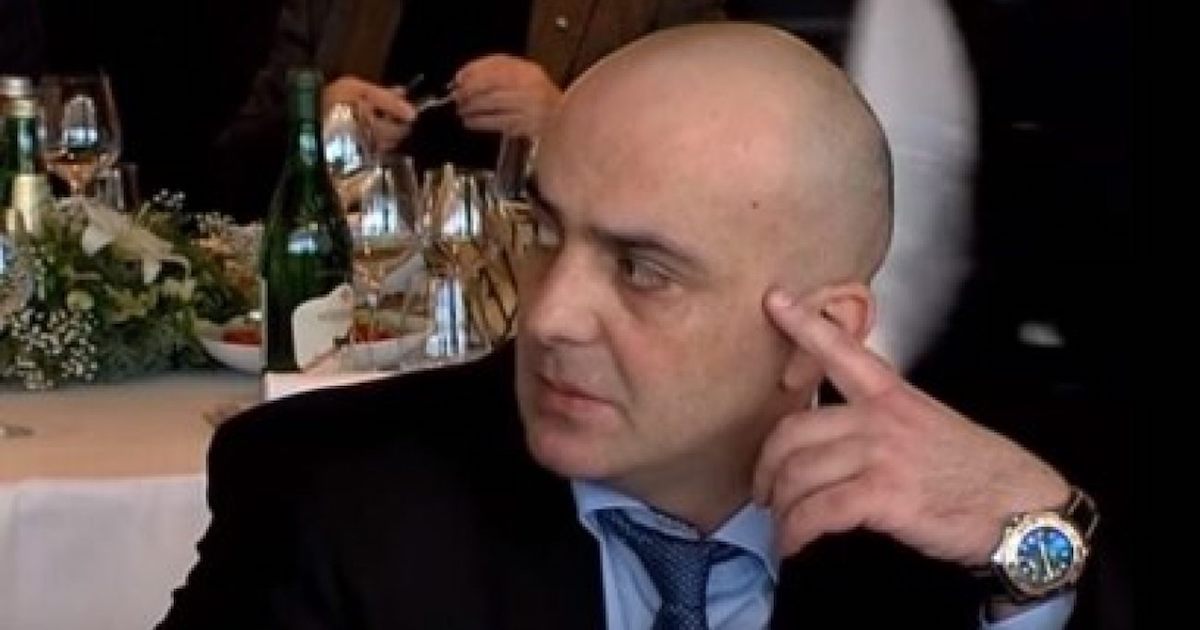
Georgian banks have frozen accounts of Mr. Partskhaladze
According to the National Bank of Georgia, Otar Partskhaladze, former Prosecutor General and under US sanctions, has had his access to bank assets and financial transactions restricted. All his accounts were frozen.
As explained in the National Bank, the under-sanctioned person is restricted both in the disposal of funds and in the ability to conduct all types of financial transactions. It is reported that from February 26, 2022, according to the instruction of the National Bank of Georgia, Georgian financial institutions will fully operate in accordance with the financial sanctions imposed by the United States, the European Union and the United Kingdom against the Russian Federation.
“The financial sector of Georgia is instructed to take into account the requirements established by the US Department of the Treasury’s Office of Foreign Assets Control (OFAC) for persons on the sanctioned persons list (SDN list), which implies limiting access to assets and execution of financial transactions by sanctioned persons. A sanctioned person is restricted both in the disposal of funds and in the ability to perform all types of financial transactions.
We would like to remind that the financial sector of Georgia operates in full compliance with the requirements stipulated by the sanctions regime. In order to comply with the financial sanctions, a special department has been established in the National Bank, which supervises/monitors this process. It should be noted that international organizations positively assess the steps taken by the National Bank in this direction,” the statement reads.
- How the Georgian Judicial System Fell Under Western Sanctions
- Ukraine demands sanctions on Bidzina Ivanishvili and his circle
- “There is accurate info on the involvement of judges in corruption” – US State Department on sanctions against judges in Georgia
On September 14, the United States imposed sanctions against Otar Partskhaladze. This is related to his business activities and cooperation with the Russian FSB. Before the official announcement of the decision, the media reported that a “Georgian-Russian oligarch” was among those subject to sanctions.
According to the US State Department, the Russian Federal Security Service (FSB) worked with Otar Partskhaladze to influence Georgian society and politics in favor of Russia.
In addition, the US State Department statement said that in addition to Partskhaladze, sanctions were imposed on Russian intelligence officer Alexander Onishchenko, who allegedly helped “his associate Partskhaladze obtain a Russian passport and possibly Russian citizenship.”
The sanctions imposed imply the following restrictions:
- All property and capital of a sanctioned person in the United States or, if such property is owned or controlled by a U.S. citizen, will be blocked and may not be transferred, paid for, exported, seized or otherwise used in financial transactions.
Restrictions on or for the benefit of a sanctioned person prohibit any contributions or funds, delivery of goods, or provision of services from the United States. It is also prohibited to receive any donations or finances, goods or services from that person. - In addition to restrictions on property and financial transactions, sanctions also include a ban on entry into the U.S., as sanctioned persons are deemed to be harmful to U.S. interests. Exceptions are made if the U.S. Secretary of State or the Secretary of Homeland Security determines that entry of such an individual would not be contrary to U.S. interests.
The sanctions prohibit violations of and circumvention of the restrictions imposed.
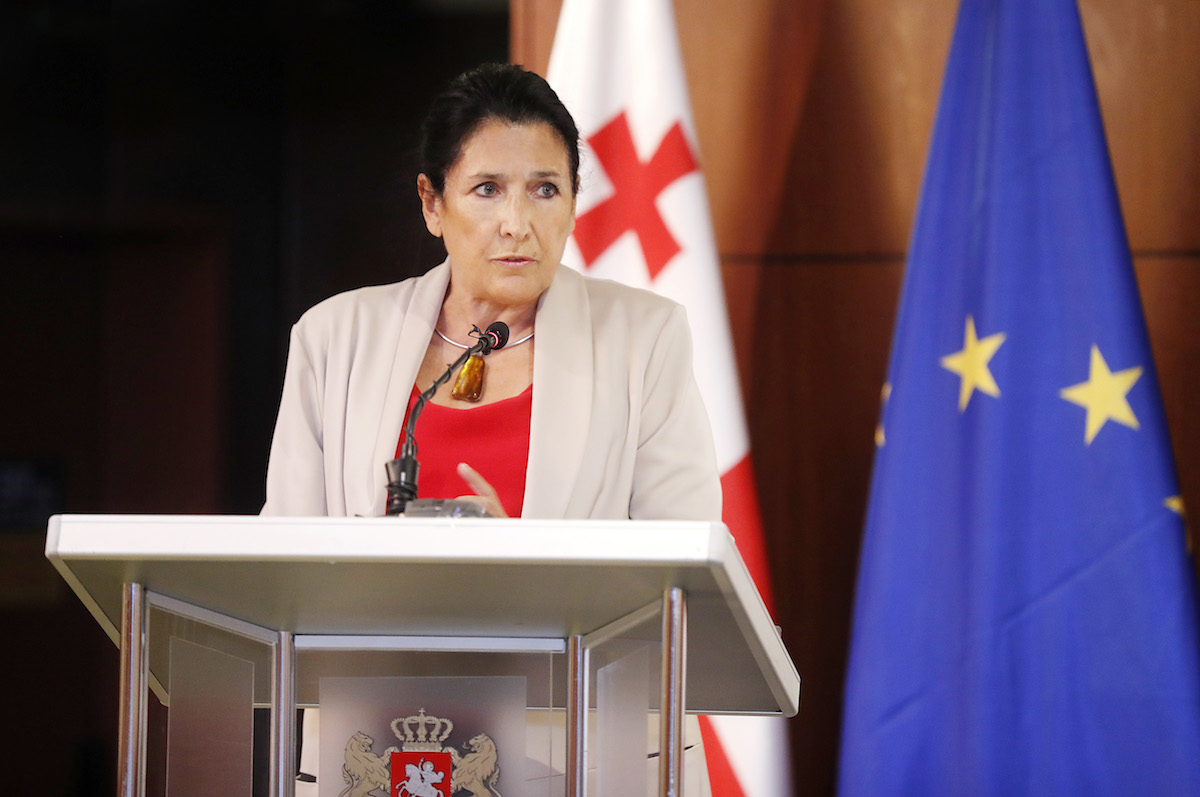
Salome Zurabishvili on Partskhaladze
Georgian President Salome Zurabishvili demanded to launch an investigation into the case of former Prosecutor General of Georgia Otar Partskhaladze sanctioned by the United States. According to Zurabishvili, “the biggest misfortune” is that the country’s Prosecutor General was an FSB [Russian] agent. Zurabishvili said this while speaking at a meeting with representatives of non-governmental organizations.
“I think despite the fact that Mr. Kakha [Kaladze, Tbilisi mayor] said that the biggest trouble is my visits to Europe, actually the biggest trouble is when the country’s prosecutor general was an FSB or KGB agent. That’s the biggest trouble. And it is an even bigger trouble when there is no panic about it in the agencies that are supposed to investigate it today. I am here before you demanding that the public respond with a detailed investigation. This is not a request, but a demand,” the president said.
- Statement on impeachment of Georgian president signed by 80 MPs
- Ukraine demands sanctions on Bidzina Ivanishvili and his circle
On September 14, the United States imposed sanctions against Otar Partskhaladze. This is related to his business activities and cooperation with the Russian FSB. Before the official announcement of the decision, the media reported that a “Georgian-Russian oligarch” was among those subject to sanctions.
According to the US State Department, the Russian Federal Security Service (FSB) worked with Otar Partskhaladze to influence Georgian society and politics in favor of Russia.
In addition, the U.S. State Department statement said that in addition to Partskhaladze, sanctions were imposed on Russian intelligence officer Alexander Onishchenko, who allegedly helped “his accomplice Partskhaladze obtain a Russian passport and possibly Russian citizenship.”
On September 18, it became known that the National Bank of Georgia restricted former Prosecutor General and under U.S. sanctions Otar Partskhaladze’s access to bank assets and financial transactions. All his accounts have been frozen.
As the National Bank explained, the sanctioned person is restricted both in the disposal of funds and in the ability to conduct all types of financial transactions.