
(MENAFN – The Peninsula) The Washington Post A news release I recently received, announcing a new line of canned baked beans made with no added sugar, instantly sparked my interest. I reliably …
Day: September 16, 2023
First they start on a positive note, then they start to reveal
their true hypocritical nature. However, for the time being, we are
not talking about France, or a group of pro-Armenian officials
represented at the UN. This time we are talking about the Minister
of Foreign Affairs of Belgium, Hadja Lahbib, who first identified
himself as a diplomat and later revealed her true prejudice against
Azerbaijan.
A couple of days ago, when the information about her visit was
spread, the Belgian Minister of Foreign Affairs showed a more
positive position regarding the resolution of the ongoing
Armenian-Azerbaijani tension in the South Caucasus. However,
Lahbib, who started her first trip from Armenia, somehow damaged
the reputation of the European Union with her diplomatic
illiteracy. It is likely that Hadja Lahbib did not even look at the
agenda related to the region prior to her visit to the South
Caucasus. After all, why look? Because everyone believes that Hadja
Lahbib is successfully following the path of French diplomats.
A Belgian “diplomat” in Armenia meets with the soldiers of an
occupying state crushed under the iron fist and presents them with
flowers. Lahbib’s French-style action presented her purpose and
position to the public at the first moment.
Perhaps she has never asked herself the question on whose
territory that soldier whom she hugged before fought and received
the deserved punishment. Lahbib completely devoted herself to
Armenia, stepping on the diplomatic behavior of Charles Michel, the
President of the Council of Europe, in Brussels. Whatever the
reason that made her to this request, it was not received
unambiguously for Azerbaijan.
The Belgian Minister of Foreign Affairs, who participated in the
briefing in Yerevan, demonstrated her insidious behavior and even
attepted to send a note against the Azerbaijani Foreign Minister
Jeyhun Bayramov: “The rights and security of the population of
“Nagorno-Karabakh” must be respected, let me remind my Azerbaijani
colleague about this .”
The next corrupt pro-Armenian example of Europe has astrayed so
much that she did not even respect the opinion of the President of
the Council of Europe Michel about recognizing the territorial
integrity of Azerbaijan.
You probably won’t take my criticism wrong. Indeed, Azerbaijan
has no prejudice against Lahbib. We have never seen her
contribution to conflict resolution before. But what we have seen
is that Lahbib is indeed biased towards conflicts.
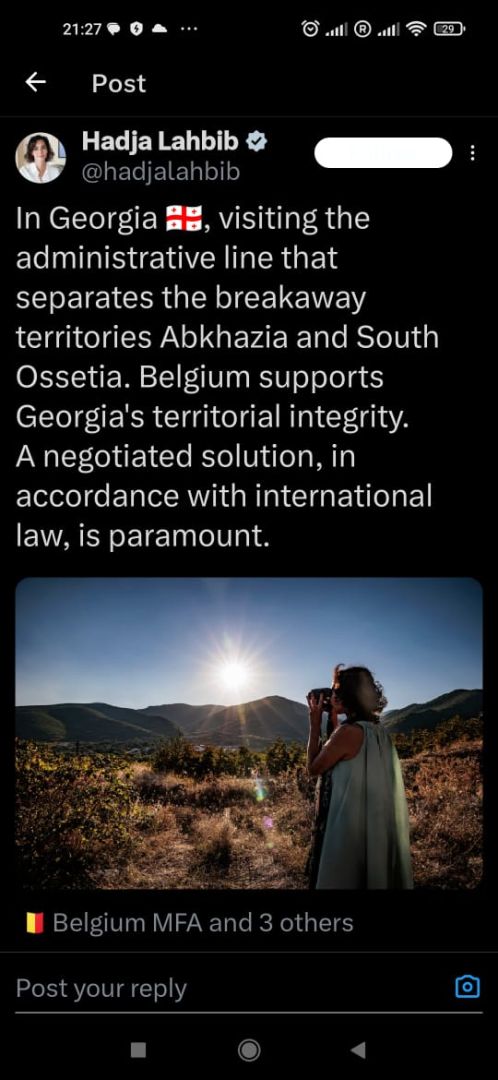
It would not be wrong to say that the issue of Georgia in the
South Caucasus is at the same level as Garabagh. It is good that
Hadja Lahbib one in her lifetime could express an honest and
objective position on this issue. Following the European Union
mission team, the so-called diplomat, who was watching the
territories with binoculars in her hand, allegedly demanded the
recognition of Georgia’s territorial integrity within the framework
of international laws. The question is, what is the problem with
Azerbaijan, Mrs. Hadja? Why don’t your binoculars show Garabagh
correctly? We have no doubt that Abkhazia and South Ossetia are
occupied territories, and so is it, according to your opinion; then
why is Garabagh strange to your statement?
You say that there is no question of self-determination of
peoples in Abkhazia and South Ossetia. But when it comes to
Garabagh, your opinions change 180 degrees, and you are not ashamed
to even express biased opinions. But we were ashamed for you. We
are ashamed that you, as a diplomat, destroyed the image of the
Council of Europe and the Parliament of the European Union and
masterfully demonstrated your diplomatic illiteracy. At least you
should be abashed to refuse to come to Azerbaijan after your rascal
behavior. You deserve to bow only to the invading soldier. I am
afraid to say that even though Azerbaijan remains true to its
diplomatic culture while coming here, the spirits of our Martyrs
over these lands will not leave you alone. So we strongly advise
you not to come at all. Maybe this will calm your “honor” and
“conscience” sold for some pennies…
—
Elnur Enveroglu is AzerNews’ deputy editor-in-chief, follow him
on @ElnurMammadli1
Follow us on Twitter @AzerNewsAz
Categories
With Friends Like These
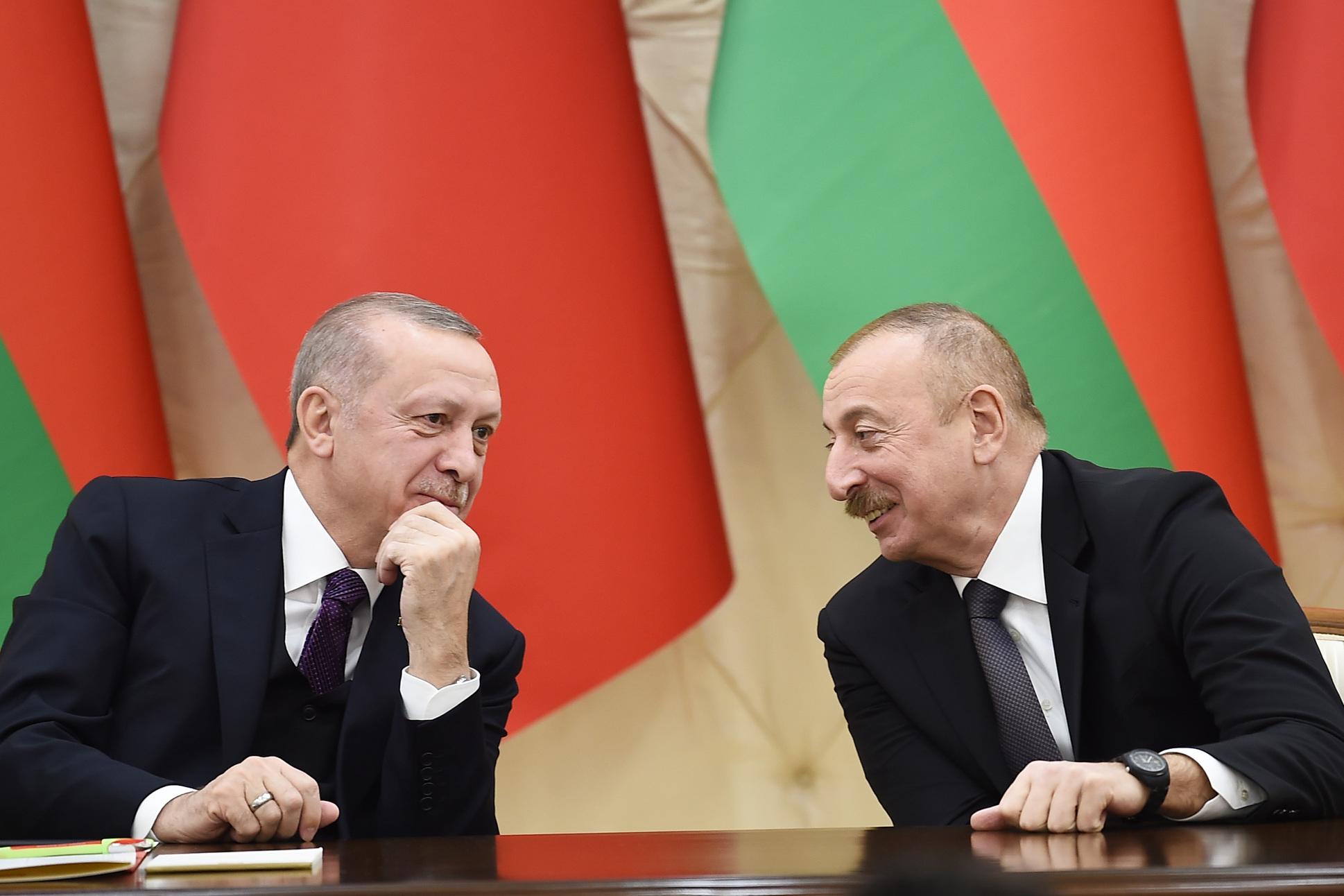
Turkey’s brinksmanship in the South Caucasus puts a spotlight on tensions within NATO.
On Friday, the foreign ministers of Armenia and Azerbaijan flew to Moscow for ceasefire talks. A “humanitarian ceasefire” was announced earlier this week, but at the time of writing appears to have broken down. “Let those holding talks in Moscow know that it’s our territory and we won’t be making any concessions,” Azerbaijan’s president, Ilham Aliyev remarked of the prospects for peace on Friday, foreshadowing this week’s renewed violence. Currently at an advantage, Azerbaijan has little incentive to return to the negotiating table.
In the past, when tensions around Nagorno-Karabakh flared up, neither side gained sufficient advantage to force the other side into concessions. By default or design, Moscow has ended up as an arbiter. This time, however, Turkey seems to be tipping the scales in Azerbaijan’s favor, with the other two regional powers, Russia and Iran, pleading for peace. In an unlikely turn, Western leaders today find themselves in the unlikely position of being more aligned with governments in Moscow and Tehran than their own NATO ally.
Aggressively backing Azerbaijan is in line with Turkey’s increasingly assertive, interventionist foreign policy developed under President Recep Tayyip Erdoğan. Turkey has pursued unilateral military interventions in Syria and Libya, pressured Greece and Cyprus over expanding maritime borders, and is now backing Azerbaijan’s territorial cause in the South Caucasus. Its military interventions in Syria and Libya have been condemned by many European countries, and with French leadership, the EU has threatened Turkey with sanctions over the Mediterranean maritime border dispute.
The security guarantees afforded by its NATO membership may be emboldening Turkey to use military force when it knows that deterrence keeps adversaries at bay. Especially in the South Caucasus, it’s conceivable that Turkey’s strategists are calculating they can escalate conflicts without fear of Russia directly retaliating on Turkish soil. Early last week, Turkey’s foreign minister was downright dismissive of Russian calls for an immediate ceasefire on his visit to Baku.
Russia has every reason to want to do something about Turkish behavior. As Samuel Ramani, a DPhil candidate in the Department of Politics and International Relations at the University of Oxford, pointed out, “[Russia] views Turkey’s seamless integration of Syrian proxy militias alongside the Azerbaijani military as worrisome, as that show that Ankara could mobilize Syrians for its own purposes effectively in more places that just Libya.” Unanswered provocations send signals of their own.
That said, Turkey does not have a completely free hand in the region either. Earlier in the conflict, Armenia accused Turkey of shooting down one of its military jets, which Turkey vehemently denied. Armenia is a member of the Collective Security Treaty Organization (CSTO), a Russian-led alliance modeled on its North Atlantic adversary. The CSTO is often dismissed as a paper tiger, but its existence complicates the calculus of all the players. Russia’s prestige in the region, as well as its credibility as a security provider, is on the line, and we do not know to what extent Turkey is willing to test these commitments. For now, the CSTO’s involvement is mostly a question of escalation—whether there is a credible threat on Armenian soil. The CSTO’s treaty obligations do not extend to Nagorno-Karabakh (which is not part of Armenia and which even Armenia has not recognized as independent), so there is ample gray area for Turkey to act. Known tensions between Putin’s regime and the government of Nikol Pashinyan could also prompt Turkish brinksmanship.
Get the Latest
Sign up to receive regular emails and stay informed about CEPA’s work.
Neighboring Iran is the other uneasy and interested spectator in the region. The country has enjoyed a close relationship with Armenia, but it has a sizeable Azeri minority living within its borders (representing 16% of Iran’s total population, more than the total number living in Azerbaijan proper). The leadership in Tehran cannot afford to alienate either side. At the same time, it also wants to avoid spillover of regional violence and is eyeing Turkey’s presence at its borders. So despite attempts to signal a neutral stance, Iran has allowed Russia to transport military supplies through to Armenia.
Nicole Grajewski, an international security fellow at Harvard’s Belfer Center, noted Iran’s seriousness in taking on a mediator role in alleviating the conflict, but highlighted the geostrategic difficulties facing any settlement. While Russia and Iran would prefer a return to the pre-July status quo and may want to re-freeze the conflict as quickly as possible, Turkey has incentives to push on for longer. Part of the motivation is domestic; saber-rattling nationalists upset with Turkey’s humiliation in the current Greece talks need to be deflected. But, Ramani says, Turkey does not want to risk pushing Russia and Iran away simultaneously, thereby both further intensifying its international isolation and straining peace negotiations in Syria.
Thus far, the West has gone missing in the conflict. This is attributable to a lack of on-the-ground presence on the one hand, as well as to uncertainty at getting involved in a complicated fight where Turkey, Russia, and Iran already dominate. Still, allowing a NATO member to court conflict so openly hardly seems like optimal policy. CEPA’s Lauren Speranza thinks NATO needs to find a way to help de-escalate the situation at a higher level, as the United States tried to do with Russia in Syria. For better or for worse, Erdoğan’s Turkey is an ally, and the Alliance will have to stand by it. The goal has to be to avoid an unintended escalation spiral should either Russia or Turkey somehow miscalculate.
Letting Russia, Turkey and Iran take the lead on brokering peace—or another ceasefire—may be the best available option, even if prospects for a lasting agreement are dim under such leadership. Western leaders, however, can’t afford to be complacent. Even the best-case outcome in Nagorno-Karabakh should lead to serious soul-searching in the Alliance. Having an erratic and increasingly authoritarian regime as a partner poses risks all its own.
Europe’s Edge is CEPA’s online journal covering critical topics on the foreign policy docket across Europe and North America. All opinions are those of the author and do not necessarily represent the position or views of the institutions they represent or the Center for European Policy Analysis.
Europe’s Edge
CEPA’s online journal covering critical topics on the foreign policy docket across Europe and North America.