
Azerbaijan reaffirms commitments to resolving ongoing issues with … Anadolu Agency | English
Day: September 16, 2023
Russia’s war against Ukraine has wrought major upheaval across Eurasia, forcing countries to search for new partners as they seek security and stability. Some Eurasian countries are looking to strengthen ties with the United States to maintain regional security and to develop new economic opportunities. Azerbaijan, for example, has sought to further its partnership with the United States on the two countries’ shared strategic interests.
Relations between the United States and Azerbaijan have historically centered on energy transit, most significantly the Baku-Tbilisi-Ceyhan oil pipeline and the Southern Gas Corridor. In July 2022, Baku signed a new memorandum of understanding with the European Union (EU) to increase Azerbaijani gas exports to the EU from 12 billion cubic meters (bcm) per year to 20 bcm by 2027. Officials in Brussels certainly see the importance of diversifying energy imports away from Russia—European Commission President Ursula von der Leyen called Azerbaijan a “reliable” partner in the bloc’s renewed emphasis on energy security.
But Azerbaijan’s geography means it is also a gateway to the countries of Central Asia and the Trans-Caspian International Transport Route (TITR), also known as the Middle Corridor, that connects Europe with China via Central Asia and the South Caucasus. The Middle Corridor provides Europe with a critical alternative to trade routes that pass through Russia and Belarus, the so-called Northern Corridor.
At the same time, the Middle Corridor provides the inverse opportunity for Central Asian countries to reduce dependency on transit through Russia to the European market. It is in Washington’s strategic interest to help develop alternative trade routes between Europe and Central Asia that minimize opportunities for Russian malign interference along the way.
Moreover, Azerbaijan and the United States share a set of strategic interests that may only grow in the coming years. Washington should resist the calls from some commentators to distance itself from Baku. Russia’s war on Ukraine has shaken stability in the South Caucasus, and Moscow may try to claw back influence in the region at the expense of regional peace and security. Greater US engagement with Baku should reinforce a platform for peace between Azerbaijan and Armenia. Stronger US-Azerbaijan ties can also help counter threats to shared interests emanating from Moscow and Tehran.
The United States has been a major mediator between Armenia and Azerbaijan since the early years of the two countries’ conflict over the Karabakh region of Azerbaijan that began in the 1990s. This mediating role gained new importance and urgency following the Second Karabakh War, which ended in November 2020 with Azerbaijan liberating Karabakh and much of its surrounding territory.
While the situation remains tense, leaders in both Armenia and Azerbaijan have worked hard to build lasting peace. Baku and Yerevan have reached important achievements to this end, with one set of peace talks mediated by Russia and a second negotiating platform with the EU and the United States. The turning point came in May, when Armenian Prime Minister Nikol Pashinyan recognized Karabakh as part of Azerbaijan in the EU-mediated summit in Brussels, following US-mediated talks weeks earlier between the two countries’ foreign ministers in Washington. There are even signs the long-standing dispute over access to the Lachin road is improving, with new reports that humanitarian aid is reaching Karabakh via the Aghdam road.
The peace process is, however, fraught with major challenges.
Some political groups in Armenia and in the diaspora continue to pressure the Pashinyan government against acknowledging Azerbaijan’s internationally recognized sovereignty over Karabakh. Separatist leadership in Karabakh refuses to integrate the region into Azerbaijan and recently undertook unrecognized “elections.” These authorities also receive financial and diplomatic support from Kremlin-connected individuals.
A peace treaty signed via Western mediation and built upon the recognition of Karabakh as part of Azerbaijan would deal a severe blow to Russia’s influence in the region. Such a treaty would create preconditions for the withdrawal of Russia’s peacekeeping mission from the Karabakh region where it was deployed after the 2020 war and, generally, deprive Moscow of one lever of influence against Baku.
This contradiction in the interests of Azerbaijan and Russia has at times strained relations between them. By voicing a plan not to extend the Russian peacekeeping mission beyond 2025 and by investing more in the Western-mediated track of negotiations, Baku regularly challenges Russia’s policies vis-à-vis the peace process.
Azerbaijan stands out as a rare post-Soviet state that has provided humanitarian and political support to Ukraine in the context of the country’s fight against Russian aggression. Azerbaijan has so far sent almost thirty million dollars’ worth of humanitarian aid, including free fuel to ambulances and vehicles operated by the State Emergency Service of Ukraine and power transformers and generators. Azerbaijan’s independent foreign policy course has drawn “bewilderment” from Russia’s foreign ministry and nuclear threats from its political circles.
The Azerbaijani government’s stance on Russia’s war of aggression against Ukraine contrasts with the policies of two of its neighbors, Armenia and Iran. Investigations and media reports in Europe and the United States have uncovered how Armenia and some other post-Soviet countries have been assisting Russia to import prohibited goods. Officials both in the United States and the EU have listed Armenia among the states that help Russia to circumvent Western sanctions. Armenia only belatedly sent a small package of humanitarian aid to Ukraine in early September.
Iran has been one of Russia’s most strident military allies in its war, providing Moscow with thousands of Shahed drones that terrorize Ukrainian civilians and helping the Kremlin evade Western sanctions. In October 2022, an Iranian military commander Yahia Rahim Safav reportedly said that Armenia may buy Shahed drones. Baku has long opposed Tehran’s brazenly aggressive foreign policy, even as Iran’s ties with Armenia and Russia may be growing. Significantly, Baku has also redoubled its support for Israel—a major US ally—despite Iran’s anti-Israel threats and increasingly militaristic posture in the region.
The time is right for the United States to strengthen its relationship with Azerbaijan and take the historic opportunity to pursue peace and break ground on a new template for regional stability.
Vasif Huseynov is the head of the Western Studies department at the Center for Analysis of International Relations (AIR Center), a think tank founded by the government of Azerbaijan. He is also a lecturer at Khazar and ADA universities in Baku, Azerbaijan.
Further reading
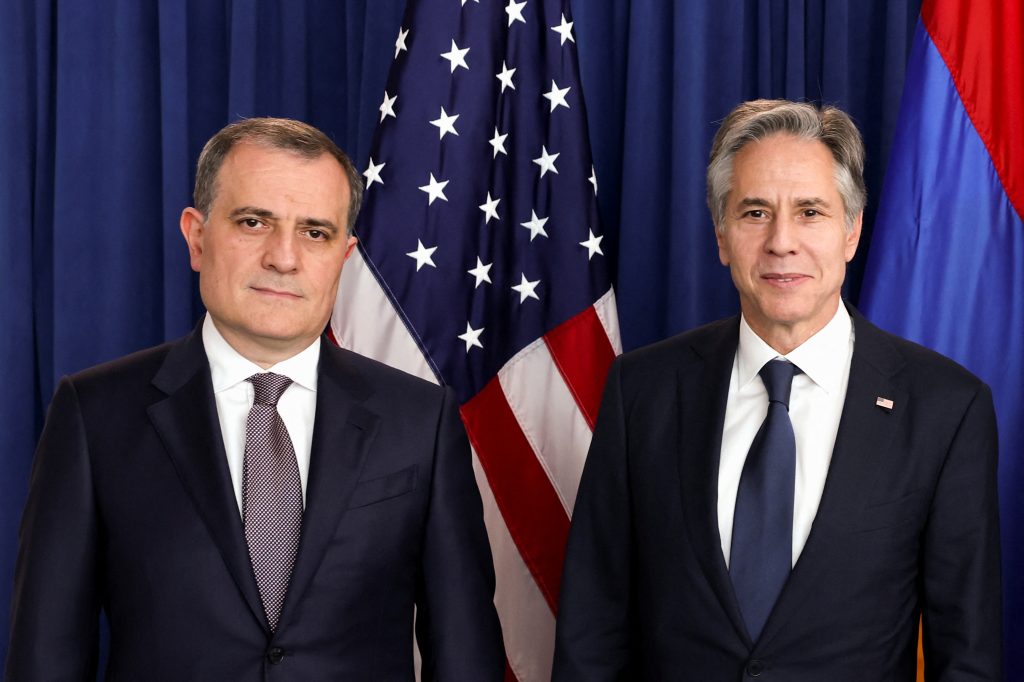
Image: U.S. Secretary of State Antony Blinken hosts Armenian Foreign Minister Ararat Mirzoyan (not pictured) and Azerbaijani Foreign Minister Jeyhun Bayramov for talks at the George Shultz National Foreign Affairs Training Center in Arlington, Virginia, U.S., June 29, 2023. REUTERS/Evelyn Hockstein
Согласно документам, полученным «Transparency International — Georgia» («TI-Georgia»), бывший главный прокурор Грузии Отар Парцхаладзе получил паспорт гражданина России 24 февраля 2021 года, а в течение 2 лет после получения гражданства приобрел в РФ дорогостоящее недвижимое и движимое имущество. Неправительственная организация «TI-Georgia» опубликовала материал об Отаре Парцхаладзе, в нем рассказывается о том, как разбогател экс-генпрокурор Грузии, […]
Proto-Indo-European (PIE) is a language that gave rise to many others. About 46% of humans, well over three billion people, are native speakers of an Indo-European language. But where did PIE first arise, and who spoke it: pastoralists from the Pontic steppe straddling eastern Europe and west Asia or agrarians from Anatolia in Turkey? The answer to that question has been eluding anthropologists for ages. And now, researchers in the journal Science suggest a third place: the Lesser Caucasus, primarily found in Armenia, Azerbaijan, and parts of eastern Turkey and southern Georgia.
PIE is both the deadest and most alive of languages. The last speaker died thousands of years ago, and if it was ever written down, we don’t know about it. The only evidence of PIE’s existence are the traces it left in the languages that descended from it.
We say “only,” but that is a lot of evidence. Modern descendants of PIE include not only English, Spanish, and Russian, but also Persian, Hindi, Bengali, and dozens more. Indo-European is by far the largest language family in the world. Sino-Tibetan, which includes Mandarin Chinese, is a distant second, with about 1.3 billion native speakers.
For the better part of a century, linguists have been looking for clues to the origin of Indo-European from within the languages themselves. Using phylogenetic analysis — phylogenetics is the study of evolutionary relationships over time, be they organisms or languages — they have reconstructed a vocabulary for PIE that gives us an idea of the culture of the people who spoke it. We know they had words for bear (bʰérōs) and goose (h₂énos), willow (wélə) and honey (méli), and peat (péḱus) and enclosure (h₂órtos).
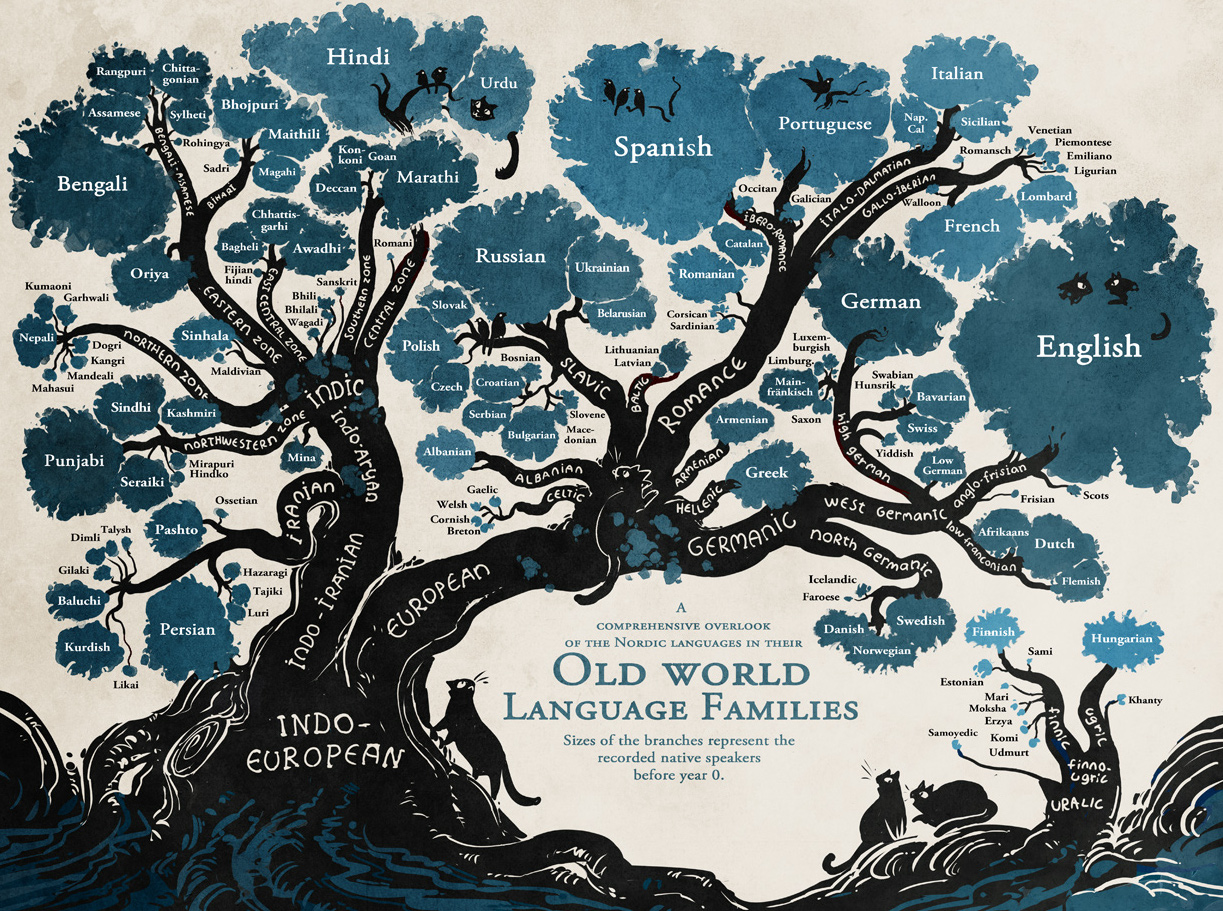
The language families descended from Proto-Indo-European beautifully rendered as the branches of a tree, with each leaf approximating the relative numbers of native speakers of each language. (Credit: Stand Still, Stay Silent by Minna Sundberg)
Based on such evidence, two schools of thought emerged. One proposed that PIE originated some 6,000 years ago in the Pontic-Caspian steppe located north of the Black and Caspian Seas, in the flatlands that stretch from northeast Romania via southern Ukraine and southwestern Russia into the furthest west of Kazakhstan. The nomadic pastoralists who lived here tamed the horse, allowing them to migrate far and wide. This is called the steppe or kurgan hypothesis, the latter after the local word for the prehistoric burial mounds that dot the area.
Other scholars posit an older and more southerly beginning for PIE: around 9,000 years ago in Anatolia. Also known as Asia Minor, this peninsula bordered by the Black, Aegean, and Mediterranean Seas is the westernmost extension of Asia. Today, it is the Asian part of Turkey. The theory is that the language piggybacked on the spread of agriculture from here to large parts of the Old World.
The kurgan hypothesis is the more widely accepted of the two. Many of its proponents think that PIE speakers, kurgan builders, and the ancient Yamnaya culture are actually one and the same. However, conflicting evidence from previous phylogenetic analyses has prevented either hypothesis from completely knocking out the other.
So, the Max Planck team constructed a new dataset of core vocabulary from 161 Indo-European languages that was more comprehensive and balanced than previous samples. Using recent advances in phylogenetic analysis, they were able to estimate that PIE was approximately 8,100 years old, and that five main branches had already split off around 7,000 years ago.
The study’s results fit poorly with both the kurgan and Anatolian hypotheses. As a solution, the researchers propose a third possibility: an early homeland for PIE immediately south of the Caucasus, with one migration veering off north into the steppe. There, PIE speakers established a “secondary homeland,” from where Indo-European entered the rest of Europe beginning 5,000 years ago, courtesy of the Yamnaya and later expansions.

Map showing the spread of Indo-European according to the kurgan hypothesis: from the Pontic steppe (dark green) to an area covering most of Europe and large parts of Asia (light green). Note the non-Indo-European language islands in Europe, representing Finnish, Estonian, Hungarian, and Basque. (Credit: Joe Roe, after Wolfgang Haak, CC BY-SA 4.0)
By offering a hybrid of the farming and pastoralist theories about the spread of Indo-European, the south-of-Caucasus hypothesis suggests a solution for an enigma that has dogged the study of Indo-European for about 200 years. Wolfgang Haak, group leader at the department of archaeogenetics at the Max Planck Institute for Evolutionary Anthropology, said:
“Aside from a refined time estimate for the overall language tree, the tree topology and branching order are most critical for the alignment with key archaeological events and shifting ancestry patterns seen in the ancient human genome data. This is a huge step forward from the mutually exclusive, previous scenarios, towards a more plausible model that integrates archaeological, anthropological, and genetic findings.”
Strange Maps #1220
Got a strange map? Let me know at [email protected].

