
Day: September 15, 2023
Otar Partskhaladze, a former Georgian prosecutor general who was accused of violence and involvement in extortion, has been included in a new list of individuals sanctioned by the US.
On Thursday, the US State Department announced that Partskhaladze, who held the post of Prosecutor General for a month and a half in 2013 and who is described as a ‘Georgian–Russian oligarch’, was sanctioned for ‘operating or having operated in the management consulting sector’ of Russia’s economy, and in relation to Russia’s ‘malign influence’ on Georgia.
The US Department of State and the Ministry of Finance imposed sanctions on 150 individuals and legal entities. US State Secretary Antony Blinken explained on 14 September that the sanctions targeted individuals and entities engaged in sanctions evasion, those ‘complicit in furthering Russia’s ability to wage its war against Ukraine’, and those contributing to Russia’s future energy production.
Blinken described Partskhaladze as a ‘Georgian-Russian oligarch whom the FSB has leveraged to influence Georgian society and politics for the benefit of Russia’.
Partskhaladze is mentioned in the sanctioned list in relation to Russian ‘Federal Security Service officer’ Aleksandr Onishenko.
‘FSB Officer [Onishchenko] likely assisted his associate [Partskhaladze] in obtaining a Russian passport and possibly Russian citizenship. [Partskhaladze] has fully taken on a Russian identity and routinely travels to Russia’, the statement read.
‘[Onishchenko] and the FSB have leveraged [Partskhaladze] to influence Georgian society and politics for the benefit of Russia. [Partskhaladze] has reportedly personally profited from his FSB connection’.
According to TV Pirveli, Partskhaladze received Russian citizenship in 2021.
‘Actively working on relations with Russia’
Followign the announcement, both US and Georgian officials suggested that the move would have no impact on US-Georgia relations.
Matthew Miller, the US State Department press secretary, said on Thursday that Washington and Tbilisi’s relations would not be affected by the US’s sanctions on Partskhaladze, which marked the second time the US has sanctioned Georgian citizens.
‘Over the last 30 years, we have become strategic partners working together […] towards our shared version of Georgia as a fully integrated member of the Euro-Atlantic family, and no individual sanction determination that we make changes that vision of ours or that relationship’, said Miller.
Georgia’s Parliamentary Speaker Shalva Papuashvili said on Thursday that Otar Partskhaladze has no connection with Georgia’s state structures, as ‘for the last 10 years, he [has been] a private person’.
Georgia’s Finance Minister, Lasha Khutsishvili, on Friday similarly asserted that ‘no state can be responsible for this or that action carried out by a specific person’.
However, on Friday, Georgia’s State Security Service (SSG) announced that it had begun investigating the US State Department’s allegations against Partskhaladze.
Khatia Dekanoidze, a representative of the Eurooptismists, a cross-party opposition group, stated on Friday that she had no expectations that Partskhaladze would face any punishment from the ruling Georgian Dream party, citing his ‘direct connection’ to the ruling party’s billionaire founder and former prime minister Bidzina Ivanishvili.
The Chair of Russia’s Commonwealth of Independent States (CIS) Committee, Leonid Kalashnikov, on Friday evening told the Georgian independent TV Formula that Partskhaladze had been involved in the recent resumption of flights between Russia and Georgia and cancellation of a visa requirement for Georgians visiting Russia. The visa regime was cancelled by Russian President Vladimir Putin on 10 May.
[Read more: Russia lifts travel restrictions for Georgians]
‘I know Partskhaladze, he is actively working on humanitarian, economic, and other relations with Russia. I personally invited him to my event when we were trying to [resume] direct flights with Russia and cancel the visa regime. He was actively involved in this process along with other Georgians’, said Kalashnikov.
Fights, scandal, and extortion
Partskhaladze became Georgia’s general prosecutor in November 2013 but resigned after 47 days.
Shortly prior to his resignation, it became known that Partskhaladze had been convicted of a crime in Germany in the 2000s. While the opposition United National Movement alleged that Partskhaladze had been convicted of theft, a few days before his resignation, Partskhaladze himself stated that he was convicted of resisting the police.
In 2018, Georgia’s Prosecutor’s Office charged Partskhaladze over a 2017 fight with then–Auditor General Lasha Tordia in a nightclub.
[Read more: Scandal ridden former Georgian chief prosecutor charged over brawl]
Tbilisi City Court granted Partskhaladze ₾5,000 ($1900) bail, as requested by the prosecution and in February 2021, the Court acquitted the former general prosecutor.
Partskhaladze was later also subject to criticism for his alleged role in the Omega tapes scandal, tapes suggesting that a number of officials had been involved in extorting money on behalf of ruling party founder Bidzina Ivanishvili.
In a 30 September 2018 interview with Rustavi 2, Zaza Okuashvili, whose Omega Group owned a tobacco company, a car dealership, and Iberia TV, accused Ivanishvili of attempting to extort money and cars from him. Okuashvili claimed Ivanishvili had ‘delegated’ the execution of the racketeering to Otar Partskhaladze.
Then-opposition-aligned channel Rustavi 2 and Okuashvili alleged that Partskhaladze kidnapped and beat up former Sports Minister Levan Kipiani, who they alleged was also involved in extorting money, over a disagreement during the extortion.
In September 2022, Ukraine added Partskhaladze to a list of 15 Georgians subjected to sanctions for their alleged ties to Russia and its war on Ukraine. The ‘War and Sanctions’ website states that Partskhaladze is ‘one of the participants in the oligarchic rule and seizure of power by Bidzina Ivanishvili’.
Bidzina Ivanishvili, who is often accused of maintaining rule over Georgia despite having formally left politics in 2021, announced in 2016 that his son, Bera Ivanishvili, was godfather to Partskhaladze’s grandchild.
The post Scandal-ridden Georgian former prosecutor sanctioned by US appeared first on OC Media.

In the aftermath of World War II, the international community created, through the United Nations and other international legal instruments, what scholars and policymakers dubbed the “post-war world order.” This term implied that the world was determined to prevent any large-scale global catastrophe by upholding certain principles that they enshrined in the UN Charter. Given that World War II was preceded by the territorial claims of Nazi Germany to Czechoslovakia—as well as irredentist claims by nationalist elements in various European nations, and, in general, the concept of ethnic kinship across state borders—the founders of the United Nations emphasized the principle of territorial integrity and sovereignty.
Post-war development brought decolonization along with many territorial disputes, some of which caused global instability, for example, the Arab-Israeli conflict. The global rivalry between the United States and the Soviet Union was characterized by both ideological struggle between liberalism and communism and the two powers’ ambitions to dominate the world, including by various means of political control. In the meantime, direct territorial expansion was put aside and, in general, the principle of territorial integrity was given priority. On several occasions, countries split, and borders were reshaped (e.g., Bangladesh, Congo); but, overall, this was rather the exception than the norm. Most territorial issues were a result of decolonization, with various newly emerging states coming into being outside of America and Europe, and were thus rendered as the issues of the “developing world” in Asia and Africa. The United States and the Soviet Union dealt with global competition mostly through proxy wars in the Third World based on ideological struggle, leaving the issue of ethnic identity as something outdated and backward.
The collapse of the Soviet Union and Yugoslavia brought this issue back to the so-called Old World. The United Nations was not prepared to deal with such issues, particularly because the “balance” which the two rival powers had maintained was no longer in place—the Soviet Union itself collapsed as a result of its inherent ethnic composition.
Here, it is important to underline that the dissolution of the USSR and Yugoslavia was not within the process of decolonization in terms of international law. These were separations based on agreements—Belovezh and Alma-Ata of 1991 in the former, and the Badinter Arbitration Commission of 1991-1993 in the latter case. The administrative borders of the former republics that constituted the Soviet Union and Yugoslavia became the state borders of the new republics. The first country that decided to break with this principle was Armenia, by raising a question about the independence of the Nagorno-Karabakh region of Azerbaijan. While Yerevan fell short of an official recognition of the independence of Nagorno-Karabakh, it adopted decisions in its domestic legislature—such as granting Azerbaijan’s Karabakh-born Robert Kocharyan the right to run for Armenia’s presidency—thus legalizing the annexation.
Disregard for the norms of international law in a remote corner of Europe did not catch the attention of major policymakers in Europe and America. This trend of irredentism and separatism in the post-socialist era was followed by the official recognition of the independence of Kosovo by the United States and its Western allies, and Abkhazia and South Ossetia by Russia, both of which happened in 2008.
The momentum of unilateralism, managed by the United States for two decades (1990s-2000s), was unfortunately not used for solidifying the existing world order, but rather for reshaping it to meet the demand of American dominance. Here, liberalism was probably the most attractive model, proven by historical developments as a viable solution to many economic and social problems. However, neoliberals misapplied the concept and disregarded regional peculiarities. Aggravated by religious tension in the Middle East (so often used by various political forces, including the United States, India, and Iran), liberalism was perceived not as a medium for democracy and social well-being, but merely as cover for a new form of colonialism.
The idea of ethnic self-determination that helped to dismantle the Soviet Union and threatened other global and small regional empires looked irresistibly attractive to the West as an ideology of freedom. In fact, thanks to self-determination, many repressive European empires became assigned to history. However, questions have arisen: What is the limit of self-determination? What unit of ethnic community should be entitled to independence? International law had certain definitions regarding self-determination, but these were mostly relevant to former European colonies. Western countries welcomed the new states emerging in Asia and Africa: Eritrea, East Timor, and South Sudan. On many occasions, the West welcomed the addition of “friendly” ethnic communities, such as Christians in South Sudan or Kosovo, as buffers against illiberal regimes. However, when those ethnic or religious communities achieved independence (here, the example of South Sudan is quite vivid, with further massacres happening after the attainment of statehood), the security and human rights situations did not improve in those territories, whereas the former parent states made better progress once their political regimes had changed. This raised the question of a correlation between democracy and ethnic struggle. Conflicts emerged in traditional democracies such as the UK, Canada, and Spain with new self-determination claims from Scotland, Quebec, Catalonia, and others. Here, the appetite for supporting independence among advanced democracies was very low.
So often, we hear about the importance of upholding the “rules-based international order,” but the room for interpretation remains quite wide. As Stephen Walt pointed out in his telling piece for Foreign Policy, appropriately titled “Some Rules of Global Politics Matter More than Others,” “Norms do matter, but there’s enormous room for interpretation and powerful states will typically find ways to work around whatever constraints a norm might impose.” The decades of the U.S. unipolar dominance from 1991 (the collapse of the USSR) to 2008 (the Russian invasion of Georgia and the financial crisis) manifested that the rules-based liberal international order is defined by the United States. In 2008, the United States and its Western allies recognized the independence of Kosovo, which opened the Pandora’s Box for countries such as Russia, eager to re-establish its former empire. For this reason, Moscow unleashed a series of recognitions of separatist entities on the territory of the former Soviet Union and openly claimed the territories of neighboring countries, beginning with the 2014 annexation of Crimea and continuing to the war of aggression against Ukraine starting in 2022. This war—a blatant violation of international law—can by no means be justified by the actions of the United States. The point I am trying to make here is that, by the year 2022, international law and the rules-based liberal order had already been eroded by the actions of global powers. One reason for such erosion was ethnic conflicts and territorial claims.
Immediately after the end of the Cold War, in 1992, the United Nations Secretary General in the report “Agenda for peace” underlined that “the foundation-stone […] must remain the State. Respect for its fundamental sovereignty and integrity are crucial to any common international progress.” He then warned, “if every ethnic, religious or linguistic group claimed statehood, there would be no limit to fragmentation, and peace, security, and economic well-being for all would become ever more difficult to achieve.”
However, the view of many leading Western countries regarding the separatist aspirations of certain ethnic groups in the aftermath of the Cold War was rather welcoming. In the 1990s, Americans viewed such movements through the prism of liberal tenets, encouraging them as those movements would help to dismantle old rivals. In fact, some movements were inspired by radicalism and extreme nationalism. After the age of big global empires, ethnic leaders, warlords, and local opportunists preached about small regional empires. One such idea was that of a “Greater Armenia” in the South Caucasus, which gave birth to the idea of miatsum (unification in the Armenian language).
Without going into historical details, the core problem was the Nagorno-Karabakh Autonomous Oblast (NKAO) within Azerbaijan—an artificial creation of the Soviet authorities dating back to the period between 1921 and 1923, which carved out territories with Armenian populations from the historical Karabakh region, which had a mainly Azerbaijani population. As with so many other conflicts, the army of warring historians and intellectuals began a dangerous danse macabre around the demand by local Armenians in February 1988 to be united with Armenia.
Ethnic conflicts have two major types: first, a separatist ethnic group trying to reach independence, and a second, which has a proper academic name: irredentist. This aims at enlargement and unification across borders with parent states. Many conflicts have some historical background with a burden of grievances caused by massacres, or economic, social, or religious problems. A large number of those grievances are legitimate and must be addressed. In the meantime, many others lead to the involvement of hordes of warlords and entrepreneurs who profit from arms sales and illegal trafficking. Armenian territorial claims produced similar characters, both locally and across the wide and influential Armenian diaspora—perhaps one of the most organized and vocal communities in many leading Western countries. This was one of the reasons why, when the conflict erupted in 1987-1988, Russian liberals and Western policymakers, celebrities, and journalists supported the Armenian demonstrations that, in essence, were part of a bloody irredentist project.
In November 1987, one of Mikhail Gorbachev’s leading economic advisors, Abel Aganbegyan, an Armenian, speaking to a group of French Armenians in Paris, said that he supported the unification of Nagorno-Karabakh with Armenia: “I have already made a similar proposal and I hope that these ideas will be implemented in the spirit of perestroika and democracy.” Russian, American, and French liberal intellectuals had little knowledge about the complexity of the history of the region and fully disregarded the legal and moral context surrounding the issue. They accepted the slogans of Armenian nationalists at face value and supported what they believed was a freedom movement in the Soviet Union. At a time when all Soviet norms and arrangements were under question, the Karabakh problem was the one about which all experts rushed to talk, just as today everyone speaks about COVID-19, Taiwan, or Ukraine.
Subsequent events in 1987-1990, with emerging refugees and massacres on both sides, left many experts puzzled about the nature of the conflict. Superficial explanations were usually available with several undertones, such as Christian Armenians fighting Muslim Azerbaijanis, which made the narrative in the West and Russia overall favorable towards Armenian irredentism. The Armenian propaganda machine employed a historical narrative about genocide. In general, Armenians were better prepared for the armed struggle and information warfare. As reported by British journalist Thomas De Waal based on interviews with local Armenian activists, as soon as 1986, Armenian nationalists had begun collecting weapons: “the activists received a first consignment of small arms from abroad in the summer of 1986 with the help of the Dashnaks [Armenian nationalist party].” The Armenian nationalists managed to create a whole historiography around victimhood and the threat of genocide, even though, prior to 1987, the situation was peaceful and in Azerbaijan there was no public discussion around issues related to Armenian-Azerbaijani animosity.
As American political scientist Stuart J. Kaufman points out, the Armenian mythology played an important role in advancing ideas about indigenous habitation dating back several millennia and convinced the wider public that history “entitles them to possession of those territories regardless of the ethnicity of their current populations.” Central to that was the idea of a “Greater Armenia,” encompassing an enormous land area in the Caucasus and the Middle East.
In addition, the Armenian people developed the idea of martyrdom for the Christian faith, claiming to be a first state to officially adopt Christendom. Among Christian advocates in the West, Armenian activists have portrayed the conflict as a religious one, even though Armenia has long enjoyed good relations with Iran. Armenian publicist and historian Rafael Ishkhanian wrote that cursing Muslims and especially Turks, and reminding people about past brutalities in Armenian society, were “all regarded as expressions of patriotism.” This hatred was also transferred to Azerbaijanis, an ethnic group close to Anatolian Turks.
While claiming the threat of a new genocide at the hands of Azerbaijanis, the Armenian Soviet government acted along with nationalists in the ethnic cleansing of Azerbaijanis from Armenia in 1987-1989. As a result, about 250,000 Azerbaijanis were violently expelled from Armenia, while about 400,000 Armenians experienced the same consequences, leaving Azerbaijan in 1988-1990 (later, between 1992 and 1994, an additional 700,000 Azerbaijanis were ethnically cleansed from the Armenian-occupied Karabakh and the adjacent areas). However, the petition of Karabakh Armenians to the central authorities in Moscow to transfer the NKAO to Armenia was not granted. Then, the Armenian Soviet parliament decided to act unilaterally and adopted a decision to annex NKAO on December 1st, 1989. This decision was annulled by the Supreme Soviet of the USSR (central parliament), as it ran contrary to the Soviet constitution—which stipulated that changes of borders between Soviet republics should be agreed upon by all parties involved. In this case, Azerbaijan did not give its consent to such a transfer.
As the Soviet Union collapsed in December 1991, the Armenian nationalists changed their tactics. The idea of miatsum was put aside because, in the situation where Azerbaijan and Armenia became two independent states, direct territorial acquisition would have been perceived by the international community as annexation. The Armenian side promoted the idea of self-determination, which received much more positive feedback from international policymakers. However, as international law was firmly on the Azerbaijani side, and the United Nations recognized Nagorno-Karabakh as part of Azerbaijan at the time of accession on March 2nd, 1992, Armenia soon launched a full-scale undeclared war against Azerbaijan. Gradually taking control of essential cities in the NKAO—for example Shusha on May 8th, 1992—and then even those outside of it, Armenia had occupied the former autonomous oblast and seven adjacent regions of Azerbaijan by the end of 1993. In response, the United Nations Security Council adopted four resolutions in 1993 recognizing Azerbaijan’s territorial integrity, including its sovereignty over the Nagorno-Karabakh region, and demanding the unconditional and immediate withdrawal of all occupying forces from Azerbaijan. The slightly vague language of the resolutions, which did not directly implicate Armenia in the military occupation thanks to the lobbying efforts of France and Russia in the UN Security Council, allowed official Yerevan to deny the involvement of its army and instead attribute the situation to local Karabakh Armenians, a population of 120,000 that supposedly defeated the regular units of Azerbaijan—a country with a population of 7 million at the time.
Similar dramatic conflicts unfolded in other former Soviet republics such as Georgia and Moldova, where small separatist groups in Abkhazia, South Ossetia, and Transnistria outperformed central armies. These all happened with the direct support of Russia. For the authorities in Russia, which found itself surrounded by newly independent states, ethnic conflicts represented an opportunity to keep the former colonies under control. In the mid-1990s, Russia formed a military union with Armenia and several other post-Soviet states, established military bases in Armenia, and essentially guaranteed Armenian control over the occupied territories of Azerbaijan.
Tragedies caused by ethnic clashes also ravaged the Balkans. The closeness to Western Europe prompted a more rapid reaction—the flow of refugees and media coverage prompted the leading Western powers to intervene. The concept of humanitarian intervention was championed by many Western leaders and renowned scholars, even though some of the modalities of such interventions had problematic implications for international order and law. Thus, certain ethnic groups were occasionally encouraged to provoke violence in order to invite interventions.
There was not, and still cannot be, a single recipe for the resolution of ethno-territorial conflicts. What solution proves to be effective is still debatable. In Bosnia, the Dayton agreement preserved the unity of Bosnia and Herzegovina and introduced a community-based power-sharing agreement to ensure the rights and security of three ethnic groups, primarily the most vulnerable Muslim Bosniaks. In Macedonia, there was a mechanism to protect the Albanian minority. However, in the case of Kosovo, the Western powers decided to promote self-determination in its maximalist understanding as the right of secession. They rejected the compromise formula “more than autonomy, less than independence,” which in some ways is reminiscent of what Baku might have been willing to offer the Armenian minority in Karabakh. And Westerners did this despite the terms set by the UN Security Council resolution 1244 (1999), which stipulated the preservation of the territorial integrity of Serbia.
While the United States and its allies recognized the independence of Kosovo in 2008, many other states, including some European ones, refused to act in a similar manner. The United Nations consequently had no unified approach. The then Secretary-General of the United Nations Ban Ki-Moon emphasized that “each situation needs to be examined based on its unique circumstances,” and Kosovo was a “highly distinctive situation,” making it sui generis, that is, a unique case. Russian President Vladimir Putin described the declaration of independence by Kosovo as a “terrible precedent that will come back to hit the West in the face,” and he decided to recognize the independence of Abkhazia and South Ossetia that same year. Serbia’s former President Boris Tadić, rightfully observed in an essay that features prominently in this edition of Horizons that “for Putin, his salami slicing of other nations begins with Kosovo: it has been repeatedly cited as precedent in recognizing or annexing South Ossetia, Abkhazia, Crimea, and now the latest regions in eastern and southern Ukraine.” As I mentioned earlier, Russian actions should not create a false equivalence with Western actions in the Balkans, where there was a complex situation involving war crimes such as those in Srebrenica. However, the outcome, and especially the legal framework that the International Court of Justice tried to include in its 2010 ruling on the Kosovo declaration of independence, inspired even more crimes and further infringements of international law. “Inconsistency has denuded international law of its authority, creating a world where unilateral declarations of border changes become permissible.”
Armenians were also inspired by the Kosovo precedent. However, the resolution of the Armenia-Azerbaijan conflict was a matter of long negotiations under the auspices of the OSCE Minsk Group, which, from 1997, was co-chaired by France, Russia, and the United States. That same year, the parties were very close to a resolution based on a proposal for an autonomy status for Nagorno-Karabakh. Unfortunately, Armenian president Levon Ter-Petrosian, who accepted this proposal, was ousted from power in 1998, and his successors, former Karabakh warlords Robert Kocharyan and Serzh Sargsyan, opted to indefinitely prolong the status quo with the hope that, in the future, a new geopolitical reality would permit achieving international recognition for Nagorno-Karabakh and then, finally, unification with Armenia.
Achieving that goal required further propaganda efforts. Orientalist biases against Azerbaijan were prevalent in Western academia and media among both liberals and Christian fundamentalists, albeit for different reasons—the latter perceived a messianic role of Westerners in supporting the Armenian cause against Azerbaijanis and Turks. American scholar Thomas Ambrosio rightly called the situation an “international permissive environment” that allowed the occupation of Azerbaijani territories. Based on already established stereotypes, Armenian nationalists streamlined the campaign for self-determination, and then, after the Armenian defeat in the Second Karabakh War (September 27th-November 10th, 2020), promoted the idea of “remedial secession.”
However, overall, the international community has been aware of the fact of Armenian occupation, and for this reason, there was no strong resistance to Azerbaijan’s military actions during the Second Karabakh War. As Damjan Krnjević-Mišković pointed out in a 2020 essay for The National Interest, “irrespective of ancient grievances, a convoluted historical record, and whatever other vagarious claims have been put forward, the situation is, at the end of the day, unambiguous: the outcome to the conflict requires the end of Yerevan’s military occupation of these lands and the return of hundreds of thousands of Azerbaijani civilians to their homes.”
Armenian nationalists had built their strategy on a false foundation by equating self-determination with the avowed rights of secession and occupation. International law is quite clear about the right of self-determination, except in cases of decolonization (which does not apply to the Karabakh region of Azerbaijan): it cannot happen by military force and requires the consent of the central government. The UN Charter and the OSCE Helsinki Act, which Armenians like referring to, are firm about the right of sovereignty and territorial integrity, presuming that self-determination cannot violently infringe on those principles. Armenia realized that it could not win the case diplomatically, that is, through international organizations, and decided to impose the principle of fait accompli—to make Azerbaijan accept the reality on the ground, or simply the fact of occupation. However, Azerbaijan always maintained that it would not accept the result of the use of force and changed the reality on the ground in 2020.
Liberal phraseology covered up the Armenian terror of ethnic cleansing and war crimes such as that of Khojaly on February 26th, 1992, when Armenian armed units destroyed an Azerbaijani settlement, killing 613 people. Vast areas in Azerbaijan were razed to the ground, contaminated by mines, while mosques and graves were pillaged—yet the liberal policymakers in America and Europe expressed their unconditional support to Armenia. The conflict produced civilian victims on both sides (although disproportionately high numbers of those killed and forced to become refugees were from Azerbaijan), but Western media paid much more attention to those on the Armenian side. As American scholars John Mearsheimer and Stephen Walt point out in their 2008 book The Israel Lobby and U.S. Foreign Policy, “the disproportionate influence of small but focused interest groups increases even more when opposing groups are weak or nonexistent, because politicians have to accommodate only one set of interests and the public is likely to hear only one side of the story.”
Westerners would reject the claim of Orientalist bias and point rather to the human rights situation as the reason for the different treatment of Azerbaijan and Armenia. Today, Armenian experts and their supporters base their claims on developing a democracy in Armenia versus authoritarianism in Azerbaijan.
How human rights correlate with the conflict is indeed subject to problematic reasoning in terms of several factors. While the argument about a democratic deficit easily fits into the media’s already existing pro-Armenian narrative, the reality could not be further from the truth.
The conflict, which is not that old and has no “ancient hatred” element, is nevertheless rooted in Imperial Russian rule and originated during the First Russian Revolution of 1905. The first clashes of 1905-1906 took place against a background of rising nationalism and socio-economic problems. The modern conflict began in 1987-1988, when both countries were part of the Soviet Union, and the problems—economic, social, and humanitarian—raised during demonstrations were prevalent across the whole Soviet system. In fact, the economic data demonstrate that on average, Karabakh residents enjoyed better living conditions than the rest of the people in Azerbaijan. The mobilization of Armenians occurred through nationalistic slogans accompanied by environmental and cultural demands. Azerbaijanis were expelled prior to the situation being reciprocated for Armenians in Azerbaijan, and this was later accompanied by full ethnic cleansing from both Armenia and the occupied areas. As Stephen M. Saideman and R. William Ayres argue in Kin or Country: Xenophobia, Nationalism, and War (2015), the Armenian seizure of Nagorno-Karabakh and plan to move “Armenia’s international boundary to cover the Karabakh region and assume control of that area’s Armenian population” through the ethnic cleansing of Azerbaijanis was aimed at “solving the problem that xenophobic nationalists often want to avoid—the incorporation of Others.” This attests to the fact that the conflict is the product of a jingoistic plan based on the idea of a “Greater Armenia,” rather than being a necessity born out of human rights concerns.
Identifying the conflict as the result of a democracy problem also implies that the West would be more sympathetic to the Azerbaijani position if it were a more democratic state. The events of 1992, more specifically Section 907, adopted as part of the Freedom Support Act and the freezing of U.S. aid to Azerbaijan—implemented during the presidency of the pro-Western and pro-democracy Abulfaz Elchibey—debunk these claims. All leaders of Azerbaijan have become victims of Western villainization, regardless of their domestic politics. In the meantime, Armenia, despite having been ruled by warlords for 20 years (1998-2018), and the autocratic and corrupt practices of its government, still enjoys support among Western policymakers and the traditional backers of the Armenian lobby. It is also essential to decode current Armenian prime minister Nikol Pashinyan’s vision of “democracy.” The fact that Pashinyan’s version of the country’s democracy can only be extended to ethnic Armenians, with Azerbaijanis ethnically cleansed from Armenia (and, until the 2020 war, from the occupied territories of Azerbaijan), makes such a vision more characteristic of a white supremacist ideology rather than democracy.
Finally, the existence of current ethno-territorial conflicts within advanced Western democracies, such as Quebec in Canada, Scotland in the United Kingdom, or Catalonia in Spain, undermines the hypothesis about the correlation between human rights and identity conflicts.
The rhetoric about human rights as a cause of conflict was invoked on several occasions. As mentioned, Western countries supported the creation and secession of several states, such as Eritrea and South Sudan. However, the establishment of new states has not improved the situation in terms of the liberties and freedoms of people living there. Kosovo is another vivid example. In fact, the people who founded the Kosovo Liberation Army (KLA)—like the former president Hashim Thaçi, the former speaker of Kosovo’s parliament Kadri Veseli, former KLA spokesman Jakup Krasniqi, and former KLA commander Rexhep Selimi—were all later brought to justice for numerous war crimes. Former Armenian presidents Robert Kocharyan and Serzh Sargsyan boasted about their participation in armed actions and admitted their role in war crimes (Sargsyan confessed to British journalist Thomas de Waal his role in the Khojaly massacre). Before the Syrian conflict, the highest number of refugees in Germany were from Kosovo. Meanwhile political refugees in Europe from Armenia outnumbered those from Azerbaijan.
In the end, discussions about injustices, past genocides, and whatever other grievances Armenia has, and the moral right to secession for Armenians in the context of human rights infringements in Azerbaijan, should be put in the context of the ethnic cleansing of Azerbaijanis from Armenia and Karabakh and the creation of a basically monoethnic Armenian state with the prevailing slogan “No Turks in Armenia,” which was voiced on the streets of Yerevan in March 2022, when the government of Nikol Pashinyan expressed initial consent to Azerbaijan’s proposal to mutually recognize the two states’ territorial integrity. The horrible crimes and destruction committed by Armenians cannot be justified because of past tragedies, even if we accept them unconditionally.
Despite numerous examples of problematic secessions and border changes, some influential policymakers and experts advocate for the creation of new states to solve the problems that people have been experiencing in existing states. Economic hardships and the lack of good governance definitely have an impact on ethnic tensions. However, the solution is not in making new borders, but rather in creating the conditions for central governments to function properly and ensure the safety and freedoms of various ethnic groups living together. The solution is coexistence and cooperation—not the building of new borders and walls. Liberals around the world should strive for this vision of a globalized world.
The Russian war against Ukraine made many European policymakers rethink their approach to the issue of self-determination and territorial integrity. How should one treat the fact that Russians in Crimea expressed their desire to live under the Russian jurisdiction? Should we accept the fact that, historically, it was only in 1954 that Crimea was transferred to Ukraine? Russian leaders and historians claim that the Ukrainian identity is a by-product of Bolshevik nation-making. By exactly the same token, Armenian nationalists speak about the transfer of Nagorno-Karabakh to Azerbaijan in 1921 (whereas according to archival documents, Karabakh was in fact left within Azerbaijan), and assert that Azerbaijanis as a distinct ethnic group emerged due to the Stalin’s nationality policy. They claim that Armenians do not want to live under Azerbaijani rule while, just as Russian leaders speak about Nazism in Ukraine, Armenian leaders talk about dictatorship in Azerbaijan.
Unfortunately, the international community does not only face serious challenges from ethno-nationalist leaders and xenophobic activists. It is the world-leading countries that frequently undermine the rules-based liberal international order—and do so at their own peril.
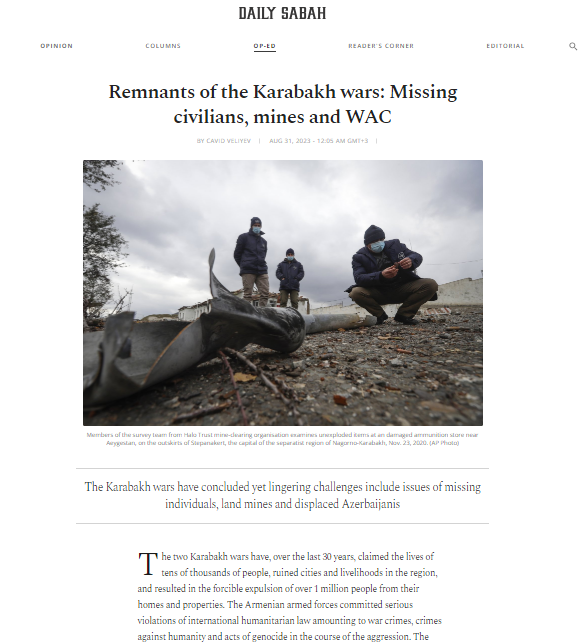
The two Karabakh wars have, over the last 30 years, claimed the lives of tens of thousands of people, ruined cities and livelihoods in the region, and resulted in the forcible expulsion of over 1 million people from their homes and properties. The Armenian armed forces committed serious violations of international humanitarian law amounting to war crimes, crimes against humanity and acts of genocide in the course of the aggression. The occupation and massacres carried out by Armenian military forces in the territory of Azerbaijan had effectively been approved by the decisions of international organizations.
However, in 2020, Azerbaijan ended the occupation by using its right of self-defense arising from the four resolutions adopted by the United Nations Security Council in 1993. Nevertheless, the problems created by the Karabakh wars continue. These problems concern missing people, mines in the liberated territories, and Azerbaijanis who cannot return to their homeland.
On Aug. 3, 2023, the families of some of the missing applied to the U.N. and requested Secretary-General Antonio Guterres to call on Armenia to provide information about the fate of the missing persons and to reveal the locations of mass graves to the Azerbaijani side. These families also demanded the appointment of a U.N. special rapporteur on missing persons.
Torture and violence
According to information from the State Commission on Prisoners of War, Hostages and Missing Persons established in Azerbaijan in 1993, as of Aug. 16, 2023, 3,888 citizens of Azerbaijan, 3,170 of them servicemen and 718 civilians, were registered missing in connection with the conflict. Of the civilians, 71 are children, 266 are women and 326 are elderly. It has been established that 871 of the 3,888 missing persons were taken as either prisoners of war or hostages, including 604 servicemen and 267 civilians, of whom 29 were children, 98 were women and 112 were elderly. Through the analysis of the materials received by the State Commission, it is known that 550 people were killed in captivity.
A clear list of missing Azerbaijani citizens has been submitted to Armenia through the International Committee of the Red Cross (ICRC) and is regularly updated. Armenia is in breach of international law for refusing to account for the missing, as well as for refusing to conduct a prompt and effective investigation into the fate of the missing people and into the evidence that at least 871 of them were taken into its custody and have not been seen since. Armenia is also in violation of international law where the additional suffering imposed upon the relatives of the missing persons is concerned, owing to the obstructive attitude it has adopted in this matter.
The testimonies of prisoners who were rescued from captivity or who managed to escape in the period before the war suggest that all of those who disappeared were killed. While women were abused, men had to endure hard labor. For example, most of them were employed in dismantling tombstones and houses in occupied territories. Some of them were employed in the homes of the invading Armenian generals. Many of them were shot and the rest died in the misery of starvation. Despite violating the international laws of war, the Armenian side has faced no sanctions.
However, with the discovery of 10 mass graves in a short time after the war, the fate of these people began to emerge. One mass grave was found in Başlibel village of the Kelbejer district; three in Edilli village of the Hocavend district; one in Farrukh village of the Hocalı district; two in Dashaltı village of the Shusha district; two in Shusha city; and one mass grave was discovered in Sarıcalı village of the Ağdam district. So far, the bones of 51 people have been found in these graves. Many of these bones show indications of torture.
War mines
With the emergence from the decades of occupation, one of the most important questions remaining concerns the mines laid in the occupied territories. According to Hikmat Hajiyev, foreign policy adviser to the president of Azerbaijan, over 1 million mines were laid in this region during the occupation period. These mines prevent the return of the civilian population to their homeland and delay reconstruction work in the region. In the post-occupation period, feverish work was being carried out with the support of friendly and allied states to clear these mines. Azerbaijan has repeatedly appealed to Armenia and demanded the correct map of the mines laid during the occupation period, but the maps provided are only 25% accurate. Since the end of the Second Karabakh War on July 10, 2023, only 51,000 mines and items of unexploded ordnance have been neutralized.
According to Azerbaijan National Mine Agency information, from 1991 to July 17, 2023, 3,382 people were injured in mine explosions – 357 of them children and 38 women. Since the Second Karabakh War ended in November 2020 up to July 17, 2023, there have been in total of 303 mine explosions that have led to deaths, injuries or other harm. These have involved 141 civilians (42 killed, 99 injured) and 162 military personnel (13 killed, 149 injured). Of the civilians, 39% were visiting their homeland, 21% were involved in infrastructure works, 19% were on duty, including mine clearance, and 21% were involved in agricultural activity.
One of the problems created by the First Karabakh War was that Azerbaijanis were expelled from their historical homelands in Armenia and could not return. Between 1987 and the outbreak of the First Karabakh War, about 250,000 Azerbaijanis living in Armenia were forcibly expelled from their own lands. Becoming organized after the Second Karabakh War, these Azerbaijanis call themselves the Western Azerbaijan Community (WAC) and have appealed to international organizations and Armenian officials to create the opportunity for their return. However, the Armenian side still does not respond positively to these calls and does not feel pressure from international organizations in this direction.
To sum up, Armenia, which has avoided fulfilling its responsibilities after the Second Karabakh War, continues to create obstacles to solving the problems created by the First Karabakh War. The three issues mentioned above are important components of the Armenia-Azerbaijan normalization process. But instead of meeting these demands in a way that will serve regional peace and cooperation, Armenia prefers moves that will distract attention from these issues. For this reason, the country is using the Lachin road for political purposes. However, it is difficult to talk about real and fair normalization between the two countries until these three issues are resolved.
This is a response to the piece published by CNN titled “Responsible to believe genocide against Armenians being committed, former ICC chief prosecutor says”, authored by Eve Brennan et al, on 12 August 2023.
The article repeats the biased and flawed conclusion arrived at in the recent report by Luis Moreno Ocampo, a former ICC chief prosecutor, whose shady past as a manager of companies “based in some of the most notorious tax havens of the world while serving as chief prosecutor at ICC” is open knowledge. Moreover, “Mediapart.fr” and European Investigative Collaborations network stated that Mr. Ocampo was supporting a client who was suspected of supporting war criminals in Libya: “In 2015 the former chief prosecutor for the International Criminal Court defended the interests of a billionaire businessman with links to the former Gaddafi regime and who was a supporter of potential war criminals in Libya. Luis Moreno Ocampo, who had left the ICC in The Hague just three years before, was paid a total of 750,000 dollars for his work”.
Besides, Mr. Ocampo’s connections to Armenia’s leadership were also confirmed when he was welcomed by Armenia’s ex-president S. Sargsyan, who himself is responsible for committing the Khojaly genocide against innocent Azerbaijanis on 26 February 1992.
The so-called report prepared by Moreno Ocampo contains many factual and conceptual errors, to say the least, and the author attempts to frivolously jostle with terms like “genocide” and “blockade” without legally substantiating the aforesaid. His efforts to manipulate international law and legal terminology in order to fit his own biased narrative into the “existing international molds” is unprofessional and disrespectful to all victims of genocide.
Therefore, the Azerbaijani side has hired another legal expert, Mr. Rodney Dixon KC, to debunk the groundless accusations contained in the report prepared by Mr. Ocampo. The initial thoughts shared by Mr. Rodney Dixon have described Ocampo’s report as “fundamentally flawed”, while his full assessment is underway.
For one, the decision of the International Court of Justice (ICJ) on 22 February which the author also alludes to, did not blame Azerbaijan for any “blockade”, contrary to Mr. Ocampo’s presentation of the case. It actually took into consideration Azerbaijan’s position that it does all within its power and disposal to ensure safe and “unimpeded” passage through the Lachin road in accordance with the Trilateral Declaration. Moreover, later on 6 July 2023, the Court rejected Armenia’s claim to modify the Court’s judgment on 22 February.
According to Article 4 of the Trilateral Declaration of November 10, 2020, “The peacekeeping contingent of the Russian Federation shall be deployed in parallel with the withdrawal of the Armenian armed forces”. Nonetheless, the Armenian side persistently refuses to withdraw the remnants of its armed formations from the Azerbaijani lands in violation of the November 2020 declaration. Moreover, by arming its military units therein via the Lachin road Armenia further escalated the situation. Unfortunately, Armenia abused the Lachin road for the military supply and sustenance of its troops, for bringing in more landmines to Azerbaijani territories, and for instigating more sabotage and subversion against Azerbaijan.
Lachin road was also consistently misused for the illegal trafficking of Azerbaijan’s natural resources extracted from Gizilbulag and Demirli gold and mineral deposits that were illegally exploited over a very long time. Previously, Azerbaijan has sent warnings to the Armenian side to stop the illegal mining of these deposits, which sadly went unheeded. On December 12, 2022, Azerbaijani people represented by the eco-activists, NGOs, students, teachers, representatives of civil society, and many others from all walks of life started to peacefully protest against the illegal exploitation of their natural resources; and finally on 23 April 2023 Azerbaijan having exercised its sovereign rights established a border checkpoint on the Lachin road in accordance with international law. Lachin Road, therefore, is not blocked, as the circulation for civilian and humanitarian purposes remains intact. Azerbaijani side also reports of vehicles belonging to the Russian peacekeepers and the International Committee of the Red Cross, people seeking medical assistance having passed through the road. It cannot, however, be used anymore for military purposes and for the illegal trafficking of Azerbaijani national assets.
However, on 15 June, 2023 Armenia militias attacked the Azerbaijani border checkpoint and injured one border officer, resulting in Azerbaijan’s temporary closure of the border post for security purposes. In doing so, Azerbaijan also presented an opportunity for the Armenian population in Karabakh to receive all foodstuff and necessary supplies through Aghdam-Xankandi road, a proposal that was also supported by the European Union Council President Charles Michel following the trilateral meeting with President Aliyev of Azerbaijan and Prime Minister Pashinyan of Armenia on 15 July, 2023. However, the alternative road presented by Azerbaijan was being blocked by Armenian separatists, who refused and also deprived Armenian residents of Karabakh to receive aid from Azerbaijan.
In a recently shared press statement of the Ministry of Foreign Affairs of Azerbaijan it is stated that after a “ series of intensive consultations and shuttle diplomacy efforts, an agreement was finally reached with respect to delivery of humanitarian cargo to the Garabagh region through various routes, as well as the organization of the meeting between the Special Representative of Azerbaijan and representatives of local Armenian residents”, which was unfortunately reneged on by Armenia and separatists in Karabakh “at a last moment by introducing politically motivated and illegitimate preconditions and various pretexts”. The statement also emphasizes that what Armenia “cynically seeks from the international community in general”, could indeed be attained had it lamentably not been filibustered by Armenia itself who by all means has chosen the paths of confrontation and propaganda against Azerbaijan.
Unfortunately, the tendentious report by Mr. Ocampo did nothing but once again showed that often personal interests and material gains could undermine one’s ability to remain balanced and dedicated professional in one’s work and hence yield to false narratives and fabricated hysteria. This seems to have also infiltrated into the ranks of CNN, since the above article published by the latter simply recites the so-called “findings” in Ocampo’s report, without making extra effort to further dig into the real state of affairs. Apparently, Mr. Ocampo’s proclivity for illegal and dubious activities in exchange for money was well exploited by Armenia’s propaganda machine and it is disillusioning to see CNN also fall for this trap.
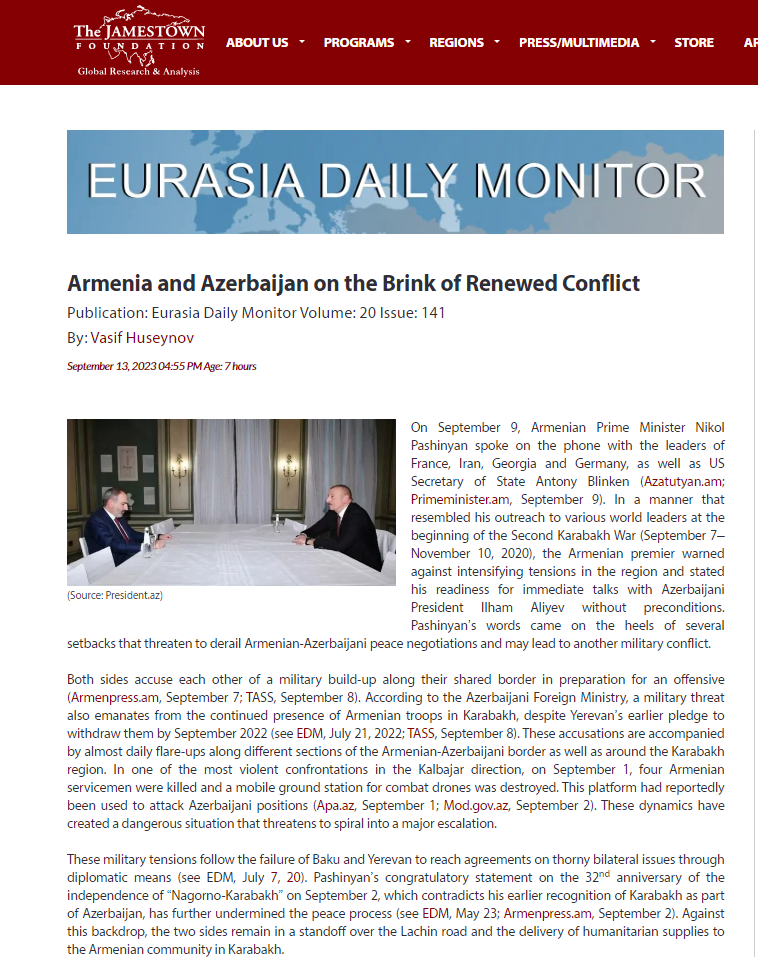
On September 9, Armenian Prime Minister Nikol Pashinyan spoke on the phone with the leaders of France, Iran, Georgia and Germany, as well as US Secretary of State Antony Blinken (Azatutyan.am; Primeminister.am, September 9). In a manner that resembled his outreach to various world leaders at the beginning of the Second Karabakh War (September 7–November 10, 2020), the Armenian premier warned against intensifying tensions in the region and stated his readiness for immediate talks with Azerbaijani President Ilham Aliyev without preconditions. Pashinyan’s words came on the heels of several setbacks that threaten to derail Armenian-Azerbaijani peace negotiations and may lead to another military conflict.
Both sides accuse each other of a military build-up along their shared border in preparation for an offensive (Armenpress.am, September 7; TASS, September 8). According to the Azerbaijani Foreign Ministry, a military threat also emanates from the continued presence of Armenian troops in Karabakh, despite Yerevan’s earlier pledge to withdraw them by September 2022 (see EDM, July 21, 2022; TASS, September 8). These accusations are accompanied by almost daily flare-ups along different sections of the Armenian-Azerbaijani border as well as around the Karabakh region. In one of the most violent confrontations in the Kalbajar direction, on September 1, four Armenian servicemen were killed and a mobile ground station for combat drones was destroyed. This platform had reportedly been used to attack Azerbaijani positions (Apa.az, September 1; Mod.gov.az, September 2). These dynamics have created a dangerous situation that threatens to spiral into a major escalation.
These military tensions follow the failure of Baku and Yerevan to reach agreements on thorny bilateral issues through diplomatic means (see EDM, July 7, 20). Pashinyan’s congratulatory statement on the 32nd anniversary of the independence of “Nagorno-Karabakh” on September 2, which contradicts his earlier recognition of Karabakh as part of Azerbaijan, has further undermined the peace process (see EDM, May 23; Armenpress.am, September 2). Against this backdrop, the two sides remain in a standoff over the Lachin road and the delivery of humanitarian supplies to the Armenian community in Karabakh.
According to Azerbaijani presidential aide Hikmet Hajiyev, Azerbaijan and Armenia had earlier agreed to simultaneously open both the Lachin and Agdam-Khankandi roads. On August 31, Hajiyev pointed out, “The integral part of this agreement was that the Aghdam-Khankandi road would be opened, and after that, the Lachin-Khankandi road would also be opened by applying the customs and border regime rules of Azerbaijan. Representatives of the Armenian residents were also supposed to come to a relevant meeting in the city of Yevlakh. … At the last moment, they refused” (Apa.az, August 31). He added that Pashinyan accepted the possibility of using the Agdam road at the Brussels summit between the Armenian premier and Aliyev on July 15. European Council President Charles Michel mediated those talks (Azadliq.org, August 31).
The Armenian side has denied that any such agreement was struck with Azerbaijan in Brussels (Armenpress.am, July 26). Yet, Michel’s statement following the meeting made clear that “discussions on these elements [the use of both the Lachin and Agdam roads] had started following the last meeting of the leaders in Brussels on 15 July 2023” (Consilium.europa.eu, September 1). The emphasis on the opening of “alternative routes … along with the Lachin road” was also mentioned in statements from the US State Department following recent phone calls between Blinken and Aliyev (State.gov, July 30; September 6).
Meanwhile, the humanitarian aid sent by different states to the Armenian community in Karabakh remains stuck due to the ongoing political disagreements between Yerevan and Baku. On August 30, Azerbaijan sent 40 tons of humanitarian cargo to the Armenian population in the region via the Agdam road; however, the convoy was reportedly stopped by the separatist regime (Caliber.az, September 4). Additional humanitarian supplies were dispatched to the region with French support around the same time and was stopped at Azerbaijan’s Lachin checkpoint before entering Azerbaijani territory (Armenpress.am, August 30). Another humanitarian convoy has been stuck at the border since July 26 (Armenpress.am, August 1)
These delays have been accompanied with growing instability within the Armenian separatist regime of Karabakh. On August 31, Arayik Harutyunyan, the leader of the regime, stated that the “unstable geopolitical situation” in the region and “internal political and social environments” necessitate flexibility and a change in governance practices. He then promptly resigned (Armenianweekly.com, August 31). In an act that was declared illegal by the Azerbaijani government, the European Union, Ukraine, the separatist regime’s “parliament” and others elected Samvel Shahramanyan as the new “president” on September 9 (Armenpress.am; Mfa.gov.az; Eeas.europa.eu, September 9).
In the aftermath of Harutyunyan’s resignation, Russia sent a truck loaded with humanitarian aid to Karabakh via the Russian Red Cross. The supplies passed through the Agdam route and were stopped a few kilometers from Karabakh. Azerbaijan’s state television channel reported that the International Committee of the Red Cross (ICRC) pressured the Russian Red Cross against using the Agdam route (Qafqazinfo.az, September 10). The ICRC later denied these allegations, stating that “the decision to allow humanitarian aid through or not is in the hands of the [two] sides” (Twitter.com/ICRCAze, September 10).
Meanwhile, Hajiyev denied the rumors that the use of the Agdam route by the Russian side would entail the opening of the Lachin road. He asserted, “It is a separate deal and should not be confused with the suggestion on the simultaneous opening of Agdam-Khankandi and Lachin-Khankandi roads for ICRC delivery. … On September 1, Azerbaijan expressed its consent … to ensure the simultaneous opening of the Agdam-Khankandi and Lachin-Khankandi roads. But the illegal regime refused” (Twitter.com/HikmetHajiyev, September 10).
The future of Armenian-Azerbaijani relations is dangerously uncertain at the moment. As the standoff over the roads leading to Karabakh persists and the two sides find themselves increasingly more confrontational in their contacts and public pronouncements, the specter of expanded violence will continue to mount. Furthermore, deteriorating relations between Russia and Armenia and Iran’s increased threats of launching a possible war over the Zangezur Corridor elevate the chances for a serious escalation (Caliber.az, September 8; Iranintl.com, September 9). As such, it cannot be ruled out that all this might end in another war—this time, on a potentially wider regional scale.vasif
https://jamestown.org/program/armenia-and-azerbaijan-on-the-brink-of-renewed-conflict/
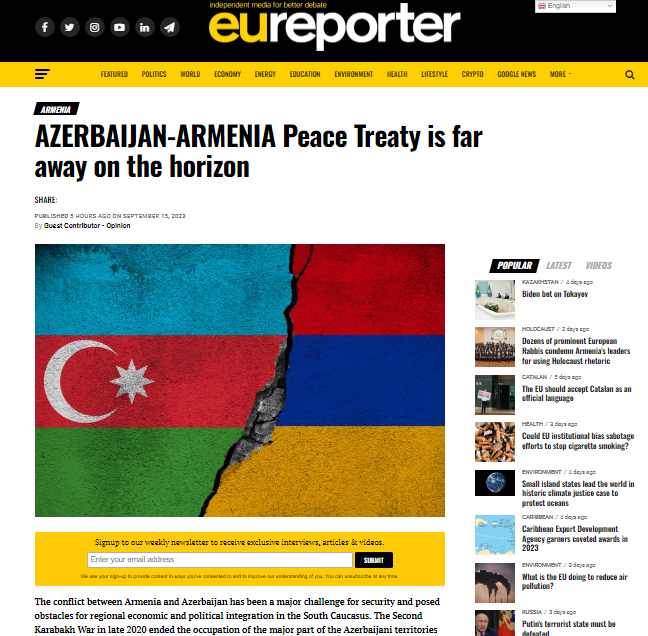
The conflict between Armenia and Azerbaijan has been a major challenge for security and posed obstacles for regional economic and political integration in the South Caucasus. The Second Karabakh War in late 2020 ended the occupation of the major part of the Azerbaijani territories and opened new horizons for regional economic integration and stability. By signing the Trilateral Declaration on November 9, 2020 between Azerbaijan, Armenia and the Russian Federation which ended the Second Karabakh war, the parties agreed to support post-war peace efforts and economic development – writes Shahmar Hajiyev , Senior Advisor at the Center of Analysis of International Relations.
The last two years were the most dynamic period for peace talks between the two South Caucasus countries as the President of the Republic of Azerbaijan Ilham Aliyev and Armenian Prime Minister Nikol Pashinyan met in different platforms to discuss many controversial issues and achieve the long-awaited signing of a peace agreement. The last trilateral meeting between Azerbaijani President Ilham Aliyev, Armenian Prime Minister Nikol Pashinyan and President of the European Council Charles Michel was held in Brussels, where the parties exchanged views on the normalization of their relations, continuation of negotiations on the peace process, delimitation of borders, opening of transport communications, withdrawal of Armenian military units from the territories of Azerbaijan and disarmament of illegal military detachments. By analyzing the dynamics of the Armenia-Azerbaijan negotiations, it is possible to note that in spite of some progress on the issues such as delimitation of borders and re-opening of transportation routes achieved, but the final peace treaty between the parties remains elusive after the recent developments in the region.
It is worth noting that the mutual recognition of each other’s sovereignty and territorial integrity and confirmation of the absence of territorial claims against each other are two main priorities for Baku. According to Armenian Prime Minister Nikol Pashinyan “Yerevan recognizes the territorial integrity of Azerbaijan, which includes Nagorno-Karabakh, provided that the safety of its Armenian population is ensured”. However, the separatist regime in Karabakh openly opposed Nikol Pashinyan’s decision and even condemned him for saying that. Strangely enough, the case presented by Armenia at the August session of the United Nations Security Council disrupts also peace talks and supports revanchist forces in Karabakh. In fact, Armenia has been exploiting the Lachin road for two years after the war to infiltrate military personnel, alongside munitions, landmines, and terrorist groups.
Moreover, Azerbaijan maintains its offer to utilize the Aghdam route for supplies to the Karabagh region. The Azerbaijan Red Crescent Society dispatched a humanitarian aid convoy consisting of 40 tons of flour products from Baku to Aghdam district in the Karabakh region, however the separatists refused to accept aid via the Aghdam-Khankendi road. Only humanitarian aid sent by the Russian Red Cross via the Aghdam-Khankendi road was accepted by separatist regime in Karabakh. As noted by Assistant to the President of Azerbaijan Hikmat Hajiyev “Russian Red Cross aid deliveries would go via the Aghdam road ‘in coordination’ with the Azerbaijani Red Crescent Society”. ‘
Another controversial event happened on September 9, 2023 when separatist regime in Karabakh illegally held a so-called “presidential election“. Four of the five parliamentary forces – Free Homeland, Ardarutyun (Justice), Dashnaktsutyun and the Democratic Party of Artsakh – have nominated State Minister Samvel Shahramanyan, who becamethe new President of the separatist regime. Azerbaijan condemned illegal elections in Karabakh, as it is a clear violation of country’s sovereignty and territorial integrity. Holding of “illegal elections” in Karabakh region of Azerbaijan is counter to the fundamental principles of the OSCE, the UN Charter and international law.
Immediately after illegal elections, many international organizations and countries worldwide such as the Organization of Islamic Cooperation (OIC), the Organization of Turkic States (OTS), the EU, the Council of Europe, as well as the UK, the US, Hungary, Romania, Pakistan, Türkiye, Georgia, Ukraine, Moldova and so forth did not recognize the so-called “presidential elections” in Karabakh. For instance, the European Union stated that it does not recognize the constitutional and legal framework within which the so-called “presidential elections” in Khankendi/Stepanakert (Nagorno-Karabakh) on 9 September 2023 were held. Moreover, during a press briefing, State Department Spokesman Matthew Miller said that the US does not recognize Karabakh as “an independent and sovereign state”, thereby not recognizing the results of those so-called presidential election that were announced over the last few days. He continued stating that “the United States will continue to strongly support efforts by Armenia and Azerbaijan to resolve outstanding issues through direct dialogue”.
Currently, the Armenia-Azerbaijan peace talks are at dead end after Prime Minister of Armenia Nikol Pashinyan congratulated the people of so-called “Artsakh” on the occasion of Independence Day. On the one hand, Armenian PM recognized Azerbaijan’s territorial integrity and sovereignty. On the other hand, congratulating the separatist regime he is against territorial integrity and sovereignty of Azerbaijan. Thus, such a controversial approach to peace process disrupts trust and may incite up a new war in the region.
Against the backdrop of such developments, Armenia has already started concentrating forces near the border between the two countries and in Karabakh. After Armenia and India signed military agreements with the aim of arming the Armenian army with heavy weapons, arms consignment from India to Armenia was transported via Iran. The arms deal included significant export orders of Pinaka multi-barrel rocket launchers (MBRL), anti-tank missiles, rockets and ammunition worth US $250 million. Such deadly weapons are cherishing revanchist ideas in Armenia and threaten regional security.
It is understandable that revanchist groups in Armenia still believe that the conflict is not over, and Armenia must patronage regime across the territories under the control of the separatists. By doing that, they aim building the “grey-zone” which is unacceptable for Azerbaijan. This tactic includes support of the separatist regime in Karabakh politically, economically and militarily, and at the same time, continue talks with Azerbaijan without significant result. Such tactic poses the greatest challenge to the peace talks and cannot prevent future conflict escalation in the region. To conclude, the normalization of relations between Armenia and Azerbaijan holds significant economic benefits for the entire region. If Armenia is interested in signing a peace treaty on the basis of the mutual recognition of each other’s sovereignty and territorial integrity, then Yerevan should stop political manipulation. Conflict resolution will create new opportunities for regional economic integration and increased connectivity.