Categories
South Caucasus News

Revisionist European Rabbis deny genocide in Artsakh


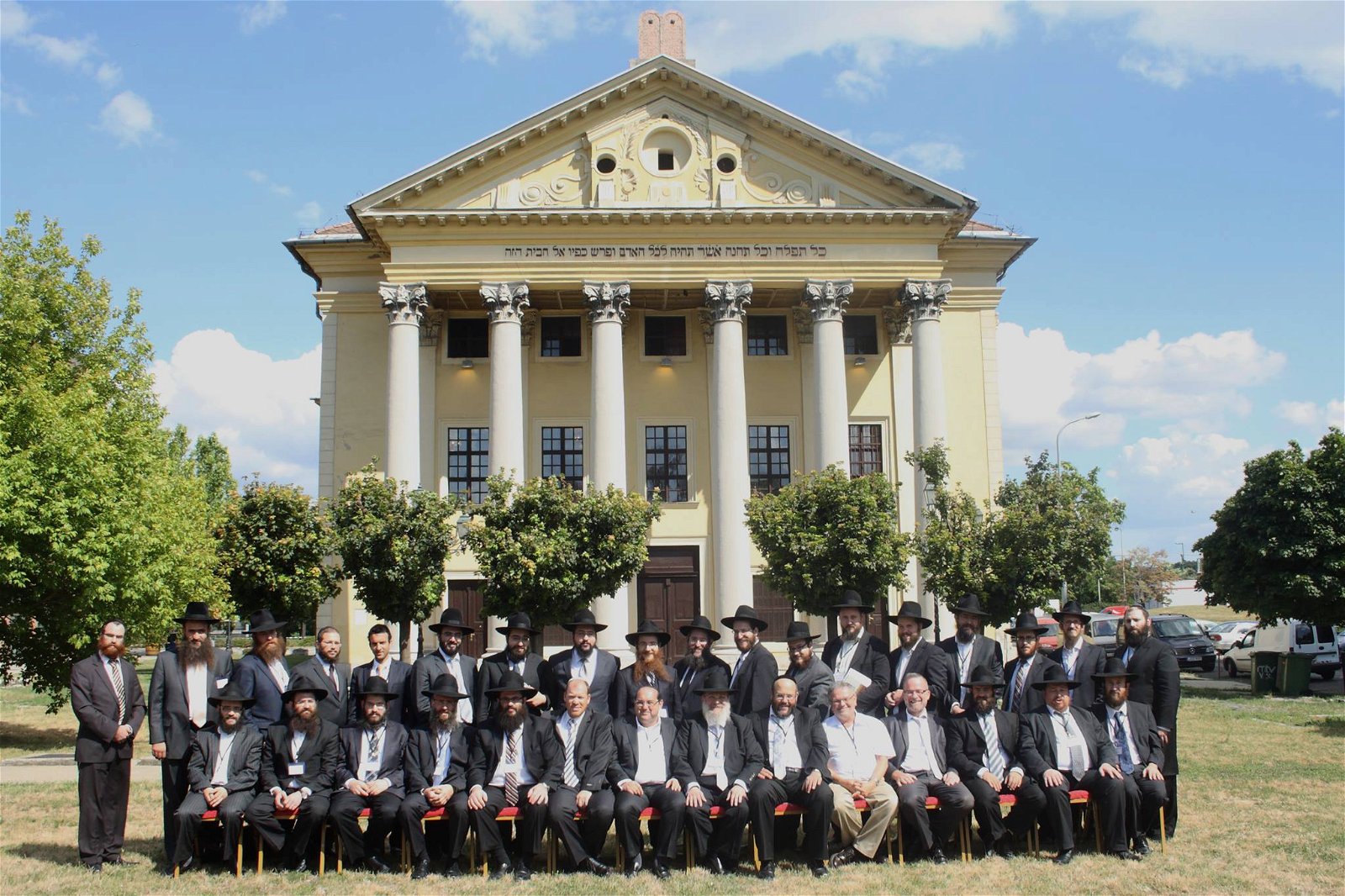
Rabbinical Center of Europe (Facebook)

The Rabbinical Center of Europe (RCE) sent a letter on Sept. 6 signed by 50 conservative Rabbis to Armenian Prime Minister Nikol Pashinyan and President Vahagn Khachaturyan, stating that Armenian officials have no right to use the term “genocide” to describe Azerbaijan’s blockade of the Berdzor (Lachin) Corridor, which is causing the starvation of 120,000 Artsakh Armenians.

The Rabbis wrongly claimed that the term “genocide” should only be used to describe the Jewish Holocaust. The Rabbis’ ignorance is only exceeded by their arrogance. Not only do they not understand the true meaning of the term “genocide,” but they also harm their own cause by claiming that no human tragedy is comparable to the Holocaust. It is in the interest of the Jewish community to describe the Holocaust as a universal calamity with which other people can identify. Even though all genocides have similarities, there are obvious differences in timing, scale and location. However, the similarities between genocides far exceed their differences. No one should have a monopoly on claims of human suffering.

According to the U.N. Convention on the Prevention and Punishment of the Crime of Genocide, “deliberately inflicting on the group conditions of life calculated to bring about its physical destruction in whole or in part” is an act of genocide. This is exactly what Azerbaijan is doing – starving 120,000 Artsakh Armenians by depriving them of food, medicine and other basic necessities.

The denialist Rabbis claim that the terms “ghetto,” “genocide” and “holocaust” are “inappropriate to be part of the jargon used in any kind of political disagreement.” The blockade of Artsakh is not a “political disagreement,” but genocide, according to the U.N. definition and Luis Moreno Ocampo, former prosecutor of the International Criminal Court.

Continuing the series of errors and misjudgments, the pro-Azerbaijan propaganda letter demands that Armenia’s leaders “explicitly and unequivocally clarify that the Armenian people recognizes and honors the terrible human suffering undergone by the Jewish people” and stop “minimizing and belittling the extent of the Jewish people’s suffering to further any political interest through incessantly using phrases associated with the holocaust suffered by the Jewish people.”

Rather than lecturing Armenia’s leaders about the Holocaust, the Rabbis should have addressed their letter to Israel’s Prime Minister Benjamin Netanyahu, who has denied the Armenian Genocide and pressured the Knesset to reject a resolution recognizing it. Israel should have been the first country to recognize the Armenian Genocide, not the last.

Furthermore, the Rabbis should have had the moral courage to issue a letter condemning the government of Israel for providing lethal weapons with which Azerbaijan killed thousands of Armenian soldiers in the 2020 Artsakh War. 

Instead of supporting the genocide denialists in Ankara and Baku, the Rabbis should have known that some of the most prominent backers of the recognition of the Armenian Genocide are Jewish: Dr. Israel Charny (director of the Institute of Holocaust and Genocide in Jerusalem), Prof. Yair Auron (historian, author of several books on the Armenian Genocide), Raphael Lemkin (who coined the term genocide), Amb. Henry Morgenthau, Elie Wiesel (Nobel Laureate and Holocaust survivor), Yossi Beilin (Israel’s Minister of Justice) and Yossi Sarid (Israel’s Minister of Education).

Both the Anti-Defamation League and the American Jewish Committee expressed their support after U.S. Pres. Joe Biden recognized the Armenian Genocide on April 24, 2021. The United States Holocaust Memorial Museum in Washington, D.C. also issued a statement on April 27, 2021, welcoming Pres. Biden’s declaration. The World Jewish Congress has also acknowledged the Armenian Genocide.

In addition, 126 Holocaust scholars issued a joint statement on March 7, 2000, “affirming the incontestable fact of the Armenian Genocide.” Among them were professors Yehuda Bauer, Stephen Feinstein, Irving Horowitz and Steven Katz.

These Rabbis did not condemn former Deputy Prime Minister of Azerbaijan and former Baku Mayor Hajibala Abutalybov, who stated during a 2005 meeting with a municipal delegation in Bavaria, Germany: “Our goal is the complete elimination of Armenians. You, Nazis, already eliminated the Jews in the 1930s and 40s, right? You should be able to understand us.” This was reported in the Realny Azerbaijan publication on February 17, 2006.

Since these Rabbis feel that they are entitled to the exclusive use of the term genocide, have they ever sent a single letter of complaint to their dear brother Aliyev for his repeated references to the fake ‘Khojalu Genocide?’ Isn’t this a shameful example of a double-standard?

The RCE should have remembered Hitler’s infamous words uttered on August 22, 1939: “Who, after all, speaks today of the annihilation of the Armenians?” Noticing that the world ignored the Armenian Genocide, Hitler was emboldened to commit the Holocaust.

Yaron Weiss of Jerusalem, a grandson of Holocaust survivors, wrote: “I condemn the cynical self-appropriation of the memory of the Holocaust victims by that group of Rabbis.” Weiss also reminded the Rabbis that “Azerbaijan refuses to condemn and apologize for the acts of mass murder committed during the Holocaust by the soldiers of the Azeri Legion.”

I urge the RCE to apologize for its revisionist and insulting letter, which compromises its decency and morality. Should this letter embolden Azerbaijan to commit more atrocities against Armenia and Artsakh, these Rabbis will be considered partners in the Azeri crimes.

Author information

Harut Sassounian

Harut Sassounian

California Courier Editor

Harut Sassounian is the publisher of The California Courier, a weekly newspaper based in Glendale, Calif. He is the president of the Armenia Artsakh Fund, a non-profit organization that has donated to Armenia and Artsakh $917 million of humanitarian aid, mostly medicines, since 1989 (including its predecessor, the United Armenian Fund). He has been decorated by the presidents of Armenia and Artsakh and the heads of the Armenian Apostolic and Catholic churches. He is also the recipient of the Ellis Island Medal of Honor.

|

The post Revisionist European Rabbis deny genocide in Artsakh appeared first on The Armenian Weekly.

Categories
South Caucasus News

Azad: A must-see journey through art, war and the human spirit


A special public performance of Azad will be held at Harvard University on Sept. 21, followed by venues in Berlin, New York City and Yerevan. Azad is a multimedia theatrical experience that weaves personal history, social justice and the resilient spirit of humanity. It features ancient Karagöz shadow puppets, indigenous Middle Eastern folk music and oral storytelling. 

Following A Thousand and One Nights as a universal map for healing trauma, Azad highlights the transformative friendship between Armenian artist Sona Tatoyan and jailed Turkish humanitarian Osman Kavala. A visceral, multi-generational journey through Aleppo, Azad takes viewers from the Armenian Genocide to the Syrian war, offering the power of creation as a remedy for hate and destruction.

Azad (“free” in Armenian, Farsi and Kurdish) is a kaleidoscopic story within a story within a story, centered on a storyteller’s discovery of her great-great-grandfather’s handmade Karagöz shadow puppets in Aleppo during the Syrian war, a century after he salvaged his family and art from the Armenian Genocide. 

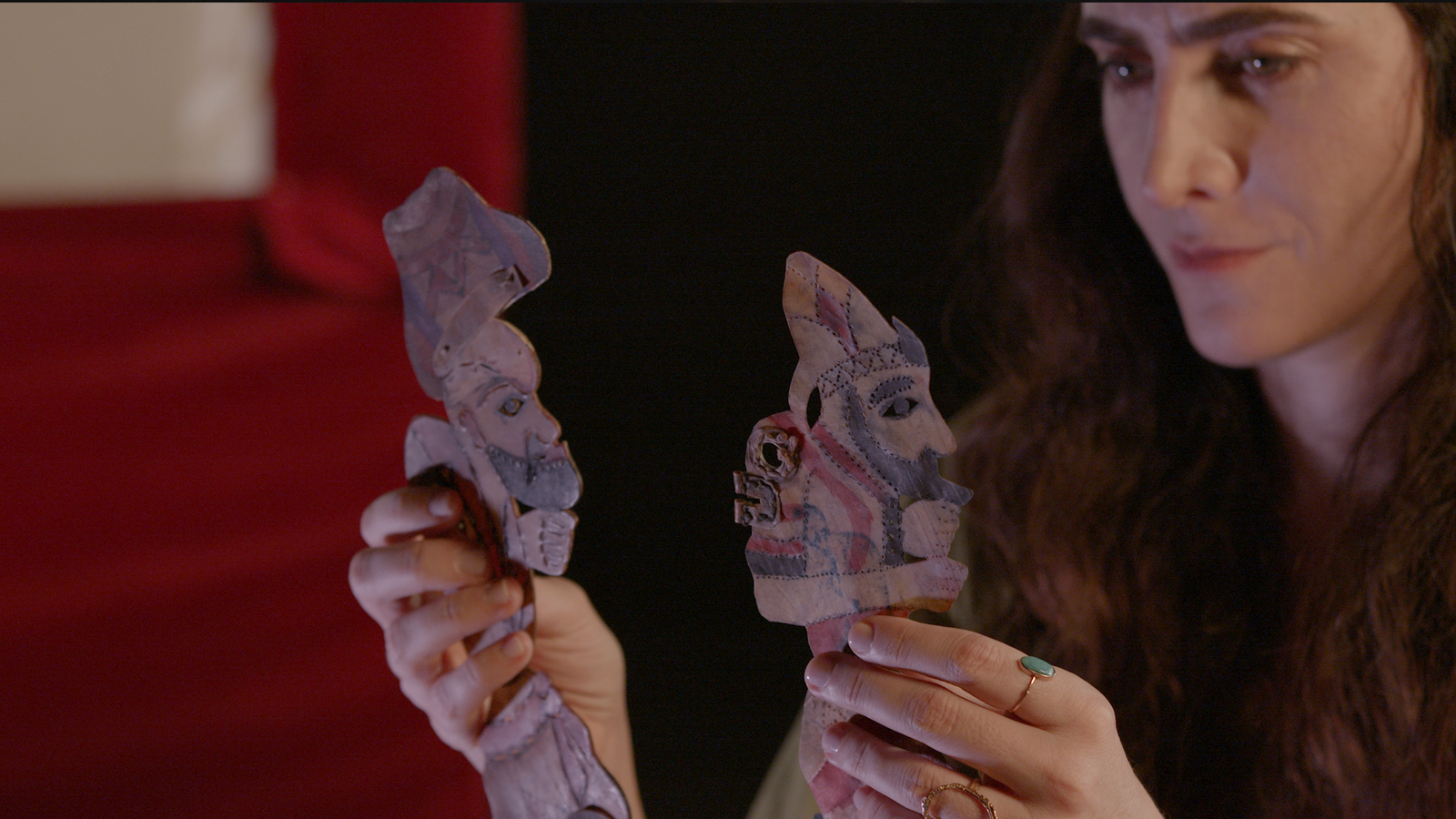
Performer, writer Sona Tatoyan holding her great-great grandfather’s Karagöz puppets. (Photo: by Alex Griffin)

When Tatoyan unearths a trunk in the attic of her abandoned family home, filled with Abkar Knadjian’s Karagöz and ancient magic tricks, she encounters his life and art, along with the ghosts of generations of family members long gone. At the same time, she grapples with the recent indictment – and possible life sentence in prison – of her dear friend and patron, Turkish human rights activist Osman Kavala.  

Amidst this backdrop of pain and loss, she discovers A Thousand and One Nights. At the heart of this cornerstone of Middle Eastern literature is another storyteller, ScherAzad (the bold, brilliant weaver of tales who counters destruction with creation), who catalyzes an epiphany for Tatoyan: A Thousand and One Nights is a story of how trauma transpires and how it is healed. 

As a first-generation Syrian-Armenian-American theater and film artist, Tatoyan is always conscious of how the Western imagination sees the Middle East: an unstable place of war, dictatorships, subjugated women, backward thinking and natural disasters. Yet the genesis of all modern storytelling, A Thousand and One Nights, is a work of Middle Eastern literature, and its genius has inspired creators around the world, from Gabriel Garcia Marquez to Guillermo del Toro to Angela Carter.

Tatoyan never knew her great-great-grandfather personally, but through his puppets, she reframed her legacy and understanding of the lands of her roots—as a place of intertwined magic and stories, wisdom and healing, alongside layers of trauma. Azad is a quantum collaboration between Tatoyan and her great-great-grandfather. An intergenerational conversation across a painful space-time. A magical healing spell to remember: when we surrender to the constant play of shadow and light, we are free.

RSVP online to see Azad at Harvard University on September 21, 2023. The event is free and open to all. Doors open at 5:30 p.m., and the performance starts at 6 p.m.

Author information

Guest Contributor

Guest Contributor

Guest contributions to the Armenian Weekly are informative articles or press releases written and submitted by members of the community.

|

The post Azad: A must-see journey through art, war and the human spirit appeared first on The Armenian Weekly.


Categories
South Caucasus News

Gen Z Georgians are losing their classic southern accent – Insider


Gen Z Georgians are losing their classic southern accent  Insider

Categories
South Caucasus News

Nagorno-Karabakh president holds meeting with top brass, law enforcement leadership to discuss Azeri buildup – ARMENPRESS


Nagorno-Karabakh president holds meeting with top brass, law enforcement leadership to discuss Azeri buildup  ARMENPRESS

Categories
South Caucasus News

MEP François-Xavier Bellamy hopes France will introduce UNSC resolution on Nagorno- Karabakh – ARMENPRESS


MEP François-Xavier Bellamy hopes France will introduce UNSC resolution on Nagorno- Karabakh  ARMENPRESS

Categories
South Caucasus News

U.S. Military Exercises in Russia’s Backyard Cause Alarm at the Kremlin | Mint – Mint


U.S. Military Exercises in Russia’s Backyard Cause Alarm at the Kremlin | Mint  Mint

Categories
South Caucasus News

Russia’s Elections In Occupied Ukrainian Regions Dismissed As ‘Sham’ – Radio Free Europe / Radio Liberty


Russia’s Elections In Occupied Ukrainian Regions Dismissed As ‘Sham’  Radio Free Europe / Radio Liberty

Categories
South Caucasus News

Azerbaijan to be represented at Doha Expo 2023 [PHOTOS] – AzerNews.Az


Azerbaijan to be represented at Doha Expo 2023 [PHOTOS]  AzerNews.Az

Categories
South Caucasus News

NAASR to Host Denial of Genocides in the 21st Century webinar


The NAASR / Calouste Gulbenkian Foundation Series on Contemporary Armenian Issues will host an online presentation by Dr. Bedross Der Matossian on Wednesday, September 20, 2023, at 7:30 p.m. Eastern / 4:30 p.m. Pacific, discussing the new publication Denial of Genocides in the Twenty-First Century, in conversation with Marc A. Mamigonian.  This program is co-sponsored by the Society for Armenian Studies (SAS). The webinar will be accessible live on Zoom (registration required) and on NAASR’s YouTube Channel.
Denial of Genocides in the Twenty-First Century (Univ. of Nebraska Press, 2023), edited by Dr. Der Matossian, brings together leading scholars from across disciplines to add to the body of genocide scholarship that is challenged by denialist literature and provides insights into how genocide denial is becoming a fact of daily life in the twenty-first century.

Throughout the twenty-first century, genocide denial has evolved and adapted with new strategies to augment and complement established modes of denial. In addition to outright negation, denial of genocide encompasses a range of techniques, including disputes over numbers, contestation of legal definitions, blaming the victim and various modes of intimidation, such as threats of legal action. Arguably the most effective strategy has been denial through the purposeful creation of misinformation.

In this program, there will be an overview of the volume, which encompasses cases ranging from the genocide of Indigenous People in the United States to the genocidal violence in Syria in the past decade, including three chapters on denial of the Armenian Genocide. The conversation will also consider the key role of denial in the current crisis in Artsakh (Nagorno-Karabakh), which is increasingly being recognized as a genocide in progress.

Dr. Der Matossian is Professor of Modern Middle East History and the Hymen Rosenberg Professor in Judaic Studies at the University of Nebraska–Lincoln. He is the author of The Horrors of Adana: Revolution and Violence in the Early Twentieth Century and Shattered Dreams of Revolution: From Liberty to Violence in the Late Ottoman Empire.

Marc A. Mamigonian is the Director of Academic Affairs at NAASR and the author of “Weaponizing the First Amendment: Denial of the Armenian Genocide and the U.S. Courts” in Denial of Genocides in the Twenty-First Century.

For more information, contact NAASR at hq@naasr.org.

Author information

NAASR

NAASR

Founded in 1955, NAASR is one of the world’s leading resources for advancing Armenian Studies, supporting scholars, and building a global community to preserve and enrich Armenian culture, history, and identity for future generations.

| Twitter |

The post NAASR to Host Denial of Genocides in the 21st Century webinar appeared first on The Armenian Weekly.


Categories
South Caucasus News

In Memory of Zareh Assadour Chalian


Zareh Assadour Chalian passed away peacefully at age 91 on September 4, 2023 in his home in Burbank, California surrounded by his family. 

Throughout his life, Zareh devoted himself to his family, his Armenian Apostolic faith, his career as a civil engineer and, above all, to Hai Tahd, the Armenian Cause. Born in Beirut, Lebanon in 1932, Zareh obtained his French baccalaureate “mathelem” and continued his studies at the Université St. Joseph, graduating with a degree in civil engineering.  

In addition to his fluency in French and his native Armenian, he also spoke Arabic, Turkish, English and the Hadjin dialect of his ancestors. He was intensely focused on his studies, graduating first in his class in college. He applied this same intensity to pass the Professional Engineering licensing exam in New Jersey and California – which he prepared for by teaching himself the English version of all that he learned at his French college. 

Zareh married Annie Baghdassarian in 1968 in Beirut. After welcoming daughters Maral, Arpi and Hoori, the family moved to the United States, fleeing the Lebanese Civil War. They settled in Fort Wayne, Indiana, then moved to Toms River, New Jersey, where they raised their children. In New Jersey, Zareh worked as a civil engineer for a real estate development company. 

Even in his professional life, Zareh never missed an opportunity to spread awareness about Armenia and Hai Tahd. While working on a new development project in Toms River, he ensured that one of the streets was named “Armenia Drive.” To this day, a replica of this street sign is proudly displayed in his family home, a nod to his work as a professional civil engineer and a testament to his pride in his heritage. 

Zareh and Annie moved their family to Los Angeles in 1986 when he joined its Department of Water and Power. He retired in 2002, culminating a professional career that spanned five decades. He received many recognitions and commendations during his long career. He was particularly proud that, as a young engineer, he was selected to represent the Lebanese Ministry of Water and Power Resources in France for a six-month project working with colleagues in the French Ministry of Public Works. 

He held leadership positions in many community organizations. In Beirut, he served on the governing committee of the Order of Engineers and Architects, the founding Board of Trustees of the Levon and Sofia Hagopian Armenian College and as a member of the Executive Committee of the A.R.F. Zavarian Student Association. In the U.S., Zareh was a founding member of the Burbank Aghbalian Chapter of the Armenian Revolutionary Federation and active in civic life in Burbank. 

Zareh was passionate about researching the Chalian family origins. One of his favorite pastimes was sharing the stories of his ancestors, heroes from the town of Hadjin in Cilicia, Western Armenia. Upon retirement, he dedicated himself to compiling the memoirs of his father Assadour, chronicling life before and during the Armenian Genocide and the displaced Armenian community’s resettlement in Beirut. With support from his entire family, he published the book Proud Son of Hadjin. He spent countless hours and sleepless nights gathering information, translating old documents, and contacting scholars and organizations who were also dedicated to preserving Armenian history. His laser-like focus on this work was a reflection of his loyal dedication to serving the Cause. The family he and Annie created and his extended Chalian kertastan proudly reflect his Armenian spirit. 

Funeral services followed by interment will be held on September 23, 2023 at 9 a.m. at Forest Lawn Memorial Park (Hollywood Hills), Old North Church, 6300 Forest Lawn Drive, Los Angeles, CA 90068.

He is survived by his wife of 55 years, Annie (Baghdassarian); his daughter, Maral Chalian; his daughter and son-in-law, Arpi Chalian and Zareh Khachatourian; his grandchildren, Siran and Gayané; his daughter and son-in-law, Hoori Chalian and Mike Panu; his grandchildren Zabelle and Haig; his sister, Maro Chalian Read; his sister-in-law, Maral Chalian; his nephews and nieces Chris (Laurie) Chalian, Alice Chalian Manoukian (Arthur), Gena Douzdjian (Viken), Garo Chalian (Val), Raffi Chalian (Anush), Armen Chalian (Maro), Ara Chalian (Talar), Vicken Chalian, Luci Chalian, Sona Cleary (John) and Sam Read (Jenny); and the Chamsarian and Baghdassarian families along with many beloved cousins and friends.

He is predeceased by his brother Garo; brother and sister-in-law Varoujan and Zaroug; and brother and sister-in-law Toros and Ani.

In lieu of flowers, the family requests that donations be made to the Armenian National Committee of America, 1711 N Street NW, Washington, D.C. 20036.

Author information

Guest Contributor

Guest Contributor

Guest contributions to the Armenian Weekly are informative articles or press releases written and submitted by members of the community.

|

The post In Memory of Zareh Assadour Chalian appeared first on The Armenian Weekly.